
A Developer's Guide to Sports Betting APIs
Unlock Profits with betting tips!
Sports betting APIs are the technical backbone that connects data providers with betting apps, sophisticated tools, and even individual bettors. These interfaces are what deliver the flood of crucial, real-time information that modern betting runs on-live odds, game scores, player stats, and historical results. For developers and serious bettors, APIs are the only way to build automated strategies, odds comparison tools, and predictive models.
Understanding Sports Betting APIs

At its core, a sports betting API (Application Programming Interface) is just a set of rules and tools that lets different software applications talk to each other. Think of it like a waiter in a restaurant. You (or your betting application) place an order for data, and the waiter (the API) takes your request to the kitchen (the data provider's server) and brings back exactly what you asked for.
This process allows you to tap into enormous streams of sports data without having to collect a single piece of it yourself. Instead of trying to scrape websites or track games by hand, you can make a simple, clean request to an API and get structured, reliable data delivered right back to you.
Key Data Types from Sports Betting APIs
To get a better sense of what these APIs deliver, this table breaks down the most essential data categories. It gives you a quick reference for the core information you can access and how it's typically used.
| Data Type | Description | Primary Use Case |
|---|---|---|
| Live Odds | Real-time betting odds from multiple bookmakers for various markets (e.g., moneyline, point spread, totals). | Odds comparison, arbitrage betting, and identifying value bets by spotting market discrepancies. |
| Fixtures & Schedules | Upcoming game and event information, including dates, times, venues, and participants. | Planning betting strategies, building calendars, and pre-match analysis. |
| Live Scores | Instant in-game updates, such as goals, points, and other key match events as they happen. | In-play betting, live trading strategies, and powering real-time dashboards. |
| Historical Data | Past game results, team performance statistics, player data, and historical odds. | Building predictive models, backtesting strategies, and conducting deep statistical analysis. |
| Player & Team Stats | Detailed statistics for individual players and teams, covering performance metrics like goals, assists, and form. | Prop betting, fantasy sports modeling, and in-depth pre-game research. |
This data is the raw material for everything from simple odds trackers to complex betting bots, giving you the information needed to make calculated decisions.
The Driving Force Behind Modern Betting
The demand for these data feeds is absolutely massive. The sports data API market, currently valued at USD 1.67 billion, is on track to hit USD 4.42 billion by 2033, growing at a compound annual rate of 11.47%. This explosion is being fueled directly by the sports betting industry's relentless need for real-time information. You can explore more about these market projections and see how this data is reshaping the industry.
This data is the lifeblood for sophisticated betting tools. Platforms that alert users to value bets, like ValueBetFactory, are built entirely on fast and accurate API data to spot tiny discrepancies between bookmaker odds. In short, these APIs are what allow bettors to move beyond simple guesswork and adopt a more analytical, data-driven approach to their wagers.
Ultimately, working with sports betting APIs gives you a huge advantage by offering:
- Real-Time Access: Get instant updates on odds, scores, and in-game events the moment they happen.
- Automation: Build automated tools for analyzing trends, placing bets, and sending alerts without manual intervention.
- Data Accuracy: Rely on verified, clean data sources instead of manual, error-prone collection methods.
- Scalability: Access data for thousands of events across dozens of sports without worrying about performance issues.
A Look at the Core API Data Categories

To really get the most out of a sports betting API, you first need to understand the different kinds of data it serves up. Each category has a specific job, whether it’s for analyzing a match before it starts, reacting to live-game action, or building long-term predictive models. Think of these data feeds as the essential ingredients for any betting tool or application you want to build.
The big four data types are Pre-Match Odds, Live/In-Play Data, Historical Data, and Fixtures/Schedules. Each one gives you a unique angle on the betting world, and knowing how to use them together is what gives you a real analytical edge. Let's break down what each one brings to the table.
Pre-Match Odds Data
Pre-match odds are the bread and butter of traditional sports betting. This data covers all the betting lines available before a game kicks off, focusing on the most popular and liquid markets.
- Moneyline: The straightforward bet on which team will win the game.
- Point Spreads: Odds that factor in a margin of victory, designed to make a lopsided matchup a more even betting proposition.
- Totals (Over/Under): A bet on whether the total combined score of both teams will be over or under a specific number.
This type of data is gold for bettors who specialize in finding early value. By jumping on the odds right after they’re released, you can often spot lines that haven't been shaped by market movement yet, giving you a shot at a profitable position.
Live and In-Play Data
The second a match gets underway, the data game changes completely. Live and in-play data feeds you real-time updates straight from the event, which is absolutely critical for any betting strategy that involves reacting to the ebb and flow of a game.
This category is all about instant updates on key events that have a direct impact on the live odds. For a soccer match, this means goals, red cards, and penalties. In basketball, it’s every basket, foul, or key turnover. This low-latency information is what allows bettors and automated systems to make split-second decisions and capitalize on momentum swings.
Live data feeds are the engine behind in-play betting, which now accounts for a significant portion of all wagers. The ability to receive and process events in milliseconds is what separates successful live betting tools from the rest.
Historical Data and Statistics
Historical data is the bedrock of any serious predictive betting model. This category is a massive repository of past results, performance stats, and even historical odds, allowing you to backtest strategies and uncover long-term trends.
This data gets incredibly granular, often including everything from a team's win-loss record to individual player stats like goals scored or assists. By digging into this information, you can build algorithms that quantify things like team strength, player form, and specific matchup dynamics. To go deeper, you can explore our comprehensive guide on the importance of sports betting data and how to analyze it effectively.
Fixtures and Schedules
Finally, fixtures and schedules data gives you a clear, structured overview of all upcoming events. This includes match dates, start times, venues, and the teams or players involved across countless leagues and sports.
It might sound basic, but this information is crucial for planning and automation. Developers use it to populate calendars, schedule data collection tasks, and get their systems ready for the day's games. For bettors, it's essential for planning research and managing betting activity across a packed sports calendar.
Comparing API Delivery Methods: WebSocket vs. REST
When you’re building any tool that relies on a sports betting API, one of the first big decisions you have to make is how you're going to get the data. Your two main options are REST (Representational State Transfer) and WebSocket, and they operate in fundamentally different ways. Nailing this choice is critical to making sure your application actually performs the way you need it to.
Think of a REST API like ordering a pizza. You call the restaurant, place your order (that's your request), and then you hang up. If you want to know when it's ready, you have to call them back again and ask. This request-response cycle is perfectly fine for information that doesn't change every second.
The REST API Model for Static Data
A REST API is your workhorse for fetching less time-sensitive information. If you need to pull historical match data, look up a schedule of upcoming fixtures, or grab the pre-match odds for tomorrow's games, REST is efficient and totally reliable. You ask the server for something, it gives it to you, and the conversation is over.
This method is straightforward, widely supported, and a solid choice for plenty of basic functions. Where it falls short is in situations that demand instant updates. Constantly asking the server "is it ready yet?" (a process called polling) is slow, clunky, and just plain inefficient for live data.
Why WebSockets Are Essential for Live Betting
Now, picture WebSocket as having an open phone line directly to the pizza place. The second your pizza comes out of the oven, they tell you instantly-no need for you to call back. WebSocket APIs create a persistent, two-way communication channel between your app and the server.
This continuous connection is completely non-negotiable for live, in-play betting. Data gets "pushed" to your application the moment it's available, which is absolutely vital for things like:
- Live Odds: In-play odds can fluctuate multiple times a second. A WebSocket stream is the only way to get these updates without a crippling delay.
- In-Play Events: Critical game events like goals, penalties, or even a red card are streamed to you in real-time.
- Live Scores: Scores update the very instant they change, with no perceptible lag.
The core advantage of WebSockets is their extremely low latency. For any application that relies on real-time data to find an edge-like identifying value bets in live markets-this instant delivery is the only viable option.
Real-time sports data APIs are the engine driving the modern betting world, enabling the in-play wagering that makes up a huge slice of the market. This live data is critical when, for some events like esports, 46% of wagers happen during the match itself. You can find more insights on the state of US sports betting and its deep reliance on real-time data over at TrafficGuard.ai.
Evaluating Top Sports Betting API Providers
Picking the right sports betting API is one of those make-or-break decisions that will define what your project can and can’t do. The market is packed with options, from enterprise-level giants to smaller, more nimble providers, and each one comes with its own flavor of strengths, weaknesses, and pricing.
The key is to cut through the noise and figure out what you actually need. Are you building a high-frequency live betting tool where a split-second delay costs you money? Or are you creating a pre-match analytics dashboard where deep historical data is the top priority? Answering that question first will make the choice a whole lot easier.
Key Players in the API Market
The sports data world is really dominated by a few big names, but there are also plenty of smaller competitors carving out their own niches with specialized or more budget-friendly services. Industry titans like Sportradar and Genius Sports are the go-to for official data partnerships and massive coverage, but they usually come with hefty enterprise price tags and complex contracts.
On the other hand, providers like The Odds API and Sportmonks are all about making data accessible. Their APIs are typically well-documented, more affordable, and perfect for independent developers, startups, or bettors building custom tools who don't necessarily need an official league stamp of approval.
A provider's data source is a crucial differentiator. Official data, sourced directly from leagues, offers the highest accuracy but is expensive. Unofficial data, often scraped or aggregated, is more affordable but may have slight delays or occasional inaccuracies.
Comparison of Leading Sports Betting API Providers
To give you a quick lay of the land, this table offers a side-by-side look at some of the top players. It’s designed to help you quickly see who might be a good fit by highlighting their core strengths and what they’re best used for.
| Provider | Key Strengths | Sports Coverage | Pricing Model | Best For |
|---|---|---|---|---|
| Sportradar | Official league data partnerships, unparalleled data depth, and high reliability. | Extremely broad, covering major and niche sports globally with official feeds. | Enterprise-level custom contracts, often very expensive. | Large betting operators, media companies, and professional platforms requiring official data. |
| Genius Sports | Official data rights for major leagues, focus on data integrity and live streaming. | Extensive global coverage with a strong focus on top-tier sports leagues. | Custom enterprise licensing and revenue-sharing models. | Major sportsbooks and organizations needing fully compliant, official data streams. |
| The Odds API | Affordability, simple REST API, and straightforward pricing plans. | Good coverage of major global sports and a wide range of bookmakers. | Subscription-based tiers with clear request limits. | Individual developers, startups, and odds comparison projects on a budget. |
| Sportmonks | User-friendly documentation, responsive support, and a blend of affordability and features. | Strong focus on football (soccer) with expanding coverage for other sports. | Flexible subscription plans suitable for various project sizes. | Developers building football-centric applications and those prioritizing ease of integration. |
Think of this table as a starting point. Before you pull the trigger, you'll want to use the evaluation checklist in the next section to dig deeper into the nuts and bolts-things like rate limits, the quality of their documentation, and how responsive their developer support really is.
How to Choose the Right Sports Betting API
Picking the right sports betting API isn't just a technical choice; it's a business decision that will define the performance, accuracy, and future of your entire project. On the surface, a lot of providers seem to offer the same things, but the devil is always in the details-hidden away in service level agreements and dense technical documentation.
A smart evaluation process is your best defense against making a costly mistake. You’re balancing several critical factors, from the purity of the data itself to how easy it is for your developers to actually work with it. A cheap API with garbage data is worthless, but an incredibly powerful API with terrible documentation can burn months of development time and leave you with nothing to show for it. You need a structured way to ask the right questions.
This decision tree flowchart hits the big questions you should ask first. It helps you quickly narrow the field by focusing on budget, sports coverage, and data speed right out of the gate.
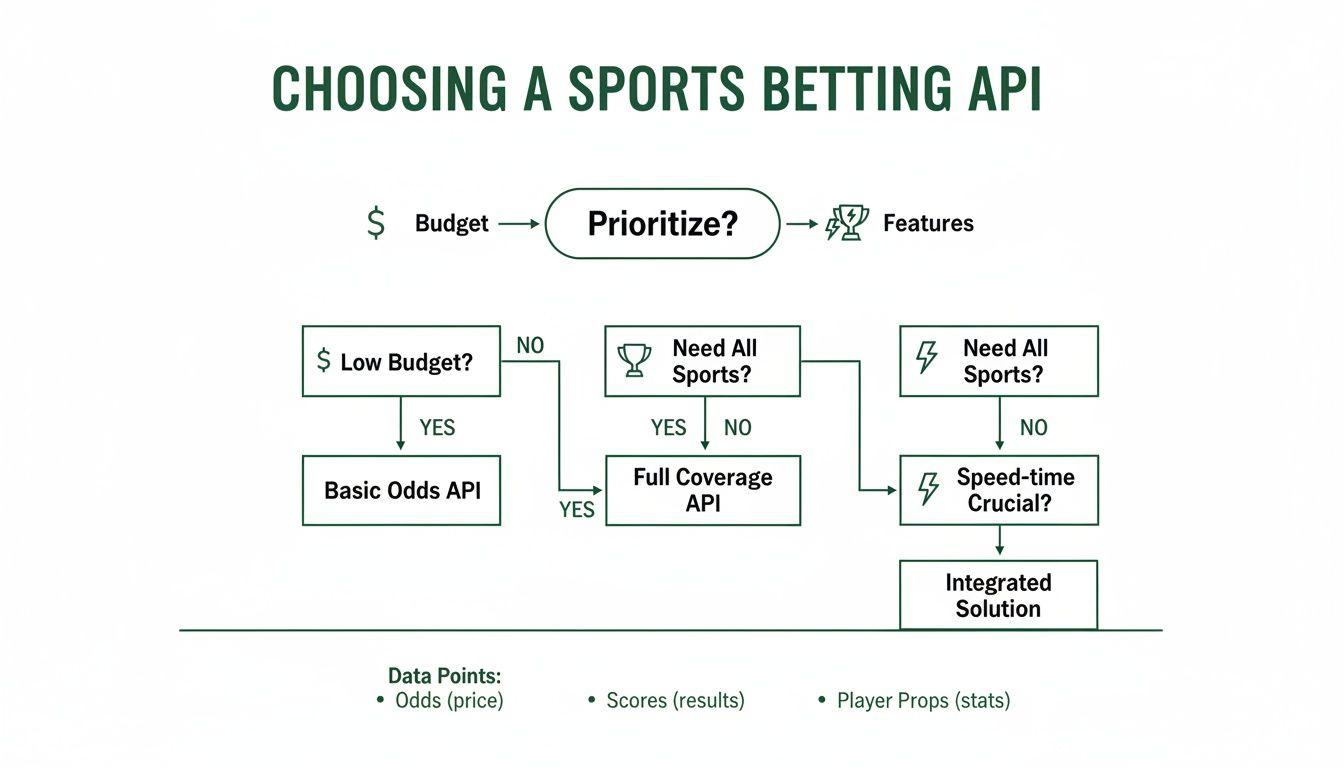
Use this visual guide to get a shortlist of providers that match your main goals. Once you have that, the real digging begins.
Data Accuracy and Latency
First things first: the data itself. Data accuracy is completely non-negotiable. If the odds are wrong or the scores are delayed, your application is dead on arrival. You need to ask potential providers where their data comes from. Are they pulling from official league partners, or are they just scraping unofficial feeds?
Just as important is latency, especially if you're building anything for live, in-play betting. The lag between something happening in the real world and that event showing up in your API feed is the razor-thin margin between profit and loss. For live odds, you absolutely need a WebSocket API where updates are measured in milliseconds.
Rate Limits and Scalability
As your user base grows, so will your appetite for data. You have to understand an API’s rate limits-how many requests you can fire off per minute or day. Smashing into those limits can get your service throttled or shut down, so find a provider whose limits make sense for your expected traffic.
Beyond that, make sure there’s a clear path to scale. How easy is it to upgrade your plan to handle more users and a higher request volume? A provider that can’t grow with you will eventually become a massive bottleneck that chokes your project.
Here's a pro tip: When you're talking to providers, always ask what happens if you go over your plan's limits. Some will hit you with brutal overage fees, while others offer predictable, tiered pricing that makes it much easier to scale your budget without any nasty surprises.
Documentation and Developer Support
Clear, well-written documentation is a developer’s best friend. Good docs speed up the integration process with clean examples, endpoint definitions, and straightforward guides. If an API's documentation is a confusing, incomplete mess, consider it a massive red flag.
Responsive developer support is the other piece of this puzzle. When you inevitably hit a snag, how fast can you get a real human to help you? Look for providers with dedicated support channels like Slack or Discord. Waiting days for an email response can bring your development to a grinding halt.
Get these core technical elements right, and then you can focus on transparent pricing and legal compliance to ensure your project is both sustainable and built on a solid foundation.
API Integration and Practical Use Cases

This is where the theory hits the road. Getting your hands dirty and integrating a sports betting API into your own project is where the real power comes to life. It’s how you build tools that give you a serious analytical edge. The process is pretty straightforward: you make a request to an API endpoint and then parse the structured data you get back.
Think of it like this: a simple API call written in Python can grab the very latest odds for an upcoming Premier League match. The script sends a request to a specific URL-something like /v4/sports/soccer_epl/odds-along with your unique API key to prove you have access. The server then replies with a clean JSON object, neatly listing all the bookmakers and their current moneyline odds for that game.
Code Example: Fetching Pre-Match Odds
Here’s a basic Python script that shows exactly how this works, using the popular requests library. This snippet connects to an API, asks for English Premier League odds, and then prints out the response. It’s a great starting point for seeing how the data flows.
import requests
import json
Replace with your actual API key and desired endpoint
API_KEY = 'YOUR_API_KEY_HERE'
API_URL = 'https://api.the-odds-api.com/v4/sports/soccer_epl/odds'
params = {
'apiKey': API_KEY,
'regions': 'us',
'markets': 'h2h', # Head-to-head or moneyline
'oddsFormat': 'decimal'
}
try:
# Make the GET request to the sports betting API
response = requests.get(API_URL, params=params)
response.raise_for_status() # Raise an exception for bad status codes (4xx or 5xx)
# Parse the JSON response
odds_data = response.json()

# Pretty-print the data to see the structure
print(json.dumps(odds_data, indent=4))
except requests.exceptions.HTTPError as http_err:
print(f"HTTP error occurred: {http_err}")
except Exception as err:
print(f"An other error occurred: {err}")
Powerful Applications and Use Cases
Pulling a single set of odds is just scratching the surface. Sports betting APIs are the engine behind a huge range of powerful tools for both individual bettors and entire platforms. They’re what turn raw data into actionable intelligence.
Here are just a few ideas of what you can build:
- Custom Odds Comparison Tools: You could build a personal dashboard that pulls odds from dozens of bookmakers in real-time. It would instantly flag the best price for any bet you're considering, making sure you never leave money on the table.
- Automated Value Betting Alerts: This is a big one. You can create systems that constantly scan the market for odds that are out of line. The second a value bet is found, your system could fire off an instant notification to your phone or email. If you're looking to get started, our guide on how to automate data analysis gives you a great framework for these kinds of projects.
- Backtesting Betting Strategies: Want to know if your new betting model is actually profitable? With a good historical data API, you can run your strategy against years of past results to test its long-term viability before you ever risk a single dollar.
These applications are also popping up in newer markets. Take esports, where global betting revenue has shot up to USD 2.5 billion. A massive 46% of all action comes from live bets, which would be impossible without the kind of low-latency APIs we’ve been talking about. The unique data demands in this space are a perfect example of how APIs are pushing betting forward. Developers can build anything from live score trackers to full-scale analytics platforms, all powered by this data.
Navigating Legal and Regulatory Requirements
Getting the technical side of a sports betting API right is only half the battle. The legal landscape is a whole different beast, full of complex challenges that can trip up even the most prepared developer. Regulations for sports betting and data use aren't one-size-fits-all; they change dramatically from one country, state, or even province to the next, creating a messy patchwork of rules you have to navigate.
This means an application that’s perfectly legal in one place could be completely non-compliant just a few miles down the road. In the United States, for example, federal laws like the Wire Act put a hard stop on interstate betting. This forces operators to use serious geolocation tech to make sure their users are physically inside an approved state’s borders. You’ll find similar tough rules popping up in newly regulated markets all over the world.
Official vs Unofficial Data Feeds
One of the most critical distinctions you’ll need to make is between official and unofficial data feeds. Official data is the real deal-it comes straight from the leagues themselves or their hand-picked partners, giving it the highest level of accuracy and, more importantly, legal protection.
Unofficial data, on the other hand, is often scraped or aggregated from various sources. It might look cheaper upfront, but it’s loaded with legal risk tied to data ownership and intellectual property rights. Using an API that sources its data unethically can get you into deep trouble, including lawsuits from the rights holders. It’s absolutely essential to confirm your API provider has legitimate licensing deals for the data they’re selling. This one step can save your project from a world of legal pain later on.
At the heart of it all, compliance means making sure your data is sourced ethically and used responsibly. If you don't, you're not just putting your app at risk-you're undermining the integrity of the whole betting ecosystem.
Ensuring Full Compliance
Given how complicated this all is, you have to prioritize due diligence. That means digging in and confirming that your API provider plays by the rules in every single market you want to operate in.
Here are a few key things to check off your list:
- Data Ownership: Does the API provider actually have the legal right to sell and distribute the sports data they’re offering? Ask for proof.
- Geolocation: Your application must have the ability to block or allow users based on their physical location, as required by local laws.
- User Age Verification: You need bulletproof mechanisms in your app to verify that every user is of legal gambling age in their jurisdiction.
Trying to figure all this out on your own can be daunting. You can get a better handle on your obligations by exploring the fundamentals of sports betting legal frameworks. But when it comes down to it, the smartest move is to talk to a legal expert who specializes in gaming law. It’s the only truly reliable way to make sure your application is built on a secure, lawful, and compliant foundation.
Your Questions About Sports Betting APIs, Answered
Diving into the world of sports betting APIs can bring up a lot of questions, whether you're a developer firing up your first project or a seasoned bettor looking to automate your edge. This section tackles some of the most common queries head-on, giving you the clear, practical answers you need.
We'll cut through the jargon and get straight to the point, covering everything from what these things cost to whether you can really build your own automated betting system.
What Is the Typical Cost of a Sports Betting API?
There's no single price tag-the cost of a sports betting API can swing wildly depending on who you go with, how deep the data is, and how much you plan to use it. Think of it less like a fixed price and more like a tiered menu.
For hobbyists or anyone just kicking the tires on a small project, plenty of providers offer free or very low-cost plans. These are great for getting started but usually come with tight limits, like a low number of monthly requests, delayed data, or access to only a handful of sports. A popular choice like The Odds API has plans that start at around $40 per month for basic access, which is a perfect entry point.
On the other end of the spectrum, you have enterprise-level APIs. These are the big guns, providing official, real-time data straight from the major leagues, and they can run you thousands of dollars a month. These plans are built for major sportsbooks and media outlets that need guaranteed accuracy and lightning-fast data.
A quick tip when you're looking at costs: don't just focus on the monthly fee. Keep an eye out for potential overage charges if you go past your request limits, and double-check that the plan actually includes the specific data you need, like live odds or deep historical stats.
Which Sports Betting API Is Best for Beginners?
If you're just getting started, the best API is one that doesn't get in your way. You want something with simple, clear documentation and a price that won't make you sweat. An overly complex or expensive API can kill a project before it even gets off the ground.
Providers like The Odds API and Sportmonks are usually great picks for newcomers. Here’s why:
- Easy to Get Started: They usually have straightforward REST APIs with well-written documentation and code snippets that make the initial setup a whole lot smoother.
- Clear Pricing: Their subscription models are easy to wrap your head around. You can start small and scale up as your project gets bigger, without having to lock into a massive enterprise contract.
- Good Support: The best beginner-friendly APIs often have active developer communities or responsive support teams ready to help you out when you get stuck.
Picking an API with a generous free tier is also a smart move. It lets you experiment and build a proof-of-concept without putting any money on the line.
Can I Build a Betting Bot with a Sports Betting API?
Absolutely. In fact, building an automated betting bot is one of the most popular and powerful ways to use a sports betting API. A well-built bot can execute a strategy by crunching data and placing wagers faster and more consistently than any human ever could.
But let's be clear: this is a complex project. It takes both solid programming skills and a real understanding of how betting markets work. A successful bot has to juggle several key jobs:
- Data Ingestion: It needs to constantly pull in and make sense of data from the API, like live odds or pre-match stats.
- Strategy Logic: You have to code the rules that tell the bot what to look for, like spotting a value bet or an arbitrage opportunity.
- Bet Execution: The bot needs to connect with a bookmaker's own API (if they offer one and allow it) to actually place the wagers.
- Bankroll Management: It must follow strict staking rules to manage risk and keep from blowing through your funds.
Building a bot that actually turns a profit is a serious challenge, but it's totally doable if you have the right data, a solid strategy, and clean, robust code.
Ready to turn data into an advantage? ValueBetFactory uses advanced algorithms to scan the market for you, delivering real-time value bet alerts directly to you. Stop searching and start betting smarter. Discover your edge at ValueBetFactory.