
Is Sports Betting Legal? A State by State Guide for Bettors
Unlock Profits with betting tips!
Yes, sports betting is legal in the United States-but with a huge catch. It’s handled on a state-by-state basis. A massive 2018 Supreme Court ruling gave each state the keys to the kingdom, letting them legalize and regulate sports wagering however they see fit. This means there's no single federal law that applies everywhere.
The New Era of Legal Sports Betting in America

The entire landscape of American sports betting was flipped on its head in 2018. Before that, a federal law called the Professional and Amateur Sports Protection Act (PASPA) kept sports wagering illegal almost everywhere, with Nevada being the famous exception. This forced a huge, unregulated offshore market to thrive in the shadows.
But when the Supreme Court struck down PASPA, it was like a starting gun firing for a nationwide race. Think of it like a massive dam that had been holding back a river of betting activity for decades. Once that dam broke, each state was free to dig its own channels to direct the flow, creating a patchwork quilt of unique laws, rules, and regulations across the country.
The Explosive Growth of a New Industry
The financial shockwave from that decision was immediate and staggering. A multi-billion-dollar industry seemed to pop up overnight as states scrambled to cash in on new tax revenue. The growth has been nothing short of explosive.
Legal sports betting has already seen a mind-blowing $220 billion in total wagers placed in the five years since PASPA was repealed. This rapid expansion shows just how fast the industry matured from a niche market into a mainstream economic powerhouse.
By the early 2020s, most of the country had gotten on board. In fact, 38 states plus Washington, D.C., had legalized sports betting in one form or another. This lightning-fast adoption fueled a market that generated over $10 billion in revenue in just the first nine months of a recent year alone-a massive jump from the year before.
Why State-Specific Rules Matter
This state-led approach is exactly why a simple "yes" or "no" to "is sports betting legal?" just doesn't cut it. The rules in your state can be completely different from those one state over.
For example:
- Some states allow you to bet from anywhere with online and mobile apps.
- Others might only let you place a wager in person at a casino or racetrack.
- The legal betting age can be either 18 or 21, depending on the state.
- Even rules on betting on college sports can vary wildly.
Getting a handle on these local nuances is the first crucial step for any bettor. To get a solid grasp of the fundamentals, check out our detailed guide on how sports betting works. It provides the essential context you need to navigate this new environment and explains why knowing your local laws is non-negotiable for safe and responsible wagering.
Retail, Mobile, and Online: How You Can Legally Bet
Once a state gives sports betting the green light, the next big question is how you can actually get a bet down. Just because it's legal doesn't mean it's a free-for-all. Each state's law carves out the specific, approved ways you can place a wager, and they generally fall into three buckets: retail, online, and mobile.
Think of it like watching a new movie release. You could go to a physical theater for the full big-screen experience, stream it on your laptop from the couch, or watch it on your phone while you're out and about. Each one offers a totally different vibe and level of convenience, and the same goes for placing a bet.
The Classic Retail Sportsbook Experience
The old-school, traditional way to bet is at a retail sportsbook. This is a brick-and-mortar spot you have to physically walk into, usually tucked inside a casino, at a horse racing track, or sometimes even at a sports stadium. The atmosphere is a massive part of the draw-you're surrounded by giant TV screens, flickering odds boards, and other fans riding the highs and lows of every single play.
Placing a bet here is as straightforward as it gets:
- Head to the Counter: You walk up to a betting window and talk to a real person, known as a ticket writer.
- Call Your Shot: Clearly state the team or event you're on, the type of bet you want, and how much you're risking.
- Get Your Ticket: The writer hands you a physical betting slip. This is your proof of purchase, so hang onto it tight. You'll need it to cash in your winnings.
This hands-on approach is perfect for newcomers who like having someone to talk to, or for anyone who just loves the electric buzz of a live sports environment.
Online Betting: Convenience from Your Computer
Next up is online sports betting, which lets you place wagers from a desktop or laptop through a licensed operator's website. This was the first major leap in convenience, pulling betting out of the casino and putting it right into people's homes. Instead of making a trip, you can analyze odds and lock in your bets from your office or living room.
These online platforms are a goldmine of information, offering up detailed stats, how-to guides, and a much wider menu of betting markets than you'd typically find at a smaller retail book. By law, these sites must use geolocation software to make sure you're physically inside the state where they're licensed. If you're not within the legal borders, the site will block you from placing a wager.
Mobile Betting: Power in Your Pocket
Finally, we have the undisputed king of modern betting: mobile sports betting. This is all about downloading a state-licensed sportsbook app straight to your smartphone or tablet. Mobile betting takes the convenience of online access and pairs it with the go-anywhere portability of your phone, letting you place a bet from pretty much anywhere in a legal state-a bar, a buddy's house, or even from your seat at the game.
Mobile wagering has completely taken over the industry, now accounting for over 85% of all sports betting money in many states. Its sheer ease of use and instant access have fundamentally changed how people interact with sports.
Just like the websites, these mobile apps use your phone's GPS to pinpoint your location. This is a non-negotiable compliance step to ensure every bet is placed legally within state lines, which is exactly why it's so critical to know the specific rules where you are. Some states have gone all-in and allow all three methods, while others might only permit retail betting, making it absolutely essential to know what's allowed in your area.
Where Is Sports Betting Legal in the US
Trying to figure out where sports betting is legal in the US can feel like a nightmare. There’s no simple yes-or-no answer. Ever since the Supreme Court gave states the green light back in 2018, the country has become a confusing patchwork of different rules and regulations.
Keeping track of this constantly shifting map is enough to give anyone a headache. To cut through the noise, it helps to break the states down into a few simple categories. This gives you a clear framework for understanding what’s allowed, where, and what might be coming down the pike.
Fully Legal and Live (Online and In-Person)
This is the gold standard for bettors. These are the states that have gone all-in on sports wagering, giving you the freedom to place bets through multiple channels. It’s all about maximum flexibility and convenience.
In these states, the welcome mat is officially rolled out, allowing for:
- Mobile and Online Betting: You can download licensed sportsbook apps straight to your phone or log into their websites and place a wager from anywhere inside state lines.
- Retail Sportsbooks: If you prefer the old-school feel, you can still walk into a physical location like a casino or racetrack to place your bets in person.
Big players like New Jersey, Pennsylvania, Michigan, and Ohio fall into this group. They’ve created competitive markets with tons of different operators, which means more choices and better odds for you. It’s no surprise that in many of these states, mobile wagering makes up over 85% of all bets placed-people love the convenience of betting on the go.
Legal With a Catch
Next up are the states that have said "yes" to sports betting, but with some significant strings attached. The most common restriction is limiting all wagering to in-person, retail-only locations. Think of it like this: you can go to a movie theater, but you can’t stream anything at home. You can participate, but only at a designated physical spot.
For instance, a state might only allow sports betting inside tribal casinos or at licensed horse racing tracks. This means no statewide mobile or online betting is available. Bettors in states like South Dakota or Mississippi (which has very limited on-site mobile) have to be physically present at an approved venue to get a bet down. It’s legal, sure, but it lacks the convenience that has supercharged the market elsewhere.
Not Yet Legal
Finally, we have the states where sports betting is still completely off-limits. This group includes states that have shown zero legislative interest in legalization, as well as those where bills have been introduced only to fizzle out and fail.
States like Utah have deep-seated cultural and legal prohibitions against all forms of gambling, making legalization a long shot. On the other hand, you have massive potential markets like California and Texas, where complex negotiations between lawmakers, tribal groups, and pro sports leagues have created a stalemate.
If you live in one of these states, you have no legal, state-regulated options. It's critical to understand that using offshore or unregulated betting sites from these locations is a huge risk. They operate with zero US consumer protections, meaning your money is never truly safe. The map is always changing, though-states like Georgia and Missouri are constantly debating new laws, so what's illegal today could be legal tomorrow.
The diagram below shows the main legal channels that open up once a state decides to legalize.
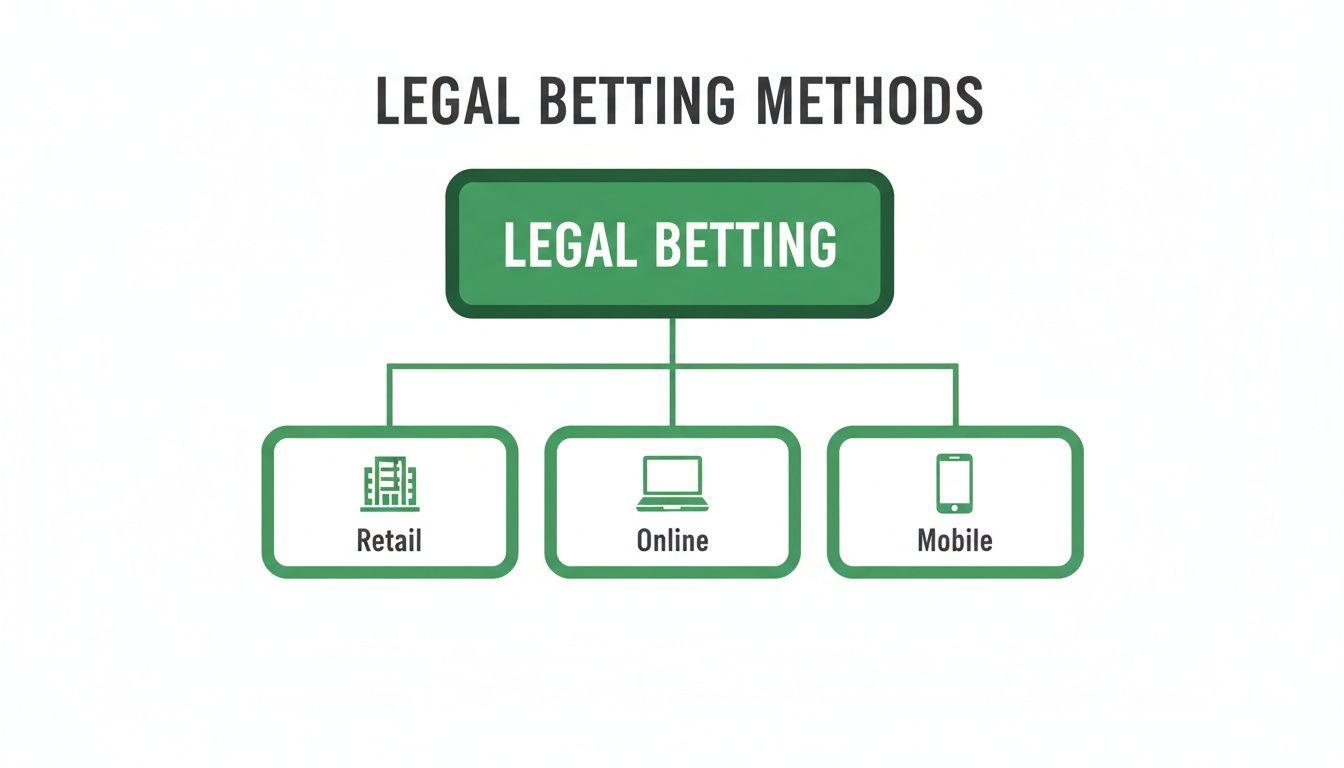
As you can see, states can choose to authorize retail, online, or mobile wagering-either one at a time or all at once.
US Sports Betting Legal Status by State
To give you a quick, at-a-glance overview, the table below breaks down the legal status of sports betting across the United States. Use it to quickly find out what the rules are in your state.
| State | Legal Status | Available Betting Types | Key Notes (e.g., Legal Age) |
|---|---|---|---|
| Alabama | Not Legal | None | Legislation has been proposed but not passed. |
| Alaska | Not Legal | None | No current legislative movement. |
| Arizona | Legal | Online/Mobile & Retail | Legal Age: 21 |
| Arkansas | Legal | Online/Mobile & Retail | Legal Age: 21 |
| California | Not Legal | None | Multiple ballot initiatives have failed. |
| Colorado | Legal | Online/Mobile & Retail | Legal Age: 21 |
| Connecticut | Legal | Online/Mobile & Retail | Legal Age: 21 |
| Delaware | Legal | Retail Only | Legal Age: 21 |
| Florida | Legal | Online/Mobile | Legal Age: 21 (Hard Rock Bet is the only operator) |
| Georgia | Not Legal | None | Legislation is debated annually but has not passed. |
| Hawaii | Not Legal | None | Strong anti-gambling stance. |
| Idaho | Not Legal | None | No current legislative movement. |
| Illinois | Legal | Online/Mobile & Retail | Legal Age: 21 |
| Indiana | Legal | Online/Mobile & Retail | Legal Age: 21 |
| Iowa | Legal | Online/Mobile & Retail | Legal Age: 21 |
| Kansas | Legal | Online/Mobile & Retail | Legal Age: 21 |
| Kentucky | Legal | Online/Mobile & Retail | Legal Age: 18 |
| Louisiana | Legal | Online/Mobile & Retail | Legal Age: 21 (Legal in 55 of 64 parishes) |
| Maine | Legal | Online/Mobile & Retail | Legal Age: 21 |
| Maryland | Legal | Online/Mobile & Retail | Legal Age: 21 |
| Massachusetts | Legal | Online/Mobile & Retail | Legal Age: 21 |
| Michigan | Legal | Online/Mobile & Retail | Legal Age: 21 |
| Minnesota | Not Legal | None | Legislation has stalled in recent years. |
| Mississippi | Legal | Retail Only | Legal Age: 21 (Mobile allowed on-site at casinos) |
| Missouri | Not Legal | None | Bills have repeatedly failed to pass. |
| Montana | Legal | Online/Mobile & Retail | Legal Age: 18 (Mobile restricted to licensed facilities) |
| Nebraska | Legal | Retail Only | Legal Age: 21 |
| Nevada | Legal | Online/Mobile & Retail | Legal Age: 21 (Requires in-person registration for mobile) |
| New Hampshire | Legal | Online/Mobile & Retail | Legal Age: 18 |
| New Jersey | Legal | Online/Mobile & Retail | Legal Age: 21 |
| New Mexico | Legal | Retail Only | Legal Age: 21 (Only at tribal casinos) |
| New York | Legal | Online/Mobile & Retail | Legal Age: 21 |
| North Carolina | Legal | Online/Mobile & Retail | Legal Age: 21 (Online launched in March 2024) |
| North Dakota | Legal | Retail Only | Legal Age: 21 (Only at tribal casinos) |
| Ohio | Legal | Online/Mobile & Retail | Legal Age: 21 |
| Oklahoma | Not Legal | None | Tribal gaming compacts do not include sports betting. |
| Oregon | Legal | Online/Mobile & Retail | Legal Age: 21 (DraftKings is the sole online operator) |
| Pennsylvania | Legal | Online/Mobile & Retail | Legal Age: 21 |
| Rhode Island | Legal | Online/Mobile & Retail | Legal Age: 18 |
| South Carolina | Not Legal | None | No current legislative movement. |
| South Dakota | Legal | Retail Only | Legal Age: 21 (Only in the city of Deadwood) |
| Tennessee | Legal | Online/Mobile Only | Legal Age: 21 |
| Texas | Not Legal | None | Major legislative pushes have failed. |
| Utah | Not Legal | None | Strong constitutional ban on all gambling. |
| Vermont | Legal | Online/Mobile Only | Legal Age: 21 |
| Virginia | Legal | Online/Mobile Only | Legal Age: 21 |
| Washington | Legal | Retail Only | Legal Age: 18 (Only at tribal casinos) |
| Washington D.C. | Legal | Online/Mobile & Retail | Legal Age: 18 |
| West Virginia | Legal | Online/Mobile & Retail | Legal Age: 21 |
| Wisconsin | Legal | Retail Only | Legal Age: 21 (Limited to a few tribal casinos) |
| Wyoming | Legal | Online/Mobile Only | Legal Age: 18 |
This information is your first and most important step to making sure you're betting safely and, most importantly, legally. Always double-check the specific laws in your location before placing any wagers.
How to Spot a Safe and Legal Betting Site
With sports betting exploding across the U.S., the internet is suddenly flooded with options. Here's the catch: only a fraction of these sites are actually operating legally within the United States. Learning to tell a licensed, regulated operator from a risky offshore platform is the single most important skill you can develop to keep your money and personal data safe.
Think of a state gaming license as an official seal of approval, kind of like an FDA stamp on food. It’s your guarantee that the operator is held to strict standards for fairness, security, and responsible gaming. Unlicensed sites operate in the shadows, offering zero such protections.
Check for the Official State License
The absolute most reliable way to know if a sportsbook is legit is to find its licensing information. Legal operators are required to display this, and frankly, they're proud of it.
You can almost always find this right in the website's footer-the very bottom of the homepage. Look for the official logo and name of your state's gaming enforcement agency, like the "New Jersey Division of Gaming Enforcement" or the "Ohio Casino Control Commission." If you can't find this badge, that’s a massive red flag.
Look for Trust Signals and Partnerships
Beyond the official license, safe and legal betting sites give off other clear clues about their legitimacy. These are established businesses that have poured millions into building trust with both regulators and the public.
Here are some key trust signals to watch for:
- Official League Partnerships: Legal sportsbooks often have deals with major sports leagues like the NFL, NBA, or MLB, or with individual teams. Securing these kinds of partnerships is impossible for illegal offshore sites.
- Secure and Familiar Payment Methods: Regulated sites offer payment options you already know and trust, like PayPal, Visa, and direct online bank transfers. Offshore sites often have to use cryptocurrency or shady payment processors because major U.S. financial institutions block them.
- A Commitment to Responsible Gaming: Legal operators are mandated to provide resources for responsible gaming. Look for easy-to-find links to set deposit limits, session time limits, and self-exclusion options, plus contact info for organizations like the National Problem Gambling Helpline.
These elements aren't just for show; they prove a site is accountable to U.S. laws and genuinely invested in protecting its customers. Browsing a list of the sharpest sportsbooks in the world can give you a great feel for what these reputable platforms look like.
Geolocation Technology is Mandatory
Ever had a betting app ask for access to your location? That’s not a polite request-it’s a non-negotiable legal requirement.
Every single legal sports betting site in the US must use geolocation software to confirm you are physically inside a state where they are licensed before you can place a bet.
This technology is the digital fence that keeps all wagers within legal state lines. If a site lets you place a bet from anywhere without verifying your location, you can be 100% certain it is not a legal U.S. operator. It's one of the clearest technical differences between the regulated market and the offshore Wild West.
Your Responsibilities as a Legal Sports Bettor
Placing a bet in a legal market is about more than just picking a winner. When you join a licensed sportsbook, you’re stepping into a regulated world that comes with a few key responsibilities. Understanding these obligations is the best way to keep your betting experience safe, secure, and completely above board.
Two of the biggest areas to get a handle on are identity verification and taxes on your winnings. These aren't just random hoops to jump through; they're federal and state requirements that protect both you and the operator, making the whole system work the way it's supposed to.
Why Sportsbooks Need Your Personal Information
One of the first things a legal sportsbook will ask for during signup is your personal info, including your Social Security Number (SSN). I know, it can feel a little invasive, but it's a non-negotiable part of the legal framework.
Think of it this way: when you open a bank account, the bank is required by federal law to verify who you are to stop fraud and money laundering. Legal sports betting sites operate under the exact same "Know Your Customer" (KYC) regulations. Handing over your SSN is a standard, secure step that proves you are who you say you are and confirms you're old enough to bet.
This process is a hallmark of a regulated operator. Unlicensed offshore sites often skip this step, which might seem convenient, but it means they aren't complying with U.S. laws designed to protect your identity and finances.
A legal site uses this information strictly for verification and tax reporting. It's the same secure process you'd go through with any other legitimate financial institution.
Understanding Taxes on Your Winnings
Another key responsibility is paying taxes on your winnings, because the IRS considers all gambling proceeds to be taxable income. This is just a crucial part of playing in the legal U.S. market.
The rules can seem a little complicated, but they generally boil down to a few key points. You are legally required to report all your winnings on your tax return, no matter the amount. However, you'll only get an official tax form from the sportsbook under certain conditions.
A sportsbook has to issue you a Form W-2G if your winnings are $600 or more and the payout is at least 300 times your original stake. Even if you don't get this form, the responsibility to report the income to the IRS still falls on you. The good news? You can also deduct your gambling losses, but only up to the amount of your winnings. For a much deeper dive, our guide explaining the nuances of taxes on sports betting winnings breaks it all down with clear, actionable info.
Playing Responsibly Is Your Top Priority
Beyond the legal and financial stuff, your most important responsibility is to yourself: responsible gaming. Legal sports betting is meant to be a form of entertainment, and keeping it fun means staying in control.
All regulated sportsbooks are required to offer tools that put you in the driver's seat. Making use of these features is the cornerstone of safe, sustainable betting.
- Set Personal Limits: Before you even place a bet, use the app's tools to set limits on how much money you can deposit, wager, or lose over a certain period (daily, weekly, or monthly).
- Establish Time Limits: You can also set session time limits to make sure you aren't spending more time on the app than you intended.
- Know When to Step Away: If you ever feel like your betting is no longer fun or is causing stress, it's time for a break. Legal sites offer "cool-off" periods or self-exclusion options that let you do just that.
If you or someone you know needs confidential help, resources like the National Problem Gambling Helpline are available 24/7 at 1-800-GAMBLER. Embracing these responsibilities ensures that your sports betting journey stays a positive and controlled part of your entertainment.
Of course. Here is the rewritten section, designed to sound like an experienced human expert, following all the provided guidelines.
Final Questions on Legal Sports Betting
As you get started, it's completely normal to have a few questions rattling around. The world of legal sports betting is full of specific rules and weird technical details that can feel a little confusing at first. Let's clear up some of the most common questions new bettors ask, making sure you have the confidence to get started safely and legally.
Think of this as your final checklist before you jump in.
Why Does My Betting App Suddenly Stop Working When I Cross State Lines?
Ever driven from a legal state like Ohio into a non-legal one like Missouri and had your betting app instantly lock you out? That's geolocation technology at work. Legal sports betting apps are required by law to know exactly where you are, down to the inch. It's not optional-it's how they prove every single bet is placed inside a state where they hold a license.
Your ability to place a wager is always tied to your physical location at that exact moment, not where you live or where you first signed up. The second you cross that border, the app knows, and it will block you from placing any new bets until you're back in legal territory.
What’s the Real Difference Between a Regulated Site and an Offshore One?
The difference is everything. A regulated site is licensed and watched over by a U.S. state gaming commission. This means it has to play by a strict set of rules covering everything from game fairness and data security to responsible gambling practices. Most importantly, you have legal protection and a clear path to follow if you ever have a dispute.
An offshore site operates completely outside of U.S. law, which means it offers zero consumer protection. Using them is a huge gamble-your funds could be frozen, you could face unfair practices, or your personal and financial data could be compromised. Sticking to regulated sites is the only way to know your money is safe.
Do I Actually Have to Pay Taxes on My Sports Betting Winnings?
Yes, absolutely. In the United States, the IRS views all gambling winnings as taxable income, and it's your responsibility to report them.
There are specific rules for when a sportsbook has to send you a tax form. They're required to issue a Form W-2G if you win $600 or more and the payout is at least 300 times your original stake. But here's the key part: even if you don't get a W-2G, you are still legally required to report all your winnings on your tax return. On the bright side, you can also deduct your gambling losses, but only up to the total amount of your winnings.
How Do States Actually Benefit from Legalizing Sports Betting?
States have some pretty powerful reasons to bring sports betting out of the shadows, and it all starts with tax revenue. This new income stream can be massive, and it often gets funneled directly into public services that benefit everyone.
- Funding Public Programs: Many states earmark this money for critical areas like K-12 education, fixing roads and bridges, or funding local community projects.
- Supporting Responsible Gaming: A slice of the tax revenue is almost always set aside to fund problem gambling support, including treatment services and awareness campaigns.
- Economic Growth: Legalization creates thousands of jobs in tech, marketing, customer service, and compliance. It also pulls a massive, untaxed industry out of the illegal offshore market and into the light, which protects consumers and ensures the integrity of the games themselves.
By making betting legal, states don't just find a new way to fill their budgets; they create a safer, more transparent market for everyone. It's a fundamental shift that benefits both the state and the bettors.
Ready to stop guessing and start making smarter, data-driven wagers? ValueBetFactory uses powerful algorithms to find the hidden value in the odds, giving you an edge. Explore our tools and educational resources to take your betting strategy to the next level. Find your next value bet at ValueBetfactory.