
Master Your Bankroll for Sustainable Success
Unlock Profits with betting tips!
Think of a bankroll as the dedicated pool of money you set aside specifically for betting or investing. It’s not your rent money, your grocery budget, or your savings account. This is your strategic capital, completely separate from your day-to-day finances.
This separation is the first—and most important—step in shifting from a casual hobbyist to a serious, disciplined player.
What Is a Bankroll and Why Does It Matter?

Let’s use an analogy. Imagine you're starting a small business. You wouldn't just pull cash from your personal wallet to buy inventory or pay for marketing, would you? Of course not. You'd open a separate business account. This allows you to track every dollar, measure your actual profit, and make smart decisions about where to invest next.
A bankroll does the exact same job for a bettor or an investor. It’s more than just an accounting trick; it’s a psychological barrier that transforms how you view your money. When your funds are cordoned off, every decision becomes more intentional. You're no longer just "gambling"—you're managing a dedicated fund with a specific goal in mind.
The Foundation of Strategic Thinking
Here's a hard truth: without a properly managed bankroll, even the most talented bettors are almost guaranteed to go broke. The reason is a powerful, unavoidable force called variance. Variance is just the natural ebb and flow of luck—the winning streaks and the losing streaks.
A cold streak can easily wipe out someone who isn't prepared. But a player with a solid bankroll can weather that storm, absorbing the losses without panicking, and stay in the game long enough for their skill to win out in the end.
A well-structured bankroll is your shield against variance. It provides the resilience to withstand losing streaks and the structure to capitalize on winning ones, ensuring you stay in the game long enough for your strategy to work.
This structure also keeps you honest and objective. It’s easy to get emotional when you're on a hot streak or chasing losses during a downturn. Your bankroll is your anchor, grounding your decisions in logic. It forces you to ask the right questions:
- Is the size of my bet appropriate for my total capital?
- Am I making a smart play, or am I just trying to win back what I lost?
- How does this single result impact my long-term plan?
The table below breaks down the core principles that make bankroll management so effective.
Core Principles of Bankroll Management
| Principle | Description | Why It's Critical |
|---|---|---|
| Separation of Funds | Keeping your strategic capital entirely separate from personal finances. | Prevents emotional decisions and protects your essential living expenses. |
| Risk Mitigation | Using a structured approach to absorb the natural ups and downs (variance). | Allows you to survive losing streaks without going bankrupt, which is inevitable for everyone. |
| Objective Measurement | Providing a clear, data-driven way to track performance and profitability. | Removes emotion from the equation and lets you accurately assess if your strategy is working. |
| Discipline and Structure | Forcing you to adhere to predefined rules about how much to risk per wager. | Instills the professional discipline needed for long-term success and prevents impulsive betting. |
These pillars aren't just suggestions; they are the bedrock of any successful long-term strategy.
More Than Just Money—It's Your Strategic Fuel
Ultimately, your bankroll is the fuel that powers your engine. A bigger, more powerful engine needs more fuel, just as a more aggressive or high-volume strategy needs a larger bankroll to sustain it. This isn't some niche concept; it's a fundamental principle of finance.
Think about the sheer scale of the financial world. By 2025, global bank revenues are projected to hit $8.5 trillion, while the top U.S. banks manage assets totaling over $11.5 trillion. Those massive sums are all governed by the same core idea as your personal bankroll: capital must be managed methodically to fuel growth and control risk. You can dig into more banking statistics to see just how deep this principle runs.
Defining and protecting your bankroll is the non-negotiable first step. It’s the primary tool that gives you the discipline, resilience, and clarity required to achieve sustained success.
How to Build Your First Bankroll
Alright, let's turn the idea of a "bankroll" into something real you can actually use. This isn't about getting bogged down in complicated spreadsheets or financial jargon. It’s about being honest with yourself and sticking to a plan. Think of it like pouring the concrete foundation for a house—it needs to be solid and built with materials you can truly afford.
There's one golden rule here, and it’s not up for debate: only fund your bankroll with money you are completely comfortable losing. This can't be your emergency savings, next month's rent, or cash set aside for bills. It has to be genuinely disposable income. Getting this right from day one is crucial because it eliminates the kind of stress that forces you into making bad, emotional decisions. If losing the entire sum would cause you any real-life problems, you're starting too big.
Determine Your Initial Funding
Before you can even think about a number, you need to get clear on your goals. The size of your starting bankroll is tied directly to what you're trying to accomplish and the level of risk you’re okay with.
Start by asking yourself a few key questions:
- What are my goals? Am I just having some fun and hoping to make a small profit? Or am I serious about trying to build a legitimate side income over the long haul?
- What is my personal risk tolerance? Can I stomach the big ups and downs, or would I rather take a slow-and-steady approach to minimize the swings?
- What's the minimum stake for the bets I want to place? Your bankroll absolutely must be large enough to handle a long losing streak at the minimum bet size. This is how you survive variance.
Answering these honestly will point you toward a realistic starting figure. For some, that might be $100. For others, it could be $1,000 or more. The exact number isn't as important as the principle behind choosing it.
Methods for Funding Your Bankroll
Once you have a target number in mind, you need to decide how to get the cash together. There are really two main ways to go about it, and both work well.
1. The Lump Sum Method: This is as simple as it sounds. You deposit your entire starting bankroll in one go. It's a clean, straightforward approach that gets you in the game immediately. This is perfect if you already have the disposable cash on hand and you're eager to get started.
2. The Contribution Method: This strategy is about building your bankroll over time with smaller, regular payments. For example, you might decide to add $50 from every paycheck. It's a fantastic, low-pressure way to build a solid bankroll without needing a big chunk of cash upfront.
No matter which path you choose, the next step is absolutely critical.
You have to separate this money, either physically or digitally. Open a separate bank account or use an e-wallet just for your bankroll. This one simple action creates a powerful mental separation, making it crystal clear that this money has one specific job.
Putting It All Together
Let's walk through a quick example. Imagine a new sports bettor wants to start small, focusing on learning the ropes and developing discipline. They decide that $500 is an amount they could lose without it causing any financial stress. They open a new digital bank account and transfer the $500 into it.
That $500 is now their official starting bankroll. Every single bet, win, or loss will be tracked and managed from this separate fund. This clear division is the bedrock of good bankroll management. For a deeper look at what comes next, you can check out our detailed guide on sports betting bankroll management, which explores strategies that build on this foundation.
By following this simple plan—setting goals, picking a realistic number, choosing a funding method, and separating the money—you've built more than just a pile of cash. You've created a professional tool that sets you up for long-term success.
Choosing Your Bankroll Management Strategy
Alright, you've set aside your bankroll and it's ready to go. Now for the important part: deciding how you're actually going to use it. Think of your bankroll as a car's engine; your management strategy is the transmission. It dictates how you apply that power—aggressively for fast growth, or conservatively to protect what you have. Choosing the right approach is everything when it comes to managing risk and growing your funds in a way that fits your personal style.
Just like big financial players adapt to market shifts, you need a strategy for your own capital. For example, the top 25 global banks grew their combined market cap by 20.1% to $4.7 trillion in early 2025, largely by making smart strategic adjustments. You can read more about how these institutions adapt on GlobalData.com. The same principle of adapting your strategy applies to your bankroll, just on a more personal scale.
This image breaks down a simple, effective way to structure your funds before you even place a bet.
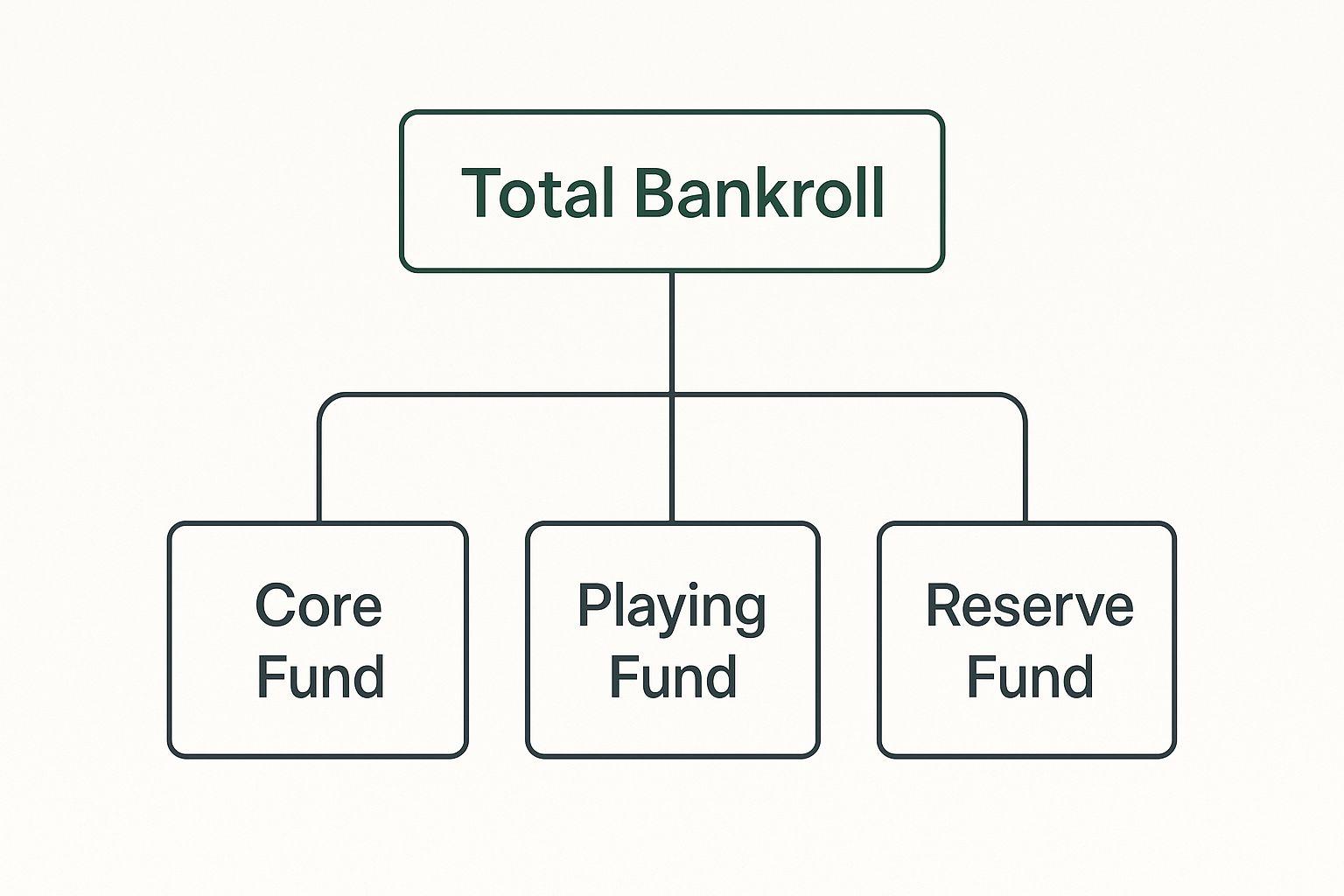
It shows how you can split a total bankroll into different pots: a core fund for stability, a playing fund for your active bets, and a reserve to protect you from those inevitable rough patches.
Flat Staking: The Power of Simplicity and Stability
The most straightforward and widely used strategy is flat staking, sometimes called level staking. The concept is dead simple: you bet the exact same amount on every single play. It doesn't matter how confident you are or what happened in your last bet. This method is the ultimate discipline-builder.
Most people stick to risking between 1% and 3% of their total bankroll per wager. So, if you have a $1,000 bankroll and decide on a 2% stake, you will bet $20 every single time. It makes no difference if you're on a five-bet winning streak or a ten-bet losing skid—your stake is always $20.
The real magic of flat staking? It strips emotion and ego out of the equation. It forces you to be consistent and gives you a rock-solid baseline to judge your actual betting performance over time.
This approach is perfect for beginners because it keeps things simple and shields your capital from the kind of devastating losses that come from chasing losses or getting overconfident.
Percentage Staking: A More Dynamic Approach
The next level up is percentage staking. This model is dynamic, meaning your stake size moves up and down with your bankroll's total value. You still pick a fixed percentage, like 2%, but you apply it to your current bankroll, not your starting amount.
Here’s a quick look at how it plays out:
- Start: With a $1,000 bankroll, your 2% stake is $20.
- You Win: Your bankroll climbs to $1,020. Your next 2% stake is now $20.40.
- You Lose: Your bankroll dips to $980. Your next 2% stake shrinks to $19.60.
This strategy has a couple of key advantages. First, it naturally compounds your wins by increasing your bet size when you're on a hot streak, which can accelerate growth. On the flip side, it has a built-in safety net; it automatically reduces your stakes during a downturn, helping to protect your capital when you need it most.
The Kelly Criterion: The Mathematician's Choice
For bettors who are confident they have a quantifiable edge and want to maximize their growth rate, the Kelly Criterion is the most advanced strategy out there. This mathematical formula calculates the optimal percentage of your bankroll to wager on an opportunity to achieve the highest possible long-term growth.
The formula can look a bit scary, but the idea behind it is simple: it tells you to bet more when your perceived advantage is higher and the odds are good. The biggest challenge isn't doing the math—it's accurately calculating your "edge." If you get that wrong and overestimate your advantage, the formula can suggest some dangerously large stakes.
Because of this risk, many seasoned bettors use a Fractional Kelly approach. Instead of betting the full amount the formula suggests, they'll wager a fraction of it, like 50% (Half Kelly) or 25% (Quarter Kelly). This lets you capture some of the growth benefits while giving yourself a much-needed safety margin. To even consider this strategy, you have to be skilled at identifying value—spots where the odds are better than the true probability. For anyone looking to master that skill, our guide on finding value in betting is the perfect place to start.
At the end of the day, the best strategy is the one that truly fits your risk tolerance, your goals, and how confident you are in your ability to find that all-important edge.
The Best Tools for Tracking Your Bankroll

There’s an old business mantra that’s just as true at the betting window as it is in the boardroom: "What gets measured gets managed." Without keeping a clear record, you're essentially flying blind. You're left to rely on gut feelings and hazy memories, which are notoriously unreliable when money is on the line. Tracking your performance is what turns wishful thinking into hard evidence, showing you exactly where you're succeeding and where you're falling short.
The good news is you don't need a finance degree to do this effectively. The tools available today range from incredibly simple and free to highly specialized software built for pros. The most important thing is finding a system you'll actually use consistently.
The Foundation: A Simple Spreadsheet
For most people, a basic spreadsheet is the perfect starting point. It’s free, you can tailor it exactly to your needs, and it forces you to manually enter your results. That last part is more important than it sounds—actively engaging with your numbers is a powerful way to learn.
A good spreadsheet doesn’t have to be complicated. All you really need to start are a few key columns:
- Date: When did you place the bet or make the investment?
- Description: A quick note about what it was (e.g., "Chiefs -3.5 vs. Broncos").
- Stake: How much did you risk?
- Profit/Loss: The net result of the wager.
- Running Total: A live tally of your bankroll after each outcome.
This running total is your North Star. It provides an unemotional, real-time snapshot of your progress, cutting through the noise of winning and losing streaks.
Tracking isn't just about recording wins and losses; it's about creating a database of your own decisions. Over time, this data becomes your most valuable asset for refining your strategy.
Dedicated Bankroll Tracking Apps
Once you get more serious, you might find that a spreadsheet feels limiting. That's when it's time to look at dedicated tracking apps. These platforms are designed from the ground up for bettors and traders, offering features that automate the heavy lifting and provide much deeper insights.
Many of these tools, like Pikkit, can sync directly with your sports betting accounts to import your history automatically. They then slice and dice that data, generating reports that would take hours to build yourself. You can see your profitability broken down by sport, bet type, or even odds range, helping you pinpoint exactly where your true edge lies.
Comparison of Bankroll Tracking Methods
So, which tool is right for you? It really comes down to your level of commitment, your budget, and what you want to achieve. A beginner has different needs than a full-time pro.
This table breaks down the most common options to help you decide.
Comparison of Bankroll Tracking Methods
| Tracking Method | Best For | Key Features | Potential Drawbacks |
|---|---|---|---|
| Spreadsheet | Beginners and DIY analysts who want full control and no cost. | Completely customizable, free to use, reinforces discipline through manual entry. | Requires manual data entry, can be prone to errors, lacks advanced analytics. |
| Tracking Apps | Serious bettors looking for automated, in-depth performance analysis. | Automated data import, advanced charting, detailed performance breakdowns. | Often requires a subscription fee, can have a learning curve. |
| Manual Notebook | Old-school purists who prefer a physical record of their activity. | Tangible and simple, no technology required, forces methodical thinking. | Extremely time-consuming, impossible to analyze data at scale, easily lost or damaged. |
Ultimately, the best tool is the one you actually stick with. It doesn't matter if it's a simple Google Sheet you update after every game or a sophisticated app that tracks every move. The consistent act of tracking is what elevates you from a casual gambler to a disciplined strategist. It turns your bankroll from a static pile of cash into an intelligent, evolving asset.
Navigating Risk and Avoiding Common Pitfalls
Even if you have the perfect bankroll and a brilliant staking plan, the biggest variable is still you. Your mind can be your greatest edge, but it can also be your worst enemy. Truly effective bankroll management isn't just about the math; it's about mastering your own psychology. Think of this section as mental armor, designed to protect you from the emotional battles that can destroy even the best-laid plans.
First, you have to truly understand and respect variance. It’s the unavoidable rollercoaster of wins and losses that comes with the territory. No matter how good your strategy is, you will hit losing streaks. The goal isn't to magically avoid them—that's impossible. The goal is to build a bankroll big enough to ride them out without panicking and abandoning your entire approach.
Disarming the Biggest Bankroll Killers
Three classic emotional traps have wiped out more bankrolls than bad luck ever could. If you can learn to spot them, you can disarm them before they do any damage. These aren't just simple mistakes; they're predictable human reactions you have to actively fight.
Chasing Losses: This is the most infamous bankroll killer. After a few frustrating losses, the urge to place one massive bet to "win it all back" can feel irresistible. This is a purely emotional decision that lights your carefully crafted strategy on fire. It’s the strategic equivalent of a pilot ignoring the flight plan to fly directly into a hurricane.
Getting Reckless on a Winning Streak: When every bet seems to be a winner, it's easy to start feeling invincible. This is when you might ditch your disciplined 2% rule and start dropping 10% or more on a single wager, convinced your hot streak can't end. It will, and that overconfidence can erase weeks of patient work in a single afternoon.
Failing to Adjust Stake Size: This is a more subtle but equally destructive habit. As your bankroll shrinks, your unit size must shrink with it. If you keep betting the same large amount when your overall funds are down, you dramatically accelerate your risk of going broke.
Practical Techniques for Staying Disciplined
Discipline isn't a personality trait; it's a muscle you build through consistent practice. The trick is to create firm, unbreakable rules for yourself before you're in the heat of the moment. One of the most powerful tools for this is the stop-loss limit.
A stop-loss is a pre-determined point where you stop for the day, period. For instance, you might decide that if your bankroll drops by 10% during a session, you close your laptop and walk away. This acts as a circuit breaker, stopping a bad day from spiraling into a catastrophic one.
A stop-loss isn't a sign of weakness; it's a mark of professional discipline. It's the logical part of your brain protecting your bankroll from your future, emotional self.
This isn't just a betting concept; it's a fundamental principle of risk management everywhere, including high-stakes global finance. For example, S&P Global Ratings forecasted global banking credit losses to rise by about 7% to $850 billion in 2025. Yet, despite anticipating these losses, around 80% of bank ratings remained stable, showing confidence in the industry's risk management protocols. Professionals plan for losses; they don't react to them.
Here are a few more proven techniques to keep your decision-making sharp:
- Set Time Limits: Decide in advance how long you'll bet and stick to it. This stops mental fatigue from causing sloppy mistakes.
- Review Your Goals: Before you start, take 30 seconds to remind yourself of your long-term objective. Are you trying to get rich overnight or build your bankroll methodically?
- Know When to Walk Away: This also applies to winning streaks. Set a "take-profit" goal for the day and have the discipline to cash out when you hit it.
Protecting your bankroll is about protecting your mindset. As you'll see in our guide to developing a winning betting strategy, long-term success comes from managing your emotions just as carefully as you manage your money.
Frequently Asked Questions About Bankroll Management
Even with the best-laid plans, questions always pop up once you start putting theory into practice. Here are some of the most common ones I hear, with straightforward answers to help you navigate the real world of bankroll management.
How Often Should I Re-evaluate My Bankroll Strategy?
Think of it like a regular health check-up for your betting funds. A scheduled review every month or quarter is a great baseline. However, you should also take a step back and reassess after any major swing—whether it's a big win or a painful losing streak.
The goal is to stay disciplined. Scheduled reviews prevent you from making knee-jerk decisions based on a lucky run or a bit of bad variance. It’s your chance to ask, "Does my strategy still align with my current bankroll size, goals, and risk tolerance?" This ensures your adjustments are strategic, not emotional.
What Is the Biggest Mistake Beginners Make?
Without a doubt, the single most damaging mistake is failing to create a separate, dedicated bankroll from the start. When you mix your betting money with your day-to-day personal finances, you lose all sense of discipline. It becomes far too easy to chase losses with money earmarked for rent, bills, or groceries—a recipe for disaster.
Coming in a close second is staking way too much on a single bet. Newcomers often get excited and risk a huge chunk of their bankroll on what feels like a "sure thing." This habit dramatically increases your risk of ruin, turning a normal, expected losing streak into a catastrophic event.
The most common pitfall is treating your bankroll like an ATM instead of a dedicated investment fund. Separation is the foundation of discipline.
Can I Use the Kelly Criterion Without Being a Math Expert?
Absolutely. You don't need a degree in mathematics to use the Kelly Criterion, especially since dozens of online calculators will do the heavy lifting for you. The real skill isn't in solving the formula, but in feeding it the right information.
The entire calculation hinges on one critical variable: your perceived "edge," or the true probability of your bet winning. This is where people get into trouble. Overestimating your edge is incredibly common and can lead to dangerously aggressive stakes.
To counteract this, many pros use a "Fractional Kelly" strategy. Instead of betting the full amount the formula recommends, they'll bet just a fraction of it—say, 25% or 50%. This approach still lets you capitalize on the model's powerful growth principles while building in a vital safety net against inevitable errors in your probability estimates.
Ready to put this knowledge to work? ValueBetFactory uses powerful algorithms to pinpoint valuable betting opportunities, giving you the edge you need to grow your bankroll. Explore real-time alerts and start making more informed decisions today by visiting the ValueBetFactory website.