
How to Calculate Expected Value: Simple Guide for Better Decisions
Unlock Profits with betting tips!
Understanding Expected Value in Real-World Decisions

Professional poker players and smart investors don't just rely on gut feelings; they live by this principle. Their goal isn't to win every single hand or have every stock pick be a winner. Instead, they consistently make decisions that have a positive expected value (+EV). They know that over hundreds of wagers or trades, the math will work out in their favor, leading to profit. It’s the key to playing the long game: focusing on the average outcome, not just a single win or loss.
The Real Cost of a Lottery Ticket
A lottery ticket is a perfect everyday example. It might feel like a small price to pay for a shot at a massive prize. But if you know how to calculate expected value, you start to see things differently. Let's imagine a local raffle selling 500 tickets at $10 each for a car valued at $10,000. Your potential gain is $9,990 (the car's value minus your ticket cost), and your chance of winning is 1 in 500 (or 0.2%). This means your chance of losing your $10 is 499 in 500 (99.8%).
When you run the numbers on this specific scenario, the expected value is actually positive. The average return on your $10 ticket works out to be $19.98. In this case, buying the ticket is a smart bet. Most state lotteries, however, have a deeply negative expected value, meaning that, on average, every ticket you buy is a losing proposition. Over time, those "small" purchases add up. Understanding the expected value meaning helps you tell a good opportunity apart from a bad one.
A Concept Forged in Games of Chance
Interestingly, the whole idea of expected value came from a problem just like this. It goes back to the mid-17th century when famous mathematicians Blaise Pascal and Pierre de Fermat were trying to solve the "problem of points." The debate was about how to split the prize money fairly in a game of chance that was stopped early.
Their solution was to figure out each player's rightful share based on their probability of winning if the game had continued. This work laid the groundwork for modern probability theory. It goes to show that from its very inception, expected value was created to solve practical problems involving money and uncertainty—a job it still does perfectly today.
Breaking Down the Formula That Changes Everything
Diving into mathematical formulas might feel like a headache waiting to happen, but the idea behind expected value is refreshingly simple. Instead of getting tangled in symbols, let's build the concept from the ground up. The main goal is to figure out the average worth of a bet or decision by weighing every possible outcome against how likely it is to occur. This isn't just theory; it’s a hands-on tool for making smarter financial moves.
The first step is always to identify every possible result. With a basic coin flip, your outcomes are heads or tails. In sports betting, you're looking at a win, a loss, or sometimes a push (a tie where you get your money back). Once you know the outcomes, you attach a value to each one, which is typically the amount you stand to win or lose.
The Core Components of the Calculation
With your outcomes and their potential payouts listed, the next key ingredient is probability. This is where a little bit of research or a solid estimate comes into play. For that coin toss, the probability of it landing on heads is 50% (or 0.5). For a sports bet, you might use the implied probability from the sportsbook's odds or conduct your own analysis to estimate a team's real chances of winning.
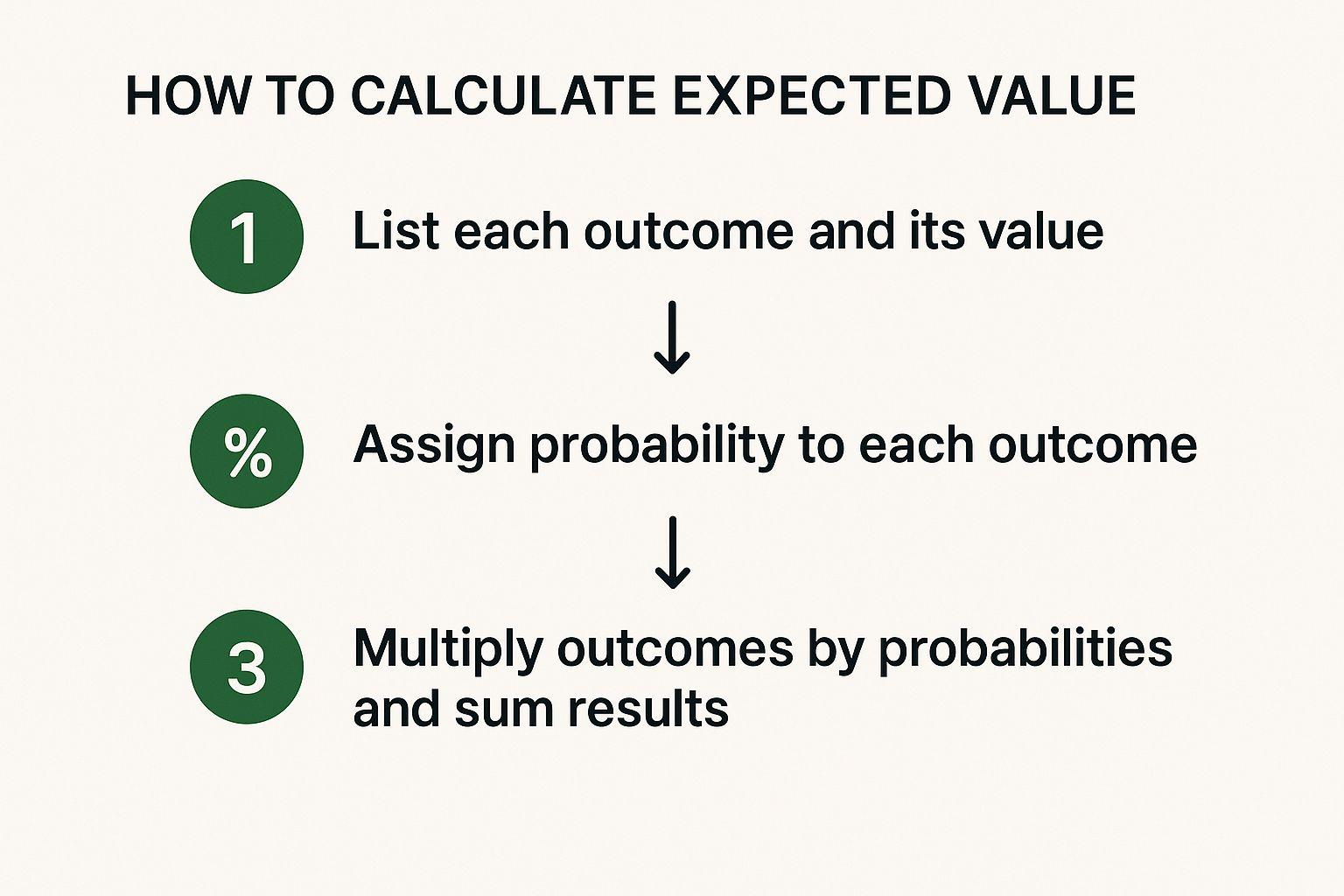
The final piece of the puzzle is putting it all together. The process of how to calculate expected value involves adding up the value of each possible outcome after multiplying it by its probability. This gives you a single number that represents the long-term average value of that decision if you could repeat it over and over. If you want to get into the nitty-gritty of the math, you can explore the foundational principles of expected value on Wikipedia. This formula is the engine behind professional betting and many investment strategies.
A Practical Walkthrough: A Simple Bet
Let’s put this into action with a real betting scenario. Imagine you're placing a $10 bet on a team to win a match at +150 odds. If they win, you make a $15 profit. A friend who loves stats tells you the team has a genuine 45% chance of winning.
Here’s how we break down the calculation:
- Outcome 1 (Win):
- Value: +$15 (your profit)
- Probability: 45% (0.45)
- Calculation: $15 * 0.45 = +$6.75
- Outcome 2 (Lose):
- Value: -$10 (your stake)
- Probability: 55% (calculated as 1.00 - 0.45)
- Calculation: -$10 * 0.55 = -$5.50
Now, we just add the two results together: $6.75 + (-$5.50) = +$1.25.
The expected value (EV) of this wager is +$1.25. This means that for every $10 you risk on this exact bet, you can expect to profit an average of $1.25 over the long haul. It doesn't promise a win this time, but it does confirm the bet is mathematically a good one. This is the secret to finding "value" and is precisely what platforms like ValueBetFactory are designed to do automatically.
Mastering Betting Scenarios Like a Professional
Theory is one thing, but nothing drives home the concept of how to calculate expected value quite like applying it to a situation where real money is on the line. Seasoned bettors don't rely on gut feelings; they methodically break down wagers to find a mathematical edge. This is where the abstract formula becomes a practical tool for spotting valuable opportunities that most casual bettors overlook.
Let's walk through a common sports betting scenario. Imagine the Los Angeles Lakers are set to play the Boston Celtics. A sportsbook is offering odds of +120 for a Lakers victory. In simple terms, this means a successful $100 bet would earn you a $120 profit. But the bookmaker's odds are only half of the equation. The most important question you need to answer is: what's the real probability of the Lakers winning?
After doing your own homework—or consulting a reliable analytics model—you estimate that the Lakers have a genuine 50% chance to win the game. With this piece of information, we can now calculate the expected value (EV) to determine if this bet is a smart move.
Pinpointing Value in a Sports Bet
To find the EV, we need to consider the two possible outcomes: the Lakers winning or the Lakers losing.
- If the Lakers Win: There's a 50% (0.50) probability you'll win $120. The value of this outcome is $120 × 0.50 = +$60.
- If the Lakers Lose: There's also a 50% (0.50) probability you'll lose your $100 stake. The value of this outcome is -$100 × 0.50 = -$50.
Now, we just combine the two to get the total expected value: $60 - $50 = +$10. This +$10 EV tells us that, on average, this bet is projected to make you $10 for every $100 wagered. This is a clear positive expected value (+EV) opportunity—exactly the kind of bet that professional gamblers look for. While it doesn't guarantee a win on this specific game, placing hundreds of similar +EV bets over time means you are mathematically favored to be profitable.
This infographic breaks down the core process of how to calculate expected value into a simple, visual flow.
Beyond a Single Bet: The House Edge
The same logic perfectly explains the old saying that "the house always wins" in casino games. Let's take a standard American roulette wheel, which has 38 slots (numbers 1-36, plus 0 and 00). If you bet on a single number, the casino pays you 35-to-1 if it hits. The true probability of your number coming up is 1 in 38, which is about 2.63%.
Let's run the numbers for a simple $10 bet on a single number:
- Potential Win: $350 (your profit)
- Potential Loss: $10 (your stake)
- EV Calculation: ($350 × 1/38) + (-$10 × 37/38) = $9.21 - $9.74 = -$0.53
For every $10 you stake on a single number in roulette, you can expect to lose an average of 53 cents. This negative expected value is the casino's built-in profit margin, often called the house edge. It’s also why strategies like card counting in blackjack are so famous; they allow skilled players to spot rare moments when the deck’s composition flips the EV in their favor, creating a brief +EV opportunity against the house.
To give you a clearer picture, this table compares the expected value across a few common betting and gambling situations.
| Betting Scenario | Possible Outcomes | Probabilities | Expected Value (on $100 Bet) | Recommendation |
|---|---|---|---|---|
| Our +EV Sports Bet | Win $120 / Lose $100 | Win: 50% / Lose: 50% | +$10.00 | Favorable Bet: A mathematically profitable wager over the long term. |
| Roulette (Single #) | Win $3,500 / Lose $100 | Win: 2.63% / Lose: 97.37% | -$5.26 | Unfavorable Bet: The house has a significant, built-in advantage. |
| Coin Flip (Fair Odds) | Win $100 / Lose $100 | Win: 50% / Lose: 50% | $0.00 | Neutral Bet: No mathematical edge for either the bettor or the house. |
| Typical Parlay Bet | High Payout / Lose $100 | Very Low Win % / Very High Loss % | Often -$15 to -$30 | Highly Unfavorable: The odds rarely justify the low probability of winning. |
This comparison makes it clear how crucial it is to assess the actual probabilities versus the offered payout. A positive EV is the sign of a smart investment, while a negative EV is a clear signal that the odds are stacked against you, making it a poor choice for anyone serious about long-term success.
Applying Expected Value to Investment and Business Decisions

The core principles are exactly the same. Instead of a simple win or loss, you evaluate potential market scenarios—like a booming economy, a mild recession, or a market crash. The "payout" is the potential return on an investment in each of those situations. By assigning probabilities to these economic futures, you can figure out if a stock, bond, or new project is a mathematically sound choice for your portfolio.
From Stocks to Startups: A Versatile Tool
Let's walk through a real-world business case. Imagine a business owner is weighing a $100,000 investment in new equipment. They forecast three possible outcomes over the next year:
- Strong Growth (20% probability): This would generate a net return of +$50,000.
- Stable Market (60% probability): A more likely scenario, leading to a modest net return of +$10,000.
- Economic Downturn (20% probability): The worst-case outcome, resulting in a net loss of -$30,000.
Calculating the EV is pretty straightforward once you have these numbers:
- (0.20 × $50,000) + (0.60 × $10,000) + (0.20 × -$30,000)
- $10,000 + $6,000 - $6,000 = +$10,000
The expected value of this investment is a positive $10,000. This figure suggests the project is a financially sensible risk and gives the owner a solid, data-backed reason to move forward. Although this is a simplified example, it’s the same framework project managers use to get funding for major initiatives. The basic idea of finding a positive long-term average is consistent, whether you're analyzing a stock or betting for value in the sports world.
A Cornerstone of Modern Statistics
The usefulness of expected value goes far beyond business and finance; it’s a foundational concept in statistical theory. Its principles are closely related to the Central Limit Theorem (CLT), a key idea in statistics. The CLT explains why the average of your results tends to follow a normal "bell curve" distribution when you repeat a decision or experiment many times.
This theorem is vital for statistical modeling and helps analysts make predictions with much greater confidence. It shows that understanding how to calculate expected value is a gateway to deeper data literacy. If you're interested in the theory behind it, you can explore more about expected value in statistical theory to see how it all connects.
Choosing the Right Tools for Effortless Calculations
While understanding the math behind how to calculate expected value is a game-changer for making smart judgments, you don't need to be hunched over a calculator for every bet. Honestly, for complex wagers or when you need to act fast, using the right tools doesn't just save time—it cuts down on simple mistakes. Pros in betting and finance aren't doing long division; they're using a mix of tools to get accurate analysis, fast.
The great thing is, you already have powerful tools at your fingertips. You can start with a basic spreadsheet program like Microsoft Excel or Google Sheets. By plugging in the EV formula, you can create your own reusable calculator. This is perfect for digging into more detailed decisions where you have multiple outcomes to consider, each with its own probability and potential payout.
From Spreadsheets to Specialized Software
If you're analyzing betting odds regularly, manual entry gets old, fast. This is where dedicated online tools become your best friend. Instead of typing in odds, stakes, and probabilities every time, a specialized calculator does it all for you. For a quick and reliable way to check your numbers, a free expected value calculator is an excellent resource. These are built specifically for betting, letting you plug in the odds and get an instant EV read—perfect for when opportunities pop up and you need to make a quick call.
These tools are all solving the same core equation for you. It might look a bit intimidating, but it's just a formal way of showing the process we've been talking about.
This formula simply means you take the value of each possible outcome (x), multiply it by its probability (P), and add them all together. The key takeaway is that whether you're using a custom spreadsheet or a slick online tool, the fundamental logic doesn't change.
To help you decide what tool might be best for your needs, here's a quick comparison of some popular options.
| Tool Name | Type | Best For | Key Features | Cost |
|---|---|---|---|---|
| Microsoft Excel / Google Sheets | Spreadsheet | Custom, multi-scenario analysis (business, complex bets) | - Fully customizable formulas - Visual data with charts - Handles complex variables | Included with software suite or free |
| Pinnacle Odds Calculator | Online Calculator | Quick betting calculations | - Pre-set for different odds formats - Calculates implied probability - Simple, user-friendly interface | Free |
| OddsJam +EV Tool | Specialized Software | Finding positive EV bets across sportsbooks | - Scans multiple bookmakers - Identifies arbitrage opportunities - Real-time odds comparison | Subscription-based |
| Custom Python/R Scripts | Programming Language | Advanced quantitative analysis and modeling | - Unlimited customization - Can process huge datasets - Integration with other data sources | Free (requires programming skill) |
As you can see, the choice really depends on how deep you want to go. A simple online calculator is often enough for daily betting, while a spreadsheet offers more power for unique situations.
Advanced Tools and Verification
Once you get into more serious territory, like quantitative sports analysis or high-frequency trading, you’ll find specialized software built with programming languages like R or Python. These platforms can chew through massive amounts of data and run sophisticated simulations, but they all still run on the same basic principles of expected value.
No matter which tool you land on, one habit is absolutely essential: verification. Always double-check what you've entered. A single misplaced decimal or a typo in the odds can throw your entire calculation off. My personal rule for any significant decision is to run the numbers twice, sometimes using a second tool just to be sure. This little habit builds confidence and ensures your choices are based on solid, accurate data. The best tool is simply the one that fits what you're trying to do, whether it's a quick calculation on your phone or a detailed analysis for a major investment.
Avoiding Costly Mistakes That Trap Most People
Knowing how to calculate expected value is one thing, but applying it flawlessly under pressure is a different game entirely. Even seasoned analysts and professional bettors can fall into expensive traps. The most common error isn’t about fumbling the math; it’s about overestimating your own accuracy. It’s a classic psychological bias where we become a little too confident in our probability estimates, forgetting about the wide range of what could actually happen.
This mental shortcut often leads people to misinterpret what expected value truly represents. Remember, EV is a long-term average, not a crystal ball for a single event. A bet with a +$10 EV doesn’t mean you’re going to walk away with an extra $10. The only two real outcomes are winning your payout or losing your stake. That +$10 figure is just the mathematical gravity pulling your bankroll upward over hundreds of similar bets. Forgetting this can destroy your bankroll management, as you might risk too much on one +EV wager, not appreciating that you still have a significant chance of losing it all.
When Expected Value Can Deceive You
Another dangerous pitfall is using expected value in isolation, especially when you're dealing with rare but catastrophic events. This is sometimes called the "black swan" problem. Let's say you're offered a bet with a massive payout but a tiny, nearly impossible-to-calculate chance of a huge loss. A standard EV calculation might show it as profitable, but it completely fails to account for the ruinous impact of that one-in-a-million negative outcome. If the worst-case scenario can wipe you out completely, the EV alone is a poor guide.
Similarly, you have to be wary of highly correlated outcomes. If you place ten different +EV bets that all depend on a single player having a great game, your risk isn't diversified at all. If that player gets injured in the first quarter, all ten of your bets will likely go down together. In this situation, your overall risk is much higher than the sum of each individual bet's EV would suggest.
Protecting Yourself from Common Errors
To safeguard your decisions, you should always stress-test your assumptions. Here are a few practical tips I've learned to rely on:
- Be Skeptical of Your Probabilities: Constantly ask yourself, "What if my 40% probability estimate is actually 35%?" Rerun the calculation with more conservative numbers to see if the bet still holds value.
- Consider the Range of Outcomes: Don't just get tunnel vision on the single EV number. Acknowledge the volatility and the real potential for a string of losses, even when you have a positive EV.
- Think About Risk of Ruin: For any significant decision, ask if the worst-case scenario is something you can financially survive. If the answer is no, the bet probably isn't worth it, regardless of its EV.
By staying aware of these psychological and statistical traps, you can develop the critical thinking needed to validate your work. This is what separates someone who just knows the formula from someone who can make genuinely better decisions under uncertainty.
Your Personal Expected Value Action Plan
We’ve covered the theory, the formulas, and the common pitfalls. Now it's time to put it all together and build a system for making smarter decisions. Knowing how to calculate expected value is one thing, but turning that knowledge into a consistent habit is where you’ll find your real edge. This is about more than a few one-off calculations; it’s about creating a personal framework that guides every choice you make, from sports bets to financial investments.
The goal is to make EV analysis second nature. Let's move from abstract concepts to a concrete process. Here's a simple checklist you can adapt for any +EV opportunity you're thinking about, turning the math into a repeatable and reliable part of your routine.
Your Simple Bet Checklist
Before you lock in any significant wager, run through these points. It’s a quick sanity check to make sure your decision is backed by data, not just a gut feeling.
- Map Out All Outcomes: What are the possible results? A win, a loss, or even a push? List every single one.
- Know Your Payouts: What's the exact profit if you win? What's the total amount you stand to lose? Be precise with your numbers.
- Estimate the True Probability: This is where the magic happens. Use solid data to estimate the real probability of each outcome, ignoring the bookmaker's odds for a moment. This could come from historical stats, a trusted analytics model, or your own in-depth research. Remember, an error of just a few percentage points can turn a +EV bet into a money-loser.
- Do the Math: Plug your numbers into your preferred formula or tool.
- Analyze the Result: Is the EV positive? If it is, how big is the edge? Is the potential reward worth the risk involved?
Tracking for Long-Term Success
The only way to truly know if your probability estimates are on point is to track everything. A basic spreadsheet is all you need. Set up columns for the bet details, your estimated probability, the odds you took, your calculated EV, and, of course, the final result. Over time, this log becomes an invaluable dataset on your own performance.
This practice is essential for calibration. For instance, you might find that you’re consistently overestimating the chances of underdogs pulling off an upset. When you see this pattern in your own data, you can adjust your future probability models, making your entire system more accurate. It’s a powerful feedback loop that sharpens your judgment.
By building this habit, you go from someone who just understands expected value to someone who actively uses it to achieve consistent results.
Ready to put this plan into motion with tools that do the heavy lifting for you? ValueBetFactory finds these +EV opportunities in real-time, giving you the data-backed edge you need to bet smarter. Stop guessing and start making calculated decisions today.