
Automate Data Analysis for Sports Betting Success
Unlock Profits with betting tips!
If you want to truly automate your data analysis for sports betting, you need a system. This isn't just about running a few scripts; it's about building a complete pipeline that pulls in raw data, applies your logic, and delivers actionable insights without you having to lift a finger. The end goal is a hands-off system that works around the clock, consistently unearthing profitable opportunities like value bets.
Gain a Data-Driven Edge in Sports Betting
Are you tired of staring at spreadsheets and relying on gut feelings? It’s time to evolve your sports betting from manual guesswork into a systematic, data-powered engine. The real beauty of automation is how it tackles the two biggest enemies of a successful bettor: emotional bias and human limitations.
Let's be honest, manual analysis isn't just slow; it's fragile. A painful loss can easily cloud your judgment for the next game. Plus, no one can possibly track thousands of odds changes across dozens of bookmakers 24/7. This is precisely where an automated pipeline becomes your greatest ally. It chews through massive amounts of odds, team stats, and market data with a speed and consistency a human simply can't replicate.
Why Manual Analysis Falls Short
The fundamental problem with the old-school approach is that it’s almost always reactive. You spot a game you like, pull up some basic stats, and make a call based on a very limited snapshot in time. That process is riddled with potential for error, incomplete data, and—most importantly—the emotional baggage from your recent wins and losses.
An automated system, on the other hand, runs on pure logic. It strictly follows the rules you give it, ensuring every single opportunity is measured against the exact same yardstick. That kind of discipline is the bedrock of long-term profitability.
This isn't about some magic formula. It's about building a disciplined framework that systematically finds an edge. The power is in removing emotion and executing your strategy flawlessly, every single time.
This shift isn't unique to betting. We're seeing data analysis automation explode across every industry, driven by artificial intelligence (AI) and machine learning (ML). In fact, by 2025, an estimated 65% of organizations will be using or exploring AI for data analytics to handle complex jobs that once took huge teams of people.
Manual vs Automated Sports Data Analysis
To really see the difference, it helps to put the two approaches side-by-side. The contrast highlights just how much of an advantage a well-built automated system can provide.
| Aspect | Manual Analysis | Automated Analysis |
|---|---|---|
| Speed | Slow, limited to one game at a time | Near-instant, processes thousands of data points |
| Consistency | Varies based on mood, bias, and fatigue | 100% consistent, follows predefined logic |
| Scale | Can only cover a few games or markets | Scans entire markets and multiple sports 24/7 |
| Bias | Highly susceptible to emotional decisions | Completely objective and data-driven |
| Reaction Time | Reactive, analyzes past data | Proactive, provides real-time alerts |
In short, automation takes what is often a hobby driven by hunches and turns it into a calculated, strategic operation.
The True Advantage of Automation
When you automate your analysis pipeline, you're building a machine designed to systematically find market inefficiencies. For bettors, this usually means identifying value bets—situations where a bookmaker's odds don't accurately reflect the real probability of an outcome. To really nail this concept, I highly recommend reading our complete guide to understanding value betting.
An automated system gives you the power to:
- Process More Data: Analyze far more games, markets, and variables than you ever could on your own.
- Act Faster: Get real-time alerts the second a profitable opportunity emerges, long before the odds move.
- Maintain Discipline: Completely remove emotional decision-making and stick to a proven, data-backed strategy.
- Save Time: Free yourself from hours of tedious manual research so you can focus on sharpening your models.
Ultimately, to automate data analysis is to create your own personal betting assistant—one that’s tireless, objective, and laser-focused on finding an edge.
Building Your Automated Data Pipeline
This is where the rubber meets the road. We're moving from a cool idea about automating sports betting analysis to building the actual system that makes it happen. Think of the data pipeline as the heart of your entire operation—it's what pumps fresh, reliable data to your scripts for analysis. If your pipeline is weak, your analysis will be flawed. There's no way around it, so building a solid one is non-negotiable.
The very first choice you'll make, and honestly the most important, is where you get your data. I see a lot of people try to scrape websites for free, but this is a classic beginner's trap. It’s not only unreliable but can get you in hot water for violating a site's terms of service. The professional approach is to use a dedicated sports data API (Application Programming Interface). Yes, they come with a subscription fee, but you get clean, structured data on odds, player stats, and injury news delivered right to you.
A well-organized dashboard is a game-changer for keeping an eye on your data pipeline and boosting your efficiency.
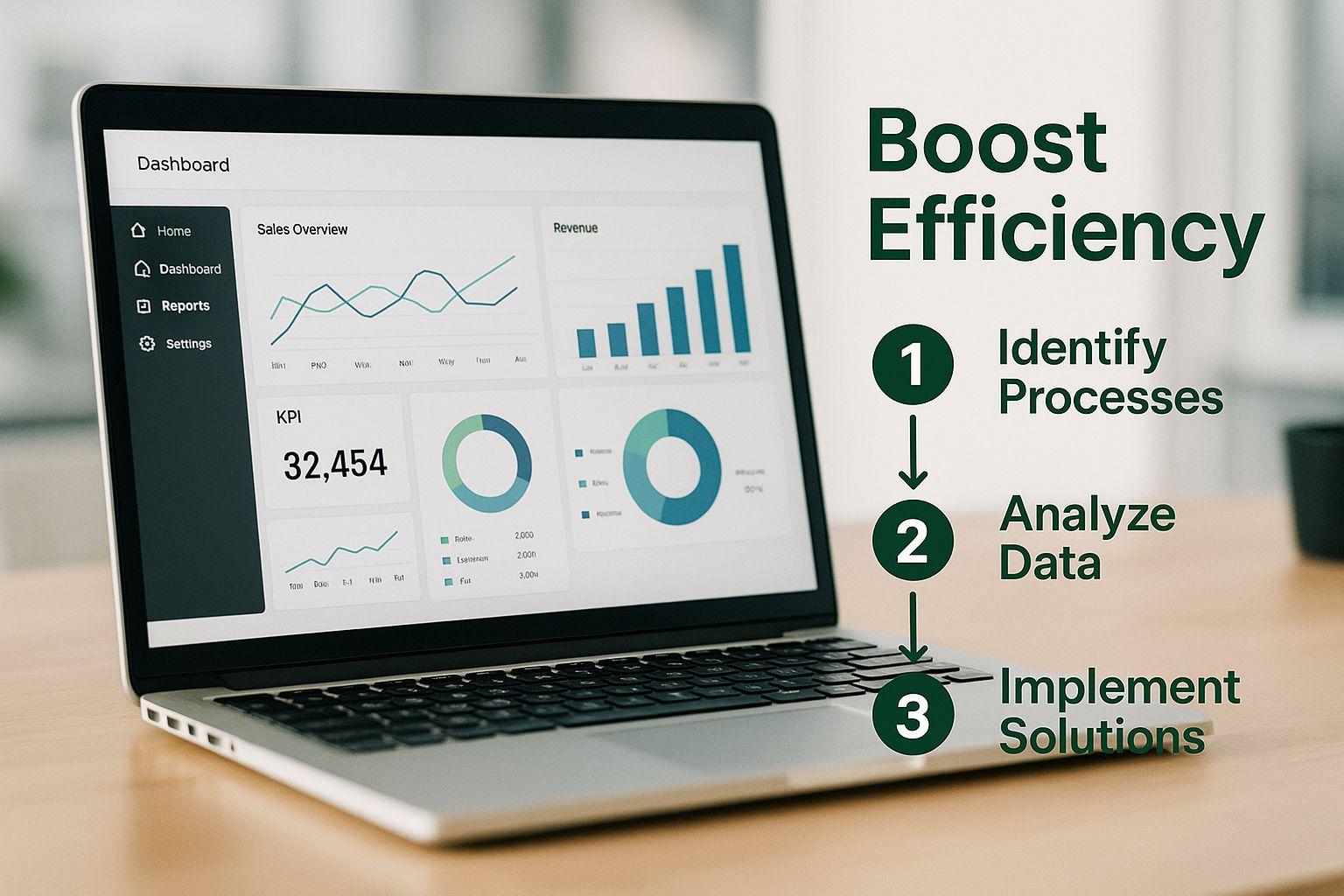
Being able to see your pipeline's health at a glance helps you spot errors or bottlenecks fast, making sure your whole system stays up and running smoothly.
How to Choose the Right Data APIs
Not all data providers are the same. When you're looking at different APIs, you need to be a bit of a detective to make sure they're the right fit for your strategy.
Here’s what I always look for:
- Coverage: Does it actually cover the sports, leagues, and betting markets I care about? If you’re focused on Korean baseball, an API that only covers major US sports is useless.
- Data Points: Does it provide the exact metrics you need? This could be anything from basic moneyline odds to more obscure stats like player pass completion percentages.
- Reliability and Speed: How fast are the odds updated? If you’re building an in-play betting model, you need data that's practically real-time. For pre-game models, a few seconds of delay might be okay.
- Documentation: Is the API documentation clear? I can't stress this enough—good documentation will save you hours of headaches and guesswork.
- Cost: Prices vary wildly. Find a provider that fits your budget and, ideally, offers a free trial so you can kick the tires before you commit.
Don't make the rookie mistake of paying for a premium API that gives you thousands of data points you'll never touch. If your first model is just for picking Premier League match winners, you only need odds and basic team stats—not deep player analytics for every league on the planet. Start lean.
Fetching and Storing Your Data
Once you’ve picked an API, it’s time to write scripts to pull that data in. Python is the go-to language here. It’s relatively simple to learn and has fantastic libraries like requests for making the API calls and pandas for organizing the data you get back.
The goal is to create a process you can run over and over. Your script will ping the API, grab the data (which usually comes in a format called JSON), and then save it somewhere. When you're just starting, saving the data as simple CSV files in neatly organized folders is a perfectly good way to begin.
For a more serious setup, you'll want to use a database. PostgreSQL is an excellent, free, open-source choice that’s built to handle tons of structured data. Putting your data into a proper database makes it much easier to run queries, merge different datasets (like odds and team stats), and look back at historical trends down the road.
Pro Tip: Build error handling into your data-fetching scripts from day one. APIs go down, your Wi-Fi will drop, and sometimes the data format changes without warning. Your script needs to handle these hiccups gracefully—by logging the error and trying again later—instead of crashing your whole system.
This single practice ensures that a temporary glitch doesn't derail your entire effort to automate data analysis.
Tackling Common Pipeline Problems
Building a pipeline isn’t just about the happy path; it’s about preparing for what can go wrong. The two biggest hurdles you'll almost certainly face are API rate limits and messy data.
Most APIs will cap how many requests you can make in a certain time frame (e.g., 100 requests per minute). Your script has to play by these rules, or you’ll get temporarily blocked. The simple fix is to add a short pause between your API calls, like time.sleep(1) in Python.
Messy data is another guarantee. You'll find missing values, team names spelled differently across various sources, and incorrect data types. This is where the "Transform" part of an ETL (Extract, Transform, Load) process becomes your best friend. Before you load any data into your database, you need to write functions to clean and standardize it. This ensures your analytical models are fed consistent, high-quality information. Taking the time to build these cleaning functions early will make your system infinitely more reliable.
Scripting Your Strategy to Uncover Value Bets
With a reliable data pipeline in place, you’ve secured the fuel. Now, it’s time to build the engine that drives your betting decisions. This is where you translate your strategies into code, creating scripts that systematically sift through data to find those elusive value bets. This is the heart of how you automate data analysis and turn raw information into a real, tangible edge.
The go-to tool for this job is almost always Python, specifically with its powerhouse library for data manipulation, pandas. If your data pipeline is the heart of the system, think of pandas as the brain. It lets you load, clean, merge, and analyze huge datasets with stunning efficiency. Forget manually comparing odds in a spreadsheet; you're about to build a script that does it instantly across hundreds of games.

From Raw Odds to Implied Probability
One of the first, most fundamental calculations your script needs to handle is converting betting odds into implied probabilities. This simple mathematical step is what allows you to compare the bookmaker's view of a game to your own. It’s a non-negotiable first step.
For example, if a bookmaker offers decimal odds of 2.50 on a team to win, the implied probability is calculated as (1 / 2.50) * 100, which gives you 40%. Your script can run this calculation for every single game and outcome you've pulled in a fraction of a second.
By transforming odds into a universal metric—probability—you create a common ground for comparison. This allows your system to objectively evaluate every opportunity against your personal analytical models, removing all guesswork.
This automated conversion is the first domino to fall. It opens the door to spotting discrepancies between the market's price and your own assessment of true probability, which is the very definition of a value bet.
Encoding Your Analytical Model
The word "model" sounds intimidating, but it can start out incredibly simple. Your first model might just be a basic set of rules. For instance, you could program your script to flag any game where your own predicted probability for a team to win is at least 5% higher than the implied probability baked into the bookmaker's odds.
Let's walk through a real-world scenario:
- Data Ingestion: Your script loads the latest odds for upcoming NFL games from your database.
- Probability Calculation: It crunches the numbers, calculating the implied probability for each team to win based on the available odds.
- Model Comparison: It then compares this against your own pre-calculated win probabilities (which you might have derived from historical performance data or another model).
- Value Identification: The script flags a game where the Las Vegas Raiders have a bookmaker-implied win probability of 45%, but your model gives them a 52% chance. That 7% difference is a potential value bet you need to investigate.
This entire process, which might take a person 15 minutes to do manually for just one game, is done by your script for the entire week's slate in under a second. That's the power we're tapping into here. For a deeper dive into the methodologies, you can explore our comprehensive guide on sports betting analytics, which breaks down these core concepts further.
Finding Arbitrage and Market Discrepancies
Your analysis isn't limited to just one bookmaker, either. By pulling odds from multiple sources, your script can spot even more lucrative opportunities, like arbitrage. This happens when different bookies have such divergent odds that you can bet on all outcomes of an event and guarantee a small profit, no matter who wins.
Your script can automate this hunt by:
- Collecting moneyline odds for the same game from three or four different sportsbooks.
- Converting all odds to implied probabilities and summing them up.
- Flagging any game where the total implied probability across the best odds for each outcome is less than 100%. This indicates a risk-free arbitrage opportunity.
These windows are rare and often slam shut within minutes, making an automated scanner the only practical way to catch them.
Ultimately, scripting your strategy is about building a system that executes your logic flawlessly and tirelessly. It’s how you transform a messy, constant stream of sports data into a curated list of high-potential betting opportunities, delivered right to you.
Taking Your Workflow from Manual to Automatic with Schedulers and Alerts
A brilliant analytical script is only half the battle. If you have to sit there and manually trigger it every time you want to find an edge, you're leaving a massive amount of speed and consistency on the table. This is the crucial step where you operationalize your entire system, turning it from a powerful tool into a truly hands-off, automated engine. This is how you really automate data analysis for a 24/7 advantage.
The goal is pretty straightforward: get your data collection and analysis scripts running automatically, without you ever having to touch them. This ensures you’re constantly scanning the market for fresh opportunities, even when you're not at your desk.
Setting Up an Automated Schedule
To get this done, you’ll need a scheduler—a simple utility that runs your scripts at whatever interval you decide. The specific tool depends on your operating system, but the concept is the same everywhere.
- For Linux or macOS users: The gold standard is the
cronjob. It’s a time-based scheduler baked right into the OS that lets you specify exactly when to run a command or script. I've used it for years to execute Python scripts every 15 minutes like clockwork. - For Windows users: The equivalent is Task Scheduler. It’s a graphical tool that's a bit more user-friendly, allowing you to set up triggers (like a daily schedule or on system startup) to run your scripts.
Just imagine setting your system to run its full analysis at the top of every hour. It fetches the latest odds, runs your model, and flags potential value bets while you're at work, asleep, or out with friends. This is a level of vigilance that’s just impossible to maintain manually, and it’s one of the biggest wins of a fully automated workflow.
Moving from Silent Analysis to Actionable Alerts
Okay, so automated execution is great, but it’s not the whole story. If you're still manually checking a dashboard or a log file to see if your script found anything, you're still doing a chore. The real game-changer is setting up instant notifications.
Instead of you pulling information from the system, the system should push critical information directly to you. When a value bet matching your precise criteria is found, you need to know about it the moment it happens. This speed is absolutely critical, as good odds can disappear in a matter of minutes.
A truly automated system doesn't just find the needle in the haystack; it delivers the needle directly to your pocket. The goal is to move from actively searching for insights to passively receiving them when they matter most.
This shift in approach is a massive productivity booster. We see the impact of this kind of automation everywhere—for instance, marketing teams use automation 76% more than sales departments, all chasing similar efficiency gains. And the results speak for themselves. Detailed industry statistics show that over 90% of workers report a boost in productivity from automation, while companies see operating costs drop by an average of 22%.
Choosing Your Alerting Channel
The good news is that setting up alerts is probably easier than you think. You can extend your Python script to send a message through various services using their APIs. The key is to pick a channel that fits your lifestyle and guarantees you'll see the alert immediately.
Here are a few options I've found to be really effective:
- Telegram: This is a fantastic choice. You can create a private channel, use a bot, and have your script send messages directly to your phone. The notifications are instant and can be customized to include all the key details you need.
- Discord: Much like Telegram, you can use a "webhook" to post messages into a specific channel on a private server. If you're already a heavy Discord user, this is a natural fit.
- Email: While it's a bit less immediate than a chat app, email is a reliable fallback. Python's built-in
smtpliblibrary makes sending simple email notifications pretty straightforward.
Think about it this way: your script identifies a value bet on a Premier League match. It can immediately format a message like: "VALUE ALERT: Arsenal vs. Chelsea - Bet on Arsenal to win at 2.75 odds. Our model shows a 6% edge." That message gets sent instantly to your private Telegram channel. Now, you can review the opportunity and place the bet from anywhere, all within moments of its discovery. That's the power of a fully operationalized system.
Refining Your Models and Managing Risk
Getting your automated system up and running isn't the finish line. Honestly, it's just the starting gun. The real work begins now, turning your setup from a cool project into a disciplined, profitable operation. This is where you shift from building to fine-tuning, and it’s this commitment to constant improvement that separates a flash in the pan from long-term success.
Your first and most critical task is backtesting. I can't stress this enough. Before you even think about putting real money on the line, you absolutely must validate your models against historical data. This means running your scripts over months, or even better, years of past games to see if you actually had a genuine edge.

If the backtest comes back negative, don't sweat it. That’s perfectly normal. In fact, it’s a good thing—it's a free lesson on what doesn't work. This feedback loop is where you forge a model that can actually stand up to the market.
Track Everything With Meticulous Logging
Once you go live, logging becomes your new best friend. You need to build a system that records every single move your script makes. This isn't just about catching errors; it’s your primary source of performance intelligence.
For every single bet your system considers, your logs should capture:
- The Matchup: Who played, what league, and when.
- The Odds: What were the odds, and which bookie offered them?
- Model Output: Your calculated probability and the value or "edge" you identified.
- The Result: Did the bet win or lose?
This detailed history lets you slice and dice your performance. You might find your model is crushing it on underdog moneyline bets in the NBA but is getting killed on NFL point spreads. That kind of insight is pure gold. It tells you exactly where to focus your capital and where to pull back, which is the core of how you automate data analysis for the long haul.
A system without logs is a total black box. You’re flying blind, with no idea why you’re winning or losing. Good logging shines a light on everything, giving you the hard data you need to make smart, informed decisions.
Protect Your Capital With Disciplined Bankroll Management
Even a world-class model will go broke with sloppy money management. Letting emotion or gut feelings dictate your stake size is the quickest way to zero out your account. Your automated system needs to have ironclad bankroll rules baked directly into its code.
I've seen two staking plans work particularly well in automated setups:
- Percentage-Based Staking: This is the straightforward choice. You simply risk a fixed percentage—usually 1-2%—of your total bankroll on each bet. When your bankroll grows, your stakes grow. If you hit a losing skid, your stakes shrink automatically, protecting your capital from ruin.
- Kelly Criterion: This one's a bit more advanced. It dynamically calculates the perfect stake size by considering both your perceived edge and the odds. It’s definitely more aggressive, but it can supercharge your growth if your probability models are sharp.
No matter which path you take, the goal is consistency. You have to apply the rules like a robot. One of the biggest advantages of automation is removing human emotion from staking, and this is where you cash in on that benefit. Of course, this all hinges on having a solid model to begin with. If you need a refresher, our guide on how to build a sports betting model is a great place to start.
This disciplined approach ensures a bad run of luck doesn’t knock you out of the game. It gives your statistical edge the time it needs to materialize, turning your project into a resilient system built for sustainable growth.
Common Questions About Automated Betting Systems
Whenever you start thinking about automating your sports betting analysis, a bunch of questions immediately pop up. It makes sense. You're blending technology with sports and money, so it’s smart to get the lay of the land before you dive in. Let's walk through some of the most common things people ask when they're ready to move beyond manual spreadsheets.
One of the first hurdles people worry about is the legal side of getting the data in the first place. And they're right to be cautious.
Is It Legal to Automate Data Collection From Betting Sites?
This is easily the most frequent question, and the answer is a bit of a legal gray area. While just looking at data for your own use sounds harmless, pretty much every bookmaker explicitly forbids automated scraping in their Terms of Service. Trying to do it anyway is a recipe for disaster—you risk getting your account banned, and the data you get is often messy and unreliable.
The smarter, more professional route is to use an official sports data API. Companies like Sportradar or The Odds API provide clean, structured, and legally obtained data for a subscription fee. This keeps you on the right side of the rules and, more importantly, ensures you're building your models on a foundation of high-quality data. Junk in, junk out.
What Technical Skills Are Necessary to Start?
You definitely don't need a computer science degree, but you can't go in completely cold either. The most important thing is a solid comfort level with technology and a knack for logical problem-solving.
If you're building from scratch, here are the core skills you'll want to have in your toolbox:
- Python Programming: You’ll need a working knowledge of Python, specifically using libraries like
requeststo talk to APIs andpandasto wrangle all the data you get back. - Basic SQL Knowledge: Knowing how to pull data from a database is incredibly useful. It's how you'll store and access historical odds and results efficiently.
- A Problem-Solving Mindset: Your code will break. APIs will change. Data will come in weird formats. You have to be patient and willing to troubleshoot and debug your scripts. This isn't a "set it and forget it" project on day one.
Don't let that list intimidate you. You can learn and sharpen these skills as you go.
Can an Automated System Guarantee Profits?
No. And anyone who tells you otherwise is selling something. It's critical to get this straight from the beginning.
An automated system doesn't guarantee profits. What it does guarantee is the disciplined, systematic execution of your strategy. It takes human emotion, gut feelings, and fat-finger errors out of the equation, which is a massive advantage in itself.
Your actual success will always boil down to three key things:
- The quality and speed of your data.
- The intelligence of your analytical model—does it actually have an edge?
- Your discipline with bankroll management.
The betting markets are sharp, and finding a real edge is tough. Your system is just a tool to execute your plan perfectly. The plan itself still has to be profitable.
An automated system isn't a magic money machine. It's a high-performance vehicle. It will get you where you want to go faster and more efficiently, but you still need to be the one steering it with a good map.
How Much Does It Cost to Build and Run This System?
The cost can swing wildly depending on how serious you want to get. You can absolutely start on a shoestring budget, but if you're aiming for something robust and reliable, you should plan for some monthly costs.
Here’s a realistic look at what you might spend:
| Component | Low-Budget Approach | Robust Approach |
|---|---|---|
| Data Source | Free, less reliable APIs or manual entry | Paid subscriptions ($50 - $300+/month) |
| Hosting | Running on your personal computer (free) | Cloud server (e.g., AWS, DigitalOcean) ($10 - $30/month) |
| Your Time | Significant initial time investment | Significant initial time investment |
The biggest "cost" right out of the gate is your own time. You can start small, running scripts on your home PC with a cheap data feed, and then scale up once you've proven your models are finding value.
Ready to skip the heavy lifting and get straight to the insights? ValueBetFactory uses advanced technology to do the hard work for you, pinpointing odds discrepancies and delivering real-time value bet alerts. Start making more informed decisions today by visiting ValueBetFactory.com.