
Football Spreads Explained How to Read and Bet Like a Pro
Unlock Profits with betting tips!
When you’re trying to get a handle on football spreads explained in the simplest way, just think of it as a handicap. Sportsbooks give this handicap to the team that's expected to lose, and its whole job is to level the playing field between two unequal opponents. The goal? To make a bet on either side a genuinely balanced choice.
What a Point Spread Actually Means in Football
The point spread is the absolute heart of football betting. Forget just picking who will win; with a spread, you’re betting on the margin of victory. The entire point is to engineer a situation where any game, no matter how lopsided it looks on paper, has roughly 50/50 odds for either side of the bet.
Think about it. Without a spread, everyone would just pile their money on powerhouse teams to crush weaker opponents. That creates a totally one-sided market, which is a nightmare for sportsbooks and, honestly, pretty boring for bettors. The spread fixes this by adding a crucial condition to your wager.
The Favorite and the Underdog
Every single point spread has two main characters: the favorite and the underdog. You can tell them apart instantly by the little symbol sitting next to their name.
The Favorite: This is the team everyone expects to win. Their spread number always has a minus sign (-) in front of it. That minus means points are being subtracted from their final score. So, a team listed at -7.5 has to win by 8 points or more for you to cash your ticket.
The Underdog: This is the team expected to lose. Their spread number gets a plus sign (+), which represents the head start or point cushion they're being given. A bet on the underdog wins if they either win the game outright or if they lose by fewer points than the spread. A team at +7.5 covers the spread as long as they don't lose by 8 or more points.
This balancing act is what makes betting the spread so engaging. It takes a simple "who will win?" question and turns it into a much more strategic puzzle about how a team will perform against expectations.
To boil it all down, here’s a quick-glance table to help you decode any point spread you come across.
Understanding a Point Spread at a Glance
| Component | Symbol | Meaning | How to Win Your Bet |
|---|---|---|---|
| Favorite | - | The team expected to win. | They must win by more than the point spread. |
| Underdog | + | The team expected to lose. | They must win outright OR lose by less than the spread. |
| The Number | e.g., 7.5 | The handicap or "points" given to the underdog. | This is the margin that decides the bet. |
Keep this little cheat sheet handy. It’s the key to quickly understanding the conditions of your bet every single time.
A point spread doesn’t predict the exact final score. Instead, it acts as a market equalizer, designed to attract an equal amount of betting money on both the favorite and the underdog.
Once you grasp this core concept, you’ll stop just picking winners and start analyzing how well a team will actually perform against the market's expectation. For a deeper dive into these fundamentals, you can explore our full guide on understanding the point spread in more detail. It's the first real step to making smarter, more informed wagers.
How to Read Football Spreads and Betting Odds

Cracking the code on a betting line is the key that unlocks the whole world of football spreads. That string of numbers and symbols can look a little intimidating at first, but every single part tells a piece of the story. Once you know what you’re looking at, you can decode any line in seconds.
Let’s say you’re browsing a sportsbook and see a matchup listed like this:
- Duke Blue Devils -9.5 (-110)
- UConn Huskies +9.5 (-110)
This one line gives you everything you need: the favorite, the underdog, the point spread, and the price of your bet. Let's break it down piece by piece.
Dissecting the Point Spread
The first number you see next to each team is the point spread itself. As we covered, the minus sign (-) points to the favorite, while the plus sign (+) signals the underdog.
Duke -9.5: For a bet on Duke to cash, they need to win the game by 10 points or more. If they win by 9 points or less (or lose the game outright), the bet doesn't cover. That .5 is called a "hook," and its only job is to make sure there are no ties.
UConn +9.5: For a bet on UConn to win, they can either win the game outright or lose by 9 points or fewer. If UConn loses by 10 or more, your bet is a loss.
Getting this part down is the first layer. The next number, the one sitting in the parentheses, tells you how much your bet costs and what you stand to win.
The most common odds you'll see attached to a point spread are -110. This number is the key to understanding the sportsbook's commission, better known as the "vig" or "juice." It’s how they guarantee they make money.
Decoding the Odds and Calculating Payouts
That number in parentheses, like (-110), is basically the price tag on your wager. It's listed in American odds format and tells you how much you have to risk to win a certain amount of profit.
The standard -110 line means you must bet $110 to win $100 in pure profit. This almost always applies to both sides of the spread. If you risk $110 on Duke -9.5 and they cover, you get your original $110 back plus $100 in winnings, for a total payout of $210. The exact same math works if you bet on UConn +9.5.
Of course, you can bet whatever amount you're comfortable with; the -110 is just a ratio.
- A $55 bet would win $50 in profit.
- A $22 bet would win $20 in profit.
- A $11 bet would win $10 in profit.
That extra 10% you’re risking is the sportsbook's built-in commission. If one person bets $110 on Duke and another bets $110 on UConn, the book has collected $220. No matter which team covers, they only have to pay out $210 to the winner, keeping the leftover $10 as their fee.
What Happens in a Push
Every now and then, you’ll see a spread with a whole number instead of a decimal, like -7. This opens up the possibility of a "push," which is basically a tie from a betting standpoint.
Imagine the Green Bay Packers are favored by -7 over the Chicago Bears. If the Packers win the game by exactly seven points, say, a final score of 24-17, then neither the favorite nor the underdog covered the spread.
When this happens, the bet is declared a push. The sportsbook simply refunds your original wager in full. You don’t win anything, but you don’t lose your money either. It’s a draw, and your stake goes right back into your account. This is exactly why sportsbooks love using that half-point hook; it guarantees a clear winner and loser on every single bet.
Why Betting Lines Move and What It Reveals
Point spreads aren't numbers set in stone by some oddsmaking oracle. It’s better to think of them as living, breathing things that react to a constant flood of new information and market pressure.
A huge misconception is that a spread is the sportsbook's prediction of the final score. It's not. The spread's real job is much simpler: to balance the action. Bookies want roughly the same amount of money wagered on the favorite as on the underdog so they can guarantee a profit no matter who wins.
When a line moves, it's the market talking directly to you. If a bookie opens the Kansas City Chiefs at -6.5 and gets hammered with bets on them, they're suddenly facing a massive potential loss if the Chiefs cover. To protect themselves, they’ll nudge that line up to -7 or -7.5. This makes betting the Chiefs a little harder and makes the underdog look a whole lot more appealing, all in an effort to rebalance the money.
This constant push and pull is driven by a few key forces. Understanding them is the first step to seeing what a moving line is truly revealing.
Public Money and Sharp Action
The most common reason a line moves is simply the sheer volume of bets from the general public. These casual bettors, often just called "the public," tend to back popular teams, big-name stars, and obvious favorites. When a team like the Dallas Cowboys plays in a primetime game, you can bet public money will pour in on them, which can artificially inflate the spread.
But sportsbooks are far more interested in "sharp money." This is the cash wagered by professional, respected bettors with a long history of winning. One big bet from a known sharp can move a line more than a thousand small bets from the public.
This creates one of the most powerful signals in sports betting: "reverse line movement." It’s when the line moves in the opposite direction of the public betting percentages.
For example, let's say 75% of the bets are on the favorite, but the line actually moves to make the underdog less of an underdog (say, from +7 down to +6.5). That’s a massive red flag. It tells you that even though the public is on one side, the big, respected money from the sharps is coming in hard on the other, and the bookmaker is adjusting to their action, not the public's. You can get a much deeper understanding of how to read these signals in our full guide to betting line movement.
Injuries and External Factors
Of course, it’s not just about the money. Real-world events can slam into the betting market and change a line in an instant. The biggest one, by far, is injuries. If a star quarterback is suddenly ruled out, the point spread can swing by a full touchdown in the blink of an eye.
Other game-changers include:
- Significant Weather Changes: A forecast for heavy snow or gusting winds can completely kill an offense. This often drives down both the point spread and the game total (over/under).
- Team News and Suspensions: Any unexpected news, a key player suspension, a surprise coaching change, introduces uncertainty and forces oddsmakers to scramble and adjust the line.
A shifting line is a story unfolding in real time. It reveals where the money is going, who is betting it, and how real-world events are shaping expectations for the game.
Watching how a line evolves from its opening number to kickoff can tell you almost everything you need to know. A great trick is to compare the percentage of bets with the percentage of actual money wagered on a team.
For instance, if the Tampa Bay Buccaneers are getting 69% of the total spread bets but have attracted 92% of the money, that +23% gap is screaming that the big, professional wagers are backing them. It's a powerful clue that the sharps have found an edge, and it’s information like this that helps you find your own.
Connecting Spreads to Implied Win Probability
Understanding the point spread is one thing, but truly sharp bettors know how to look for the deeper meaning behind the numbers. A spread isn't just a handicap; it's a powerful clue about how often a team is expected to win the game, period. Once you connect the spread to a team's implied win probability, you start uncovering the hidden value that separates guessing from profitable betting.
Think of it this way: the point spread is a close cousin to the moneyline. While the spread is all about the margin of victory, the moneyline is a simple bet on who will win outright. These two markets are deeply connected, and you can absolutely use one to find an edge in the other.
From Spreads to Probabilities
Every moneyline odd can be translated into an implied probability, the win percentage the market thinks a team has. This is a critical skill because it turns abstract odds into a concrete number. A moneyline of -300, for example, doesn't just mean you have to risk a lot to win a little; it implies that team has a 75% chance of winning the game.
This is where the magic happens. We can dig into historical NFL data to see how often a team favored by a certain number of points actually wins the game. If a 7-point favorite historically wins 77% of the time, their "true" moneyline odds should reflect that. If a sportsbook is offering moneyline odds implying a lower chance, you might have just found a value bet. You can master this skill with our guide on how to convert betting odds to probability.
This is how pros move beyond simply guessing who will cover. They compare the market's implied probability (the moneyline) with the historical reality of what the point spread suggests.
Historical Data Uncovers Betting Edges
Decades of NFL game results have given us a mountain of data, and it shows a clear, predictable relationship between point spreads and straight-up win percentages. This isn't guesswork; it's a statistical pattern that holds true over thousands of games.
For instance, a team favored by the key number of -3 points has historically won the game outright about 70% of the time. When that spread jumps to -7, the win percentage climbs to roughly 77%. The bigger the spread, the more likely the favorite is to win.
This connection is your secret weapon. By knowing these historical win rates, you can instantly tell if a moneyline price is fair, overpriced, or a flat-out bargain. It gives you a baseline of reality to measure the odds against.
The link between NFL spreads and moneylines is remarkably accurate. One analysis of 4,835 games found that 7-point favorites win 76.8% of the time. That percentage translates to "fair" moneyline odds of -331. So, if a sportsbook offers that same favorite at -280, it presents clear value because the payout is better than what historical probability says it should be.
Finding Value in the Discrepancy
This is the very heart of value betting. You're hunting for moments when the sportsbook's price (the moneyline) implies a lower win chance than historical data for that point spread suggests.
Let's walk through a real-world scenario:
- Identify the Spread: The Green Bay Packers are -7 point favorites over the Chicago Bears.
- Know the Historical Win Rate: You know from the data that 7-point favorites win the game roughly 77% of the time.
- Check the Moneyline: The sportsbook is offering the Packers moneyline at -310.
- Calculate Implied Probability: A -310 moneyline implies a win probability of just 75.6%.
- Spot the Edge: The historical probability (77%) is higher than the sportsbook's implied probability (75.6%). That small gap is your edge, signaling that the moneyline bet on the Packers offers positive value.
Sportsbooks sometimes tweak their moneylines to react to public betting patterns, which is what creates these small but meaningful gaps. By understanding this relationship, you’ve added an essential tool to your betting arsenal, turning you from a casual fan into an informed analyst.
Practical Strategies for Betting Football Spreads
Knowing how a point spread works is the first step. But putting that knowledge into action? That’s what separates casual weekend bettors from the sharps who do this for a living. Winning isn't about luck; it's about applying proven strategies to find value and manage your risk. This is where you stop just reading the lines and start reading between them.
The best strategies are all grounded in data and a real understanding of how the betting market behaves. By zeroing in on a few critical statistical concepts and learning to spot when the public is getting a little too emotional, you can build a disciplined approach that gives you a genuine long-term edge. It all starts with the most important numbers in the game.
Betting Around Key Numbers
In football, not all points are created equal. Since the most common scoring plays are worth 3 points (a field goal) or 7 points (a touchdown plus the extra point), the final margin of victory lands on or near these numbers all the time. This makes 3 and 7 the most critical key numbers in football betting.
A spread of -2.5 is way more valuable than -3.5, even though it's just a single point on paper. Why? Because a three-point win, an incredibly common outcome, covers the first spread but loses the second. Smart bettors get this, and they’ll often shop around different sportsbooks just to find a line that gets them on the right side of these numbers.
This chart shows just how much of a difference landing on the right side of a key number can make to your win rate.
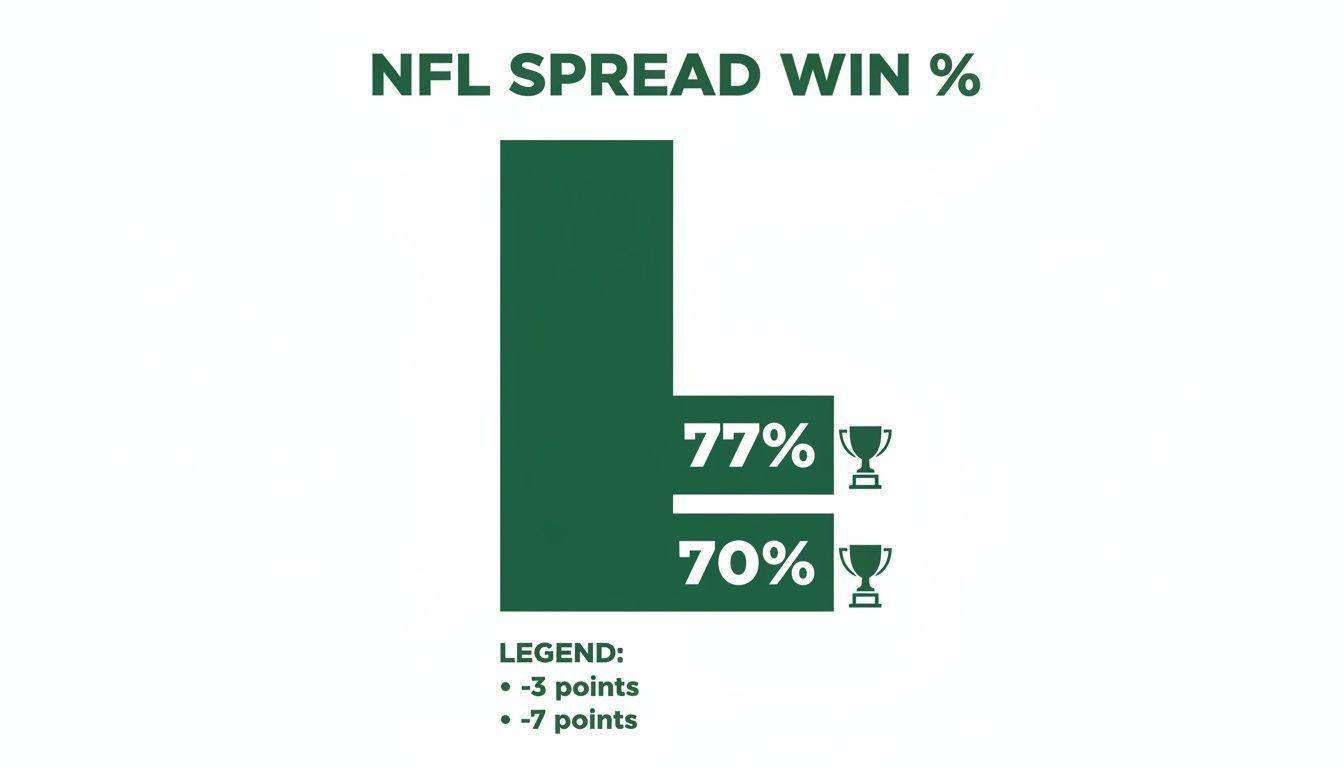
As you can see, favorites at exactly -3 and -7 have historically high win rates, making these numbers absolutely pivotal when you're sizing up a bet.
Exploring Alternate Lines and Teasers
Beyond the main spread, sportsbooks offer a few other ways to bet that give you more control over the numbers, though you'll usually have to pay a different price for it. The two most common options you'll see are alternate lines and teasers.
This table breaks down the essentials of these betting variants, giving you a quick look at how they work and when you might consider using them.
Spread Betting Variants Explained
| Bet Type | How It Works | Pros | Cons |
|---|---|---|---|
| Alternate Lines | You "buy" or "sell" points to move the spread. For example, moving a -7.5 favorite down to -6.5. | Gives you more control and lets you cross key numbers to improve your chances of winning. | Comes at a cost. You'll get a worse payout (e.g., -130 instead of -110) for the improved line. |
| Teasers | You combine two or more spread bets into a parlay but get to move the line significantly in your favor on all legs. | Makes each individual bet much easier to win. A common 6-point teaser can turn a -7.5 line into -1.5. | You must win every single leg of the teaser to cash out, and the overall payout is much lower than a standard parlay. |
The main takeaway here is that you're always making a trade-off. You're swapping a better chance of winning for a smaller payout. This is only a smart move when moving the line across those key numbers of 3 and 7 gives you a clear and significant statistical advantage.
The Strategy of Fading the Public
As we've covered, the general betting public absolutely loves favorites, popular "brand name" teams, and betting the "over." This predictable behavior often creates lopsided action, forcing sportsbooks to move their lines to limit their financial risk. This is where the powerful strategy of fading the public comes into play.
Fading the public is exactly what it sounds like: betting against the overwhelming popular opinion. If 80% of the bets are pouring in on the Dallas Cowboys at -7, a contrarian bettor might see value in taking the underdog at +7, believing the line has been pushed too high by all the public hype.
This strategy works because it capitalizes on the market overreacting to popular sentiment instead of cold, hard analysis. Historical data shows just how often underdogs beat these lines. For example, on a tight spread of 1.5 points, underdogs have covered 43.4% of the time. But when spreads get wider, they have a tougher time; at 9.5 points, they cover just 12.5% of the time. You can dig into how underdogs perform at every single spread with the full historical NFL odds data.
Bankroll Management: The Ultimate Strategy
No strategy, no matter how clever, can work without a solid foundation of disciplined bankroll management. This is, without a doubt, the single most important factor for long-term success. It simply means setting aside a specific amount of money just for betting and only risking a small, fixed percentage of it on any single game.
A solid rule of thumb is to bet between 1-3% of your total bankroll on any given wager. This flat-betting approach ensures that an unlucky losing streak won't wipe you out. More importantly, it keeps emotional decisions, like chasing your losses after a bad beat, from destroying your discipline. Your betting strategy can be perfect, but without managing your money, you're just setting yourself up to fail.
Costly Mistakes to Avoid When Betting Spreads
Knowing how to read and bet on football spreads is a great start, but the real path to long-term success often comes from knowing what not to do. It's almost a rite of passage for new bettors to fall into a few predictable traps that can drain a bankroll and turn a fun hobby into a frustrating mess.
Honestly, avoiding these common slip-ups is just as crucial as any winning strategy you could develop.
One of the first and most common errors is blindly betting on favorites. It just feels right to back the better team, doesn't it? But sportsbooks are experts in human psychology and bake that instinct right into the spread. The whole point of the point spread is to act as an equalizer, meaning the favorite has to perform way better than their opponent just to cash your ticket. Just winning the game is almost never enough.
Another major blind spot is ignoring the impact of the "juice" or "vig." That standard -110 you see everywhere means you're risking more than you stand to win on every single bet. This quietly stacks the deck against you, creating a surprisingly high bar for profitability. You have to nail roughly 52.4% of your spread bets just to break even. Forgetting about this built-in commission gives you a totally false sense of how well you're actually doing.
Emotional and Financial Pitfalls
The emotional rollercoaster of betting can easily become your worst enemy. A classic, bankroll-killing mistake is "chasing losses," where you try to instantly win back money from a bad beat by making bigger, more impulsive bets. This almost always ends in a train wreck because you're no longer thinking clearly; you're just reacting to frustration.
Discipline is the bedrock of successful spread betting. It's not about one big win; it's about making consistently smart, unemotional decisions that protect your bankroll and give your strategies time to work.
Finally, even the sharpest betting analysis in the world will be undone by poor money management. Two mistakes, in particular, will wipe you out faster than anything else:
- Betting on Too Many Games: Spreading your money thinly across the entire slate of games is a guaranteed recipe for disaster. It's far, far better to focus your energy on a few handpicked matchups where you feel you have a genuine analytical edge.
- Wagering Too Much Per Game: Firing off a huge percentage of your bankroll on a single game is like playing Russian roulette. Even a short, unlucky losing streak which will happen to everyone, can knock you out of the game completely.
By steering clear of these common traps, you start to build a disciplined framework for betting. This is the stuff that takes you from simply making picks to truly understanding how football spreads explained at a level that can lead to sustainable success.
A Few Final Questions About Football Spreads
Even after covering the basics and diving into strategy, a few questions always seem to pop up. Let's tackle some of the most common ones bettors have, making sure you have a rock-solid foundation for how spreads work in the real world.
What Does -110 Mean in Betting?
That -110 you see next to almost every spread is the price of your bet. Think of it as the commission, or "juice," the sportsbook charges to take your action.
In simple terms, it means you have to risk $110 to win $100 in profit. This slight premium is how the bookmaker ensures they make money, regardless of which team wins or covers.
Can a Point Spread Change After I Bet?
Absolutely. Point spreads are constantly moving in response to betting action and new information. But here's the crucial part: your bet is always locked in at the number you wagered on.
If you bet a team at +7.5 and the line shifts to +6.5 an hour later, your ticket is still graded against that original +7.5 spread. When the line moves in your favor like that, it's called getting "closing line value," a key indicator of a sharp bet.
What happens if the final score lands exactly on the spread? That's called a "push." For example, if you bet a team at -7 and they win by exactly 7 points, the bet is a tie. Your original stake is simply refunded to your account, no harm, no foul.
Why Do Some Spreads Have a Half-Point?
Sportsbooks love using half-points (like 3.5 or 7.5) for one simple reason: it guarantees a result. That little half-point, often called a "hook," completely eliminates the possibility of a push.
By using a hook, every bet is guaranteed to be either a win or a loss. It's their way of ensuring there's a decisive outcome on every single wager they take.
Is It Better to Bet on the Favorite or the Underdog?
This is the million-dollar question, but the answer is neither. There's no universal rule that one side is "better" than the other. Value can be found on both favorites and underdogs; it all depends on the matchup and, most importantly, the accuracy of the point spread itself.
Successful betting isn't about just picking one side. It’s about finding situations where the line doesn't quite match a team's real potential.
For instance, sometimes the public will hammer a popular favorite, pushing the line higher and higher. In those spots, the real value is often on the underdog, who now has an inflated number of points to work with. It always comes down to finding a gap between the market's price and your own analysis.
Ready to stop guessing and start finding real value in football spreads? ValueBetFactory uses powerful tools to scan the market for odds discrepancies, sending you alerts when profitable opportunities arise. Move beyond the basics and make data-driven decisions. Explore our platform and see the difference at ValueBetFactory.