
Mastering Betting Line Movement
Unlock Profits with betting tips!
Ever watched the odds for a big game bounce around all week and wondered what's going on? That's betting line movement in action. It’s not just random fluctuation; it's the sportsbook's direct response to market forces, a lot like how a stock price reacts to company news.
Every shift in the odds tells a story, and learning to read it is a game-changer.
Why Betting Lines Move and What It Means for You
Think of the opening line as the oddsmaker's first draft of a prediction. Once it's out there, it’s no longer just their opinion. It becomes a living number, pushed and pulled by two main things: money and information.
A sportsbook's primary goal isn't to perfectly predict the game's outcome. Their goal is to get roughly equal action on both sides of a bet. Why? Because if everyone bets on the Kansas City Chiefs and they cover the spread, the book takes a massive hit. To avoid that, they have to balance their books.
When too much money piles up on one side, they'll adjust the line—the point spread or the odds—to make the other side look more attractive. This is the heart of betting line movement: a constant, real-time effort to manage risk and lock in a profit, no matter who wins.
The Forces Behind the Shift
So, what exactly triggers these moves? While the reasons can be complex, they usually boil down to a handful of key drivers that every serious bettor needs to have on their radar.
- Public Betting Volume: This is the most frequent cause. When the general public overwhelmingly backs a popular team or a media darling, the books have to shift the line to encourage betting on the other side. It’s a simple case of supply and demand.
- Sharp Money: Professional bettors (or "sharps") are the whales of the sports betting world. They place large, informed wagers that sportsbooks take very seriously. A big bet from a known sharp can move a line instantly, often against the tide of public opinion.
- Key Information: This is the stuff that can completely change the complexion of a game overnight. A starting quarterback getting injured in practice, a sudden change in the weather forecast, or even a last-minute lineup scratch will force oddsmakers to make immediate adjustments.
This diagram helps visualize how these pieces fit together.
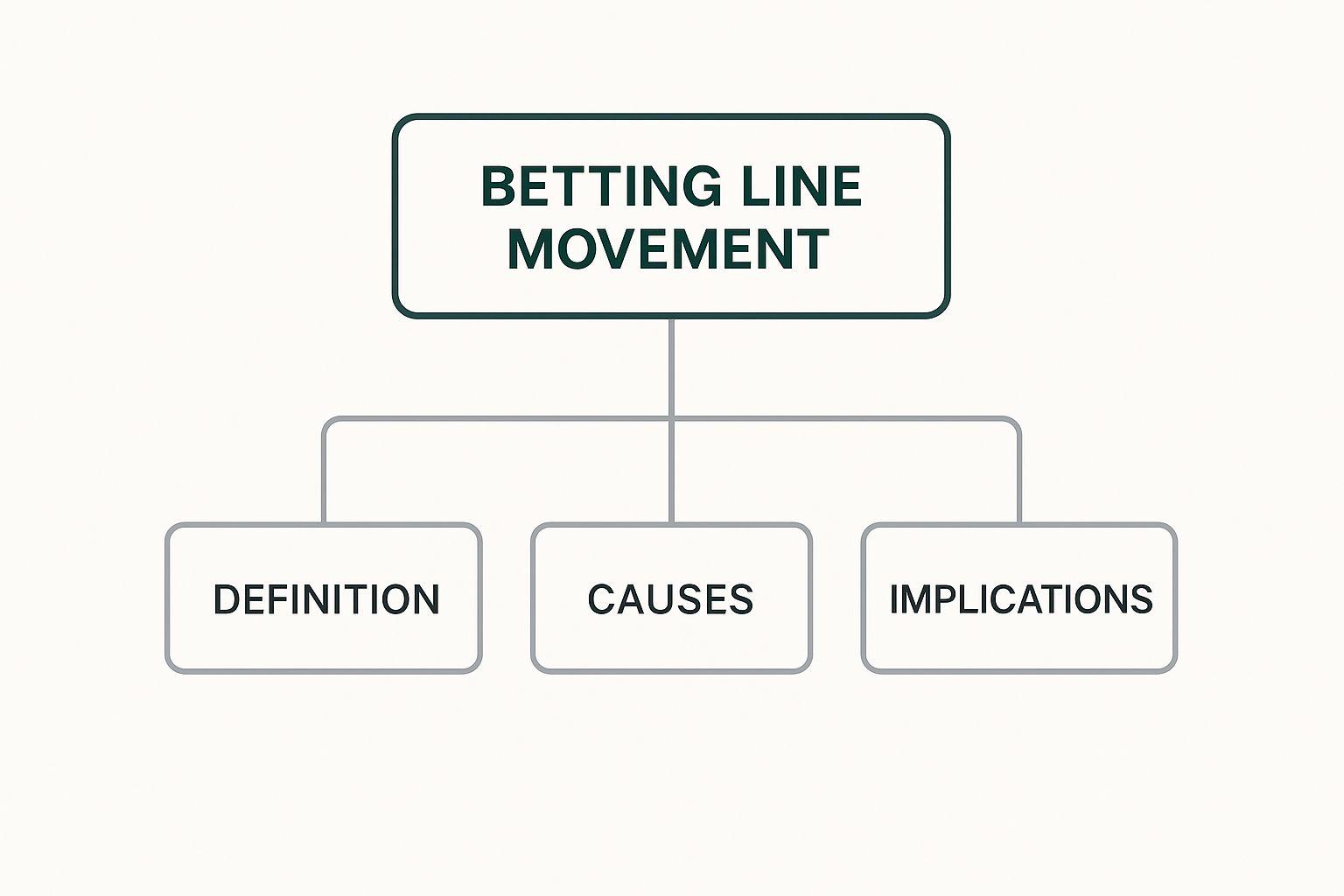
As you can see, the what, why, and how of line movement are all connected. Grasping this is the first step toward analyzing the market like a pro.
To help you get a quick handle on these concepts, here’s a breakdown of the main drivers.
Key Drivers of Betting Line Movement
| Driver | Description | Example |
|---|---|---|
| Public Betting Volume | A large number of casual bettors placing wagers on one side, often influenced by media hype. | The Green Bay Packers are a popular public team, so lines involving them often shift due to fan betting, not necessarily sharp action. |
| Sharp Money | Large, respected wagers from professional bettors who have a proven track record. | A line moving from -3 to -4.5 despite 75% of public bets being on the +3 underdog. This signals sharp money hit the favorite. |
| Key Information | New, game-altering developments that directly impact the probable outcome. | A star basketball player is ruled out with an ankle injury an hour before tip-off, causing the point spread to swing by 3 points. |
This table gives you a simple cheat sheet for understanding what might be behind any given line shift.
Reading Between the Lines
Figuring out why a line is moving is where you start finding an edge. It’s a direct signal from the market. While studies suggest that public betting patterns influence around 70% of line movements, it's the other 30%—driven by things like injuries and, crucially, sharp money—that often present the best opportunities.
When a book moves a line, they’re trying to balance their risk. But for an observant bettor, that adjustment can open a window of value. You can dive deeper into historical line movement trends and what they reveal about market behavior.
By learning to tell the difference between a line moved by public hype and one shifted by smart money, you unlock a powerful advantage. For instance, a line that moves against the public betting percentages is one of the strongest indicators of where the professional money is headed. This skill is absolutely essential if you want to graduate from casual betting to consistently finding real value.
Decoding Sharp Money Versus Public Betting
When a line moves, the first question on any serious bettor’s mind is: why? Not all money is created equal in the eyes of a sportsbook, and figuring out who is pushing the line is the first step to understanding if there’s value to be found.
Broadly speaking, the market is a tug-of-war between two very different groups: the general public and the "sharps." Think of it as a popularity contest versus an expert's critique. The public votes with their hearts, while the sharps vote with their heads—and their wallets.
Understanding Public Money
Public money, sometimes called “square” money, is exactly what it sounds like: it’s the cash coming from casual, recreational bettors. These are your everyday fans who want to put a few bucks on their favorite team to make the game more exciting.
Their betting patterns are often driven by emotion, media headlines, and gut feelings, not cold, hard data.
- Big Names, Big Bets: Teams with massive fanbases like the Golden State Warriors or superstars like Patrick Mahomes will always attract a flood of public money, often regardless of the actual matchup.
- Following the Hype: If a team is on a hot streak and getting tons of airtime on ESPN, you can bet the public will be lining up to back them.
- Keeping it Simple: Most casual bettors stick to simple bets. They’ll take the favorite on the moneyline or bet the "over" because, let's face it, it's more fun to root for points.
When you see a line move because an insane 80% of all betting slips are on one side, that’s usually the public talking. Sportsbooks will adjust the odds to limit their exposure to such a lopsided consensus.
The Influence of Sharp Money
Now, sharp money is a different beast entirely. This is the money coming from professional bettors and sophisticated syndicates—the "wiseguys" who make a living finding edges in the market.
Sharps don't bet on a whim. Their wagers are calculated, strategic, and often very large. While they might place far fewer bets than the public, the sheer size of their wagers commands respect. To an oddsmaker, a single six-figure bet from a known sharp is far more significant than a thousand $20 bets from casual fans.
Sportsbooks treat sharp money as a powerful information source. When a respected professional places a huge wager, it sends a clear signal: our line might be wrong. The bookmakers will often move the line almost instantly, essentially correcting their numbers based on this expert opinion.
If you want to dive deeper into how the pros operate, check out our guide on what makes sharp bets so effective. It’s the key to learning how to read the market like they do.
How to Tell the Difference
So, how do you spot who’s behind a line move? The secret is to look beyond the ticket count and follow the money. Most sportsbooks provide data on both the percentage of bets and the percentage of the total money (handle) on each side.
The Public Money Signature: Imagine Team A is getting 75% of the bets, but only 55% of the money. This tells you that a huge number of small bets are on Team A (the public), while bigger, more calculated bets are coming in on the other side (the sharps).
The Sharp Money Signature: Now, consider this. Team B is only getting 30% of the bets, but a whopping 70% of the money. This is a classic tell. The public is all over their opponent, but the big-money players are quietly backing Team B. This situation is what creates reverse line movement—one of the most powerful signals in all of sports betting.
Reading the Patterns in Line Movement

This is where the rubber meets the road. Knowing why a line moves is the difference between guessing and making an educated bet. We’ve covered the basics of public versus sharp money, but now it’s time to look for repeatable patterns that scream opportunity. Two of the biggest are "fading the public" and the holy grail of line movement signals: "reverse line movement."
These aren't just buzzwords you hear thrown around on betting podcasts. They are legitimate strategies that work because they’re based on the predictable behavior of both casual bettors and the pros. Learning to spot them is like learning to read the market's secret language, helping you find value where everyone else just sees a number.
The Strategy of Fading the Public
"Fading the public" is exactly what it sounds like: you bet against the team getting all the public love. The logic here is simple. The general public often bets with their heart, swayed by media hype, star players, and a bias for popular franchises or betting the "over." They aren't digging into the analytics.
This herd mentality can push a line to a point where it no longer reflects reality. When you see that 80% or more of the betting tickets are on one side, sportsbooks have to adjust the line to protect themselves from a massive loss. That adjustment creates value on the other side. By betting against that lopsided public action, you’re often grabbing a line that's much better than it should be.
Key Insight: Fading the public isn't about blindly taking every underdog or unpopular team. It’s a targeted strike. You’re looking for spots where public opinion has clearly inflated a line, creating a value gap that sharp bettors are ready to pounce on.
Reverse Line Movement: The Ultimate Tell
Now for the most powerful indicator in sports betting: reverse line movement. This happens when the line moves in the opposite direction of the public betting percentages. It’s a massive contradiction that should make your ears perk up immediately.
Think about it like this:
- The Public Piles On: 80% of the bet slips are on the Green Bay Packers at -6.5.
- The Line Moves... Down? Despite all that action, the line drops to Packers -5.5.
Wait, what? The line should be moving to -7 or -7.5 to discourage more bets on the Packers. The fact that it went the other way is the ultimate tell. It means that while thousands of small, public bets are on the Packers, a few huge, respected bets—the sharp money—are hitting their opponent.
Sportsbooks respect a professional’s six-figure wager far more than a thousand $20 bets. They are essentially telling you, "The pros are on the other side, so we’re moving the line." Spotting this is like getting a cheat sheet from a professional syndicate.
A Framework for Tracking and Analysis
To catch these moves, you need to watch the lines from the moment they open. In the NFL, for example, studies show around 60% of final betting lines shift during the week, with an average move of about 1.5 points. This constant movement tells a story. You can see how NFL odds trackers present this data to get a feel for the live market.
For example, this screenshot from an odds tracker shows a fairly balanced market for a Ravens vs. Bills game, with money coming in on both sides. But that can change in a heartbeat.
Any line movement greater than 3 points is a major event. It could be a key injury, but more often than not, it’s a sign of a massive influx of sharp money. When a line crosses key numbers in football like 3, 7, or 10, pay close attention. That's your signal to dig in, compare the ticket count to the money percentage, and figure out if you're seeing a public overreaction or a clear sign of reverse line movement. This is the framework for turning line movement into profitable decisions.
Turning Line Movement Analysis into Value Bets
Alright, so you’ve learned how to read the tea leaves. You can spot the difference between a line that’s drifted because of fan hype and one that’s been slammed into place by a pro with deep pockets. Now for the fun part: turning that knowledge into your biggest edge—finding and hitting real value bets.
This is the whole point of watching the lines. It's not some abstract exercise; it's a practical tool for spotting wagers where the odds are just plain wrong in your favor. A what is a value bet pops up when your handicapping tells you the real chance of something happening is better than what the bookie's odds suggest. Line movement is your treasure map.
When you boil it down, you can use line movement to sniff out value in two main ways. You either get in front of a market correction that the sharps are forcing, or you pounce on an overreaction fueled by the public.
Capitalizing on Sharp Action
Some of the most powerful value bets are found by tailing the pros. When a sharp bettor sees a busted opening line, they hit it. Hard and fast. This forces the sportsbook to scramble and adjust the number, sometimes in minutes. If you can figure out why they’re betting it and your own read on the game agrees, you can grab that value before the market corrects itself completely.
Picture this:
- An NFL team opens as a -2.5 point favorite.
- Within an hour, a flood of sharp money comes in on them, pushing the line to -3.5.
If your own work pointed to that team being the right side, getting your bet in at -2.5 or -3 was a golden opportunity. You locked in a number before it jumped over the most important number in football betting. The market, led by the pros, basically confirmed the opening line was soft.
Finding Value by Fading the Public
The other side of the coin is just as profitable: betting against public bias. The average joe loves betting favorites, big-name teams, and smashing the "over." It's predictable. This behavior often inflates lines as sportsbooks try to limit their risk against one-sided action. This is exactly where "fading the public" becomes a killer strategy.
When you see 85% of the betting public on one team, but the line barely budges—or worse, moves the other way (reverse line movement)—that’s the market screaming at you. It's telling you the real value is on the lonely underdog. The public has pushed the line to a point of inefficiency, creating the perfect spot for you to step in.
Actionable Strategies: When to Bet
Knowing why a line is moving is half the job. Knowing when to pull the trigger is the other half. Your timing can be the difference between a great price and a sucker's bet.
1. Bet Early to Capture Sharp Value
If your handicapping spots a weak opening line that you know the sharps will pounce on, you have to bet it. Now. This is common in smaller markets or early in the week for NFL games. You're trying to beat the professional money to the punch and lock in a number before it's gone for good.
2. Bet Late to Fade Public Overreactions
If your plan is to bet against a heavily-backed public team, patience is your friend. Public money usually pours in closer to game time, especially on weekends. As more and more casual bettors pile on one side, the line on the other side just gets sweeter. By waiting until an hour or so before kickoff, you can often get the absolute best number on the team you wanted all along.
Real-World Examples of Line Movement in Action
Theory is great, but let's be honest—seeing how betting line movement plays out in real games is where it all clicks. When you look back at games where the odds told a story before anyone even stepped on the field, you start to see a blueprint for smart betting.
These examples show how sharp money, public bias, and last-minute news can open up some incredible betting opportunities. Let's dig into a couple of classic scenarios.
Case Study 1: Spotting Reverse Line Movement (The "Sharp" Side)
This is the kind of stuff experienced bettors live for. Reverse line movement almost always pits a less-hyped team against a public favorite. Let's imagine a classic NFL matchup: the New York Jets are underdogs against the ever-popular Dallas Cowboys.
- Opening Line: Cowboys -7.5
- Public Betting: A whopping 82% of all bets are pouring in on the Cowboys to cover the spread. Everyone loves Dallas.
- The Movement: But wait. Despite all that public money on Dallas, the line drops from Cowboys -7.5 to -6.5.
What just happened? This is a massive red flag. The line moved against the public, which tells you one thing: big, respected bets from professional "sharp" bettors came in on the Jets +7.5. Sportsbooks respect that money far more than the casual fan's bet, so they adjust the line.
This is one of the most powerful signals you can find. When the line moves away from the team getting the most bets, it's a huge tell that the pros disagree with the public. That's your window of value.
Case Study 2: The Chaos of a Late Injury Report
Nothing sends a betting line into a tailspin faster than a last-minute injury to a star player, especially a quarterback. The market's reaction is immediate and dramatic, showing you just how much a single piece of information is worth.
Think back to a 2016 game between the Baltimore Ravens and Indianapolis Colts. The big question all week was whether Colts QB Andrew Luck would play. The uncertainty had the line bouncing around, but when he was officially ruled out right before the game, the market went into overdrive.
You can see how modern tools track these shifts, giving you a play-by-play of the odds.
The moment the news on Luck broke, the odds flew. The Colts, now without their star, jumped to +180 underdogs, while the Ravens became heavy -200 favorites. This huge betting line movement was a direct result of that one injury update. Bettors who were paying attention and acted fast could lock in value. You can see more examples of how breaking news affects the odds by checking out this in-depth analysis of NFL line movement.
By studying these real-world examples, you're not just learning theory; you're training your eyes to spot the narrative. Whether it’s the quiet confidence of sharp money or the loud panic of an injury, the story is always written in the numbers. Your job is to learn how to read it.
Of course. Here is the rewritten section, crafted to sound like an experienced human expert while preserving all the original content, links, and images.
Common Mistakes Bettors Make with Line Movement

Learning to read line movement is a game-changer, but it’s a double-edged sword. Get it right, and you can uncover some serious value. Get it wrong, and you’re just walking into traps set by the sportsbooks. Too many bettors get so wrapped up in why a line is moving that they completely forget the fundamentals of their own handicapping.
Let's be clear: line analysis is just one tool in your toolbox. It’s not a magic crystal ball. Relying on it alone is like a mechanic trying to fix a complex engine with nothing but a single wrench. To really make it work for you, you have to steer clear of the common pitfalls that trip up beginners and veterans alike.
Mistake 1: Overreacting to Every Minor Tick
This is, by far, the most common mistake I see. A line shifting from -110 to -115 isn't a seismic event that should send you into a panic. These tiny adjustments happen all day, every day. It's often just the bookmaker balancing their books or making a minor tweak.
If you treat every half-point move as a sign of some secret "sharp money" coming in, you're setting yourself up for failure. You’ll constantly second-guess your own research and make impulsive bets based on market noise instead of a real signal. The trick is to focus on significant moves, especially those that cross key numbers in a sport, like 3 or 7 in football.
The Bottom Line: Most small line moves are just that—small. A disciplined bettor learns to filter out the static and only pays attention when a shift is big enough to signal a genuine change in the market's thinking.
Mistake 2: Blindly Chasing Steam
"Chasing steam" is a classic rookie move. It's when you see a line moving fast because of a flood of professional money and you jump on the bandwagon. While it feels like you're betting with the pros, you're almost always too late to the party.
By the time you notice the steam move, the value is gone. The sharps might have snagged a team at -3.5, but by the time you bet, it's moved to -5.5. You're not getting their value; you're getting their overpriced leftovers.
Here’s why it’s a bad idea:
- You're Late to the Party: The real value has already been squeezed out of the line.
- You're Ignoring Your Own Research: You’re tossing your own analysis out the window to blindly follow the herd.
- The Line Can Be Overcorrected: Sometimes, heavy steam pushes a line too far, creating fantastic value on the other side.
Mistake 3: Misinterpreting the Cause of Movement
Not all line movement is created equal. A line can shift for a dozen different reasons, and assuming every big move is driven by sharp action is a critical mistake. A surprise scratch from a starting player, a sudden change in the weather forecast, or even just a wave of public money can move a line just as dramatically.
This is where your own homework becomes essential. If you see a line move, your first instinct shouldn't be to bet it—it should be to ask why. Did a key injury report just drop? Is the public hammering one side because of a popular narrative? Answering these questions first is crucial. For a deeper dive into building a more complete approach, check out our guide to sports betting strategy. The only way to build a sustainable edge is to combine different analytical methods, not just rely on one.
Got Questions? Let's Talk Line Movement
Alright, you've got the basics down, but let's be honest—this is where things get interesting and where the real questions pop up. It's one thing to know what line movement is, but it's another thing entirely to know what to do with it. Let's tackle some of the most common questions I hear from bettors.
What's the Big Deal with Reverse Line Movement?
This is the big one. Reverse line movement is probably the single most telling signal you can find in sports betting.
Here’s the scene: a whopping 75% of all the bets are pouring in on the New England Patriots. Logic says the sportsbook should make the Patriots an even bigger favorite to encourage action on the other side, right? But instead, the line moves the other way—making the Patriots a smaller favorite. It's completely counterintuitive.
That's reverse line movement. It happens because while the public is busy placing dozens of small bets, a handful of sharp, high-rolling bettors have quietly dropped a truckload of cash on the opponent. Sportsbooks are terrified of these guys—they respect their opinion far more than the casual fan's. So, they move the line to follow the "smart money," not the public money.
The Bottom Line: When you spot reverse line movement, it's like a pro just tapped you on the shoulder and whispered, "Hey, the crowd's on the wrong team."
What Are the Best Free Tools for Watching the Lines?
You don't have to break the bank to track line movement like a pro. In fact, some of the best tools out there are completely free and give you a fantastic window into how the market is behaving.
If you're looking to get started, here are a few of my go-to resources:
- The Action Network: This is a fantastic all-in-one spot. They give you odds from tons of sportsbooks and, crucially, show you the public betting percentages for both the percentage of bets and the percentage of money.
- VSiN (Vegas Stats & Information Network): Want to know what the folks in Vegas are thinking? VSiN gives you live odds and analysis straight from the source, which is perfect for seeing how the market is reacting in real-time.
- ScoresAndOdds: This is an old-school, reliable site. It’s a no-frills way to see line histories and public betting data for pretty much any sport you can think of.
Playing around with these tools will help you see how a line evolves from its opening number right up until game time. That's how you start spotting the patterns that matter.
Should I Bet Every Time the Line Moves?
No. Absolutely, positively not. This is probably the most common rookie mistake.
Chasing every little tick in the line is a surefire way to drive yourself crazy and drain your bankroll. Most tiny movements are just the sportsbook balancing their books or reacting to minor news—it's just market noise.
Your betting strategy should always start with your own research. Do your homework first. Then, use line movement as a tool to either confirm your confidence in a bet or challenge your assumptions. A significant line shift, especially a reverse line move, isn't a command to bet. It's a signal to stop and ask, "What do the sharps know that I don't?"
At ValueBetFactory, we do the heavy lifting for you by using sophisticated tools to scan for these exact market signals. Our system flags real-time line movements and betting data to alert you to potential value bets, so you can make smarter, data-backed decisions. Find your edge with us today.