
Convert Odds to Probability: A Simple Bettor's Guide
Unlock Profits with betting tips!
To find real value in betting, you first have to learn the language of the bookmakers. Converting their odds into a simple percentage—what we call implied probability—is the most fundamental skill you can develop. It’s how you translate those seemingly random numbers into a clear, actionable assessment of what the market thinks will happen.
Why Converting Odds to Probability Is a Game Changer
Before we get into the nitty-gritty of the formulas, let's talk about why this is so important. This isn't just a math exercise; it's about seeing the story behind the numbers. When you convert odds, you're essentially decoding the bookie's opinion on an event.
This skill is about mastering implied probability. That's the chance of an outcome occurring as suggested by the odds. It creates a baseline for your own analysis. For instance, if your research tells you a team has a 60% shot at winning, but the bookie's odds only imply a 50% chance, you’ve just uncovered a potential edge.
This is the absolute first step in learning what a value bet is. Without this conversion, you’re just guessing.
The logic here goes far beyond the sportsbook, too. It’s the same kind of risk assessment used in other high-stakes fields:
- Finance: Traders evaluate a stock's potential by comparing market odds to their own analysis.
- Business Strategy: Companies assess the probability of a competitor making a certain move to inform their own decisions.
Ultimately, this skill transforms you from a passive punter into an active analyst. Instead of just taking the prices you’re given, you start questioning them. You can critically evaluate whether the odds truly reflect reality, giving you a massive advantage and helping you make decisions based on data, not just a gut feeling.
How to Convert Fractional Odds to Probability
If you've ever looked at UK horse racing or futures markets, you've seen fractional odds. They tell you exactly what your profit will be relative to your stake. For instance, odds of 5/2 mean you’ll profit $5 for every $2 you bet. But to really understand the value on offer, you need to translate those fractions into probability.
Luckily, the math is simple. It all comes down to one little formula:
Probability = Denominator / (Numerator + Denominator)
Let's break down how to use it.
Odds Against vs. Odds On
You'll typically run into two kinds of fractional odds, and it's good to know the lingo.
- Odds Against: This is when the numerator is bigger than the denominator, like 9/4. It signals an underdog—an outcome with a higher payout because it's considered less likely to happen.
- Odds On: Here, the numerator is smaller than the denominator, like 4/9. This is your favorite, the outcome the bookmaker thinks has the best chance of winning.
The great thing is, the formula works the same for both. Imagine you’re looking at a horse in the Grand National priced at 9/4. To find its implied probability, you just plug the numbers in:
4 / (9 + 4) = 4 / 13 = 30.77%
Now, let's take a heavy favorite in a Premier League match priced at 4/9. The process is identical:
9 / (4 + 9) = 9 / 13 = 69.23%
This kind of quick mental math is your first line of defense against a bad bet. If your own analysis tells you a team's real chance of winning is closer to 80%, but the odds only imply a 69% probability, you've just spotted a potential value bet.
This simple conversion process is key to moving from just reading odds to actually understanding them.
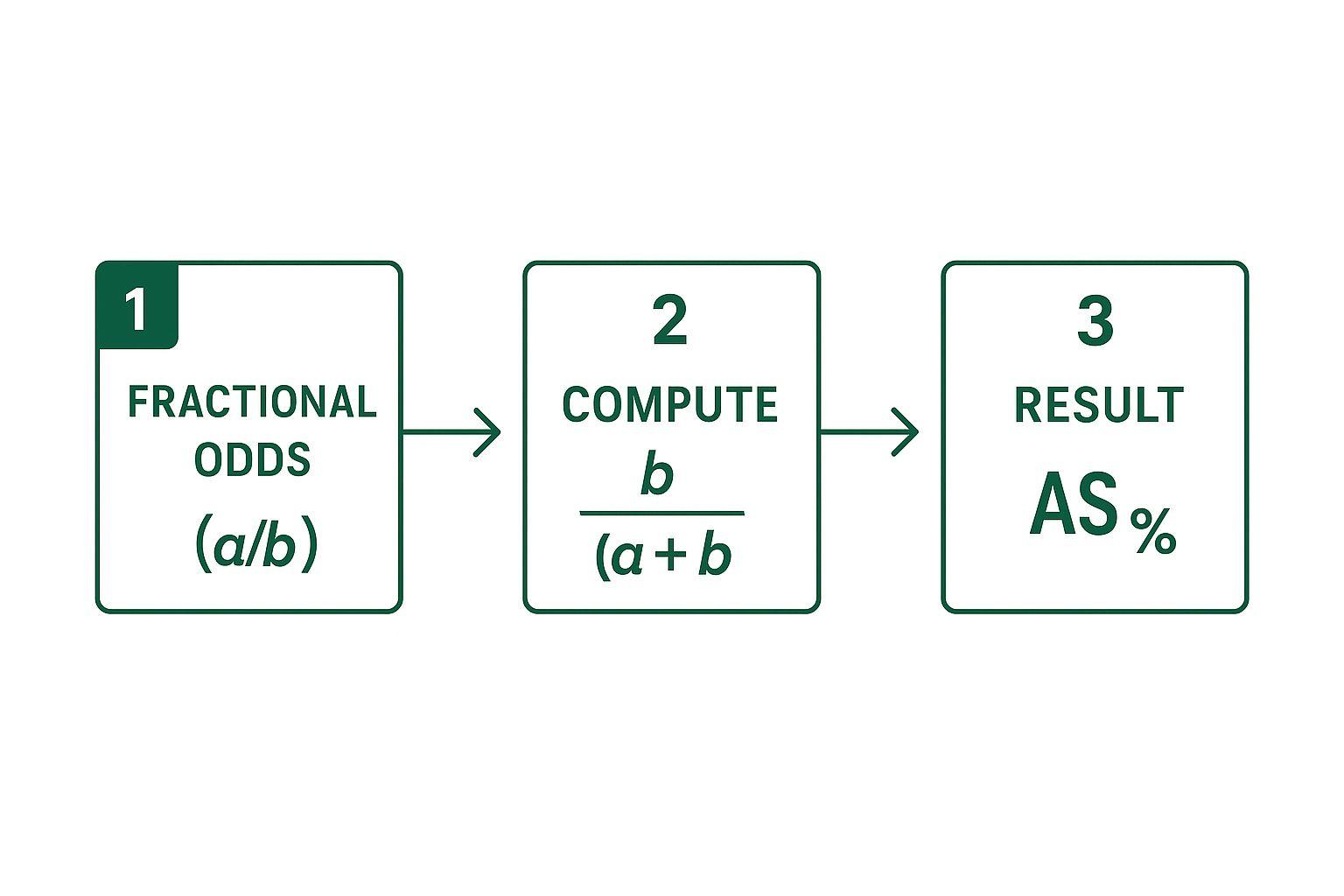
Seeing it visually really helps lock the steps in your memory. Once you get the hang of this calculation, you can instantly turn any fractional price into a clear percentage. That means you're making faster, sharper decisions without needing to constantly pull out a calculator.
Converting Decimal Odds: The Easiest Path to Probability
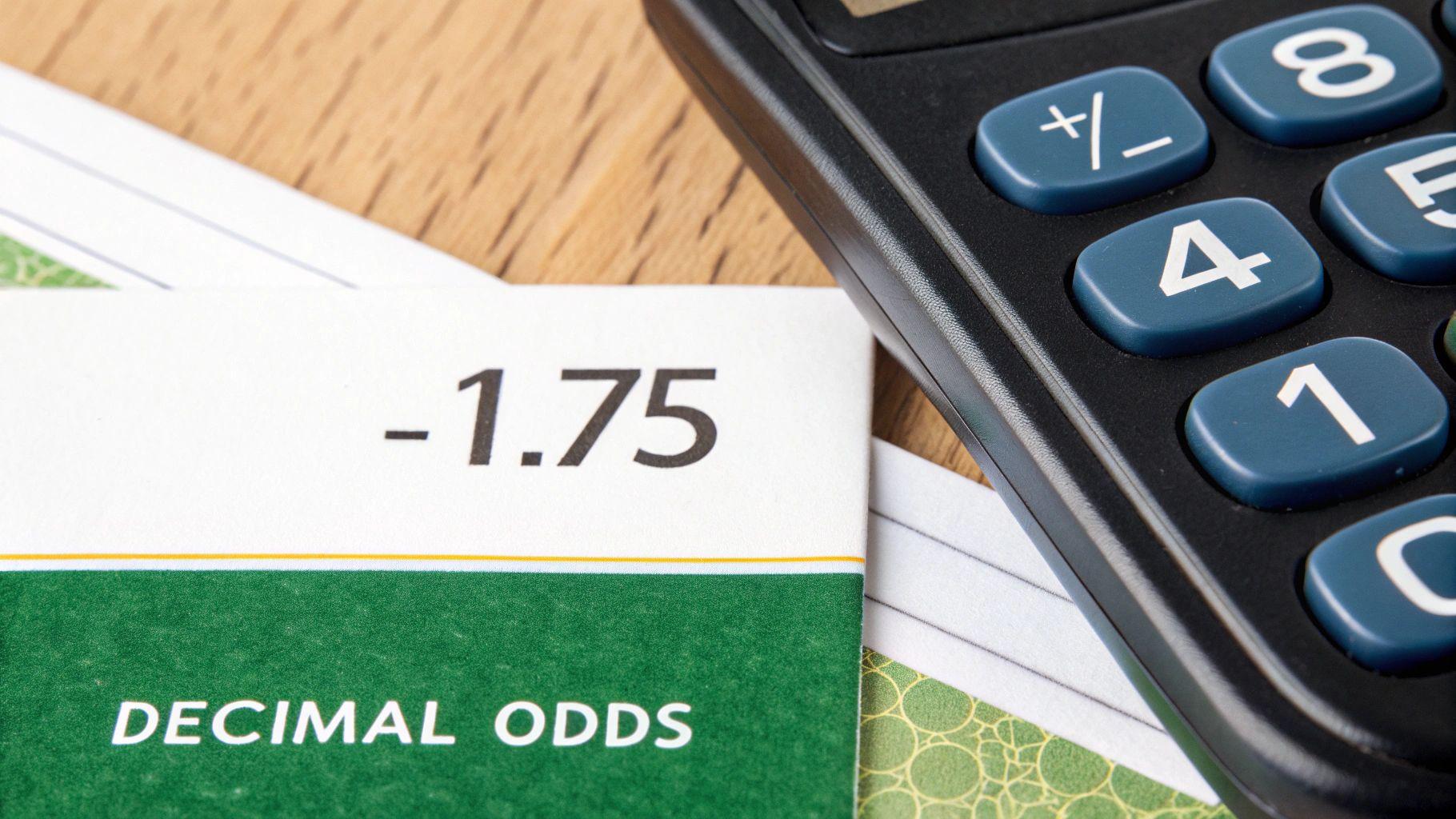
If you've spent any time on European, Canadian, or Australian betting sites, you've seen decimal odds. There's a good reason they're so popular: they are, by far, the most straightforward format for understanding a bet's probability. The conversion is a clean, one-step calculation you can often do in your head.
The formula is elegantly simple.
Implied Probability = 1 / Decimal Odds
That’s all there is to it. This little piece of math instantly tells you the probability the bookmaker is assigning to that particular outcome.
Putting the Formula to Work
Let's walk through a few real-world examples to see just how easy this is.
Imagine you're looking at a tennis match, and one player is priced at 1.75 to win. To figure out the implied probability, you just plug it into the formula:
- 1 / 1.75 = 0.5714
This translates to a 57.14% chance of winning, according to the bookie.
What about a slight underdog? Say a soccer team is listed at 2.50 to win their match.
- 1 / 2.50 = 0.40
That's a clean 40.00% implied probability.
Even with longshots, the math stays simple. A horse at 5.00 to win a race has an implied probability of:
- 1 / 5.00 = 0.20
Or a 20.00% chance.
This is precisely why so many experienced bettors prefer decimals. You can glance at a line and get an immediate feel for the numbers, making it much faster to compare odds across different sportsbooks. If you're ever in doubt, you can always double-check your work with an odds to percentage calculator for a quick confirmation.
Here's a pro tip: Always remember that decimal odds represent the total return, not just the profit. A $10 bet at 1.75 odds will pay back $17.50. That’s your original $10 stake plus $7.50 in profit. This is a crucial distinction from fractional odds, which only show the profit part.
Getting comfortable with this quick conversion is a fundamental skill for any serious bettor. It gives you the power to look past the numbers and see the probability story the bookmaker is telling, which is the first step to finding real value.
Decoding American Moneyline Odds
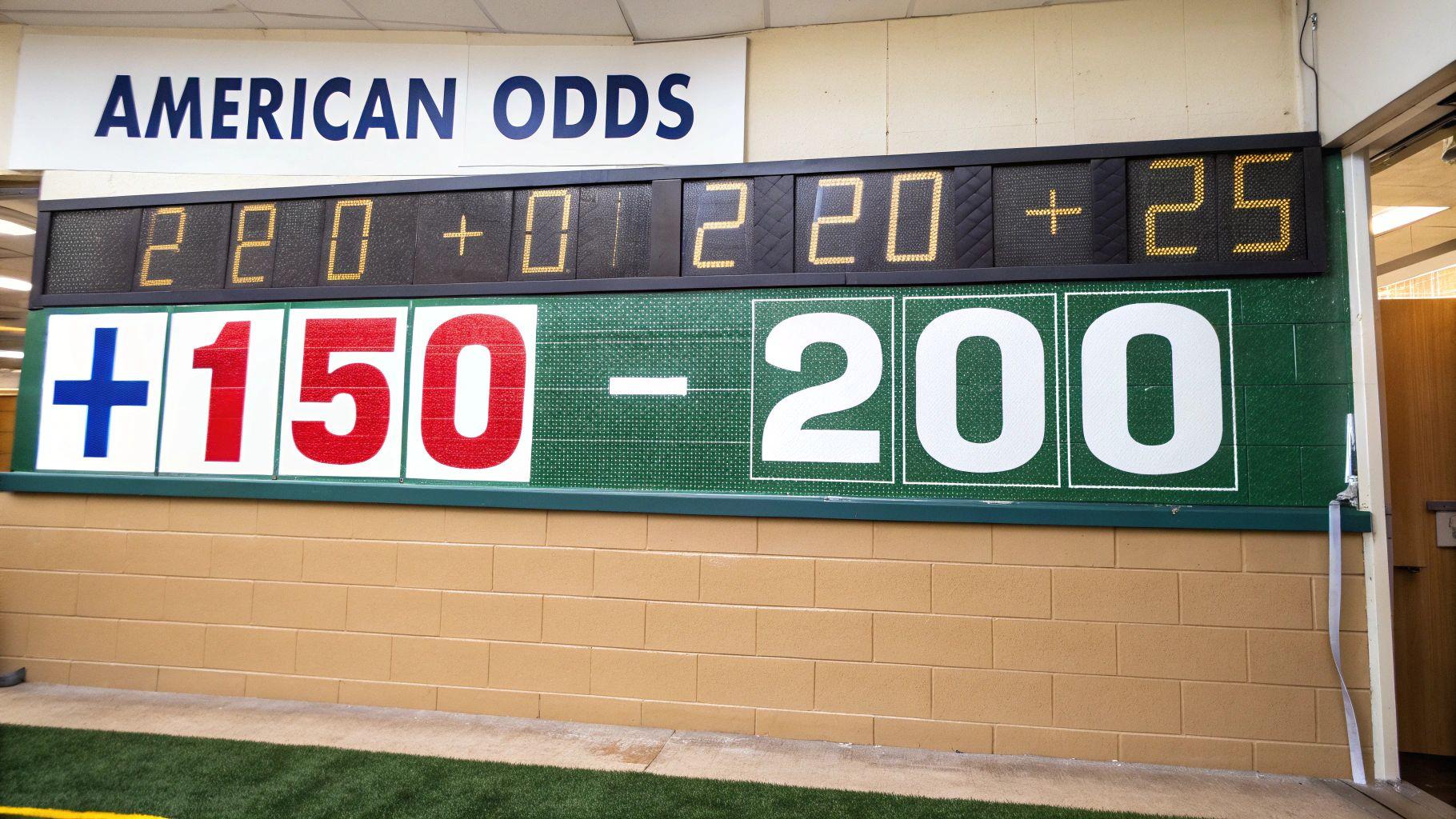
American odds, with their plus (+) and minus (-) signs, can look a bit confusing if you're new to them. But once you get the hang of it, they're actually quite simple. The key is knowing that you need a different formula depending on whether you're looking at the favorite or the underdog.
The plus and minus signs are your roadmap. A minus sign (-) always points to the favorite, while a plus sign (+) identifies the underdog.
How to Calculate for the Underdog (Positive Odds)
When you see a + sign next to a number, like a team at +220, you're looking at the underdog. This number tells you how much profit you'd make on a $100 bet. To turn this into a probability, the math is pretty straightforward.
Here's the formula: Implied Probability = 100 / (Odds + 100)
Let’s take an NBA game where the visiting team is listed at +220. Plugging that into the formula, you get: 100 / (220 + 100) = 100 / 320 = 31.25%
So, the oddsmaker is essentially saying that team has a 31.25% chance of pulling off the upset.
How to Calculate for the Favorite (Negative Odds)
For the favorite, you'll see a - sign, something like -180. This number shows how much you need to risk to win $100. The formula for converting these odds is a bit different.
Here it is: Implied Probability = |Odds| / (|Odds| + 100)
You'll notice the absolute value bars (| |), which just means you drop the minus sign and treat the number as a positive. For an NFL favorite at -180, the calculation looks like this: 180 / (180 + 100) = 180 / 280 = 64.29%
This tells us the bookmaker has priced the favorite with a 64.29% chance to win.
Converting betting odds into these percentages is a fundamental skill. It's how you can cut through the noise and see what the market truly thinks about an outcome. Whether you're dealing with American, fractional, or decimal odds, understanding this translation helps you compare odds and spot where there might be value. You can find more great information on the math behind betting odds at Investopedia.
Expert Tip: Mastering these two simple formulas is a game-changer. It allows you to instantly turn any American moneyline into a clear percentage. This empowers you to quickly gauge the market's expectation and see how it stacks up against your own research.
American Odds Conversion Cheat Sheet
To make things even easier, here's a quick reference table. It’s perfect for getting a feel for these conversions without having to pull out a calculator every time.
| American Odds | Formula Used | Implied Probability |
|---|---|---|
| +300 | 100 / (300 + 100) | 25.00% |
| +150 | 100 / (150 + 100) | 40.00% |
| -110 | 110 / (110 + 100) | 52.38% |
| -250 | 250 / (250 + 100) | 71.43% |
Keep this handy, and soon enough, these conversions will become second nature, giving you a much deeper understanding of the odds you're seeing.
Comparing Odds to Uncover True Probability
Once you get the hang of converting odds into probabilities, you’ve unlocked the first level of smart betting. The real game, however, is using that skill to compare what different sportsbooks are offering and to truly understand the story the numbers are telling.
Every set of odds has a built-in commission for the house, which you'll hear called the vigorish or "vig." This is precisely why the implied probabilities for all outcomes in a single event will always add up to more than 100%. Learning to strip out that vig is how you get closer to an outcome's "true" probability.
Spotting Value Across Different Formats
Let's put this into a real-world scenario. Imagine a huge championship game is just around the corner. You'll likely see odds posted in all three formats across various betting sites, which is a golden opportunity to hunt for the best line.
After doing your own homework on the matchup, you might find the following:
- Bookmaker A (American): Offers the favorite at -150, which translates to a 60% implied probability.
- Bookmaker B (Decimal): Prices that same team at 1.62, giving it a 61.7% implied probability.
- Bookmaker C (Fractional): Lists the team at 3/5, implying a 62.5% probability.
By quickly converting each format into a simple percentage, it's immediately obvious that Bookmaker A is offering the most value on the favorite. This is where you graduate from just converting numbers to actively shopping for the best lines.
When you can compare a bookmaker's implied probability against your own assessment of a team's actual chances, you start spotting value bets—those moments where the price just doesn't seem to match reality. This is the absolute cornerstone of long-term profitable betting.
Mastering this skill opens the door to more advanced strategies. For anyone ready to dig deeper, our guide on how to calculate expected value will teach you how to assign a tangible monetary value to every bet you consider.
One last piece of advice: always check your math. Doing the calculations by hand is an excellent skill to build, but using a reliable online odds converter can save you from simple mistakes that can be surprisingly costly. In betting, consistency and accuracy are what separate the pros from the pack.
Common Questions About Converting Odds
Once you get a feel for the formulas, you’ll probably still have a few lingering questions. That’s perfectly normal. Let's tackle some of the most common things people ask when they're first learning to translate odds into probability.
Why Do the Probabilities Add Up to More Than 100%?
This is a great question because it cuts right to the heart of how bookmakers make their money. That extra bit you see—the amount over 100%—is the bookie's margin. It’s also known as the vigorish or "vig."
Think of it as their built-in profit guarantee, ensuring they make money regardless of the outcome. By slightly inflating the implied probabilities for all possible outcomes, the total inevitably creeps past 100%. A crucial skill for any serious bettor is learning how to spot and account for this vig to get a clearer picture of an event's true probability.
Which Odds Format Is Actually the Best?
Honestly, there's no single "best" format. It really comes down to what you find most intuitive and what region you're betting in. Many bettors, especially in Europe, gravitate toward decimal odds because the math is so straightforward—just a simple division (1 / decimal odds) gets you the probability.
That said, fractional odds are woven into the very fabric of UK horse racing, while American odds are the default for pretty much any U.S. sportsbook. The smartest move is to get comfortable with all three. That way, you can instantly read and compare odds from any source without missing a beat.
The goal isn't to master just one format. It's to understand that they're all different languages telling the same story about probability. You just need to become a fluent translator.
Can I Use These Formulas for Anything Besides Sports?
Absolutely. The math for turning odds into probability is a universal principle of risk assessment. It’s a foundational skill that shows up in all sorts of fields far beyond the sportsbook.
You can apply these exact same formulas to understand likelihood in areas like:
- Financial Markets: Assessing the probability of a stock hitting a certain price.
- Statistical Analysis: Interpreting data in scientific research.
- Insurance: Calculating the risk of a specific event occurring.
Anytime you see odds used to describe the chance of something happening, these conversion methods are your key to unlocking what those numbers really mean.
At ValueBetFactory, we provide the tools and expertise to help you turn these probabilities into real, actionable insights. Our platform is designed to help you spot market discrepancies and find potential value bets as they appear. Start making more informed decisions today.