
Understanding the Point Spread in Betting
Unlock Profits with betting tips!
Think of the point spread as the great equalizer in sports betting. At its core, it's a handicap that sportsbooks create to level the playing field between two teams, making a bet on either side a compelling proposition.
It’s essentially a head start for the underdog.
What Does the Point Spread Actually Mean?
Let's use a simple analogy. Imagine a race between an Olympic sprinter and your average high school track athlete. To make it a fair contest, you’d give the high schooler a head start, right? The point spread does the exact same thing, just with points instead of distance. It's a number oddsmakers set to balance the odds between two mismatched teams.
This balancing act is what makes spread betting so popular. If it didn't exist, everyone would just pile their money on the stronger team to win every time, which isn't a viable business model for a sportsbook. The spread introduces a new puzzle to solve.
Favorites and Underdogs Explained
When you look at a betting line, you'll immediately notice two distinct roles: the favorite and the underdog. Spotting them is easy once you know what to look for.
- The Favorite: This is the team oddsmakers expect to win. You'll know them by the minus sign (-) next to their number, like -7. This means they need to win the game by more than 7 points for your bet to cash. Think of it as them "giving" points away to the other team.
- The Underdog: This is the team expected to lose. Their spread is marked with a plus sign (+), such as +7. If you bet on the underdog, you win if they either pull off an upset and win the game outright, or if they lose by fewer than 7 points. They're getting a cushion.
This system creates a totally separate outcome to bet on, one that’s completely independent of who actually wins or loses the game on the scoreboard.
The Goal is Covering the Spread
This brings us to the most important concept in all of this: covering the spread. Your goal isn't just to pick the winner of the game. It's to pick the team that will beat the number set by the sportsbook.
For a favorite to "cover," they must win by a margin greater than the point spread. For an underdog to "cover," they must either win the game or lose by a margin smaller than the point spread.
So, if the favorite wins the game but doesn't beat the spread, a bet on them is still a loss. For example, a team favored by -7.5 points might win by a single touchdown (7 points). They won the game, but they failed to cover the spread, and anyone who bet on them lost. That single dynamic is the heart and soul of point spread betting.
The Surprising History of the Point Spread
The point spread wasn't dreamed up in some flashy Las Vegas boardroom. Its roots are far more practical, born out of a simple math problem that plagued bookmakers for years. Before the spread existed, betting was a straightforward but broken system: you just picked a winner.
This created a massive headache for bookies when one team was a heavy favorite. Think about a powerhouse team playing a struggling one. Why would anyone risk their hard-earned money on the clear underdog? This led to completely lopsided betting, with almost all the cash on one side, which was a huge financial risk for the house.
The Math Teacher's Clever Solution
The big breakthrough came from a rather unexpected place. While the concept had been floating around, it was Charles K. McNeil, a Chicago mathematics teacher turned bookmaker, who really popularized the point spread in the 1940s. His idea was pure genius in its simplicity: create a handicap to even the odds.
By giving the underdog a head start (the "points"), he made betting on them a genuinely appealing proposition. This system became the lifeblood of sports wagering, allowing bookmakers to get balanced money on both teams and minimize their risk. You can dive deeper into the origins of sports betting history over at DocSports.com.
This wasn't just a minor adjustment; it completely changed the game. It turned a predictable blowout into an exciting 50/50 proposition for bettors.
The point spread was born out of necessity. It was a tool designed to solve a business problem: how to generate balanced betting on an unbalanced game. This simple idea made betting on favorites a challenge and betting on underdogs a viable strategy.
The Spread Goes National
McNeil's timing couldn't have been more perfect. Just as his invention was taking hold, televised sports were exploding in popularity across the United States. With more eyes on the games came a bigger demand for a consistent way to bet on them, and the point spread was the ideal solution.
It quickly became a universal language for bettors everywhere. A fan in New York and another in Los Angeles could now bet on the same game with the exact same handicap, creating a national market. Understanding this history is crucial because it shows the point spread isn't just a number. It’s the foundational tool that built the modern sports betting industry.
How to Read a Point Spread Like a Pro
Now that we've covered the what and why of the point spread, it's time to get practical. Let's look at how to decode a real betting line. At first glance, the jumble of numbers and symbols can feel like a foreign language, but I promise it's simple once you know what to look for.
Let's use a classic NFL matchup to break it all down. Imagine you log into your sportsbook and see this:
- Kansas City Chiefs -7.5 (-110)
- Denver Broncos +7.5 (-110)
This single line gives you three critical pieces of information for each team: who they are, their point spread, and the price of the bet.
Breaking Down the Numbers
The first thing most people notice is the spread itself. For the Chiefs, you see -7.5. That minus sign (-) is the universal symbol for the favorite. It means they are expected to win, and the sportsbook is "giving" or "laying" 7.5 points.
On the other side, the Broncos have a +7.5. The plus sign (+) always marks the underdog. They're not expected to win, so the sportsbook is "getting" 7.5 points as a head start.
The other number, (-110), is what's known as the odds or, more commonly, the juice or vigorish. This has nothing to do with the points on the field; it’s simply the sportsbook’s commission. Think of it as their fee for taking your action.
The standard juice of -110 means you have to bet $110 to win $100. That extra $10 is the bookmaker's built-in profit margin, ensuring they make money no matter which team wins against the spread.
What It Takes to Win
Knowing the parts is one thing, but understanding what needs to happen for your bet to cash is what really matters. To make it perfectly clear, let's lay out our example in a table that shows the path to victory for both sides.
Decoding an NFL Point Spread Example
This table breaks down a typical NFL betting line to show what each number means for the favorite and the underdog.
| Team | Point Spread | Odds (Juice) | What This Means to Win Your Bet |
|---|---|---|---|
| Kansas City Chiefs | -7.5 | -110 | The Chiefs must win the game by 8 points or more. |
| Denver Broncos | +7.5 | -110 | The Broncos must win the game outright OR lose by 7 points or fewer. |
See how that works? For a bet on the Chiefs to win, they don't just have to beat the Broncos. They have to beat them by more than the spread. For a Broncos bet to cash, they can either pull off the upset and win, or just keep the game close. This dynamic is the heart of what makes point spread betting so engaging. Learning how does point spread betting work is all about grasping this core relationship between the handicap and the final score.
The chart below gives you a sense of how often favorites and underdogs actually "cover" the spread. It’s a great visual for understanding just how effective these lines are at balancing the action.
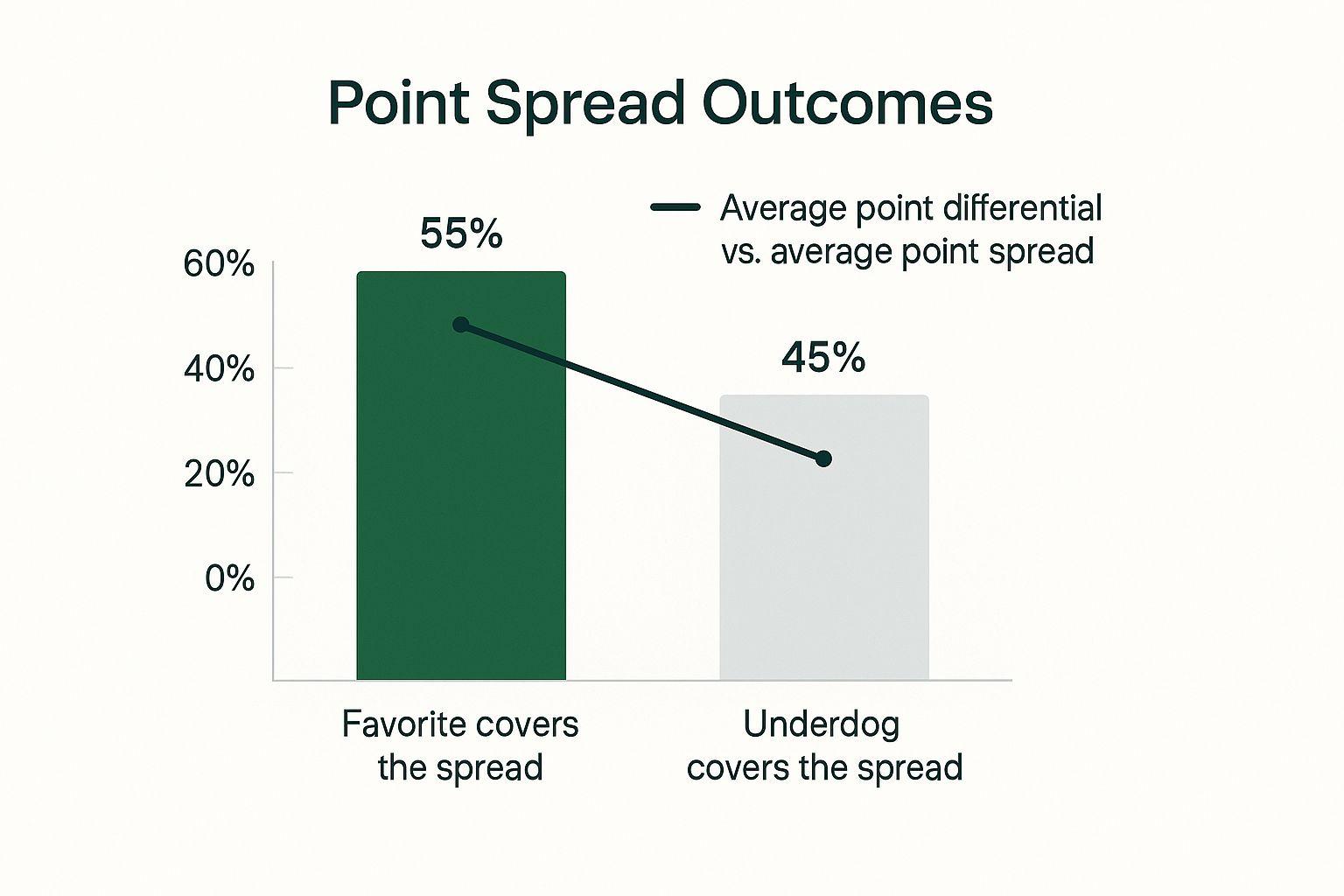
The numbers show that while favorites do cover slightly more often, it's nearly a coin flip. This is exactly what sportsbooks aim for, and it’s what makes finding an edge so challenging and rewarding. Once you can read a line and instantly know what needs to happen on the field, you've taken a massive step toward betting like an expert.
Winning, Losing, and Pushing Your Bet
Knowing how to read the betting line is one thing, but the real test comes when the game clock hits zero. This is where the theory becomes reality. Let's walk through the three possible outcomes for any point spread bet: the win, the loss, and the ever-present "push."
To keep things simple, we'll stick with one classic NFL matchup for all our examples. Picture this NFC North showdown:
- Green Bay Packers -7
- Chicago Bears +7
The Packers are the favorites here, meaning they have to win by more than 7 points. The Bears, as the underdogs, can either win the game outright or just lose by less than 7 points for their bettors to cash a ticket.
Let's see how different final scores play out.
Winning the Bet: A Clear Victory
First, the fun part: winning your bet. How you get there depends entirely on which team you backed.
You bet on the Packers -7:
- Final Score: Packers 30, Bears 20
- The Difference: Green Bay won by a solid 10 points.
- The Result: Winner! The Packers’ 10-point victory easily cleared the 7-point spread they needed to cover.
You bet on the Bears +7:
- Final Score: Packers 24, Bears 20
- The Difference: The Packers only won by 4 points.
- The Result: Winner! Even though the Bears lost the actual game, they stayed within the 7-point cushion. They covered the spread, and so did you.
In both of these scenarios, one side clearly beat the point spread, which is exactly what you're aiming for.
Losing the Bet: Falling Just Short
Of course, things don't always go your way. A loss happens when your team fails to cover its side of the number.
Imagine this nail-biter of a finish:
- Final Score: Packers 27, Bears 21
- The Difference: The Packers won by 6 points.
Here's how that single outcome creates two different results for bettors:
- If you bet Packers -7: You lose. The Packers may have won the game, but their 6-point margin wasn't enough to beat the -7 spread. A tough break.
- If you bet Bears +7: You win! The Bears kept the final score within that 7-point window, meaning they covered the spread as the underdog.
This is the perfect example of why spread betting is so popular. The final score is just one part of the puzzle; it's how that score measures up against the spread that really counts.
The Push: A Betting Tie
So what happens if the favorite wins by the exact number of the spread? This unique outcome is called a push.
A push is essentially a tie against the spread. The final margin of victory lands precisely on the number. When this happens, the bet is voided, and the sportsbook refunds everyone's original wager.
Let's go back to our Packers-Bears game for one last scenario:
- Final Score: Packers 28, Bears 21
- The Difference: The Packers won by exactly 7 points.
- The Result: It's a push! Since the margin of victory matched the point spread perfectly, all bets are off. If you bet on the Packers -7, you get your money back. If you bet on the Bears +7, you also get your money back. No one wins, but more importantly, no one loses.
This is precisely why you'll often see sportsbooks use half-points (like -7.5) in their lines. It completely eliminates the possibility of a push, guaranteeing a winner and a loser on every ticket.
If you want to dig a little deeper, we have a complete guide on what a push means in betting right here on our site.
How Sportsbooks Create an Accurate Spread
That point spread you see on your screen didn't come out of thin air. It’s the product of some serious number-crunching, powered by sophisticated algorithms, complex statistical models, and years of historical game data. The sportsbook's objective isn't just to pick a winner; it's to land on a number that perfectly splits public opinion.
To generate an opening line, sportsbooks throw a massive amount of data into their models. We're talking about everything from core team performance stats, like points per game and defensive efficiency, to situational details like player injuries, weather conditions, and even how far a team has to travel. This initial number is their best data-backed guess at how the game will play out.
The True Goal of the Point Spread
A lot of people think the spread is the sportsbook's official prediction of the final score. While it's often close, the real purpose is a little different. The ultimate goal is to set a number that attracts an equal amount of betting money on both the favorite and the underdog.
The point spread is less a prediction and more a balancing point. It's a number designed to split the betting public down the middle, guaranteeing the house a profit from the juice, regardless of which team covers.
When the money is balanced on both sides, the sportsbook simply uses the losers' money to pay the winners and keeps the commission for itself. This is the core of their business model and the key to understanding how bookmakers make money on virtually every game.
How Accurate Are the Spreads?
The precision of these lines is frankly remarkable. Oddsmakers have honed their craft over decades, and the spread often lands incredibly close to the actual final margin of victory. This isn't just a feeling; long-term data backs it up.
Just look at the NFL. A detailed analysis covering two decades of games shows just how sharp these lines are. Between 2002 and 2022, the average margin of victory across 5,412 regular-season games was 2.19 points. And the average point spread set by oddsmakers over that same period? 2.21 points. That's an astonishingly small difference between the predicted handicap and the real-world results. You can discover more insights about these NFL findings and dig into the data yourself.
This level of accuracy gives you a new respect for the point spread. It's not just a handicap; it's a highly refined tool that makes beating the books a consistent challenge.
Why Point Spreads Move During the Week
A point spread is rarely a "set it and forget it" number. When a betting line is first released, usually on a Sunday or Monday for an NFL game, that's just the oddsmakers' opening bid. Throughout the week, you'll see that number dance around, sometimes by just half a point, other times by a field goal or more.
This movement isn't random. It’s a living, breathing number that's constantly reacting to a flood of new information and, just as importantly, the flow of money.
The most common reason a line shifts is lopsided betting. Sportsbooks want to create a balanced market, meaning they want roughly the same amount of money wagered on both sides of a bet. If everyone and their brother is betting on the favorite, the book is exposed to a huge loss if that team covers.
To protect themselves, they'll move the line to make the other side more attractive. Think of it like a store marking down an item that isn't selling. The sportsbook will "sweeten the deal" on the underdog to encourage people to bet that way and balance their books.
Key Drivers of Line Movement
While public money can nudge a line, the really dramatic swings are almost always caused by new, game-changing information. A single news alert can completely reshape the outlook of a game, forcing oddsmakers to scramble and adjust.
Here are the biggest culprits behind a moving point spread:
- Player Injuries: This is the big one. If a star quarterback's status goes from "questionable" to "out," you can see a line swing by several points in the blink of an eye. The difference between a starting QB and their backup can be worth a touchdown or more to the spread.
- Weather Forecasts: Never underestimate mother nature. A sudden forecast calling for 30 mph winds or a blizzard can throw a wrench into a team's game plan, especially high-powered passing offenses. This often leads oddsmakers to lower both the point spread and the game total.
- Team News: Things like surprise lineup changes, a player suspension, or even reports of internal team turmoil can be enough to spook oddsmakers and bettors, causing a shift in the line.
The point spread is essentially a real-time reflection of all available public information. As new, impactful details emerge, the line must move to maintain its balance and accuracy.
Let's look at a classic example. The Buffalo Bills open as -6.5 point favorites at home against the Miami Dolphins. On Wednesday afternoon, news breaks that the Bills' Pro Bowl quarterback has been ruled out with an ankle injury.
Within minutes, you'll see that line plummet. Sportsbooks might immediately re-post the line at Bills -3.5, a massive three-point swing that directly reflects the value of losing an elite player.
This is why timing your bet is such a huge part of the game. If you can anticipate a line move or act quickly on breaking news, you can lock in a number that offers far more value than the one available just a few hours later. It’s all about staying informed and knowing when to pull the trigger.
Finding Your Edge in Betting History
Anyone can have a hunch about a game. But to find a real, repeatable edge, you have to move past gut feelings and start digging into the data. Historical betting information is the single best tool for turning a guess into an educated wager, helping you spot valuable patterns that the average bettor completely overlooks.
Think about it. What if you knew that a particular NFL team has an incredible record of covering the spread when they're a road underdog? Or that a certain college basketball coach's teams consistently fail to cover when they're favored by double digits? These aren't just fun facts; they're actionable insights that treat the point spread as more than just a number. It becomes a starting point for deeper analysis.
How to Spot Actionable Trends in Past Data
Of course, the old disclaimer "past performance is no guarantee of future results" always applies. But history gives you an invaluable baseline. By looking back, you can build a solid case for a bet, identifying specific situations where the betting market might have gotten it wrong.
This is how you add discipline to your process. You're not just picking a team you like; you're finding scenarios that have historically offered value.
Historical betting odds archives, some of which go back to at least 2007, have become a goldmine for sharp bettors. By lining up past results with the point spreads for those games, you can really get a feel for market efficiency and how certain teams perform against expectations over time.
This kind of research used to be incredibly difficult, but now it’s more accessible than ever. Platforms now offer huge databases filled with archived odds and results from sports all over the world. You can discover more about how betting archives work to see just how powerful this information can be for yourself.
To get started, focus your research on a few key areas:
- Team Performance vs. Spread: Don't just look at wins and losses. How does a team actually perform against the spread as a favorite? As an underdog? Do they play better at home or on the road?
- Coach and Player Tendencies: Some coaches are masters at getting their team ready after a bye week. Others might be terrible in primetime games. How much does a star player's absence really affect the spread, compared to what the public thinks?
- Line Movement Analysis: Watching how spreads moved in similar games in the past can teach you how the market reacts to certain types of news. This helps you get ahead of the curve and anticipate how a line might move before you bet it.
Ultimately, adopting a data-driven mindset is what separates successful bettors from the pack. It trains you to question the lines, hunt for hidden value, and make wagers based on evidence, not emotion.
At ValueBetFactory, our advanced algorithms do this heavy lifting for you. We analyze the odds constantly to pinpoint discrepancies and highlight potential opportunities. Empower your betting strategy by visiting us at ValueBetFactory to make more informed decisions.