
A Bettor's Guide to Understanding Betting Lines
Unlock Profits with betting tips!
Think of betting lines as the market price for a specific outcome in a sporting event. These numbers aren't just pulled out of thin air by sportsbooks; they're a carefully crafted mix of hard data, statistical probability, and a feel for public opinion. They are the absolute foundation of all sports betting.
What Are Betting Lines and How Do They Work?
At its heart, a betting line is a tool oddsmakers use to level the playing field between two mismatched teams. Picture a heavyweight champ squaring off against a total newcomer. Without a betting line, everyone would just pile their money on the champion, creating a massive, one-sided financial headache for the sportsbook.
To stop that from happening, oddsmakers create lines that give you a reason to consider betting on either side. They assign numbers that reflect how likely each outcome is, and those numbers dictate how much you stand to win or lose. This is how they create a balanced market where money flows in on both the favorite and the underdog.
The Real Purpose Behind the Numbers
Here’s a secret: a sportsbook's main goal isn't to perfectly predict who will win. Their real objective is to set a line that attracts a roughly equal amount of cash on both sides of the bet. When they pull this off, they make a guaranteed profit from their commission-known as the "vig" or "juice"-no matter which team actually wins the game.
This is exactly why you need to understand what the lines are telling you. They offer a window into how both the pros (the oddsmakers) and the public (everyone else betting) see the game. Every single number is a clue.
A betting line is more than just odds; it's a dynamic number representing the market’s collective opinion on a game. It tells a story about favorites, underdogs, and expected performance.
The global sports betting market has exploded, with more people than ever trying to read these lines. The market was recently valued at around $107.4 billion and is projected to hit a staggering $187.39 billion by 2030. This massive growth means a solid understanding of betting lines is no longer optional-it's essential.
The Three Foundational Betting Lines
While sports betting can seem complex, almost every wager you can make is built on three fundamental types of lines. Get a handle on these three, and you'll have the confidence to break down any matchup.
Before diving in, here's a quick look at the main types of lines and the simple question each one asks you to answer.
| Line Type | What It Asks You to Predict | Common Sport Example |
|---|---|---|
| Moneyline | Who will win the game, straight up? | Betting on the Lakers to beat the Celtics. |
| Point Spread | Will the favorite win by more than a set number of points? | Taking the Chiefs -7.5 over the Broncos. |
| Totals (Over/Under) | Will the combined final score be higher or lower than a set number? | Wagering on Over 210.5 total points in a basketball game. |
Each of these lines gives you a different angle on the game and a unique way to turn odds into an actionable bet.
This is all about translating those numbers into an "implied probability"-the chance of an outcome happening as suggested by the odds. Getting good at this is your first real step toward making smarter, more calculated wagers. To really nail this down, check out our guide on how to convert odds to probability and see what the numbers are really telling you.
Mastering the Three Pillars of Betting Lines
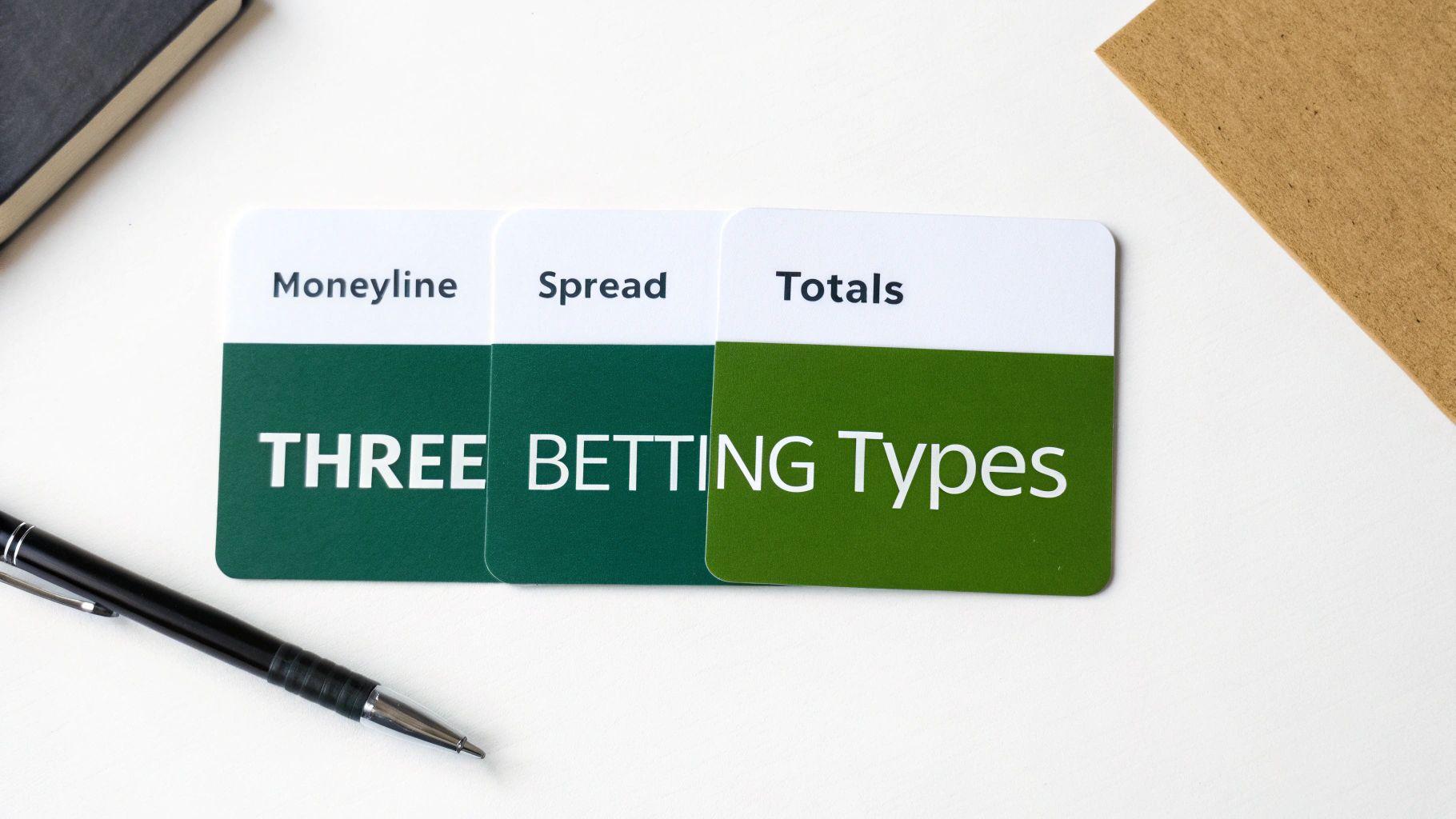
While the world of sports betting is full of different options, almost all of them are built on three core foundations. Once you learn to read these three betting lines, you can start to see the story a sportsbook is telling about any given game.
Getting a handle on these pillars moves you beyond just picking a winner. It's the first step toward making strategic decisions based on how you think a game will actually unfold.
Let's break down each of these fundamental line types with some real-world examples.
The Moneyline: The Straight-Up "Who Wins?" Bet
The moneyline is as straightforward as it gets. It asks one simple question: who is going to win the game? No point handicaps, no score requirements-you're just putting your money on the outright winner.
Every moneyline has two sides: a favorite and an underdog. The favorite is the team expected to win, and you'll always see them marked with a minus sign (-). The underdog is, you guessed it, the team expected to lose, marked with a plus sign (+).
These signs do more than just show who's favored; they tell you exactly how you'll get paid.
- The Favorite (-): The number next to the minus sign is how much you have to bet to win $100. If the Kansas City Chiefs are -150, it means you need to risk $150 to profit $100.
- The Underdog (+): The number next to the plus sign is how much you'll win for every $100 you bet. If the Miami Dolphins are +130, a $100 bet would net you $130 in profit.
The moneyline is all about risk versus reward. Backing the favorite is the safer play, so the payout is smaller. Taking a shot on the underdog is riskier, so the sportsbook offers a bigger potential payout to make it worth your while.
The Point Spread: Leveling the Playing Field
This is where things get interesting. With a point spread, you aren't just betting on who wins, but by how much they win. Think of it as the sportsbook giving the underdog a hypothetical head start to make the game a 50/50 proposition.
That "head start" is the point spread number. The favorite has points taken away from their final score, while the underdog gets points added to theirs.
Let's use an NBA game as an example:
- Los Angeles Lakers -5.5
- Boston Celtics +5.5
Here, the Lakers are the 5.5-point favorite. For a bet on the Lakers to cash, they need to win the game by 6 points or more. This is what's known as "covering the spread."
On the other side, a bet on the Celtics wins if they either win the game outright or lose by 5 points or fewer. Even if they lose the game 110-106, your Celtics +5.5 ticket is a winner.
The point spread isn't about who wins the game, but by how much. It's a brilliant tool that creates a balanced betting market for games that might otherwise seem lopsided, making both teams an attractive option.
Totals (Over/Under): Betting on the Game's Flow
The third pillar is the total, more commonly known as the over/under. This bet has nothing to do with which team wins or by how many points. Instead, you're betting on the combined total score of both teams.
An oddsmaker will set a total number, and your job is to decide whether the actual combined score will be higher (over) or lower (under) than that number.
Let's imagine a football game between the Green Bay Packers and the Chicago Bears, with the total set at 47.5 points.
- If you bet the Over, you need the final score to add up to 48 points or more. A 28-21 finish (49 total points) would be a win.
- If you bet the Under, you need the combined score to be 47 points or less. A 24-20 final (44 total points) gets the job done.
Totals are a fantastic way to bet on the pace and style of a game. Are two high-powered offenses about to get into a shootout? The over might be the play. Is it a matchup between two elite defenses in terrible weather? The under starts to look pretty good.
By understanding these three pillars, you can analyze any game from multiple angles. The moneyline tells you who's supposed to win, the point spread tells you by how much, and the total gives you a feel for the game's flow. Mastering these concepts is the first major step toward reading betting lines like a pro.
How Sportsbooks Create the Opening Line
The opening betting line you see for a game isn't just a number pulled out of thin air. It’s the product of a meticulous, data-heavy process run by professional oddsmakers who have to be part statistician, part artist to get it right. This first number is their best shot at predicting not just the game, but how the public is going to bet on it.
Think of an oddsmaker like a master chef crafting a brand-new recipe. They aren't just tossing ingredients in a bowl and hoping for the best; they’re carefully measuring and blending dozens of elements to strike the perfect balance. For an opening line, those ingredients are things like advanced statistical models, years of historical game data, and sophisticated power ratings for every team in the league.
These power ratings are the foundation of the whole process. They assign a numerical value to a team's overall strength, and the difference between two teams' ratings gives the oddsmaker a raw baseline for the point spread. But that's just the starting point.
The Art of Adjusting the Numbers
Once that data-driven baseline is set, the real art begins. Oddsmakers start tweaking the line by factoring in a whole host of situational variables-the kind of human and environmental elements that a computer model might miss but can absolutely swing a game's outcome.
These are the key factors that can push a line one way or the other:
- Key Player Injuries: The absence of a star quarterback or a starting goaltender isn't a small detail; it can shift a line by several points all on its own.
- Weather Forecasts: Heavy winds can kill a football game's passing attack and drastically lower the expected total points. Rain can completely change the dynamics of a baseball game.
- Travel Schedules: A team playing its third road game in five days is going to be tired. That fatigue gets priced into the line.
- Coaching Matchups: Some coaches just have another's number. These historical coaching advantages are absolutely factored into the odds.
Each of these elements requires a subtle, experienced touch, turning raw data into a much more nuanced betting line that reflects real-world conditions. This initial line is the oddsmaker's opening move in a strategic game against the entire betting public.
The Vig: How the House Always Wins
One of the most vital concepts to get your head around is the sportsbook's built-in commission, known universally as the "vig" or "juice." This is the small fee they charge on every single wager, and it's the mechanism that guarantees them a profit over the long haul.
For example, on a standard point spread bet, you'll almost always see odds of -110 for both sides. This means you have to risk $110 just to win $100. That extra $10 is the vig. If a sportsbook can attract an equal amount of money on both the favorite and the underdog, they simply pay the winners with the money from the losers and pocket the vig as pure, risk-free profit.
A sportsbook’s main goal isn't to perfectly predict who will win the game. Their goal is to set a line that splits public opinion right down the middle, attracting equal betting action on both sides to completely minimize their own financial risk.
Picture a perfectly balanced scale. The sportsbook puts the line right in the middle and wants bettors to add equal weight to each side. If they pull it off, they make money no matter who wins or loses, thanks entirely to the vig. For a much deeper look into this business model, check out our full article on what is a bookmaker.
The explosion of online betting has made this process even more complex and data-intensive. The integration of cryptocurrency has also accelerated this trend, offering bettors more security, especially in fast-moving markets like live esports where micro-bets on kills or round wins are common. The global sports betting market is projected to hit an incredible $261.3 billion by 2034, growing at a CAGR of 9.3%, with esports and niche sports grabbing a bigger slice of the pie. Discover more insights about these market trends on GlobeNewswire.
This is why understanding how that opening line gets made is so critical. It's not just a prediction of the game; it's a carefully engineered number designed to balance a market and lock in a profit for the house.
Why Betting Lines Move and What It Means for You

Once a sportsbook drops its opening line, the number’s job is far from over. Those odds aren't set in stone. In fact, they’re designed to be dynamic, often shifting multiple times in the days and hours before a game kicks off. For any serious bettor, learning to read these movements is a game-changing skill.
It helps to think of an opening line like the initial price of a stock. As new information rolls in and the market starts weighing in, that price has to adjust. The exact same thing happens in sports betting, where a moving line tells a story about how the sportsbook, the public, and the pros are all seeing the game.
These shifts aren't random. They're a direct response to specific pressures forcing oddsmakers to tweak their numbers. Figure out what’s causing the move, and you can unlock insights that go way beyond what the initial odds tell you.
Public Betting Action: The Weight of the Crowd
The single biggest reason a line moves is simple: a massive, one-sided flow of money. Sportsbooks are in the business of managing risk, not gambling. Their ideal scenario is a balanced book with roughly equal money bet on both sides, guaranteeing them a profit from the vig.
When the public piles on one side, that balance gets thrown way off, exposing the house to a huge potential loss. Let's say 80% of all bets come in on the Kansas City Chiefs at -7. If the Chiefs cover that spread, the sportsbook is looking at a very bad day.
To stop the bleeding, they'll move the line. They might bump it to -7.5 or even -8. This makes betting on the Chiefs a little less appealing while making the underdog look a lot more attractive. The whole point is to encourage new money to come in on the other side and get their books back in balance.
The Impact of "Sharp" Money
Here’s a crucial piece of the puzzle: not all money is created equal. While the sheer volume of public bets (often called "square money") can definitely move a line, a single large wager from a respected professional bettor-a "sharp"-can trigger a much faster and more significant shift.
Sharps are bettors with proven, long-term winning records. Sportsbooks track these accounts obsessively. When a known sharp drops a big bet, oddsmakers see it as a flashing red light that their original line might have a weakness. They will often adjust the line almost immediately in response, even if the public money is still fairly balanced.
A line that moves because of sharp money is a far more reliable signal of true value than one drifting with public opinion. Sharps bet with data and models; the public often bets with their heart.
Late-Breaking News and Information
Beyond the flow of cash, real-world events can force a line to change in a heartbeat. New information can completely flip the script on a game's expected outcome, making the opening odds totally obsolete.
To get a sense of what drives these shifts, check out this quick overview of the most common factors.
Key Drivers of Betting Line Movement
| Cause of Movement | Why It Happens | What It Signals to a Bettor |
|---|---|---|
| Player Injuries | The star quarterback gets ruled out in practice or a key defender is a last-minute scratch. | A huge, immediate line jump. The market is scrambling to re-price the game based on the new roster reality. |
| Weather Changes | The forecast for an outdoor game suddenly shifts to heavy snow, rain, or high winds. | The point total (Over/Under) will often plummet. Offensive production is expected to take a major hit. |
| Team News & Rumors | Reports of locker room drama, a surprise lineup change, or a sudden suspension leak out. | This can cause subtle but important shifts as oddsmakers try to quantify the impact of off-field issues. |
| Heavy Public Betting | The vast majority of casual bettors are all backing one side, creating massive liability for the book. | The line moves against the popular side to encourage betting on the other team. This can create value on the less popular side. |
| Sharp Money Action | A large bet from a respected professional bettor or syndicate is placed. | A quick, sharp move. The book is reacting to an expert opinion, signaling their opening number may have been off. |
Understanding these triggers is the key to interpreting what the market is telling you. For those ready to go deeper, a full breakdown of betting line movement provides advanced strategies for turning these shifts into a real advantage.
By learning why a line is moving, you can start to tell the difference between public noise and a truly valuable signal, which is essential for making smarter bets.
How to Find Value by Reading Between the Lines
So, you know what betting lines are and you’ve seen them move. That’s step one. Now for the part that actually matters: using that knowledge to find value. Value is the single most important concept for anyone trying to win long-term.
Finding value isn’t just about picking winners. It’s about finding bets where the odds are better than the real probability of something happening.
Think of it like shopping. You know a vintage watch is worth $150, but you spot it in a shop for $100. That $50 difference is your value. In betting, you're hunting for those exact same pricing errors, looking for spots where a sportsbook has underestimated a team's chances.
This is what separates casual bettors from sharp, profitable ones. Sharps aren't just guessing; they are systematically hunting for mismatches between the book's price and their own calculated probability.
Translating Odds into Implied Probability
To find any value, you first have to decode what the betting line is really saying. Every line carries an implied probability-an unspoken percentage chance of an outcome happening, according to the oddsmaker. Learning to calculate this is an essential skill.
A moneyline of -150 doesn't just look like a number; it implies the favorite has a 60% chance to win. A +200 underdog line suggests a 33.3% chance of victory. Your job is to decide if you agree with that math.
Do you believe the favorite actually has a greater than 60% chance to win? If so, you've found value. Think the underdog's real chances are closer to 40% instead of 33.3%? That's a value bet, too.
Value betting is the art of finding a discrepancy between the sportsbook’s implied probability and your own well-researched assessment of the actual probability. It’s about betting on the number, not just the team.
This simple shift in perspective moves you from being a fan who bets to an investor looking for an edge. It’s a foundational step toward making more calculated decisions.
Actionable Strategies for Finding an Edge
Okay, so you get the concept. But how do you actually find these opportunities? It takes a disciplined approach and a few core strategies to consistently uncover profitable spots.
Here are a few tactics sharp bettors live by:
- Line Shopping Across Multiple Sportsbooks: Never, ever place a bet without checking the line at several sportsbooks. One book might have a team at -150 while another has them at -140. That small difference is huge for your long-term profitability. It's free money.
- Betting Early vs. Waiting: Betting early in the week lets you grab an opening line before public money pushes it around. Waiting until game day lets you see how the market has reacted and gather more info, like late injury news. Both are valid strategies depending on the situation.
- Identifying Public Overreactions: The general public loves betting on popular teams, star players, and whatever happened last week. This often creates inflated lines on one side. Fading the public by betting against these overhyped teams is a classic and effective way to find consistent value.
When you start combining these tactics, you stop reacting to the game and start reacting to the market-and that's a much smarter way to play.
The Power of Fading the Public
Let's zoom in on that last point, because it's a goldmine. When a massive amount of public money piles onto one side of a game, sportsbooks have to move the line to protect themselves. This often pushes the line so far that it creates incredible value on the other side.
Picture a big prime-time football game. A popular team is a 7-point favorite. If 85% of the public bets are on them, the book might move the line to -8.5 to try and get some action on the underdog.
That extra 1.5 points is pure value, created entirely by public bias. A sharp bettor sees this and pounces on the underdog, knowing they’re getting a much better number than the game's fundamentals actually warrant.
Your Guide to Analyzing a Real Game
Alright, we've covered the what, why, and how of betting lines. Theory is great, but seeing these concepts click together in a real-world game is where the lightbulb really goes on.
Let's follow a sharp bettor, Alex, as he breaks down an upcoming NFL game between the Kansas City Chiefs and the Baltimore Ravens. This play-by-play will show you how a smart analysis of the lines can lead to a calculated, value-driven wager.
The Opening Line Drops
Monday morning rolls around, and the opening lines hit the board. Alex pulls up his primary sportsbook and sees this:
- Point Spread: Kansas City Chiefs -2.5
- Moneyline: Chiefs -140 / Ravens +120
- Total (Over/Under): 48.5 points
His first read is that the bookmakers see this as a nail-biter. They’re giving the Chiefs a slight nod, likely for home-field advantage. That -2.5 spread is a crucial number, sitting just under the key margin of a 3-point field goal win. The total suggests oddsmakers are expecting a decent amount of offensive fireworks.
Tracking Line Movement and News
Alex doesn’t jump on a bet right away. Patience is key. He spends the next few days just watching the lines and keeping an eye on the news feeds. By Wednesday, he spots a major shift: the line has moved to Chiefs -3.5 at most books.
This move tells a story. A jump from -2.5 to -3.5 is a huge deal because it crosses the most important number in football: 3. He does a little digging and finds two probable causes:
- The Ravens' star safety was a surprise addition to the injury report, ruled out of practice with an ankle issue.
- Early betting reports show that 75% of the public money is pouring in on the Chiefs, who are always a popular team to bet on.
This is a classic cocktail: a key injury mixed with heavy public action has pushed the line up. Alex suspects the public is overreacting to the news, and that's where value is born.
This infographic breaks down the simple process Alex follows to sniff out a value bet.
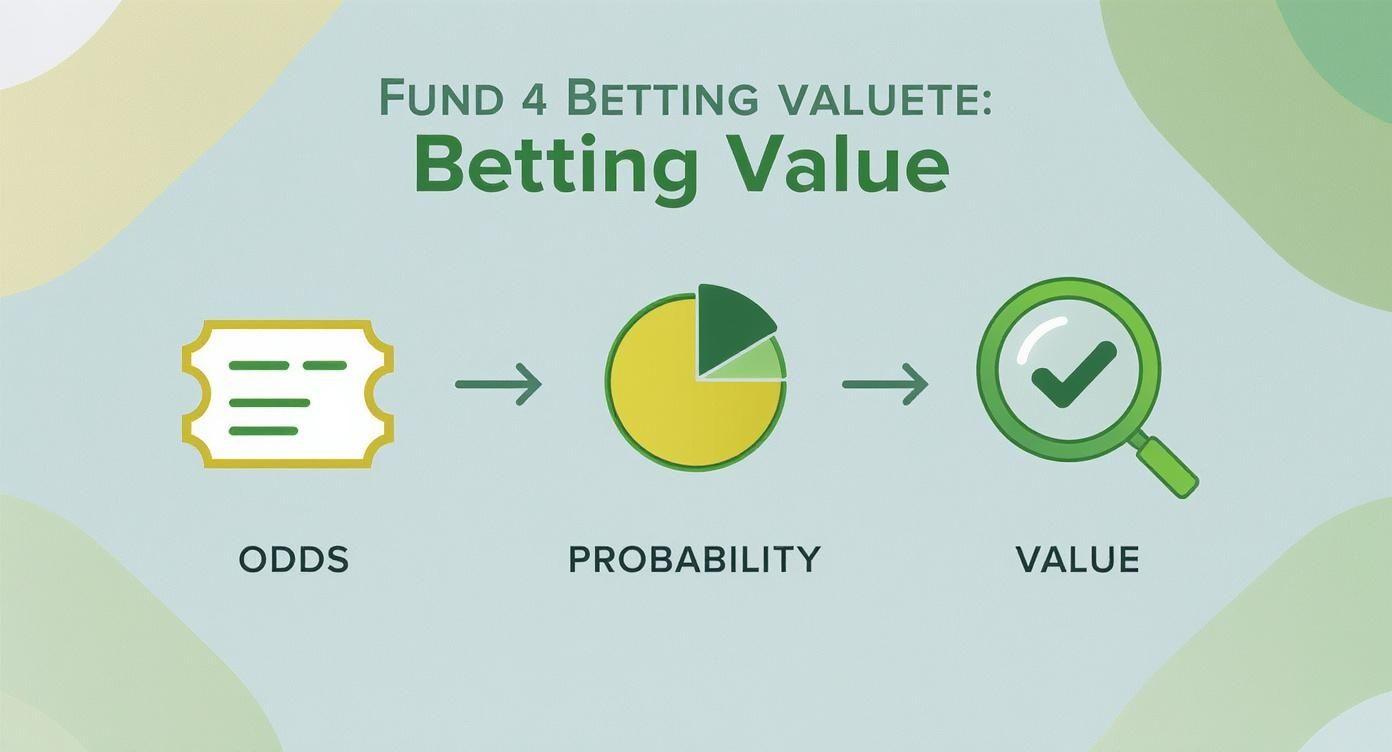
As you can see, it’s a three-step process: analyze the odds, convert them to their real probability, and then spot the gap where the value lies.
Line Shopping for the Best Number
Knowing he wants to bet on the Ravens, Alex moves to the most crucial step: line shopping. He quickly logs into three different sportsbooks to see what they're offering.
Line shopping is one of the easiest and most powerful habits you can build to boost your long-term winnings. That extra half-point on a spread might not seem like much, but over a full season, it's often the difference between a winning ticket and a losing one.
Here’s what he finds:
- Sportsbook A: Ravens +3.5 (-115)
- Sportsbook B: Ravens +3.5 (-110)
- Sportsbook C: Ravens +4 (-110)
The choice is a no-brainer. Sportsbook C is offering significantly better value. Getting the Ravens at +4 is a massive win, as it turns a potential 3-point loss into a winning bet. He locks in his wager on the Ravens +4.
Notice what Alex did. His decision wasn't based on who he thought would win the game. It was based on where he found the best value in the market. He used the line movement, fueled by a public overreaction, to get a number that gave him a clear mathematical edge. This disciplined, analytical approach is what separates casual gamblers from successful bettors.
At ValueBetFactory, we provide the tools and real-time data to help you find these value opportunities consistently. Our platform scans the market for discrepancies in betting lines, sending you alerts so you can make informed, data-driven decisions just like a pro. Start finding your edge today at ValueBetFactory.