
What Is a Bookmaker? Your Guide to the Betting World
Unlock Profits with betting tips!
A bookmaker is a person or company that takes your bets on sports and other events, all at pre-agreed odds. In today's world, you'll usually hear them called sportsbooks. They are the market makers for the entire sports betting world, creating a space where people can wager on thousands of different outcomes.
Understanding the Role of a Bookmaker
It’s helpful to think of a bookmaker as more than just someone who takes your money. They're the ones who facilitate the entire betting market for an event. It’s a lot like how a stock exchange creates a marketplace for buying and selling shares; a bookmaker creates a marketplace for wagers.
Their main objective is to accept bets on all possible outcomes of an event. To do this, they have to carefully set odds that attract a balanced amount of money on each side. If they get this right, they can lock in a profit margin no matter who wins or loses. This built-in margin is exactly how they operate as a business.
What Do Bookmakers Actually Do?
At its core, a bookmaker's job is a constant balancing act between probability, risk management, and market creation. Their responsibilities go way beyond just taking your cash. To stay in business, they have to perform several key functions with precision.
Here's a quick look at the main jobs a bookmaker handles every single day.
| Function | Description |
|---|---|
| Odds Setting | They analyze stats, team form, injuries, and even public opinion to calculate the probability of each outcome and create odds to match. |
| Accepting Wagers | They provide a platform-whether it's online or a physical shop-for bettors to place money on the odds they've offered. |
| Managing Financial Risk | A bookie constantly adjusts odds to encourage balanced betting, making sure they aren't too exposed on any single outcome. |
| Paying Out Winnings | After an event finishes, they are responsible for settling all bets and paying out the correct winnings to bettors promptly. |
As you can see, it's a multi-faceted role that combines statistical analysis with sharp business sense.
A bookmaker's success isn't defined by beating every bettor. Instead, it's about creating a balanced 'book' where their guaranteed profit margin-often called the 'vig' or 'juice'-covers their costs and generates revenue.
The Bookmaker in the Modern Betting World
Historically, bookmakers have been central figures in any regulated gambling market. Today, with the explosion of online platforms, their role is bigger than ever.
The legal sports betting market has grown massively, especially in the United States after the 2018 Supreme Court decision that allowed individual states to regulate it. To give you an idea of the scale, legal sports wagers in the U.S. shot past $70 billion in just the first eight months of a recent year. That kind of growth shows just how huge the modern bookmaking industry has become.
Understanding their fundamental business model is the first step for any bettor. If you want to go deeper, you can learn more about how bookmakers make money in our detailed guide. This knowledge helps you see them not as an adversary, but as the market operators you're engaging with.
The Art and Science of Setting Odds
Ever stared at the odds for a big game and wondered where on earth those numbers came from? It’s a natural question. The odds you see aren't just a simple guess at who will win; they’re carefully crafted prices designed to build a balanced market and, most importantly, guarantee the bookmaker a profit.
This built-in profit is what bettors call the "vig" or the "juice". To get your head around it, let's start with something everyone understands: a coin toss. A fair toss has a 50% chance of heads and a 50% chance of tails. In a perfect world with no profit motive, the odds for both would be even money (2.00 or +100).
But a bookmaker is a business, not a charity. So instead of offering even odds, they might offer 1.91 (-110) on both heads and tails. That tiny adjustment is their commission. If they take an equal amount of money on both outcomes, they’re guaranteed to pay out less than they took in, locking in a profit no matter which way the coin lands.
From a Coin Toss to a Football Match
Now, let's take that simple logic and apply it to a real-world event, like a football match. The process gets a lot more complex, but the core principles are exactly the same. Bookmakers use sophisticated statistical models, historical data, and expert analysis to figure out the initial probability of each outcome-Team A wins, Team B wins, or a draw.
This three-step process is how they turn raw data into the final odds you see on their sites.
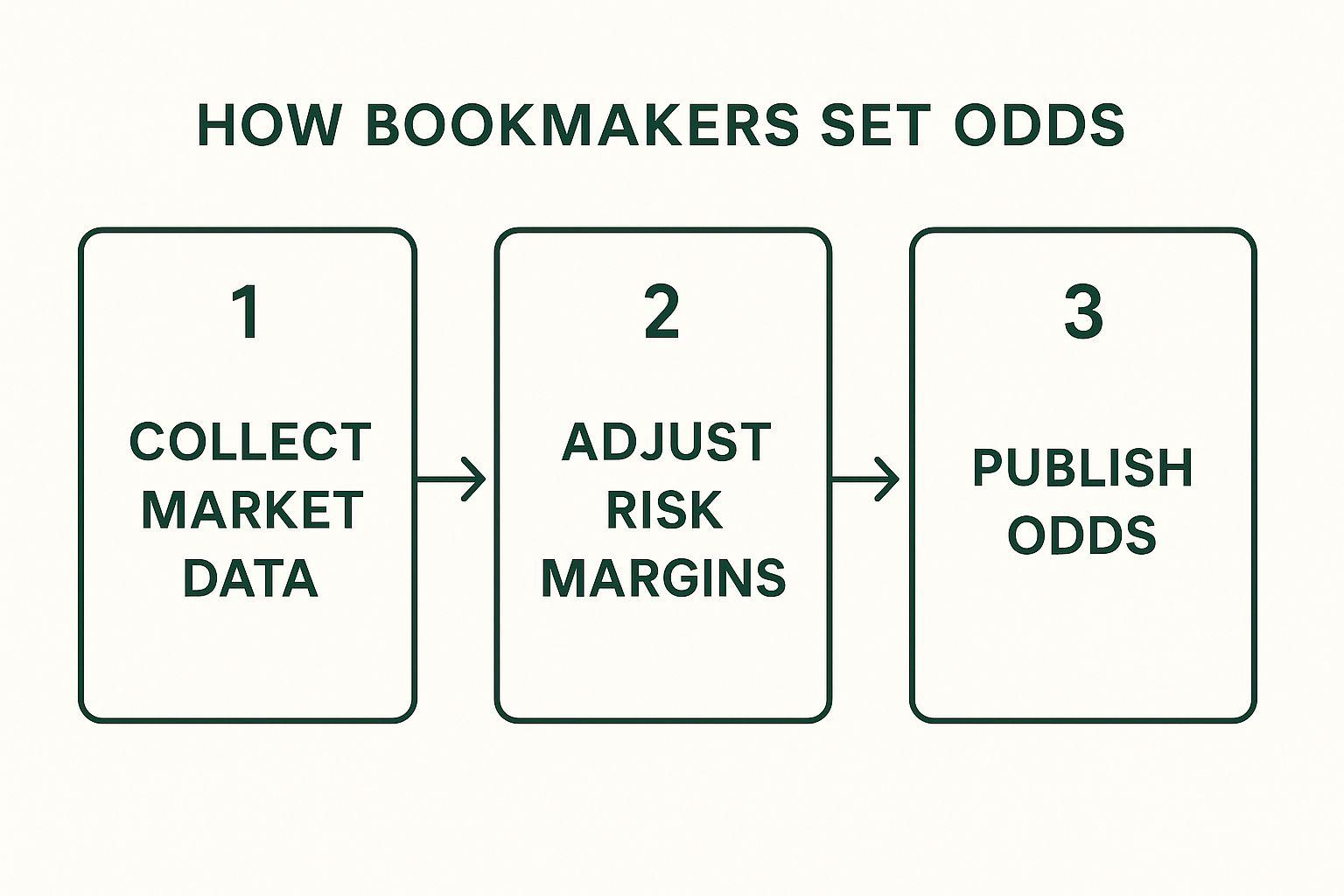
As the infographic shows, setting odds is a fluid dance between data collection, risk management, and market pricing.
But their job doesn't stop once the initial odds are posted. From that moment on, the odds become dynamic. A bookie has to constantly watch and adjust them based on a few key factors:
- Team News: A last-minute injury to a star player can completely change the game's probabilities.
- Public Opinion: If a ton of money comes in on one team, the bookmaker will shorten their odds and lengthen the odds on the other side. This is to encourage bets on the less popular team and balance their books.
- Market Movement: They also keep a close eye on what other bookmakers are doing to make sure their prices stay competitive.
The ultimate goal for a bookmaker isn't to be right about who wins. It's to set odds that attract balanced action on all sides of a bet. By doing this, they can lock in their profit margin before the game even kicks off.
This delicate art of risk management is the very foundation of their business model. Take the U.S. sports betting market, for example. The total amount wagered each month often falls between $10 billion and over $15 billion. Out of that massive handle, bookmakers’ revenues consistently sit between a 6.4% and 12.5% hold percentage-a direct result of managing their odds and risk effectively. You can dig into more of these numbers with these insights from the American Gaming Association. It's a perfect illustration of how precisely they work to guarantee their own profitability.
How Bookmakers Manage Risk and Balance the Book
It’s a classic misconception that bookmakers are just like us, trying to pick winners and losers. The reality is far more calculated. Their business model isn't built on outsmarting every single bettor; it’s built on managing financial risk.
Their dream scenario isn't for one team to win. It's to create what's known as a balanced book.
Think of a balanced book as a set of scales. The bookmaker's goal is to get a roughly equal amount of money wagered on every possible outcome of an event. When they achieve this, their built-in profit margin (the "vig" or "juice") guarantees they make money no matter who wins the game. They operate less like a gambler and more like a financial market maker, carefully managing their liability to ensure a predictable return.
The Art of Adjusting the Lines
So, how do they nudge the betting public toward this perfect balance? Simple: they adjust the odds and point spreads in real time. As money starts flooding in on one side, they make betting on the other side more attractive.
Let's use the Super Bowl as a perfect example. Imagine the Kansas City Chiefs open as -3 point favorites against the San Francisco 49ers. As the game gets closer, a tidal wave of public money-say, 80% of the total cash-pours in on the Chiefs to cover the spread.
This is a nightmare scenario for the bookmaker. It creates a massive financial liability. If the Chiefs win by more than 3 points, the bookie faces a colossal payout. To protect themselves, they have to shift the line to encourage action on the 49ers and balance their books.
To do this, they will move the line. It's a dynamic process, and they might adjust the spread multiple times to find that sweet spot. Here’s how it might unfold:
- Initial Line: Chiefs -3
- After heavy betting on Chiefs: Chiefs -3.5
- If money keeps coming for the Chiefs: Chiefs -4
With each tiny shift, betting on the Chiefs gets a little tougher, and taking the 49ers becomes more tempting. A bettor who liked the 49ers getting +3 points will absolutely love them at +4. This shift is designed to incentivize wagers on the less popular side, helping the bookmaker offload their risk.
This constant dance of line movement is the very core of what a bookmaker does. They are constantly reacting to the flow of money, using the odds as their primary tool to manage exposure and lock in their profit margin. Their success isn't measured by picking the winning team, but by masterfully balancing the wagers on both sides.
Exploring Different Types of Bookmakers
The world of bookmaking isn't one-size-fits-all. Just as there are different kinds of bettors, the bookmakers themselves come in a few distinct flavors, each with its own business model and target audience.
Knowing the difference between them is a game-changer. It helps you find the right place for your specific betting style and avoid the frustration of picking the wrong tool for the job.
Traditional Bookmakers (Soft Books)
This is the category most people are familiar with. Think of the big, household names you see plastered on TV ads and football shirts. These are traditional bookmakers, often called soft books.
Their main goal is to attract a huge volume of everyday, recreational bettors. They build their profit margin, what's known in the industry as the "vig" or "juice," right into the odds they offer. These companies are masters of risk management, and they're quick to limit or even shut down the accounts of anyone who wins too consistently. It's nothing personal; it's just their business model.
High Street Shops vs. Online Sportsbooks
Even within the "traditional" world, there's a split between the classic betting shop and its online counterpart. The brick-and-mortar shop offers a tangible, social vibe. You can walk in, hand over cash for a physical betting slip, and watch the games on big screens with other punters.
Online sportsbooks, however, are all about convenience and sheer scale. With a few taps on your phone, you get access to thousands of markets across the globe, in-play betting, and a constant stream of promotions. The shift to digital is massive-the global online sports betting market hit a staggering $102.4 billion in 2024 and is still climbing fast.
Betting Exchanges: The Peer-to-Peer Model
Now for something completely different: the betting exchange. Forget betting against "the house." An exchange is more like a stock market for sports, where you bet directly against other people.
On an exchange, you can "back" an outcome (betting it will happen) or "lay" an outcome (betting it won't happen).
Betting exchanges don't create the odds; the users do. This peer-to-peer competition often results in better odds and lower margins, as the exchange only takes a small commission on winning bets.
This model is a favorite among more experienced bettors. It offers way more flexibility and, crucially, doesn't penalize you for being a long-term winner like a traditional bookie does.
Sharp Bookmakers: Where the Pros Play
Finally, we have the sharp bookmakers. These operators are built for professional, high-stakes bettors. Unlike soft books that focus on casual players, sharp books run on a high-volume, low-margin model.
Their odds are incredibly accurate and move in a flash, reacting to sophisticated data models and large wagers from respected bettors. While they won't limit you for winning, their lines are much, much tougher to beat. Finding real value here requires some serious analysis.
To help you decide which is the best fit, let's break down the key differences.
Comparison of Bookmaker Types
This table gives a clear, side-by-side look at how these different types of bookmakers stack up. Each one serves a distinct purpose in the betting ecosystem.
| Bookmaker Type | Key Feature | Best For | Potential Drawback |
|---|---|---|---|
| Traditional (Soft) | High margins, promotional offers | Recreational bettors, bonus hunters | Limits winning players quickly |
| Betting Exchange | Peer-to-peer betting, lay betting | Experienced traders, arbitrage bettors | Can have low liquidity on niche markets |
| Sharp Bookmaker | Low margins, high betting limits | Professional and high-stakes bettors | Odds are extremely efficient and hard to beat |
Ultimately, choosing the right type of bookmaker boils down to your own goals. Are you a casual fan just looking for some weekend fun, or are you a serious analyst hunting for the sharpest odds on the planet? Your answer will point you in the right direction.
Finding Your Edge Against the Bookmaker
Knowing how a bookmaker works is half the puzzle. The other half? Learning how to flip the script and find your own advantage. Many bettors think the secret to profit is just picking more winners than losers, but the real, sustainable edge comes from a much smarter strategy.
That strategy is called value betting. At its core, value betting is the art of finding spots where a bookmaker’s odds are just plain wrong when compared to the real statistical probability of an event happening. It’s less about having a crystal ball and more about spotting pricing errors in the market.
Think of it like shopping for a new TV. If you know a specific model is worth $500, but you find a store selling it for $400, you’ve found value. You’d buy it instantly because you know it's a fantastic deal. Value betting applies that exact same logic to sports odds.
Spotting Positive Expected Value
Every bet you place has an expected value (EV), which can be either positive or negative. A bet with positive expected value (+EV) is one where the potential payout is greater than the statistical risk, making it a profitable wager to take over the long term. Consistently finding these opportunities is the only sustainable way to build a profitable betting portfolio.
The goal isn't to win every single bet. It's to only place bets when the odds are stacked in your favour. Over hundreds of bets, this mathematical edge ensures you come out ahead, even if you lose more individual wagers than you win.
Now, manually calculating the true probability of an outcome and comparing it against every bookmaker’s odds is a monumental task. The market moves fast, and those valuable opportunities can vanish in minutes. This is where modern tools become absolutely essential for any serious bettor.
How Technology Helps Find Value
Today, advanced platforms can do all the heavy lifting for you. By automatically scanning dozens of bookmakers in real-time, they can pinpoint these mispriced odds the second they pop up.
Here’s an example of what one of these platforms looks like in action.
This kind of tool shifts your entire approach from guesswork to data-driven decision-making. By highlighting bets with positive expected value, it allows you to consistently place wagers that have a real mathematical edge. The key is understanding the fundamentals of this approach, and you can dive deeper by reading our detailed explanation of what is a value bet and how to calculate it.
Armed with this knowledge and the right tools, you can finally turn the tables and deal with bookmakers on your own terms.
Common Questions About Bookmakers and Betting
As we wrap things up, it's totally normal to still have a few questions rattling around. The world of sports betting has its own language, and it can feel a bit confusing at first. This section cuts through the noise with clear, direct answers to some of the most common things people ask about bookmakers.
Each answer is designed to be short and to the point, reinforcing the key ideas we've covered so you can move forward with confidence.
Can Bettors Really Win Against a Bookmaker?
Yes, absolutely. While bookmakers always build a profit margin right into their odds, a sharp bettor can definitely find an edge and be profitable over the long run. The secret isn't luck; it's being able to consistently identify value bets-wagers where the odds offered are better than the true probability of something happening.
This means shifting your mindset from just trying to pick winners to playing a mathematical game. Those who treat it like that give themselves the best shot at coming out ahead.
Why Do My Betting Limits Get Reduced?
This is a classic move by traditional "soft" bookmakers. Their entire business model is built around casual, recreational bettors. If their software flags your account as someone who is winning consistently or making sharp, value-driven bets, they'll often limit the amount you can stake to protect their bottom line.
It's a frustrating but common part of the game. This is exactly why many serious bettors spread their action across multiple sportsbooks or switch to betting exchanges, which don't care if you win because you're betting against other people, not the house.
It's a common myth that bookmakers want every single bettor to lose. The truth is, their perfect scenario is a "balanced book" where they have equal money on both sides of a bet. That way, they make their profit from the commission, no matter who wins. Their main job is managing risk, not predicting winners.
Is It Legal to Use a Bookmaker?
The answer to this depends entirely on where you live. Over the last decade, many countries and states have moved to legalize and regulate sports betting. The U.S. market, for example, has exploded since a 2018 Supreme Court decision opened the floodgates.
It is crucial that you check the specific laws in your area before placing a single bet. Always, always stick to licensed and regulated bookmakers. This ensures your money is safe and that you're dealing with a fair and legitimate operation. For a deeper dive, check out our guide on how sports betting works, which touches on the legal side of things.
What Is the Difference Between Odds and Probability?
Think of it this way: odds are simply the price a bookmaker is offering for an outcome, and that price always includes their built-in profit margin. Probability is the actual, statistical likelihood of that outcome happening in real life. A sharp bettor's entire job is to find the gap between the two.
For instance, a bookie might offer odds that translate to a 45% chance of a team winning. But after doing your homework, you believe the true probability is closer to 55%. That 10% difference is your value-that's your edge. Learning how to convert odds into implied probability is one of the most fundamental skills any successful bettor needs.
Ready to stop guessing and start making data-driven decisions? ValueBetFactory uses powerful algorithms to scan the market for you, identifying profitable value bets in real-time. Start your journey to smarter betting today at ValueBetFactory.