
Unlocking the 1st Quarter Spread Meaning in Sports Betting
Unlock Profits with betting tips!
If you've ever stared at a full-game point spread, you know you're betting on the final outcome after four long quarters. But what if you could bet on just the first 15 minutes? That's exactly what a 1st quarter spread is.
In simple terms, you're betting on which team will cover the spread in the first quarter alone. It’s a wager on which team comes out of the gate faster, completely isolating that opening sprint from the rest of the game.
What Exactly Is a 1st Quarter Spread
Think of a football game as a four-lap race. A bet on the full-game spread is a wager on who wins the entire race. The 1st quarter spread, on the other hand, is a bet on which runner is leading after just the first lap.
Who wins the race in the end doesn't matter one bit. All that counts is who got off to the better start.
This type of bet has become a favorite for sharp bettors because it focuses on a team's preparation and opening script. It lets you capitalize on teams known for starting strong, regardless of whether they have the stamina to keep that pace for a full 60 minutes.
This niche market gives you a unique angle because it zeroes in on specific team tendencies that full-game lines often hide. If you're new to the concept of spreads in general, our guide on understanding the point spread is a great place to start.
Isolating Early Game Performance
The real beauty of the 1st quarter spread is its power to isolate a small, predictable chunk of the game. You might have a team that’s a heavy underdog for the whole contest but consistently punches above its weight in the opening frame before coaching adjustments or fatigue kicks in.
By focusing only on the first quarter, you cut out all the noise-second-half comebacks, garbage-time touchdowns, and all the other chaos that can wreck a full-game bet. It's a pure wager on preparation and initial game plan execution.
This targeted approach has a proven track record. For instance, in a recent NFL season, the top teams against the first-quarter spread cashed tickets at a rate of over 65%, which translates to some serious profit. You can dig into more of these NFL Q1 stats over at StatSharp.com.
The secret is figuring out which teams come out of the locker room fired up and ready to dominate from the opening whistle.
How Sportsbooks Create 1st Quarter Lines
Ever wondered how oddsmakers land on that specific first-quarter number? It's a common mistake to think they just slice the full-game spread into four equal pieces. The real process is way more nuanced-a sharp blend of data modeling and expert intuition designed to predict a team's initial burst right out of the gate.
Think of it like a sprinter versus a marathon runner. The full-game spread is all about the marathon, factoring in pacing, endurance, and late-game adjustments. The first-quarter line, on the other hand, is all about the sprinter’s explosive start. It’s a bet on who gets out of the blocks fastest.
This whole process boils down to a quick, isolated wager on the game's opening moments.
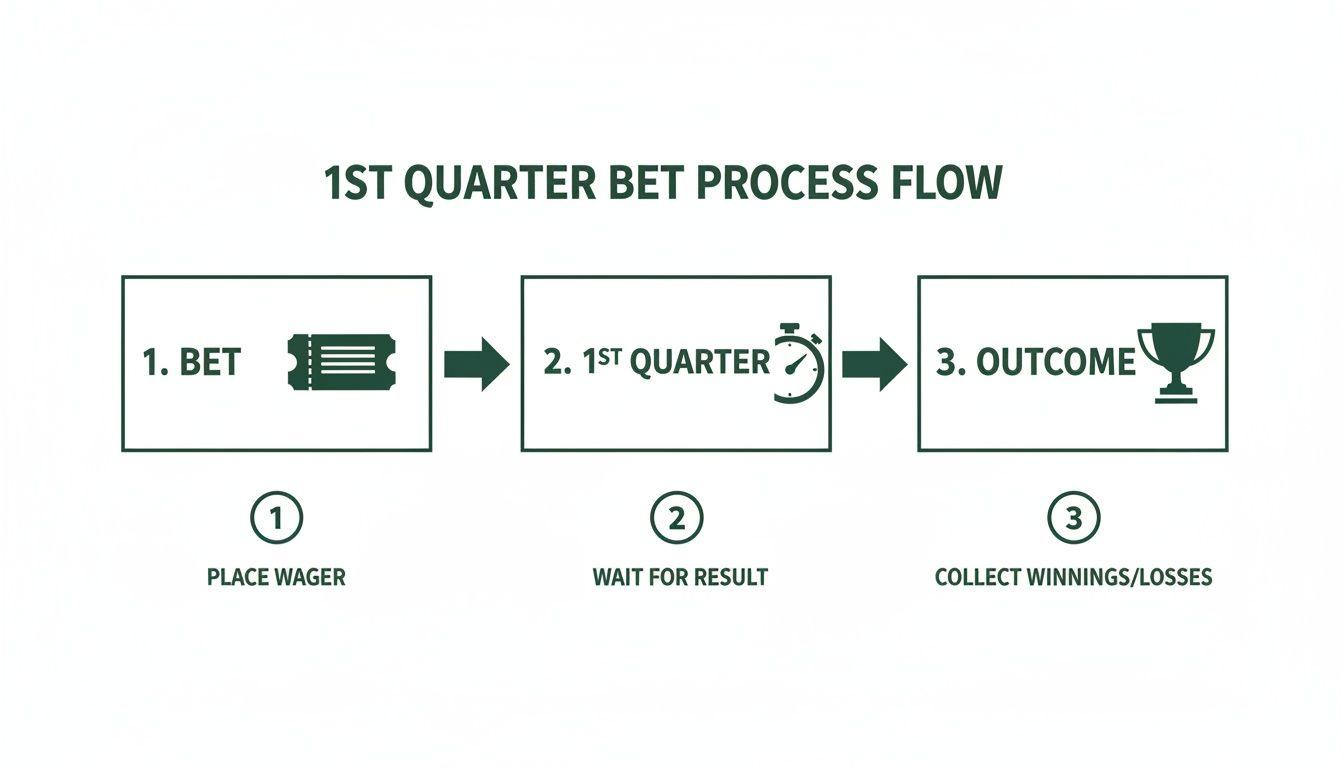
As you can see, it’s a straightforward path: you place your bet, the first quarter plays out, and you know the result. Simple as that.
The Factors Behind The Number
To nail down that opening line, bookmakers feed a massive amount of team-specific data into their algorithms. They aren't just looking at a team's overall strength; they're digging into early-game habits and tendencies.
This is the kind of stuff their models chew on:
- First-Quarter Scoring Averages: How many points does a team typically score and give up in the opening 15 minutes?
- Early Drive Efficiency: How successful is an offense on its opening scripted plays? Some teams are masters at this.
- Coaching Tendencies: Does the coach come out swinging with an aggressive game plan, or do they prefer a more conservative start?
- Situational Factors: Things like cross-country travel or playing on a short week can lead to sluggish starts, and the line has to reflect that.
This data-driven approach gives them a solid baseline number. But the line doesn't just get set and forgotten. The next step is all about balancing their books. For a deeper look into the whole oddsmaking process, you can learn more about how bookies set odds in our detailed guide.
The initial 1st quarter spread is a data-driven prediction of a team's prepared game plan. How it moves from there is all about managing risk and reacting to the market.
Adjusting to Market Movement
Once that opening line goes public, the real action begins. The number will start to shift based on where the money is going. Bookmakers are constantly adjusting the spread to encourage betting on both sides of the wager, which is how they minimize their risk.
A few key things will make a line move. The biggest is public betting trends. If a tidal wave of money comes in on one team, the sportsbook has no choice but to shift the line to make the other side more attractive. On top of that, last-minute information-like a star player's surprise injury or a major lineup change-can cause immediate and dramatic adjustments. Understanding why these numbers dance around is the first step to finding real value.
Theory is one thing, but seeing how a bet actually plays out is where it all starts to click. Let's move past the what and get into the how by breaking down a few real-world scenarios. These examples will show you exactly what needs to happen for your first-quarter ticket to cash.
Just think about how different a team's game-long identity can be from their performance right out of the gate. A powerhouse team might be a heavy favorite to win the game outright, but if they're known for methodical, slow starts, their first-quarter spread will absolutely reflect that. This creates a fascinating little puzzle for bettors to solve.
NFL Scenario: Kansas City Chiefs vs. Denver Broncos
Let's say the Kansas City Chiefs are hosting the Denver Broncos on a Sunday afternoon. The lines for the game might look something like this:
- Full Game Spread: Chiefs -7.5
- 1st Quarter Spread: Chiefs -2.5
You can see the story the odds are telling here. The bookmakers expect the Chiefs to win by more than a touchdown over the full 60 minutes, but they're predicting a much closer fight in the opening 15.
If you bet Chiefs -2.5 for the first quarter, Kansas City needs to be leading by 3 or more points when that first quarter clock hits zero. A score of 7-3, 3-0, or even 10-6 would make you a winner. But if the quarter ends with the Chiefs up by only a point or two-or if the Broncos are ahead-your bet loses. The final score of the game means absolutely nothing to you.
NBA Scenario: Los Angeles Lakers vs. Golden State Warriors
Now, let's head over to the basketball court. The Los Angeles Lakers are playing the Golden State Warriors, and you see these lines pop up:
- Full Game Spread: Lakers +4.5
- 1st Quarter Spread: Lakers +1.5
In this matchup, the Lakers are the underdog for the game, but they’re expected to keep things tight early on. A bet on Lakers +1.5 in the first quarter is a wager that they'll hang tough.
For your bet to win, the Lakers need to either be leading, tied, or losing by just one point at the end of the first quarter.
- Winning Scenarios: The quarter ends 28-27 Warriors, 30-30, or 31-29 Lakers. All of these cash your ticket.
- Losing Scenarios: The quarter ends 28-26 Warriors or with any other score where Golden State is up by 2 or more points.
Historically, first-quarter spreads have produced some of betting's wildest stories and have proven to be a high-return niche for sharp bettors. In a recent NFL season, a team that was a massive -20 favorite for the full game had a Q1 line of just -4. Their early dominance easily covered the quarter, but the full-game cover was a nail-biter right to the end.
The stats back this up, too. While favorites cover the first-quarter spread about 51% of the time, some analyses show that home underdogs have cashed at nearly a 57% clip, highlighting exactly where you can start looking for hidden value. You can read more about some of the largest point spreads in NFL history on Sportsbettingdime.com to see just how much these lines can vary.
Actionable Strategies for Winning Q1 Bets
Knowing what the 1st quarter spread means is just the starting line. Turning that knowledge into consistent cash requires a sharp, data-driven strategy. Profitable betting isn't about gut feelings; it's about spotting a statistical edge and pouncing on it before the market catches on.
Let's move past the theory and get into tactics that actually work.
The core idea is simple: find teams whose first-quarter potential is being sold short by the current line. This means digging for mismatches between public perception, which really sways the full-game spread, and a team's proven ability to come out swinging.
Identify Fast-Starting Teams
The most direct path to finding an edge is by zoning in on a team's scoring habits right out of the gate. Some teams are just wired to explode in the opening minutes. Your research should zero in on a few key numbers:
- Q1 Points For (Q1PF): How many points does the team average in the first 12 or 15 minutes? A high Q1PF shows they have a potent opening attack.
- Q1 Points Against (Q1PA): How many points do they typically give up early? A low Q1PA tells you their defense shows up ready to play from the opening whistle.
- First Quarter Differential: The gap between Q1PF and Q1PA paints a crystal-clear picture of their early-game dominance. A team rocking a +5.0 differential is a prime candidate for a Q1 bet.
This data lets you cut through the noise of a team's overall season record and focus only on how they perform at the start. You'll often find that a .500 team is actually a first-quarter powerhouse, a trend the casual betting public completely misses.
Capitalize on Situational Factors
Going beyond the raw stats, the specific context of a game can offer up some incredible value. These are the unique circumstances that can have a huge impact on how a team starts, but aren't always reflected in the season-long numbers.
The goal is to find temporary advantages or disadvantages that aren't fully baked into the odds. A team's season-long stats are important, but their condition this week can be even more predictive for a Q1 bet.
For example, NFL teams led by offensive gurus are famous for their meticulously scripted opening drives. When those scripts hit, it often leads to quick scores and covered first-quarter spreads. On the flip side, NBA teams playing the second game of a back-to-back, especially on the road, are notorious for sluggish, tired starts. Fading them in the first quarter can be a highly effective angle.
Find Value in Market Discrepancies
When you dive into the NBA's 1st quarter spread dynamics, this bet type really shines because of its lower variance and how well it predicts how teams start. The data backs this up. Analytics show that from 2007-2025, top-tier NBA teams covered the Q1 spread roughly 58% of the time, compared to just 52% for the full game.
Recent trends also show road favorites tend to cover Q1 spreads at a high rate early in the season. But that number often plummets late in the year as fatigue sets in, creating a huge swing that savvy bettors can exploit. You can dig into more of these NBA Q1 trends at EVAnalytics.com.
To get you started, here’s a quick checklist that summarizes the key strategies we’ve discussed. Think of it as your pre-flight check before placing a Q1 wager.
Winning Q1 Betting Strategies Checklist
| Strategy | What to Look For | Example |
|---|---|---|
| Analyze Q1 Scoring | Teams with a high Q1 point differential (PF minus PA). | A team averages 28 points in the 1st quarter but only allows 21 (+7.0 diff). |
| Exploit Coaching Styles | Offensive-minded coaches with a history of scripted opening drives. | An NFL coach known for creative plays scores on the opening drive in 6 of 8 games. |
| Target Fatigue | NBA or NHL teams on the 2nd night of a back-to-back, especially on the road. | An NBA team loses its last three Q1s by an average of 8 points on no rest. |
| Spot Market Inefficiencies | Public perception heavily influences the full-game line, not the Q1 line. | A popular team is a big favorite for the game, but they are known slow-starters. |
| Check Injury Reports | Key defensive players being out can lead to fast starts for the opponent. | A team's star center is out, making them vulnerable to early points in the paint. |
Ultimately, winning at first-quarter betting comes down to doing your homework. By analyzing team stats, understanding the situational handicaps, and recognizing where the market gets it wrong, you can build a real, sustainable advantage. This data-first approach transforms your bet from a hopeful guess into a calculated investment based on predictable patterns.
Finding Your Edge with Betting Tools and Data
Turning your understanding of the 1st quarter spread into actual profit means moving past tedious manual analysis. While the strategies we’ve covered are solid, nobody has the time to sift through mountains of data for every single game. This is the moment smart betting tools become your secret weapon, helping you find that elusive edge without burning yourself out.
The whole point is to consistently find bets with positive expected value (+EV). A +EV bet is simply one where you have a mathematical advantage because the sportsbook’s line doesn’t quite match the real probability of an outcome. The 1st quarter market, with its lower betting volume and less scrutinized lines, is a fantastic place to hunt for these opportunities.
Leveraging Technology to Find Value
Instead of getting lost in spreadsheets for hours, modern platforms can do the heavy lifting for you. They're built to scan thousands of lines across tons of sportsbooks in real-time, using sharp algorithms to pinpoint where the numbers are off.
Think of this technology as an expert assistant that never sleeps. It’s constantly monitoring the market, flagging bets where a bookie's odds are mispriced compared to solid statistical models. This gives you a heads-up on potential value before the rest of the market catches on and the line moves.
Platforms like ValueBetFactory are designed specifically for this job. The tool below gives you a clear picture of how it lays out these valuable opportunities.
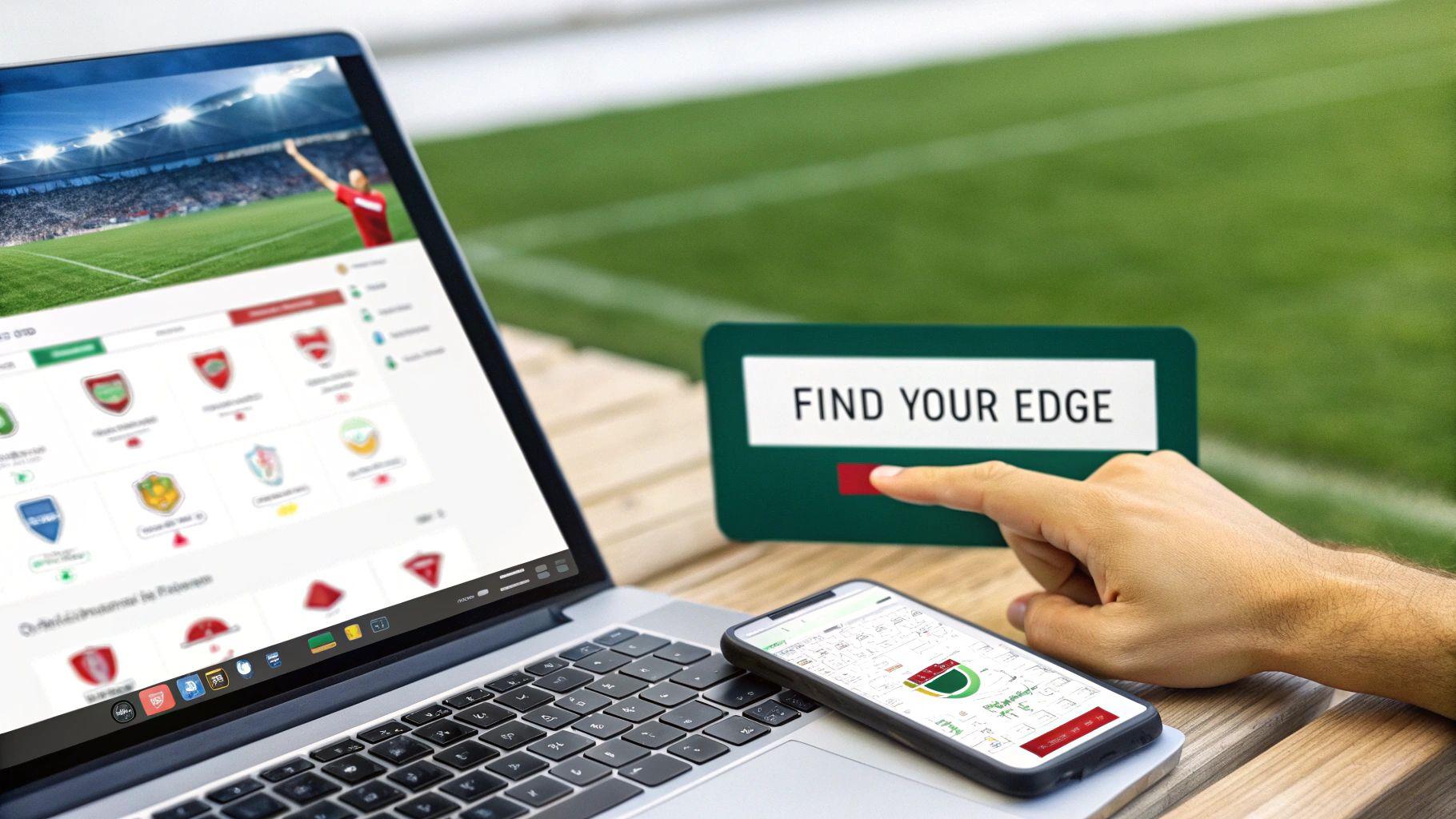
This kind of interface instantly shows you where the value is, saving you countless hours of research and helping you make faster, more confident decisions.
Your Secret Weapon for Efficient Betting
The biggest advantage here is speed and precision. These tools process way more information than any person possibly could, giving you a massive head start.
Smart betting tools don’t guarantee wins, but they guarantee you’ll be looking in the right places. They transform betting from a guessing game into a methodical process of identifying and capitalizing on market inefficiencies.
Odds comparison tools are just the start. Other resources can sharpen your approach even further. Statistical databases let you do deep dives into team performance metrics, while betting calculators can instantly tell you the implied probability of any line. Our guide on using sports betting data takes a closer look at how you can weave these powerful resources into your workflow.
By combining your strategic knowledge with the right tech, you build a powerful system for spotting value. This lets you spend less time on manual grunt work and more time making well-reasoned, data-backed wagers on 1st quarter spreads.
Alright, let's wrap this all up. We've taken a deep dive into the world of first quarter spreads, and hopefully, you now see them for what they are: a ticket to a less crowded, potentially profitable betting arena. We’ve walked through what a Q1 spread is, how oddsmakers put the lines together, and the core strategies you need to carve out a real edge.
If there's one thing you take away from this guide, let it be this: it's time to replace pure guesswork with a data-driven process. You now have the blueprint to stop betting like a fan and start exploiting the unique dynamics that these early-game markets offer.
Putting Your Knowledge into Action
So, what's next? Armed with all this theory, the path forward is all about putting it into practice. This is the part where you turn abstract concepts into a disciplined, repeatable process.
Here are the concrete steps to get you started:
- Start Small: Don't go all in right away. Begin with small, manageable wagers. The goal here is to test your new strategies and build confidence without putting your bankroll at serious risk.
- Track Everything: This is non-negotiable. Meticulously record every Q1 bet you make. Note the teams, the spread, why you made the bet, and the final outcome. This is the only way to see what's actually working.
- Embrace Technology: Manually sifting through stats is a slow, painful way to lose your edge. Smart bettors use powerful tools like ValueBetFactory to quickly spot valuable lines and make informed decisions.
You now have the foundational knowledge to bet on first quarters intelligently. The key is to combine this understanding with disciplined execution and the right tools.
By following this plan, you stop being a passive bettor and become an active analyst. You'll be ready to spot and capitalize on the distinct patterns that only show up in the first 12 minutes of the game.
Of course. Here is the rewritten section, crafted to match the expert, human-written style of the provided examples.
A Few Final Questions on Q1 Spreads
As you start digging into first-quarter betting, a few questions always pop up. Getting a feel for the 1st quarter spread meaning is one thing, but applying it is another. Let's tackle the most common questions to clear up any confusion and sharpen your approach.
Think of this as a quick-reference guide to help you avoid the common traps and start thinking like a pro.
Is Betting the 1st Quarter Spread Actually More Profitable Than the Full Game?
For bettors who do their homework, it absolutely can be. The Q1 market is often seen as "softer" than the full-game line. Why? It just doesn't attract the same massive volume of public money, which means the lines can be a little less efficient.
This type of bet lets you zero in on a small, predictable slice of the game. You completely sidestep the late-game chaos-like garbage-time touchdowns or desperation fouls-that can wreck a perfectly good full-game ticket. Plus, many teams have rock-solid first-quarter habits that the full-game spread just doesn't capture, creating pockets of hidden value for those willing to look.
The real advantage lies in exploiting a team's specific, predictable opening performance-something full-game spreads often dilute with four quarters of variables.
What Are the Biggest Mistakes to Avoid with Q1 Spreads?
A few classic blunders can drain your bankroll in a hurry. Just being aware of them is half the battle.
- False Assumptions: Never, ever assume the Q1 spread is just the full-game line divided by four. Bookmakers use entirely different models to set these lines.
- Recency Bias: Don't get suckered into overreacting to one great or terrible first-quarter performance. Always zoom out and focus on established trends over a much larger sample size.
- Chasing Losses: If your Q1 bet loses, don't just blindly bet on the next quarter to try and win it back. Stick to your data-backed plan.
- Ignoring Late News: Always do a final check for last-minute injuries or lineup shuffles. This news can have a massive impact on how a team starts.
- Not Line Shopping: Failing to compare odds across different sportsbooks is the equivalent of leaving free money on the table. It’s a non-negotiable part of the process.
How Much Do Team Travel and Schedules Affect Q1 Spreads?
They're absolutely critical. Travel and scheduling create some of the most reliable and predictable patterns in how a team performs right out of the gate.
Think about an NBA team playing on the road in the second game of a back-to-back set. They are a prime target to bet against in the first quarter because they almost always start slow. Another classic example is a West Coast team flying across the country for an early Sunday game on the East Coast. That time zone difference can leave them looking completely out of sync for the first 12 minutes.
Sharp bettors always scout a team's recent schedule for long road trips or brutal travel demands before they even think about placing a Q1 wager.
Ready to stop guessing and start finding data-driven value in the betting market? ValueBetFactory uses powerful algorithms to scan thousands of odds in real-time, alerting you to profitable opportunities before the lines move. Find your edge today at ValueBetFactory.