
How Do Bookies Set Odds A Bettor's Guide
Unlock Profits with betting tips!
Bookmakers set odds using a three-part formula. First, they calculate the true statistical probability of an outcome. Next, they bake in a profit margin, often called the vigorish or 'vig'. Finally, they adjust those odds based on market demand and betting patterns to keep their own risk in check.
This process transforms a pure statistical guess into a commercial product, one that’s carefully designed to guarantee them a profit.
The Three Pillars of Oddsmaking
Ever stared at a set of odds and wondered where the numbers actually come from? It’s not just guesswork. The way bookies set odds is a calculated business strategy built on three core pillars.
Think of it like a three-legged stool: if any one leg is weak, the whole thing collapses. For a bookmaker, those legs are probability, profit, and risk management.
Getting your head around this concept is the first real step for any bettor looking to move beyond casual punting. Once you understand the system, you start to see why odds move and, more importantly, where the real value might be hiding.
To get started, here's a quick look at the core components we'll be breaking down.
The Core Components of Setting Odds
| Pillar | What It Is | Why It Matters for Bettors |
|---|---|---|
| Probability | The bookmaker's statistical baseline, their best guess at the real-world chances of an outcome. | If your own probability estimate is more accurate than the bookie's, you've found an edge. |
| Margin | A built-in commission (the overround or vig) applied to the odds to guarantee a profit. | The margin is what you're up against. A higher margin makes it harder to find profitable bets. |
| Market | Adjustments made to the odds based on betting volume to balance their books and limit risk. | Market movements can create value opportunities as odds drift away from the true probability. |
These three pillars work together to create the betting markets you see every day. Let's dig into each one.
Pillar 1: Probability – The Statistical Foundation
The journey of creating odds starts with pure mathematics. Long before a bookie even thinks about their profit, a team of analysts and powerful algorithms get to work calculating the true probability of every possible outcome. This is their unbiased, statistical baseline.
They crunch a massive amount of data to build this picture, including things like:
- Historical Performance: How have these two teams or players fared in past matchups?
- Current Form: What’s their recent performance been like? Are they on a hot streak or in a slump?
- Situational Factors: This covers everything from key player injuries and team morale to weather forecasts and even travel fatigue.
By weighing all these factors, they create an initial percentage chance for each outcome. For instance, they might figure that Team A has a 60% chance to win, a draw has a 25% chance, and Team B has a 15% chance. This first step is all about getting as close to reality as they possibly can.
Pillar 2: Margin – The Built-In Profit
Once the true probability is set, the bookmaker adds their cut. This is the most crucial part of their business model, and it's known as the vigorish (vig) or overround. They deliberately shorten the odds for every outcome, which makes the combined implied probabilities add up to more than 100%.
A bookmaker's goal isn't just to predict the winner; it's to create a market where they can lock in a profit no matter what happens. The overround is their guaranteed commission for taking your bet.
This infographic breaks down how these pillars work together in a simple flow.
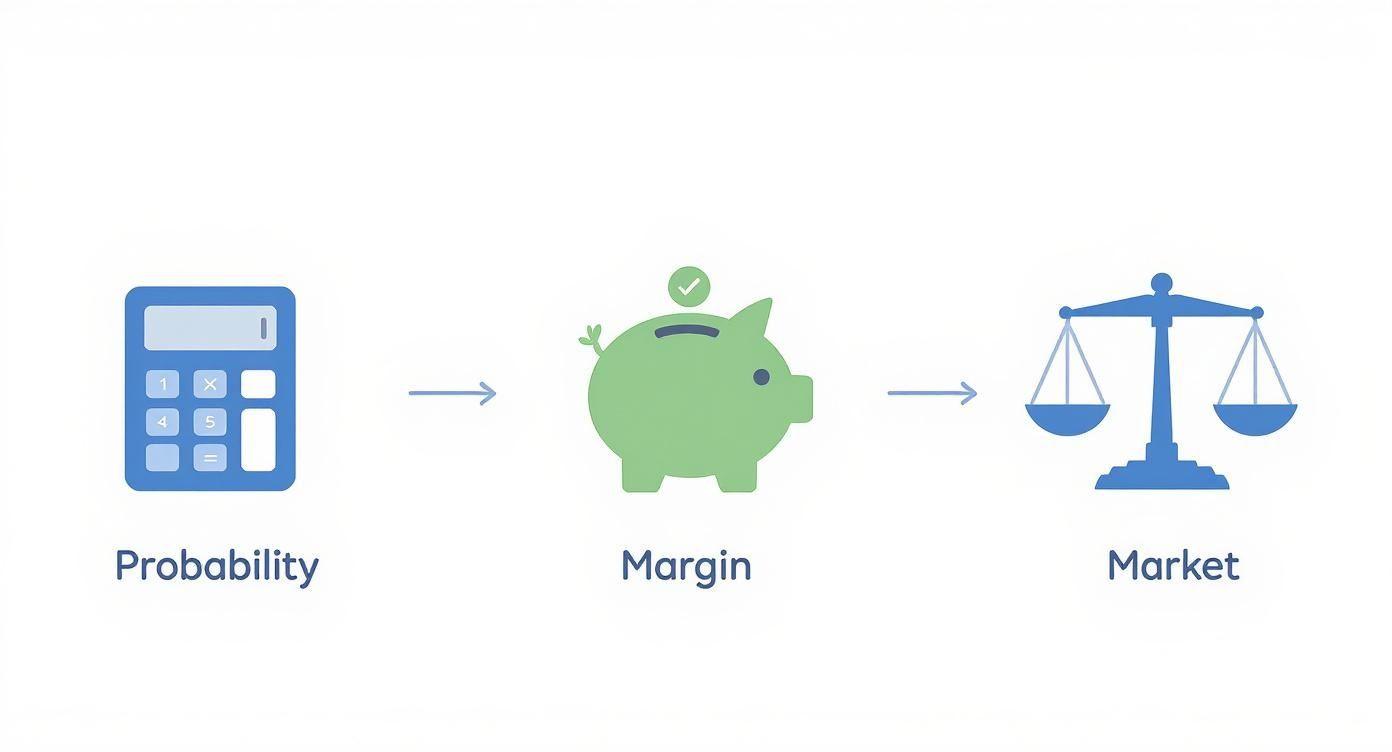
As you can see, the process moves logically from a statistical assessment to applying a profit margin, and finally to balancing the whole thing against real-world betting.
Pillar 3: Market – The Final Adjustment
The last pillar involves reacting to you, the bettor. Once the odds are live, bookmakers watch the betting activity like a hawk. If too much money floods in on one side, it creates a huge liability for them.
To manage this risk, they adjust the odds to "balance their books." They’ll shorten the odds on the popular outcome to make it less attractive and lengthen the odds on the unpopular side to encourage bets there. This dynamic adjustment is all about protecting their profit margin and turning a simple prediction into a balanced, profitable market.
Calculating an Event's True Probability
Every betting line you see starts with one fundamental question, and it has nothing to do with profit. Before a bookie even thinks about their cut, they have to answer this: what are the real chances of each outcome happening? This first, crucial step is all about calculating an event's true probability.
This isn't some back-of-the-napkin guess. It’s a deep, data-heavy process where oddsmakers act more like financial analysts than sports fans. They use teams of experts and powerful algorithms to crunch a massive amount of information, all to build a clean, unbiased statistical model of reality.
Their goal is to spit out a percentage for every possible result. This number represents their best guess at what would happen if the game were played a hundred times over. This pure, unfiltered probability is the anchor for everything that follows.
The Anatomy of a Probability Model
To build this statistical picture, oddsmakers weigh a huge range of variables, giving each one a specific importance that feeds into the final calculation.
It’s a bit like a chef perfecting a recipe. Each ingredient (a data point) is added in a precise amount to get the final product just right.
Key factors often include:
- Historical Data: How have these teams performed against each other in the past? Are there any clear trends in head-to-head matchups?
- Player Form and Fitness: Is a star player on a hot streak or just coming back from an injury? The availability and condition of key individuals can completely change a team's chances.
- Situational Factors: This bucket covers everything else, home-field advantage, nasty weather conditions, travel fatigue from a long road trip, or even locker-room morale.
A strong home-field advantage might add a few percentage points to the home team's chances, while a last-minute injury to a key player could knock several points off.
At its core, calculating true probability is an attempt to model the future based on the past. The oddsmaker's initial line is their most accurate, unfiltered prediction of how an event will unfold, completely separate from any profit motive.
And these initial calculations are scarily accurate. For instance, one detailed study of over 5,000 NFL games found that sportsbook point spreads accounted for about 86% of the variation in the actual margin of victory. While the analysis showed bookies tend to slightly overestimate the final margin (by about one point on average), their forecasting is still remarkably precise. You can read more about the study's findings on forecasting accuracy to see just how close they really get.
From Data Points to Percentages
Let's walk through a simple football match to see how this works in practice. Imagine Manchester United is playing Liverpool at home. The oddsmakers' model might break it down something like this:
- Baseline Probability: Based purely on historical league performance, the model might start with Manchester United having a 50% chance of winning.
- Adjust for Home-Field Advantage: Playing at home is a big deal, so the model adds +10% to their win probability.
- Adjust for Player Injuries: United's star midfielder is out, so the model subtracts -5% from their chances.
- Final Probability: After all the tweaks, the model lands on a true probability of 55% for a Manchester United win.
They’d then repeat this process for the other outcomes. A draw might be calculated at 25%, and a Liverpool win at 20%.
Notice that these "true" probabilities add up perfectly to 100% (55% + 25% + 20%). This reflects a pure, margin-free statistical assessment. This initial percentage is the raw material that will later be turned into the odds you see on a betting site. For a deeper dive into this crucial next step, you might be interested in our guide on how to convert probability into odds.
How Bookmakers Guarantee Their Profit
If a bookie just offered odds based on pure, unfiltered probability, they’d do little more than break even over the long haul. And let's be honest, breaking even isn't much of a business plan. This is where their secret weapon comes into play, the core mechanism that ensures they always, always have an edge.
This built-in advantage is called the overround, or more famously, the vigorish (the "vig"). It’s a small, calculated commission that’s baked directly into every single betting market they offer. By deliberately shortening the odds on all outcomes, bookies create a market where the implied probabilities add up to more than a perfect 100%.
That little bit extra is their guaranteed profit margin. It’s the hidden cost you pay to place a bet and the fundamental reason bookmakers stay in business.
The Overround Explained
Imagine a fair market is a perfectly whole pie, where all the slices, the chances of each outcome, add up to exactly 100%. A bookmaker's pie, however, is bigger. They slyly add a few extra slices just for themselves.
This mathematical trick ensures that, in the long run, they will always pay out less than the total amount of money they take in. A typical bookie’s market will have implied probabilities that sum up to somewhere between 105% and 120%, depending on the sport and event.
The overround is the bookmaker's safety net. It creates a mathematical imbalance in their favor, ensuring that if they take a proportional amount of money on all sides of a bet, they lock in a profit regardless of the result.
This is the single most important principle that separates sports betting from a fair game of chance. The house always has a subtle but incredibly powerful advantage.
From True Probability To Profitable Odds
Let's jump back to our football match from the last section. The true probabilities looked like this:
- Home Win: 60%
- Draw: 25%
- Away Win: 15%
Add them up, and you get a perfect 100% (60 + 25 + 15). Now, the bookmaker steps in and applies their margin, we’ll use a modest 5% for this example. They don't just tack it onto one outcome; they cleverly distribute it across all of them by shortening the odds.
This process morphs the true probabilities into implied probabilities that might look something like this:
- Home Win Implied Probability: 62.5%
- Draw Implied Probability: 26.5%
- Away Win Implied Probability: 16.0%
Now, do the math. The new total is 105% (62.5 + 26.5 + 16). That extra 5% is the bookmaker’s overround, their guaranteed slice of the pie. For a full breakdown of how they do this, check out our guide on how bookmakers make money.
Why Understanding The Vig Matters
Recognizing the vig is the first giant leap toward becoming a sharp bettor. It fundamentally changes how you should view the odds board. You're not just betting against the chance of an event happening; you're betting against the bookmaker's built-in commission, too.
This means that for a bet to have real "value," the outcome doesn't just need to be likely. Its true probability has to be high enough to clear the hurdle of the house edge. This hidden margin is precisely why blindly backing favorites is a surefire way to bleed your bankroll dry over time.
The size of the vig also tells you a lot about the market itself. A higher overround often signals a less popular event or one with more uncertainty, where the bookie is building in a bigger buffer for themselves. On the flip side, a lower overround is common in hyper-competitive markets, like major football leagues, where bookies are forced to offer sharper odds to attract customers.
Reacting to the Market and Balancing the Books
Once the odds go live, a bookmaker’s job has only just begun. Those initial numbers, carefully crafted from probability models and profit margins, are just the opening act. The real work starts the moment the market begins to speak, when the first bets roll in and force oddsmakers to start reacting.
This next phase is all about one thing: managing risk. A bookie's worst nightmare isn't just being wrong about who wins; it's being massively overexposed on one side of a bet. Their ultimate goal is to create what's known in the industry as a balanced book.
A balanced book is a state of commercial bliss for a bookmaker. It means they've taken in just the right amount of money on every possible outcome. When that happens, they can simply use the cash from all the losing wagers to pay out the winners and keep their built-in vig, guaranteeing a profit no matter what the final score is.
The Problem of Liability
Of course, the market rarely cooperates so perfectly. Bettors often pile onto one side, creating a lopsided pool of money. When a flood of cash comes in on a single outcome, it creates a massive liability for the bookmaker.
Imagine a tennis match where 90% of the betting volume is on Player A. If Player A wins, the bookie is on the hook for a colossal payout without nearly enough money from bets on Player B to cover it. This is the exact financial cliff they're desperate to avoid.
To fight this, they have to adjust the odds. This isn’t about changing their mind on who's likely to win; it's about steering the market to protect their bottom line.
The constant movement of odds before a game is rarely about the bookmaker changing their mind. It's about them managing their financial exposure by encouraging bettors to wager on the less popular side.
This is a critical insight for any bettor. The odds you see aren't just a reflection of probability; they're also a gauge of public opinion and the bookmaker's current risk. Learning to read these shifts is a core skill, and you can get a much deeper understanding from our guide on understanding betting line movement.
How Bookies Adjust the Odds
When a book gets unbalanced, oddsmakers have a simple but powerful toolkit to nudge it back into shape. The strategy boils down to making the popular choice less appealing while making the unpopular one more attractive.
Here’s the game plan:
- Shorten the Odds on the Popular Side: If too much money is coming in on the home team, the bookie will lower the payout for that bet (e.g., dropping the odds from 2.00 down to 1.85). This move discourages more bets by shrinking the potential reward.
- Lengthen the Odds on the Unpopular Side: At the same time, they’ll boost the payout for the other outcome (e.g., raising the away team's odds from 3.50 to 3.75). This sweetens the pot, inviting money to flow to the side they need bets on to balance their books.
This constant push and pull is why odds can swing so dramatically in the hours leading up to an event. It’s a delicate dance of risk management, where every tiny adjustment is designed to herd the betting volume back toward a profitable equilibrium.
Responding to Sharp Money vs. Public Money
Not all money is created equal in the eyes of an oddsmaker. They pay extremely close attention to who is placing the bets, and their reaction changes dramatically depending on the source.
- Public Money: This is the cash coming from the general, casual betting public. This money is often driven by gut feelings, media hype, or a natural bias toward favorites. When public money moves a line, bookies are less worried, as they generally trust their own models over popular sentiment.
- Sharp Money: This is money wagered by professional, respected bettors known for their sophisticated models and ability to spot value. When a big bet comes in from a "sharp," bookmakers sit up and take notice. It often serves as a red flag that their own odds might be off, prompting them to adjust their lines far more aggressively.
In short, public money makes bookies manage their liability. Sharp money makes them question their probability. A good oddsmaker's ability to tell the difference is vital for setting truly effective lines that can withstand pressure from every corner of the market.
Where the Math Gets Complicated: Advanced Factors Shaping the Odds
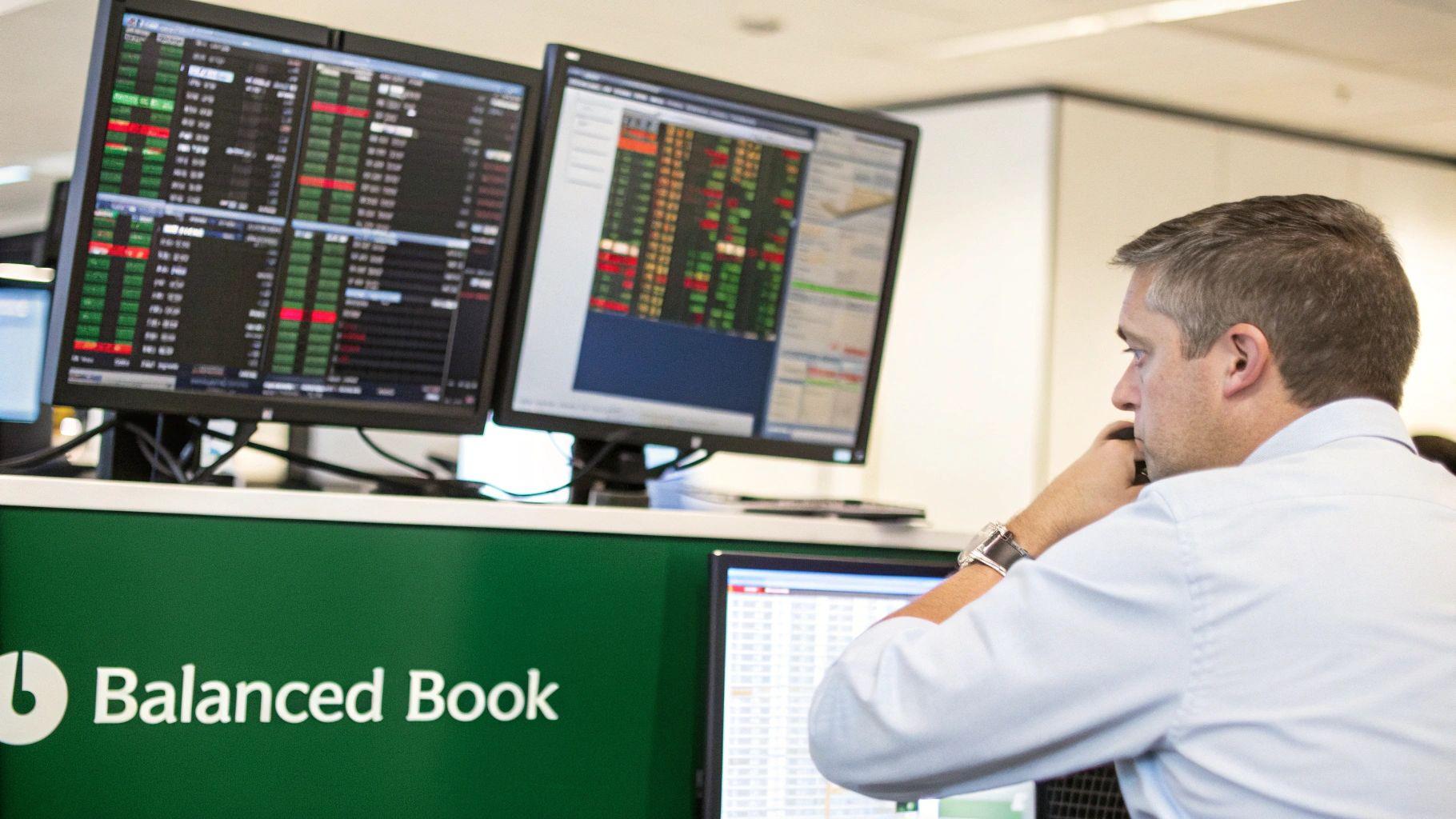
While the core recipe for odds involves probability, margins, and market money, the process doesn't stop there. Several other factors come into play, fine-tuning the numbers you see on your screen and revealing just how complex a modern sportsbook operation really is. This is where bookies move from setting odds on a single game to managing a massive, interconnected ecosystem of bets.
This is where the art of oddsmaking meets high-frequency trading. Today's top bookmakers are technological powerhouses, using automated systems to juggle thousands of markets at once. It's a blend of hardcore statistical modeling and real-time market strategy that has left the old, subjective methods in the dust.
The Chaos of Live In-Play Betting
The explosion of in-play (or live) betting completely changed the game. Forget static pre-match odds; bookmakers now have to manage lines that bounce around every few seconds. This demands a whole different level of speed and precision, and it's driven almost entirely by algorithms.
These systems are hooked up to a firehose of real-time data from the event itself, every pass, shot, or foul. The algorithm instantly recalculates the probability of every possible outcome after each tiny action on the field.
Think about it: a single goal in a football match doesn't just tweak the match-winner odds. It triggers a chain reaction, an instant, automated price adjustment across dozens of related markets:
- Total Goals: The probability of an "Over 2.5 goals" bet just went through the roof.
- Next Goalscorer: Odds for every player on the pitch are instantly recalculated.
- Correct Score: Every potential final score is repriced based on the new game state.
This constant, high-speed recalibration is a masterclass in risk management. It’s designed to protect the bookmaker from sudden shifts in momentum while keeping a continuous stream of betting opportunities open.
Why the Vig Changes from Match to Match
A bookmaker's profit margin, or vig, isn't a one-size-fits-all number. It’s a flexible tool they use to manage risk and competition, strategically dialing it up or down based on the event's profile.
Think of the vig as a bookmaker's confidence meter. A low vig signals high confidence in their data and a competitive market. A high vig signals uncertainty and a need for a bigger safety net.
On a massive event like the World Cup final, the betting market is incredibly efficient. Huge amounts of money and data are pouring in from all corners. To compete, bookmakers will slash their vig, sometimes down to a razor-thin 2-3%. They're confident in their models and need sharp odds to attract a slice of that massive betting volume.
But what about a niche market, like a lower-league volleyball match? Here, the available data is sparse and the betting volume is tiny. The bookmaker faces way more uncertainty. To protect themselves against sharp bettors who might have superior information, they'll apply a much fatter vig, often 8-10% or even higher.
Juggling Liability Across the Entire Platform
A modern sportsbook isn't just balancing the books on one match. They're managing their total financial exposure across thousands of events happening at the same time. This is known as portfolio management. Their systems are built to ensure that one massive, unexpected upset doesn't create a catastrophic loss for the whole company.
This is why they rely so heavily on automated, algorithm-driven systems. These platforms use complex mathematical models to generate dynamic odds across their entire site. When confidence in their data is high, bookmakers lower their margins to attract more bets. But if uncertainty is high, those margins go up to protect profits, all while balancing their total liability. You can discover more insights about these automated systems to see how they function.
This holistic, big-picture view allows them to absorb shocks and stay profitable even when individual results go haywire.
Turning This Knowledge into an Edge
Getting a real grip on how bookies set their odds is the single biggest advantage you can have. This isn't just background noise; it's the fundamental piece of the puzzle that separates casual punters from bettors who can actually challenge the market.
At its core, the whole process is a formula. Bookmakers start with a statistical probability, bake in their profit margin, and then nudge the final numbers based on where the money is going. Once you truly understand this framework, you're on your way to betting smarter.
This knowledge completely reframes how you see the board. You stop looking at odds as a simple forecast of who might win. Instead, you see them for what they really are: a commercial product, carefully priced to balance the bookie's risk and lock in a profit.
Finding the Value Hidden in the Numbers
Your goal is no longer just to pick winners. It's to hunt down value bets. These are the golden opportunities where you believe the real-world probability of something happening is higher than the bookmaker's odds suggest, even after you account for their built-in cut.
To spot these chances, you have to start thinking like an oddsmaker yourself. This means you need to:
- Become Your Own Analyst: Develop your own way of estimating the true probability of an outcome, completely separate from the bookie's numbers.
- Always Calculate the Vig: Get in the habit of checking the overround. A market with a 108% book is a much tougher nut to crack than one sitting at a lean 103%.
- Learn to Read the Market: Keep an eye on major line movements. A sudden, sharp shift could be a signal of an overreaction to public money, potentially creating value on the other side of the bet.
The heart of smart betting isn't about owning a crystal ball. It’s about finding small but consistent edges where the bookmaker’s price doesn’t quite line up with the real-world probability of an event.
This analytical mindset is the first real step toward making strategic, data-driven decisions. The tools we've built here at ValueBetFactory are designed around this exact principle, to help you systematically find those little market slip-ups. It’s all about turning your understanding of how the sausage gets made into a real, actionable advantage.
A Few Final Questions About Oddsmaking
To wrap things up, let's run through a few of the most common questions people have about how this all works. Getting these straight will help solidify the key ideas we've covered and give you a much clearer picture of the world from the other side of the counter.
Do Bookies Want a Specific Team to Win?
Not a chance. A bookmaker's perfect game isn't one where the favorite wins or the underdog pulls off a miracle. Their dream scenario is a "balanced book."
A balanced book means they've taken a proportional amount of money on every possible outcome. When they pull this off, they can pay out the winning tickets using the money from the losing ones and pocket their built-in margin (the vig), no matter what the final score is. Cheering for a team is terrible for business; their only goal is financial balance.
Why Do Betting Odds Change So Much?
Odds are constantly on the move for two big reasons: new information and the flow of money. Any piece of significant news, a star player's last-minute injury, a sudden change in the weather forecast, can force oddsmakers to re-evaluate the real probability of an outcome.
More often than not, though, odds shift to manage liability. If a huge wave of cash comes in on one side, the bookie will shorten those odds to make them less attractive and lengthen the odds on the other side to encourage bets there. It's a non-stop balancing act to manage their financial risk.
Odds are not just a static prediction; they are a dynamic reflection of both statistical probability and the flow of money in the market. Understanding this is key to spotting opportunities.
How Accurate Are a Bookmaker's Odds?
Bookmaker odds are exceptionally good at forecasting the general likelihood of something happening. Their sophisticated models and massive datasets make their initial probability estimates incredibly precise.
However, they are not a pure reflection of probability. The odds you see are always tweaked by two things:
- The Overround (Vig): Their profit margin is baked right into the odds, slightly shortening them on all outcomes.
- Market Weight: The odds are adjusted on the fly to balance the betting volume and protect the bookmaker's bankroll.
So while they are highly accurate, they really represent a blend of statistical analysis and commercial risk management, not just raw probability.
Ready to put this knowledge to work? ValueBetFactory uses powerful algorithms to scan the market for you, identifying the exact moments when a bookmaker's odds create a value opportunity. Stop guessing and start making data-driven decisions. Discover your edge today.