
what is run line in baseball: A bettor's guide
Unlock Profits with betting tips!
So, what exactly is the run line in baseball? Just think of it as baseball’s answer to the point spread you see in football or basketball, but it’s almost always locked in at 1.5 runs. It’s a simple but powerful twist on picking a winner.
If you bet on the favorite, they don’t just have to win, they have to win by two or more runs. On the flip side, the underdog can either pull off an upset and win the game outright, or even lose by a single run, and your bet still cashes. It’s all about leveling the playing field.
Decoding the Run Line in Baseball Betting
The run line adds a fascinating strategic layer to baseball betting, pushing you to think beyond simply who will win. Instead, it forces you to ask the much more interesting question: by how much will they win? Grasping this concept is your key to finding much better value, especially when one team is a massive favorite.
Here’s a simple way to frame it: imagine you’re giving the underdog a 1.5-run head start before the first pitch is even thrown. Once you see it that way, the whole idea just clicks. The favorite now has to overcome that imaginary deficit on the scoreboard for your bet to be a winner.
The Basics of a Run Line Bet
At its heart, the run line is a spread bet tailored specifically for baseball. The sportsbook will set the line at -1.5 for the team they expect to win (the favorite) and +1.5 for the team they expect to lose (the underdog). Your job is to predict the final margin of victory, not just the victor.
Here’s what that looks like in the real world:
- Betting the Favorite (-1.5): Your team must win the game by 2 or more runs. A 5-3 victory is a win, but a nail-biting 5-4 win means your bet is a loss.
- Betting the Underdog (+1.5): Your team can win the game outright OR lose by only 1 run. A 4-5 loss might sting for the team, but it still makes your bet a winner.
This structure is a staple in MLB betting. Looking at historical data, you'll find that favorites tend to cover that 1.5-run line roughly 45-50% of the time in recent seasons. This stat alone highlights both the challenge and the potential reward. You can dig deeper into these kinds of numbers and find more MLB run line statistics on EV Analytics.
To keep it simple, here is a quick reference for how run line bets cash.
Run Line Betting At a Glance
| Betting On | Run Line | Winning Condition |
|---|---|---|
| The Favorite | -1.5 | Must win the game by 2 or more runs. |
| The Underdog | +1.5 | Can win the game or lose by only 1 run. |
This table boils it down to the core requirement for each side of the bet. It's all about that margin of victory.
Why Does the Run Line Exist?
So why bother with a run line at all? Its main purpose is to create more balanced and attractive odds, especially in games that look like a total mismatch on paper. Baseball has plenty of lopsided matchups, which often leads to terrible moneyline odds on the favorite that just aren't worth betting.
The run line transforms a potentially low-payout bet on a heavy favorite into a much more valuable proposition. By requiring the favorite to win by a specific margin, sportsbooks can offer much more attractive odds than a simple win/loss wager.
This mechanic introduces real strategic depth. It forces you to look past a team's basic ability to win and really analyze their offensive firepower to build a lead and their defensive strength to protect it. It's about predicting dominance, not just victory.
Run Line vs. Moneyline: Unpacking the Differences
If you're new to betting, you probably started with the moneyline. It’s the most straightforward bet there is: you just pick the team you think will win the game. The run line, however, adds a fascinating layer of strategy by bringing the margin of victory into play. Getting a handle on how these two bets differ is a huge step toward building a smarter baseball betting strategy.
A moneyline bet is as simple as it gets. You pick a team, and if they win, you cash your ticket. It doesn't matter if they scrape by with one run in the 10th inning or blow out their opponent by ten. A win is a win. If you want a refresher on the basics, our guide on what is a moneyline bet covers it all.
The run line completely changes the question. It goes from "who will win?" to "who will win, and by how much?"
Shifting Risks and Rewards
The choice between a run line and a moneyline boils down to how you want to balance risk and reward. Backing a heavy favorite on the moneyline can feel like a sure thing, but the payouts are often so small they’re barely worth the trouble. The run line, on the other hand, demands more from that favorite team but offers much better odds as a reward.
Let's say the Los Angeles Dodgers are massive favorites against the Milwaukee Brewers.
- Moneyline Bet: The Dodgers might be sitting at -250. This means you’d have to risk a hefty $250 just to win $100.
- Run Line Bet: The Dodgers would be listed at -1.5, but their odds could flip to something much more attractive, like +110. Now, a $100 bet wins you $110.
This visual map breaks down exactly how a run line works for both the team expected to win and the underdog.
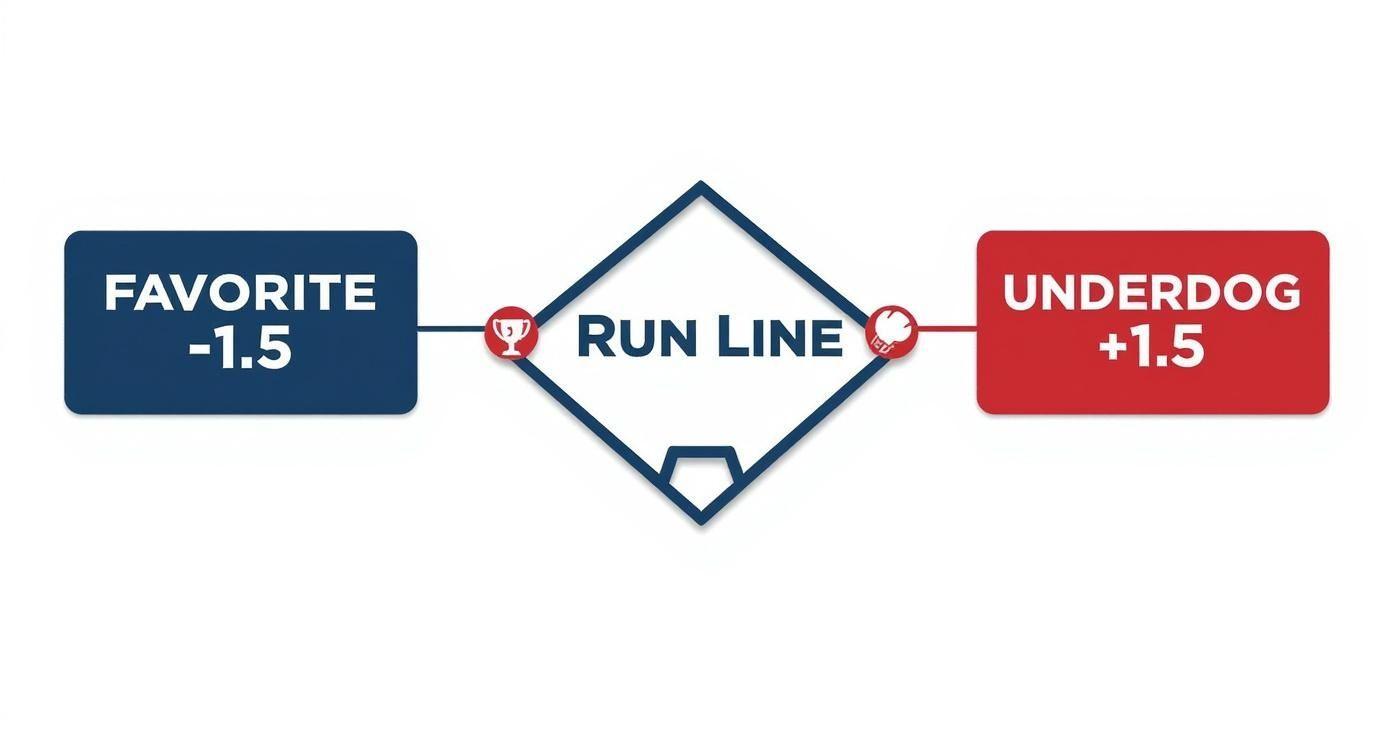
As you can see, the favorite has to win by at least two runs to cover that -1.5 spread. The underdog gets a +1.5 run cushion, which completely changes the game from a betting perspective.
When to Choose the Run Line
So, when does it make sense to pull the trigger on a run line bet? The main reason is to find better value. If you’re confident a strong favorite is not just going to win but is going to dominate, the run line gives you a much better return. In our example, if the Dodgers won 3-1, that run line bet would be a winner.
The run line is your tool for turning a low-value, prohibitive favorite into a worthwhile wager. It shifts the focus from simply picking a winner to accurately predicting game script and performance.
Flipping things around, taking an underdog at +1.5 is a fantastic way to give yourself a safety net. This bet gives you two ways to win: either the underdog pulls off the upset and wins outright, or they just keep the game close and lose by a single run. If you think an underdog is scrappy enough to stay competitive but might not have the firepower for an outright win, the run line is often the smarter play. It’s a strategic choice that rewards a deeper analysis of the matchup.
How to Read Run Line Odds and Calculate Payouts
At first glance, the numbers bolted onto a run line bet can look a bit like hieroglyphics. But once you crack the code, they're surprisingly simple. Getting a handle on them is what separates someone who just knows what a run line is from someone who can actually place a smart wager.
A full run line gives you two key pieces of information: the spread and the price.
Let's use a real-world example. Say the Los Angeles Dodgers are facing the Milwaukee Brewers, and the bookmaker lists the run line like this:
- Los Angeles Dodgers: -1.5 (+110)
- Milwaukee Brewers: +1.5 (-130)
The -1.5 and +1.5 are the run spreads we've already covered. The numbers in the parentheses, the +110 and -130, are the American odds. These odds tell you the price of the bet, or how much you stand to win for the risk you're taking. For a deeper dive into how these work across all sports, check out our complete guide on how to read sports betting odds.
Understanding Positive and Negative Odds
The beauty of American odds is that they're always based on a simple $100 benchmark. This makes figuring out your potential payout a piece of cake once you know the rules.
- Positive Odds (+): This number tells you how much profit you’ll make on a $100 wager. Here, the +110 on the Dodgers means a winning $100 bet on them to cover the -1.5 spread would earn you $110 in pure profit.
- Negative Odds (-): This number tells you how much you need to risk to win $100 in profit. The -130 on the Brewers means you’d have to bet $130 on them to cover the +1.5 spread just to win $100.
Think of the plus sign as a reward for taking a bigger risk and the minus sign as the "price of admission" for backing what the bookmaker sees as the more likely outcome.
Calculating Your Payouts Step by Step
Let's walk through the payouts for a $100 bet on both sides of our example game. Imagine the final score was Dodgers 3, Brewers 1.

Betting on the Dodgers -1.5 (+110):
- Check the Spread: The Dodgers won by two runs (3-1), which is more than the required 1.5. Your bet is a winner.
- Calculate the Payout: The odds are +110. A $100 bet nets you $110 in profit.
- Total Return: You get your original $100 stake back plus your $110 profit, for a total of $210.
Betting on the Brewers +1.5 (-130):
- Check the Spread: The Brewers lost by two runs (1-3). Since they needed to lose by one run or win the game outright, they didn't cover the spread. Your bet is a loss.
- Calculate the Payout: Your $130 stake is lost.
The gap between the odds on both sides of a bet (-130 vs +110) represents the sportsbook's commission, often called the "juice" or "vig." Understanding this built-in margin is essential for assessing the true value of any run line wager before you place it.
Smart Strategies for Run Line Betting
Alright, so you know what a run line is. That's step one. Now for the fun part: learning how to actually win money with it.
Smart run line betting means shifting your focus. Stop trying to just pick the winning team and start analyzing how they’re built to win. Are they a powerhouse that blows teams out, or do they grind out close, one-run victories? Answering that question requires a much deeper look than just checking the league standings.
You have to get into the nitty-gritty of the matchup to figure out if a game is destined for a blowout or a nail-biter.

Key Factors to Analyze
Before you even think about placing a run line wager, successful bettors are digging into a few critical areas. These factors paint a much clearer picture of whether a favorite is likely to cover the -1.5 spread or if an underdog has a real shot at keeping things close.
- Starting Pitching Matchup: This is everything. An ace going up against a team's fifth starter creates a massive mismatch that often leads to lopsided scores. It's the single most important factor.
- Bullpen Strength: A baseball game is nine innings long, and the starter rarely finishes it. A team with a dominant, lights-out bullpen can slam the door and protect a lead, while a shaky one can easily turn a comfortable win into a heartbreaking loss, blowing your -1.5 bet in the process.
- Offensive Power: Dig into stats like runs per game and team slugging percentage. A lineup stacked with hitters who consistently smack doubles and home runs is far more likely to win by multiple runs than a team that relies on singles and stolen bases.
- Home vs. Road Performance: It’s a real thing. Some teams are just different animals in their home ballpark. This "home-field advantage" can absolutely influence the final score and needs to be part of your calculation.
Avoiding Common Betting Mistakes
New bettors tend to fall into the same predictable traps that can drain a bankroll in a hurry. Knowing what not to do is just as important as knowing what to look for. The biggest mistake? Betting with your heart instead of your head.
For example, casual bettors love to flock to the big-name, popular teams. Data from the 2022 MLB season showed the Los Angeles Dodgers were favored on the run line in a whopping 65% of their games, mostly because of public perception. The reality? They only covered that -1.5 spread 47% of the time. That’s a massive gap between public belief and actual results. You can dig into these kinds of numbers by checking out public betting trends at Sports Betting Dime.
A common error is blindly backing heavy favorites on the run line without considering the odds. Just because a team is expected to win doesn't mean they offer good value to win by two or more runs.
Another classic mistake is ignoring a team's recent form. A red-hot team might be a fantastic value pick, while a slumping powerhouse could be the perfect team to bet against, especially if you can get them as an underdog at +1.5. The goal is to analyze what’s happening right now, not just rely on season-long reputations. This analytical mindset is what separates pure guessing from making sharp, strategic bets that consistently find value in the run line market.
Understanding Why Run Lines and Odds Move
Have you ever checked the odds for a game in the morning, only to see them look completely different by the first pitch? That movement isn't random. It’s the sportsbook reacting in real-time to a flood of information and money, constantly adjusting to balance their books and react to new developments.
Think of the opening run line as the sportsbook's starting point. From there, every single bet placed is like a vote, telling the bookmaker which side the public and professional bettors are backing.
The Forces Behind Line Movement
So, what causes a run line or its odds to shift? It really boils down to a few key factors. When a sportsbook sees a massive amount of money being wagered on one side, they have to adjust to limit their own financial risk. If everyone is betting on the favorite at -1.5, the book might change the odds to make that bet less attractive, or even shift the line to -2.5.
Other major catalysts for line movement include:
- Breaking News: A last-minute injury to a star player or a surprise change to the starting lineup can completely alter a game's expected outcome.
- Weather Changes: A sudden shift in wind direction at a hitter-friendly ballpark like Wrigley Field can have a huge impact on the total number of runs scored, which directly influences the run line.
- Sharp Money: When respected professional bettors, the "sharps," place large wagers, sportsbooks pay close attention. This "sharp money" often signals that the original line offered good value, forcing a quick adjustment.
Understanding why a line moves is crucial. A shift caused by heavy public betting on a popular team is very different from a move triggered by sharp, professional money. The latter often indicates a true value opportunity that the pros have identified.
Reading the Market to Find Value
This line movement is more than just numbers changing; it’s a story about market perception. By learning to read these shifts, you can gain insight into how a game is being viewed by both casual fans and seasoned experts. For a deeper look into the mechanics, our guide on betting line movement provides additional context.
Historical analysis shows that these shifts are directly tied to betting action. During the 2023 MLB season, for instance, the average run line moved by 0.3 runs from its opening to its closing number. Some games saw even bigger swings of up to 1.0 run due to lopsided betting. Sportsbooks simply have to adjust the line to balance their risk when a significant portion of the money is on one team. You can discover more insights about MLB line movement on BetQL.
By tracking these changes, you can start to anticipate them. Timing your bet correctly, either by grabbing a favorable number before it moves or waiting for the line to shift in your favor, is a key skill for any serious bettor looking to maximize their advantage.
Answering Your Run Line Betting Questions
Even when you've got the basics down, certain situations can pop up that make you second-guess a bet. To make sure you're ready for anything, let's run through some of the most common questions that trip bettors up. Think of this as your quick-reference guide for those tricky spots, so you can tackle any run line with confidence.
We'll clear up the confusion around extra innings, pushes, and those tempting alternate lines you see at the sportsbooks.
What Happens to My Run Line Bet in Extra Innings?
This is a fantastic question, and the answer is great news for bettors. All action in extra innings counts toward your run line bet. The final score is the final score, whether the game wraps up in the ninth inning or the fourteenth.
So, if you bet on a favorite at -1.5 and they're tied going into extras, you're still in the game. If they walk it off with a two-run homer in the 10th, your bet is a winner. The extra baseball just gives your team more chances to cover the spread.
Can There Be a Push on a 1.5 Run Line?
Nope, a "push" is impossible with a standard -1.5/+1.5 run line. A push is just a tie where the sportsbook refunds your stake, and because baseball runs are whole numbers, a game can't end with a half-run margin.
The beauty of the 1.5 run line is that it guarantees a decisive outcome. One side of the bet will always win, and the other will always lose. This eliminates the possibility of a tie, ensuring there's a clear result for every wager you place.
This is a key difference from football spreads like -3 or -7, where a three or seven-point victory results in a push. That little .5 in the run line is there specifically to prevent that from happening.
Are Alternate Run Lines a Good Idea?
Sportsbooks love to offer alternate run lines, letting you bet on different spreads like -2.5/+2.5 or even -3.5/+3.5. These bets can look tempting. Taking a favorite at -2.5 might dangle a huge payout in front of you, while betting on an underdog at +2.5 offers a massive safety net, but with tiny odds.
While they can be useful in very specific situations, like when an elite team faces a struggling opponent with a tired bullpen, alternate run lines add a lot of risk and complexity. For most bettors, especially if you're just getting started, sticking to the standard 1.5 run line is the way to go. It gives you a consistent framework for analysis without adding a bunch of extra variables to worry about.
How Much Does the Starting Pitcher Affect the Run Line?
The starting pitching matchup is everything. It's arguably the single most important factor oddsmakers look at when they set the initial run line and moneyline.
Think about it: a game featuring a team's Cy Young ace against another team's fifth starter is going to have a wildly different run line than a game between two evenly matched pitchers. The perceived gap in pitching quality directly shapes the expected run differential, which is exactly what the run line measures. If there's a last-minute pitching change, you can bet the run line and the odds will shift immediately and dramatically.
Ready to put your knowledge to the test? Stop guessing and start making data-driven decisions. ValueBetFactory uses advanced tools to scan the market for odds discrepancies, giving you the edge you need to find valuable betting opportunities. Learn how to spot value and bet smarter by visiting ValueBetFactory.com.