
What Is Money Line Betting Explained Simply
Unlock Profits with betting tips!
Stripped of all the jargon, a money line bet is the purest and most straightforward wager in sports betting. At its heart, you're just picking which team or player you think will win the game. That’s it.
Think of it like a simple bet you’d make with a friend on who will come out on top, with no other strings attached.
What Is a Money Line Bet in Simple Terms
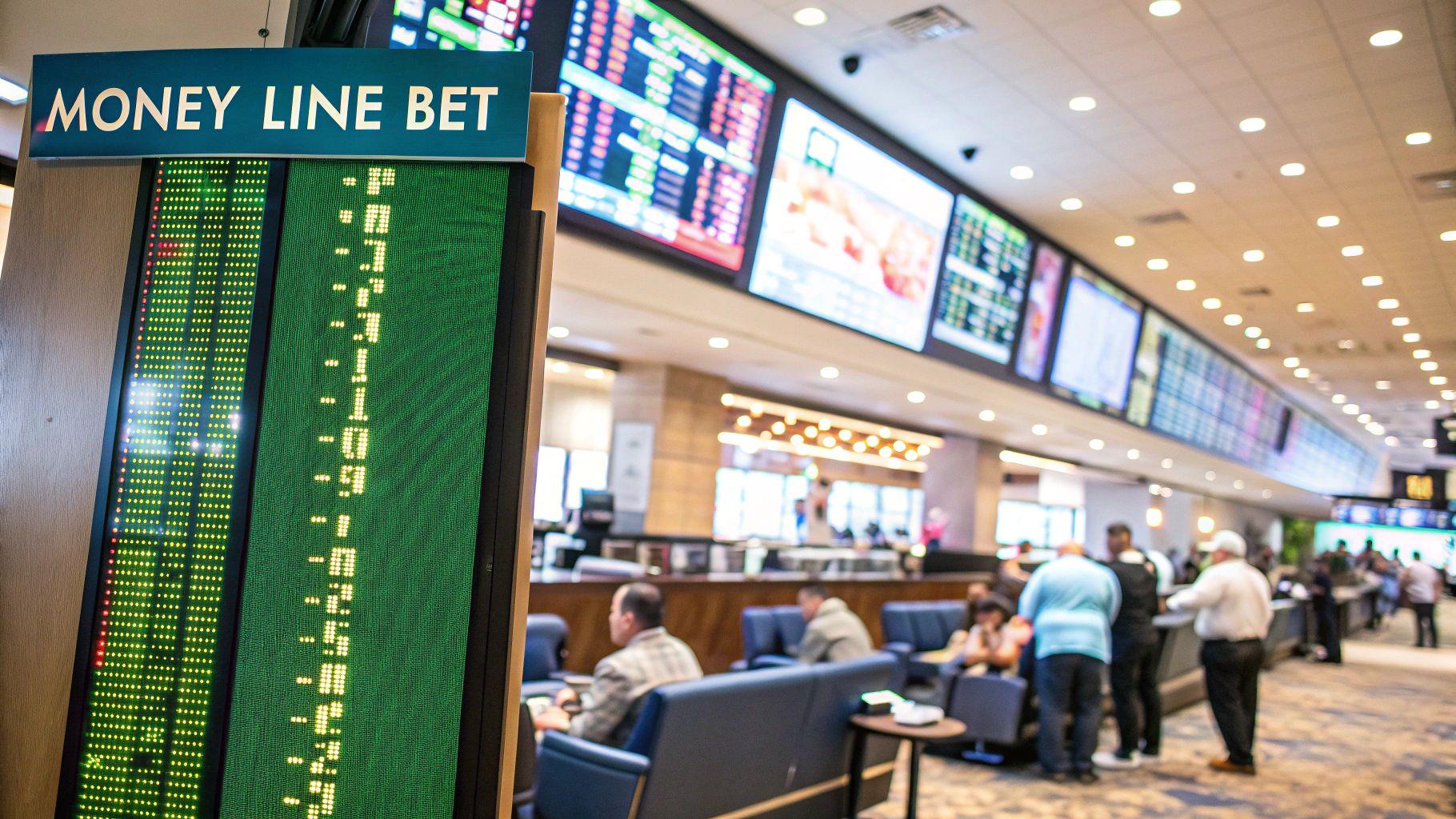
The money line is so popular because it’s incredibly simple to understand. Unlike point spreads, where you’re dealing with margins of victory, a money line bet only cares about one thing: the outright winner. It's a clean, direct wager, and its massive popularity is a key part of modern sports betting trends.
But of course, not every team is created equal. To balance the action between a heavy favorite and a longshot underdog, sportsbooks assign odds to each side. This is where you'll see the plus (+) and minus (-) signs, and they instantly tell you the story of the matchup.
Favorites vs Underdogs
Every money line bet revolves around two key players: the favorite and the underdog. Spotting them is easy once you know what to look for.
- The Favorite: This is the team expected to win. Their odds always have a minus sign (-), like -150. That minus sign is a signal that you'll have to risk more money than you stand to win, simply because they have a higher chance of winning the game.
- The Underdog: This is the team expected to lose. You’ll see their odds marked with a plus sign (+), such as +130. The plus sign tells you there's a bigger potential payout for a smaller risk, as their victory is seen as less likely.
A great way to remember this: Minus means less money (than you bet), while plus means more money (than you bet). This simple idea is the key to unlocking how all money line bets work.
To give you a quick reference for these core concepts, let's break it down into a simple table. This will help you see the key components at a glance.
Money Line Betting at a Glance
| Betting Concept | Symbol / Sign | What It Means | Example |
|---|---|---|---|
| The Favorite | - (Minus) | The team expected to win; you risk more to win less. | -150: You must bet $150 to win $100. |
| The Underdog | + (Plus) | The team expected to lose; you risk less to win more. | +130: Your $100 bet wins $130. |
This table covers the fundamental building blocks of any money line wager. Once you have these basics down, you're ready to start understanding how the numbers translate into real dollars and cents.
How to Read Money Line Odds Like a Pro
At first glance, the plus (+) and minus (-) signs in money line odds can look a little intimidating, but they boil down to two incredibly simple rules. The best way to think about American odds is to see them as a system built around a simple benchmark: a $100 bet.
Once you frame it that way, understanding the risk and reward for any wager becomes second nature.
The key is to remember that the sign in front of the number completely flips its meaning. One tells you what you have to risk, while the other tells you what you stand to win. Once you nail this difference, you'll be able to size up any money line in a heartbeat.
Understanding the Favorite (Minus Sign)
When you see a minus sign (-), you’re looking at the favorite. This is the team the sportsbook expects to win, so you won't get a massive payout for backing them. The number next to that minus sign tells you exactly how much you need to risk to win a $100 profit.
For instance, if you see the Los Angeles Lakers listed at -200:
- You must bet $200 to win a profit of $100.
If the Lakers win, the sportsbook gives you back your original $200 stake plus your $100 in winnings for a total payout of $300. The minus sign is a signal of lower reward, but also a higher implied chance of winning the bet.
The core idea for favorites is simple: the odds show you how much to risk for a $100 gain. This structure balances the betting by making you risk more on the team that is expected to win.
This relationship between the odds and a team's chances is critical. These numbers aren't just pulled out of thin air; they reflect the bookmaker's assessment of each team's strength. You can get an even deeper understanding of what these numbers truly represent by learning how to convert odds to probability.
Understanding the Underdog (Plus Sign)
On the flip side, the plus sign (+) points to the underdog. This is the team less likely to win, which means betting on them comes with a much higher potential reward. The number next to the plus sign shows you how much profit you'll make for every $100 you bet.
Let’s say the Miami Heat are playing as the underdog at +180. This means:
- A $100 bet will win you a profit of $180.
If the Heat pull off the upset, you get back your initial $100 stake plus the $180 in profit, totaling $280. The plus sign signals a greater reward precisely because you're taking on more risk by backing the team that, on paper, is less likely to win. These bigger payouts are what make finding the right underdog so appealing.
Calculating Your Potential Payouts Step by Step
Alright, so you’ve got the plus and minus signs down. That’s the first step. But the real fun begins when you can turn those money line odds into actual dollars and cents. The good news is, you don’t need to be a math whiz to figure this out. The formulas are surprisingly simple and they work for any bet size, not just the standard $100 benchmark.
Getting comfortable with these calculations means you’ll always know the exact risk and reward before you ever lock in a wager. Whether you're backing a heavy favorite or taking a shot on a longshot underdog, this is how you take full control of your bankroll.
How To Calculate Winnings On Favorites
When you bet on a favorite (the team with the minus sign), the math is all about figuring out your profit relative to how much you're risking. The formula is straightforward and shows you exactly what you stand to gain.
Here’s the simple formula to use:
Profit = (Stake / Odds) * 100
Let's walk through a real-world example. Imagine you want to place a $50 bet on a team with odds of -150.
- Calculation: ($50 / 150) * 100 = $33.33 profit
- Total Return: Your original $50 stake + $33.33 profit = $83.33
See? Even with a smaller bet, the principle is the same. You're risking a bit more to win a bit less on the team that's expected to get the job done.
How To Calculate Winnings On Underdogs
Figuring out the payout for an underdog (the team with the plus sign) is even easier. Since the odds already show you the potential profit per $100, the formula scales perfectly with whatever amount you decide to bet.
This is the formula for underdogs:
Profit = Stake * (Odds / 100)
Now, let's say you're feeling adventurous and decide to put a $20 wager on an underdog with odds of +200.
- Calculation: $20 * (200 / 100) = $40 profit
- Total Return: Your $20 stake + $40 profit = $60
As you can see, backing the underdog offers a much sweeter return on your investment, which is the trade-off for taking on a bit more risk. If you ever want to skip the manual math, you can always use a handy betting odds calculator to get the numbers instantly.
This table breaks down how your potential profit changes with different stake amounts for both our favorite and underdog examples.
Sample Money Line Payout Calculations
| Stake Amount | Favorite Odds (-150) | Potential Profit | Underdog Odds (+200) | Potential Profit |
|---|---|---|---|---|
| $10 | -150 | $6.67 | +200 | $20.00 |
| $25 | -150 | $16.67 | +200 | $50.00 |
| $50 | -150 | $33.33 | +200 | $100.00 |
| $100 | -150 | $66.67 | +200 | $200.00 |
Seeing the numbers side-by-side makes the risk-reward dynamic crystal clear. A small bet on an underdog can net a significant return, while you need to stake more on the favorite for a modest profit.
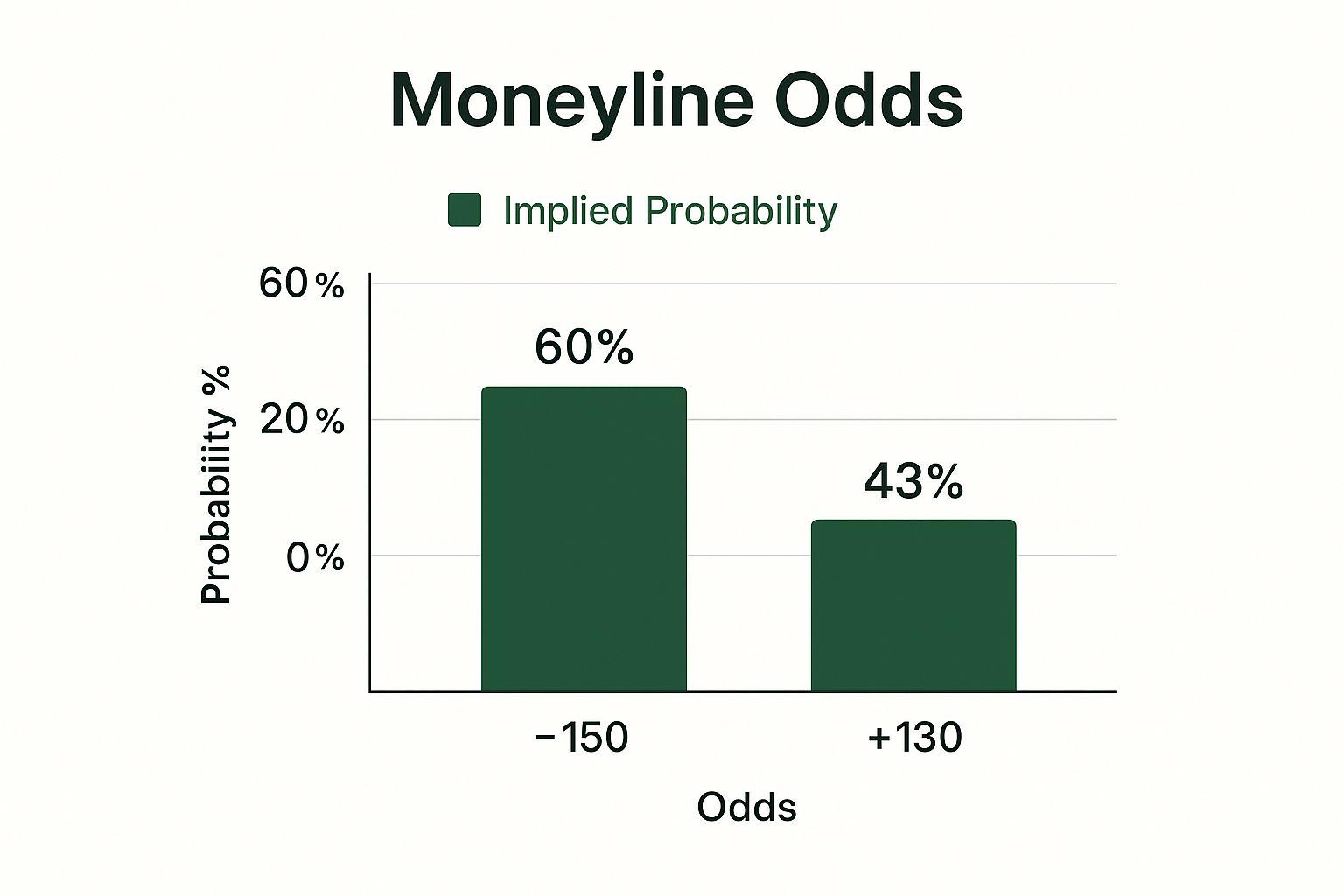
This chart helps visualize how odds translate directly into implied probability. It clearly shows that the -150 favorite has a much higher implied chance of winning (60%) compared to the +130 underdog (43.5%). At their core, money line odds are just a way of converting these probabilities into payoffs, a system that powers a massive global sports betting market. In 2024, Europe represents roughly 48% of the market share in sports betting revenue, a figure heavily influenced by the UK's highly organized betting industry.
How Money Line Betting Works in Different Sports

A moneyline bet isn't a one-size-fits-all tool. Its role and popularity shift quite a bit depending on the sport you’re watching. Things like scoring frequency, the pace of the game, and the presence of a point spread all change how and when the moneyline comes into play.
For some sports, the moneyline is the undisputed king. In others, it hangs back, serving as a great alternative to the more popular ways to bet.
Primary Markets for Low-Scoring Sports
In lower-scoring games like baseball (MLB) and hockey (NHL), the moneyline is the most common way to get in on the action. Because the final score is so often decided by just one or two runs or goals, a point spread (known as a run line or puck line) just isn't as relevant.
Simply picking the outright winner makes a lot more sense. Think about a classic MLB game where the final score is 3-2. The margin of victory is so razor-thin that the only question that really matters is who wins and who loses. The moneyline cuts straight to that question, making it the default choice for bettors and sportsbooks alike.
This focus on the winner is also true for individual sports.
For one-on-one matchups like tennis, boxing, and MMA, the moneyline is the standard. Since there is no team score to measure against a spread, betting on who will win the match is the most direct and logical option.
In sports like soccer, where draws are common, things change a bit. Many sportsbooks will offer a variation, and you can learn more about how a tie impacts your wager by exploring the three-way moneyline.
An Alternative in High-Scoring Sports
On the flip side, in high-scoring sports like basketball (NBA) and American football (NFL), the point spread usually takes center stage. With final scores often having double-digit differences, bettors are naturally more focused on the margin of victory.
However, the moneyline still plays a vital role here. It offers a simpler alternative for bettors who just want to pick the winner without sweating the point spread. It’s particularly popular in a couple of key scenarios:
- Betting on big underdogs: If you think a team is going to pull off a major upset, the moneyline offers a much juicier payout than just taking the points.
- Backing slight favorites: When a favorite is only expected to win by a few points, the moneyline can feel like a safer bet than hoping they cover the spread.
Common Money Line Mistakes and How to Avoid Them
Knowing how money line odds work is one thing. Actually applying that knowledge to make smart bets is a completely different ballgame. It’s what separates bettors who grind out a profit from those who are constantly reloading their accounts.
Most newcomers fall into the same predictable traps, and they can drain a bankroll fast. Let's walk through the big ones so you can sidestep them from day one.
The Heavy Favorite Trap
One of the easiest mistakes to make is loading up on heavy favorites. The logic seems sound, right? They're the most likely to win. The problem is, the payouts are tiny, and a single shocking upset can instantly wipe out all the profit from your last five or six wins.
This strategy forces you to maintain an impossibly high win rate just to break even. It’s a grind that rarely pays off in the long run.
Chasing the Longshot Payout
The flip side of the coin is just as dangerous: blindly backing huge underdogs just because the potential payout looks massive. This isn't strategy; it's buying a lottery ticket.
Successful underdog betting isn't about wishful thinking. It’s about doing the hard work to find teams whose chances of winning are actually much better than the odds suggest. It requires sharp analysis to find those rare, undervalued spots.
Forgetting About the House Edge
Every single bet you place has a hidden cost baked into it. The sportsbook’s commission, known as the "vig" or "juice," is how they guarantee they make money no matter who wins. This vig ever-so-slightly skews the odds in their favor, meaning your payout is always a little less than the "true" probability would dictate.
Ignoring the vig is like forgetting about sales tax on a purchase. It’s a small percentage on every transaction, but it adds up significantly over time and directly impacts your overall profitability.
The global sports betting market is exploding, with projections showing it could hit $182.12 billion by 2030. That massive growth means more and more bettors are interacting with money line odds and the vig that comes with them. You can get a sense of this scale by exploring these insights from The Research Insights.
The key to avoiding these mistakes is to shift your mindset. Stop trying to just pick winners and start hunting for value. That means finding bets where you genuinely believe a team's odds of winning are better than what the money line implies.
Combine that with disciplined bankroll management, avoid making emotional bets on your favorite teams, and treat every wager as a calculated decision, not a gut feeling. That’s how you stay in the game.
Your Money Line Betting Questions Answered
Once you get the basics down, a few common questions always seem to pop up. Nailing these final details is the last step before you can feel truly confident placing a money line bet. Let's clear up any lingering confusion with some straight answers.
This quick-reference guide will walk you through the practical situations you’re guaranteed to run into, from what happens in a tie game to exactly what makes up your final payout.
What Happens if the Game Ends in a Tie?
For sports like football where a tie is a possible outcome, a standard money line bet on either team results in a "push."
It’s a simple concept: the bet is voided, and your original stake is refunded in full. You don't win any cash, but you don't lose any either. It's a do-over.
Does My Payout Include the Original Stake?
Yes, it absolutely does. The total amount you get back from a winning bet is your profit plus your original stake. The odds only tell you the profit part.
So, if you bet $50 at +200 odds, your profit is $100. The sportsbook will pay you a total of $150 ($100 in profit + your $50 stake back).
Remember: The money line odds show you what you win, while your total return is what you get back. This distinction is key to managing your bankroll.
Money Line vs. Point Spread
This is a classic crossroads for bettors. When should you pick the money line over a point spread? It really boils down to what you're trying to achieve with your bet.
- Choose the money line when: You're confident an underdog can pull off the outright upset. It’s also the right play when you just believe a favorite will win, and you don’t care by how much.
- Choose the point spread when: You think a favorite is going to win by a landslide, or you believe an underdog will keep the game much closer than the experts think, even if they end up losing.
If your goal is as simple as picking the winner of the game, the money line is your most direct path.
At ValueBetFactory, we provide the tools and educational resources to help you move from basic understanding to making sharp, data-driven betting decisions. Our platform helps you find value in the odds and bet smarter. Find your edge at ValueBetFactory.