
What Is a Parlay in Betting Explained
Unlock Profits with betting tips!
So, you've heard the term "parlay" thrown around and seen those screenshots of tiny bets turning into massive payouts. Let's cut through the noise and get straight to what a parlay actually is.
Think of it as a combo bet. You're taking several individual wagers (we call these 'legs') and rolling them all into one single ticket. The catch? It’s an all-or-nothing game. Every single one of your picks has to win for you to get paid.
Your Quick Guide to Parlay Betting
A parlay is like building a house of cards. Each leg you add is another card carefully stacked on the last one. The potential payout can get impressively tall, but the whole thing comes crashing down if just one single cardone legwobbles and falls. That high-wire act is what makes parlays both so exciting and so incredibly risky.
This style of betting has been a cornerstone of sportsbooks for decades, luring bettors with the promise of turning a few bucks into a life-changing score. With the sports betting industry projected to rocket from $100 billion to $187 billion by 2030, you can bet that parlays are a huge part of that explosion.
The Basic Components
To really get parlays, you need to know the moving parts. Instead of just betting on one game, you’re weaving a story of how you think a whole slate of games will play out. Each pick is a chapter, and they all have to connect for the story to work.
The real magic is in the math. The odds of each leg aren't just added togetherthey're multiplied. This compounding effect is why a simple three-team parlay can pay out at nearly 6-to-1 odds, turning a small stake into a hefty return.
Before we go any further, let's get the language right. The table below breaks down the essential terms you'll see every time you build a parlay. Getting these down is the first step to understanding both the massive upside and the serious risk involved.
Core Components of a Parlay Bet
| Component | Definition | Key Takeaway |
|---|---|---|
| Leg | A single bet that's part of your larger parlay. You need at least two legs to get started. | Every single leg has to hit. One loss, and the entire ticket is toast. |
| Odds | The number that shows the probability of an outcome and determines your potential payout. | Parlay odds are found by multiplying the odds of all your individual legs. |
| Payout | The total cash you get back if your parlay wins, which includes your original bet amount. | The payout grows exponentially with each leg you add, creating huge reward potential. |
| Risk | The chance of losing your entire bet. This skyrockets with every leg you add to the ticket. | One wrong pick means you lose the whole thing. It’s an all-or-nothing proposition. |
Think of these as the four pillars of any parlay. The relationship between the number of legs, the odds, the potential payout, and the ever-present risk is what you're constantly balancing when you decide to build one.
How Parlay Bets Actually Work
So, what exactly is a parlay? Think of it less like placing a few separate bets and more like building a house of cards. Each individual bet, or "leg," is a card. For the whole thing to stand, every single piece has to be perfect.
The real magicand the dangeris in the math. Instead of just adding up the potential winnings of each bet, the sportsbook multiplies the odds. This creates a powerful compounding effect, which is how a small stake can balloon into a massive potential payday. It’s the secret sauce that gives parlays their lottery-ticket appeal.
Of course, there's a huge catch. If even one of your legs fails, the entire house of cards comes crashing down. You get nothing for being close. It’s the ultimate all-or-nothing proposition.
Building a Three-Leg Parlay Example
Let's make this real with a classic NFL Sunday scenario. You’ve done your homework and feel good about three different games. Instead of betting them individually, you decide to tie them together into a single parlay.
Here are the three legs you’ve picked, all at standard -110 American odds:
- Leg 1: Kansas City Chiefs -7.5 point spread
- Leg 2: Dallas Cowboys moneyline (to win outright)
- Leg 3: Over 48.5 total points in the Green Bay Packers game
You put down a $100 wager on this three-leg combo. If you had placed three separate $100 bets and won them all, your total profit would be about $273. But with a parlay, the math works very differently.
The sportsbook doesn't just add your potential winnings. It multiplies the decimal odds of each outcome together to create new, much longer odds for the combined bet. A standard three-leg parlay with -110 odds on each leg typically pays out at around +596, or nearly 6-to-1.
This high-risk, high-reward structure has been a cornerstone of sports gambling for over a century. Parlay betting actually traces its roots back to American sportsbooks in the early 20th century, where the thrill of linking multiple bets into one ticket with a huge potential payout quickly caught on. You can explore more about its journey from old-school bookies to modern betting apps.
The All-Or-Nothing Outcome
Now, let's see what has to happen for our example parlay to cash. For your ticket to be a winner, all three of these events must occur:
- The Kansas City Chiefs have to win their game by 8 points or more.
- The Dallas Cowboys have to win their game, period.
- The Packers game must end with a combined score of 49 points or higher.
If you nail all three picks, your $100 bet would pay out roughly $696that's your original $100 stake back plus $596 in pure profit.
But if the Chiefs only win by a field goal, or the Cowboys get upset, or the Packers game turns into a defensive slog, your entire $100 is gone. That brutal reality is the trade-off for getting those amplified odds, and it’s the absolute core of how a parlay works.
Calculating Parlay Payouts and Odds
The real magic of a parlayand what makes it so temptingis how the payout can explode with each new bet you add. You don't need to be a math whiz to get it; the core idea is simple multiplication, and understanding it is key to seeing both the massive upside and the serious risk involved.
Unlike a single bet where your potential profit is locked in, a parlay’s odds are calculated by compounding the odds of each individual leg. This creates a powerful snowball effect. With every leg you add, the potential return gets bigger and bigger, which is exactly how a small wager can turn into a life-changing win.
This infographic gives you a great visual of how quickly the odds jump as you stack more bets into your parlay.
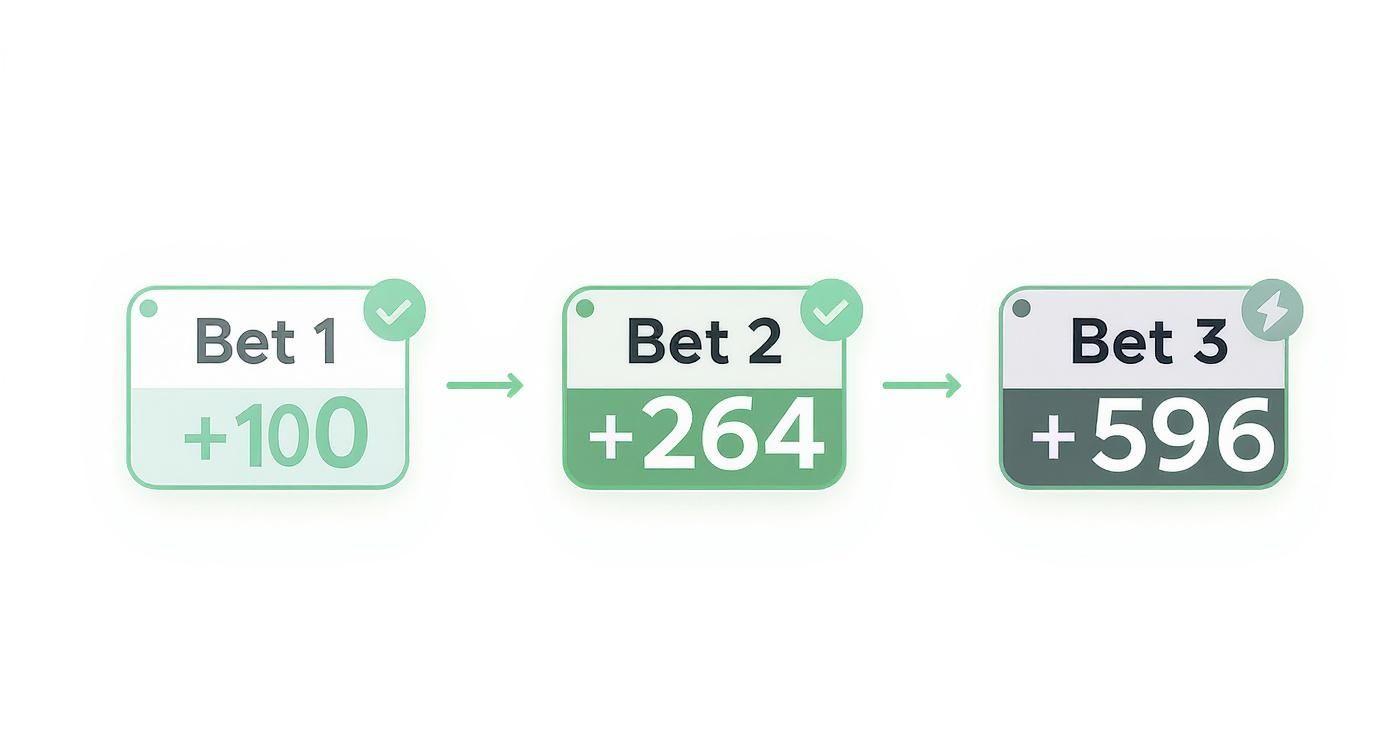
As you can see, the leap from a single bet to just a three-leg parlay creates dramatically longer odds. It’s a perfect illustration of that compounding effect in action.
The Math Behind the Payout
Let's break it down with a simple example using the standard -110 odds you see everywhere for point spreads and totals. A single $100 bet at -110 odds would net you a $90.91 profit. Solid, but not spectacular.
Now, let's see what happens when we bundle three of those bets into one parlay.
A three-leg parlay where each leg has -110 odds pays out at around +596. This means that same $100 bet could suddenly return roughly $696 if all three legs hit. You can see how that multiplication really starts to work in your favor.
Single Bets vs. Three-Leg Parlay Payout Comparison
To make the financial appeal crystal clear, let's compare the outcomes of placing three separate $100 wagers versus rolling them into one $100 three-leg parlay. This side-by-side view shows exactly why bettors are so drawn to the high-risk, high-reward nature of parlays.
Sometimes, a bet might not win or lose but ends in a tie. If you want to see how that impacts your wagers, you can check out our guide on what does push mean in betting.
Here’s a table that breaks down the difference in potential returns.
| Bet Type | Wager Amount | Number of Winning Bets | Total Payout |
|---|---|---|---|
| Three Single Bets | $300 ($100 each) | 3 | $572.73 |
| Three-Leg Parlay | $100 | 3 | $696.00 |
This table lays out the core trade-off perfectly. The parlay offers a much bigger payout ($696) on a much smaller stake ($100), but it demands perfection. If even one of those three bets loses, your entire $100 is gone.
With single bets, you could still turn a profit if just two out of three win. This is the fundamental risk-versus-reward calculation you have to make every time you think about placing a parlay.
Understanding the Risks and Rewards
The magnetic pull of a parlay is simple: it’s the chance to turn pocket change into a serious, sometimes life-altering, payout. Let's be honest, it’s the sports betting version of a lottery ticket, offering a massive reward for a tiny investment. This is the dream that keeps bettors coming backthat one perfect ticket that connects on all legs.
But for every incredible win you see on social media, there are countless tickets that crashed and burned on the final leg. The risk is huge, and it grows exponentially with every single bet you add to the slip. Getting your head around this dynamic is the key to betting them smartly, instead of just chasing a jackpot.
The Amplified House Edge
Every single bet you place comes with a built-in house edgethe mathematical advantage the sportsbook holds over you. But in a parlay, that edge doesn't just exist; it gets supercharged. Because the odds of each leg are multiplied together to create your payout, the sportsbook's advantage gets multiplied right along with them. This creates a much bigger profit margin for the house over the long run.
This is exactly why sportsbooks push parlays so hard. They roll out the red carpet with flashy ads and juicy-looking bonuses because, statistically speaking, these bets are their most profitable product by a country mile.
The core idea to burn into your brain is this: while your potential payout skyrockets, your actual probability of winning plummets. The true odds of hitting a multi-leg parlay are almost always way worse than the payout odds the bookmaker offers. That gap is the amplified house edge in action.
This isn't just some theory; the data backs it up loud and clear. Research from UNLV looked at 35 years of gaming data and found that sportsbooks won on a staggering 31% of all parlay bets. For comparison, their win rate on standard, single football bets was just 5%. That massive difference shows you just how tough these wagers are to hit with any consistency. You can see the full breakdown of these sportsbook profit findings to get the complete picture.
A Clear-Eyed Perspective on Parlays
Now, this isn't to say you should never place a parlay. The goal here is to give you a realistic, balanced view so you can approach them with the right mindset. Knowing the odds are stacked against you is the first step.
Think of parlays in these simple terms:
- High Reward: The chance to get a massive payout from a small stake is unmatched. A simple $10 wager can genuinely turn into thousands of dollars if everything breaks your way.
- High Risk: Your probability of winning is incredibly low. You have to be perfect. One busted leg and your entire stake is gone. No partial credit.
- Entertainment Value: For a lot of bettors, small parlay wagers are a form of entertainmentno different from buying a Powerball ticket when the jackpot gets huge. It's a fun, low-cost sweat.
Ultimately, to really understand what a parlay is in betting, you have to accept both sides of the coin. It's totally fine to appreciate the thrill of a massive potential payout, but you have to respect the huge risks and the powerful house edge you’re up against.
Exploring Different Types of Parlays
Once you get the hang of a basic parlay, a whole world of more flexible and strategic options opens up. The standard, all-or-nothing parlay is just the starting line. Over time, clever variations have popped up to give bettors more control, new ways to tell a story about a game, and even a safety net for when one pick inevitably goes wrong.
These aren't just minor tweaks; they fundamentally change how you build and think about your bet. Each one strikes a different balance between risk and reward, letting you tailor your wager to the specific outcome you're predicting. Learning these types expands your betting toolkit far beyond a simple win-or-lose ticket.
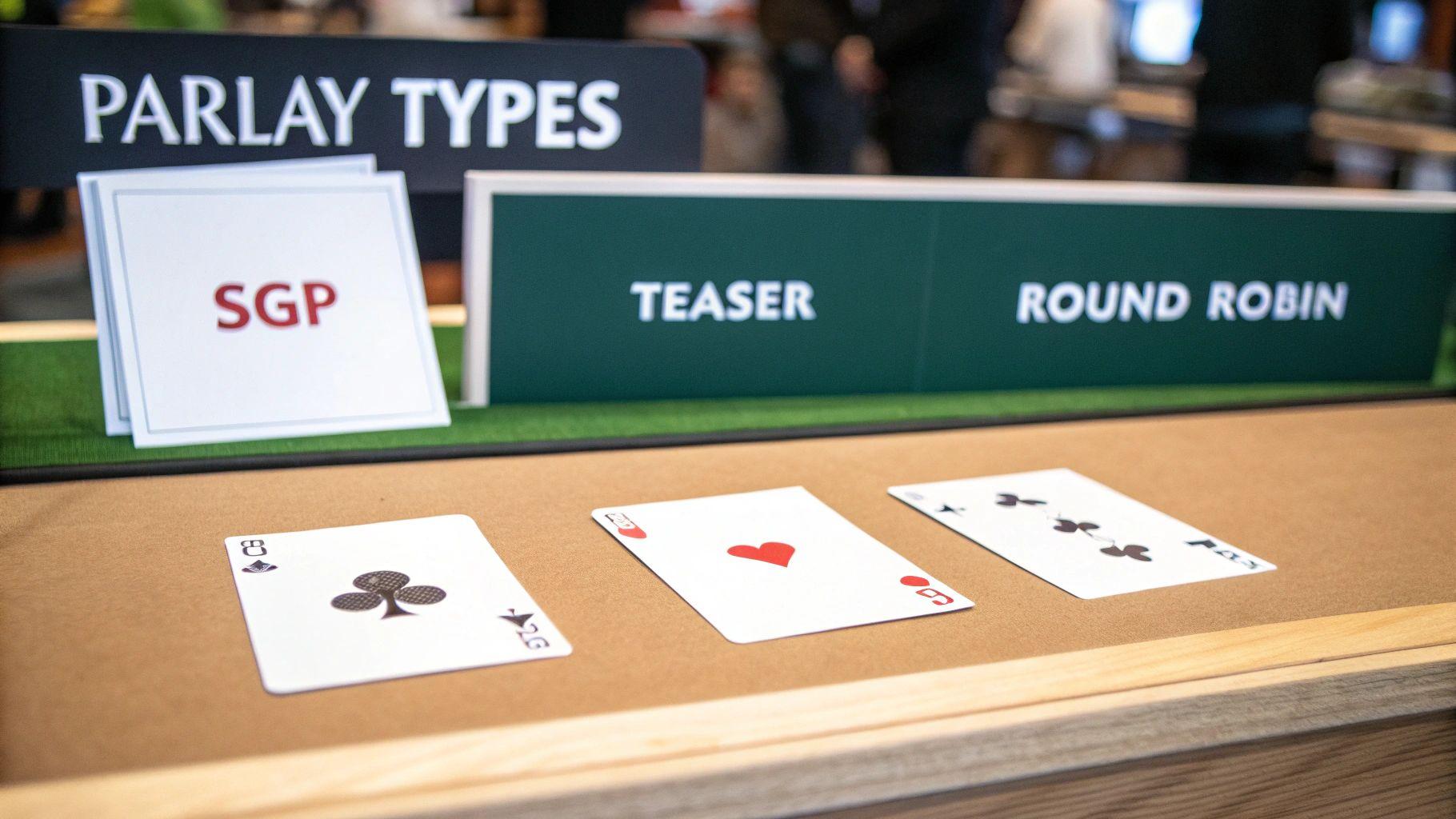
Same Game Parlays (SGPs)
The Same Game Parlay, or SGP, has absolutely exploded in popularity, and for good reason. It lets you roll multiple bets from a single game into one ticket. This is the perfect tool when you have a strong feelinga specific narrativefor how a matchup is going to play out.
Instead of needing picks from several different games, you can build a parlay on outcomes that are all connected within one contest.
- How it works: You combine a few different bets from the same event, like a team's moneyline, a specific player prop, and the over/under on the game total.
- Example: Let's say you're watching an NFL game. You could parlay the Kansas City Chiefs to win, Travis Kelce to score a touchdown, and the total points to go over 52.5. If your read on the game is a high-scoring Chiefs victory led by their star tight end, an SGP lets you bet on that exact story.
This is where your deep knowledge of a single game can really pay off.
Teasers
A Teaser is a pretty slick parlay variation that lets you adjust the point spreads or totals in your favor, making each individual leg much easier to win. The trade-off? In exchange for that advantage, the sportsbook gives you a lower payout than you'd get on a standard parlay.
Think of a teaser as buying yourself some insurance. You're giving up a slice of that massive potential payout in return for a significantly better shot at each leg hitting. It's a more conservative way to play parlays.
For example, with a common 6-point football teaser, you could move a -7.5 point favorite all the way down to -1.5, or a +3.5 point underdog up to a much safer +9.5. That's some serious breathing room.
Round Robins
A Round Robin is a clever way to hedge your bets when you're building a multi-leg ticket. Instead of creating one giant parlay where a single loss sinks the whole thing, a Round Robin automatically breaks your selections down into a series of smaller parlays.
Let's say you've picked three teams you love: Team A, Team B, and Team C. A Round Robin would automatically create three separate two-team parlays from that group (A+B, A+C, and B+C).
This means that even if Team C lets you down, your A+B parlay can still cash, saving you from a total loss. It's a fantastic safety net. If you want to play around with the numbers, a good parlay Round Robin calculator can show you exactly how the combinations and potential payouts work.
Actionable Strategies for Smarter Parlay Betting
Look, while no strategy can ever completely erase the high-risk nature of parlays, taking a calculated approach can absolutely tilt the odds a little more in your favor. The first step is to stop treating them like lottery tickets. It's time to move past random picks and start making decisions with a bit of analytical muscle behind them.
The most fundamental rule? Keep your parlays small. I get it, the temptation to build a 10-leg monster for a life-changing payout is real, but the odds of hitting one are just astronomical. Instead, your focus should be on smaller, more manageable parlays of two or three legs where you have a strong, data-driven read on every single pick.
Finding Correlated Value
One of the sharpest ways to build a parlay is by finding correlated plays, a strategy that's especially powerful in Same Game Parlays (SGPs). Correlation just means that if one thing happens, it makes another thing more likely to happen too. You're creating a logical link between your bets.
- Example: Think about an NFL game. If you bet on a star quarterback to throw for over 300 yards, it just makes sense to also parlay that with his top receiver going over their receiving yards prop. The two outcomes are directly tied together.
This approach completely changes the game. Your parlay is no longer just a random collection of bets; it becomes a single, cohesive prediction about how you think the game will play out. You aren't just betting on events anymore; you're betting on a narrative.
The smartest parlay bettors don't just look for winners; they hunt for value. This means finding legs where the odds offered by the sportsbook are better than the true probability of the event happening. True value is the cornerstone of any successful betting approach.
Finally, disciplined bankroll management is completely non-negotiable. Because parlays are high-variance bets with a low win rate, you should only ever allocate a tiny slice of your betting funds to them. Sticking to just 1-2% of your bankroll for these types of wagers helps ensure that a bad run won't wipe you out.
For a deeper dive into crafting winning tickets, you can explore more advanced parlay betting strategies and really start to refine your approach.
Got Questions? Let's Clear a Few Things Up
Even once you get the hang of parlays, a few "what if" scenarios always seem to pop up. Let's tackle some of the most common questions head-on so you know exactly how the rules work in the real world.
What Happens If a Game in My Parlay Is a Push?
This one’s a classic. If one of the games in your parlay ends in a pushmeaning it’s a tie against the point spreaddon't sweat it. Your bet isn't a loser.
Instead, the sportsbook simply voids that specific leg and removes it from your ticket. A three-leg parlay with one push just becomes a two-leg parlay, and the payout gets recalculated based on the new, shorter odds.
Can I Mix and Match Different Sports?
Absolutely. In fact, this is one of the biggest draws of parlay betting. Most sportsbooks are more than happy for you to build cross-sport parlays, letting you weave together bets from completely different leagues.
You could easily put together a ticket that includes:
- An NFL moneyline pick.
- An NBA point spread.
- A player prop from an MLB game.
This kind of flexibility is great because it lets you act on your strongest opinions across the entire sports calendar, all on a single bet slip.
Are Parlays a Smart Bet for Beginners?
The massive payouts are definitely tempting, but let's be real: parlays are generally not a great primary strategy for anyone new to sports betting. The odds of actually hitting one are incredibly low, which makes them a seriously high-risk game.
For new bettors, the best path is to get good at single bets first. Master the fundamentals of finding value in one game at a time. Once you have a solid foundation, you can sprinkle in a few small parlays for a bit of fun.
At ValueBetFactory, we're all about giving you the resources and tools to bet smarter, not harder. See how our platform can help you find a real edge and start making more informed decisions. Explore our features today.