
What Does Push Mean in Betting? Complete Explanation
Unlock Profits with betting tips!
Ever heard the term push thrown around in sports betting and wondered what it meant? It’s pretty simple: a push is just a tie between you and the sportsbook.
When the final score or outcome lands exactly on the betting line you wagered on, the bet is a push. This means you don’t win, but you don’t lose either. The sportsbook simply refunds your original stake, and you can live to bet another day. Think of it as hitting the reset button on that specific wager.
The Three Basic Betting Outcomes
When you place a bet, there are really only three things that can happen: you win, you lose, or you get a push. While a win is what we're all after and a loss is the risk we take, a push is that neutral middle ground.
Your money comes right back to your account, no harm, no foul.
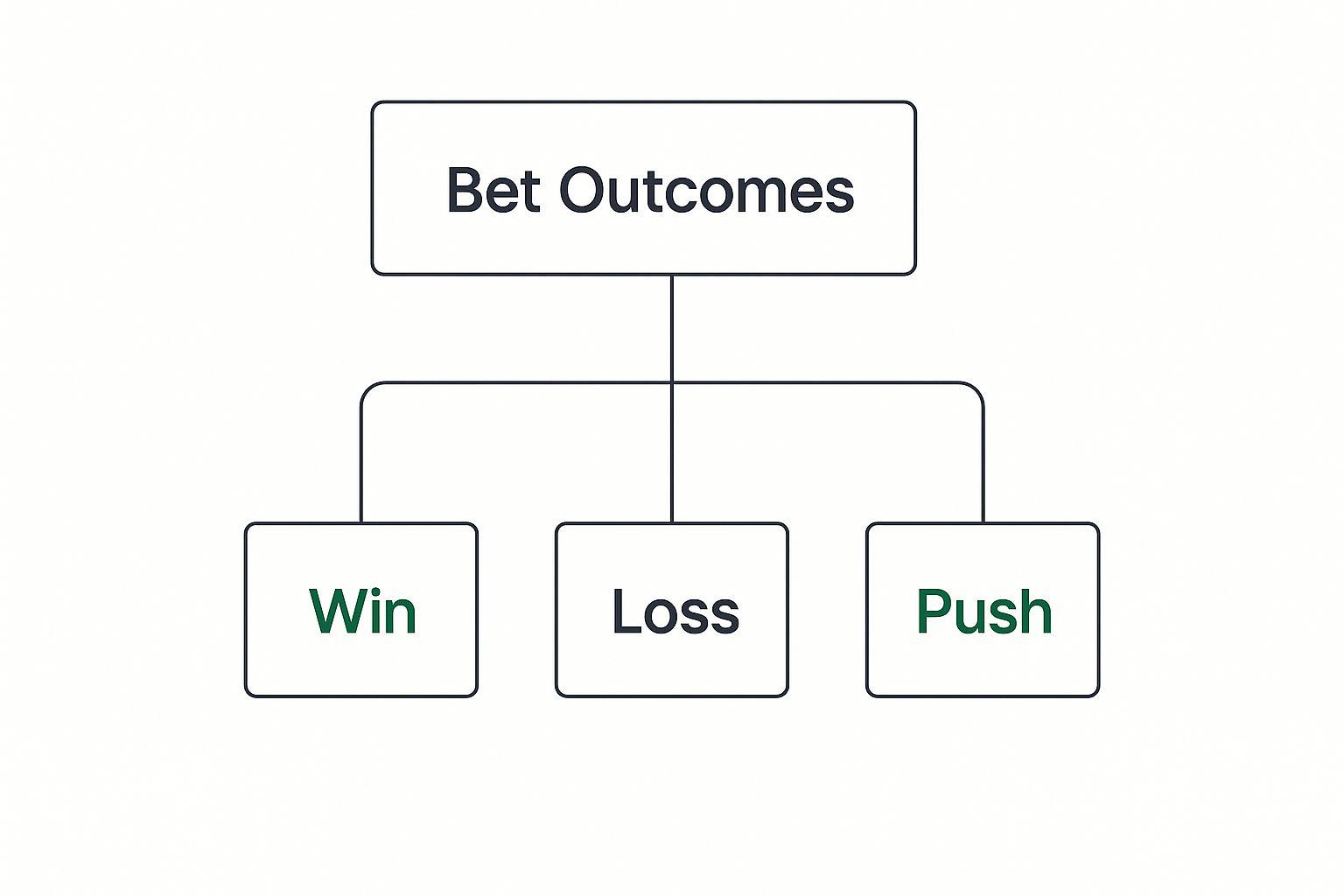
This simple hierarchywin, lose, or pushis fundamental to understanding how sportsbooks manage their lines and how your bets will be graded.
How a Push Works in Practice
Pushes happen most often with point spread and totals (over/under) bets, where the line is set with a whole number.
Let’s say you bet on the Kansas City Chiefs at -7 against the Denver Broncos. For your bet to win, the Chiefs need to win by more than 7 points. If they win by exactly 7 points, say, 24-17, the bet is a push. Because the final margin of victory hit the spread right on the nose, your stake is returned.
A push is essentially a 'no action' bet. Since neither the bettor nor the sportsbook won, the wager is voided, and the stake is fully refunded without any commission taken.
It’s important to remember that not all bets can result in a push. Some wagers are specifically designed to have a clear winner and loser. For example, a three-way moneyline bet in soccer includes the draw as a third betting option, which completely eliminates the possibility of a push.
Knowing which bets can push and which can't is a crucial piece of building a smart betting strategy.
How a Push Works for Common Bet Types
To make it crystal clear, here’s a quick breakdown of how a push plays out across different types of bets where it’s a possibility.
| Bet Type | Example Scenario | Result |
|---|---|---|
| Point Spread | You bet on Team A -3, and they win by exactly 3 points. | Push. Your original stake is refunded. |
| Totals (Over/Under) | You bet the Over on a total of 48 points, and the final score is 28-20 (48 points exactly). | Push. Your original stake is refunded. |
| Player Props | You bet on a quarterback to throw Over 2.0 touchdown passes, and he throws exactly 2. | Push. Your original stake is refunded. |
| Two-Way Moneyline | In a sport with no ties (like basketball), a push isn't possible. In a sport with ties (like soccer), if the draw isn't an option, the bet is graded as a push if the game ends in a tie. | Push (only if a tie occurs and wasn't a betting option). |
This table shows that a push consistently acts as a safety net when the outcome lands precisely on the number you bet. It’s a core mechanic you’ll encounter often, especially if you focus on spread or totals betting.
The Unlikely Origin of the Betting Push
You might think a "push" is some kind of modern glitch or a quirky sportsbook rule, but its history goes way back. It’s a core piece of the American sports betting puzzle, born from an idea that completely changed the game. To really get why a push even exists, you have to look at where it came from.
Before the 1940s, betting was dead simple. You picked a team to win, and that was that. The problem? When a powerhouse team played an underdog, almost all the money would pour in on the favorite, leaving bookmakers dangerously exposed. They needed a way to make both sides of a bet appealing.
The Birth of the Point Spread
The solution came from a Chicago bookmaker and former math teacher named Charles K. McNeil. He's the guy credited with inventing the point spread, a revolutionary system that let you bet on the margin of victory instead of just who won the game outright.
By introducing the point spread, McNeil created a third possible outcome for a bet. Suddenly, a wager didn't just have to result in a win or a loss; it could also end in a tie, or what we now call a push.
This innovation was a game-changer. For the first time, a bet could end in three ways: a win, a loss, or a push where the final score difference landed exactly on the spread number. This leveled the playing field for bettors and bookies alike, and it set the stage for sports betting as we know it today. If you're curious, you can learn more about the history of spread betting to see how this concept evolved.
This is the real answer to the question, "What does push mean in betting?" It’s not just a simple refund. It’s a fundamental outcome baked into the system since the dawn of spread betting, ensuring a fair result when the game ends exactly as the oddsmakers predicted.
Seeing the Push in Action with Real Examples
Theory is one thing, but seeing how a push actually plays out in a live game is what really makes the concept click. Let’s break it down with a few straightforward examples from different sports. You'll see exactly how a final score can land perfectly on the betting line, leading to that "no action" result where everyone gets their money back.
Once you see these scenarios, you’ll be able to spot a push on your own bet slip without any trouble.
NFL Point Spread Example
Let's say it's Sunday, and the Green Bay Packers are playing the Chicago Bears. The sportsbook has the Packers as 7-point favorites.
- Your Bet: You put your money on the Packers -7, believing they'll win by more than a touchdown.
- The Final Score: Green Bay wins the game 27-20.
- The Outcome: It's a push.
The Packers won by exactly 7 points (27 minus 20), which is the exact number of the point spread. Because they didn't win by more than 7, your bet isn't a winner. But since they didn't win by less than 7, it isn't a loser, either. The sportsbook simply refunds your original stake.
NBA Totals (Over/Under) Example
Now for a totals bet, which you'll often see called an over/under. Imagine a fast-paced game between the Los Angeles Lakers and the Golden State Warriors. The oddsmakers set the total points line at 224.
A totals bet has nothing to do with which team wins. You're simply betting on whether the combined score of both teams will go over or under the sportsbook's line.
Here’s how you could end up with a push:
- Your Bet: You bet the Over 224, expecting a high-scoring affair.
- The Final Score: The game is tight, and the final score is 112-112.
- The Outcome: That’s a push.
The two scores add up to exactly 224 points (112 + 112). The total landed right on the number, so your bet pushes. Keep in mind that for most full-game totals, the score is graded at the end of regulationwhat happens in overtime usually doesn't count for these bets.
Soccer Goal Line (Asian Handicap) Example
Soccer has its own version of the point spread, often called the goal line or Asian Handicap. Let’s take a World Cup match where Brazil is a heavy favorite against Japan, and the goal line is set at Brazil -2.0.
- Your Bet: You take Brazil -2.0, counting on them to win decisively.
- The Final Score: Brazil controls the game and wins 2-0.
- The Outcome: This is a push.
For your ticket to cash, Brazil needed to win by more than two goals (like 3-0 or 4-1). Since they won by exactly two, the result lines up perfectly with the handicap. Your bet is a push, and your stake is returned. These types of lines are popular in soccer because they add excitement to otherwise lopsided matches.
How Sportsbooks Handle Pushed Bets
When your bet results in a push, things are pretty straightforward on the sportsbook's end. The bet is simply voided, or graded as "no action," and your original stake is refunded to your account in full. It’s like the wager was never placed.
Crucially, this means the sportsbook doesn't take its cutwhat bettors call the "vig" or "juice." That commission is only collected on losing bets, so a push is a clean break for everyone involved. You get your money back, and the house doesn't profit.
The Sportsbook's Strategy: The Half-Point
Let's be clear: sportsbooks don't like pushes. When a bet pushes, they have to return all the money wagered on both sides, which means they don't get to collect their vig. To avoid this, they use a clever and very common trick: the half-point.
You see it all the time on betting lines:
- Dallas Cowboys -3.5
- Over/Under 210.5
Those little half-points are often called "hooks," and they make a push mathematically impossible. A team can’t win by exactly 3.5 points, and a basketball game can't end with a total of 210.5 points. This guarantees a clear winner and loser for every single bet, which is exactly how the sportsbook wants it. Adding that hook reduces the chance of a push to zero, helping sportsbooks manage their risk and ensure a result. This tactic is a fundamental part of how oddsmakers shape betting market probabilities.
It’s a core strategy that turns a potential tie into guaranteed action.
How a Push Works in a Parlay
So what happens if one leg of your multi-game parlay ends in a push? Don't worry, your entire ticket isn't a bust. The sportsbook simply removes the pushed leg from the parlay, and the odds are recalculated based on the legs that are still active.
Think of a pushed leg in a parlay as being erased from your bet slip. The parlay remains live, but its structure and potential payout are adjusted accordingly.
For instance, let's say you built a four-team parlay and one of the games pushes. Your bet automatically converts into a three-team parlay. The book will adjust the odds to reflect the new, smaller combination. Your potential payout will be lower, of course, but your parlay is still very much in the game.
Using the Push in Your Betting Strategy

Knowing what a push is in betting is step one, but learning how to use it to your advantage is where the real skill comes in. A push is more than just a tie; it’s a strategic tool that can save your bankroll when a game gets tight.
Think of it as a safety net built right into the point spread. When your bet comes agonizingly close but doesn't quite cross the finish line, a push hands you your stake back. This isn’t just a refundit’s a crucial part of managing your money, preventing a loss on a bet that was decided by the thinnest of margins and keeping you in the game for the next opportunity.
The Whole Number vs. Half Point Dilemma
This leads to a classic strategic crossroads every bettor faces: Do you take a whole number spread like -3, or do you opt for a half-point line like -3.5? There's a distinct trade-off with each, and making the right call is a cornerstone of any good sports betting strategy.
When you bet on a whole number, you're giving yourself three possible outcomes: win, lose, or push. That third option is your insurance policy. If the favorite wins by exactly three points on a -3 spread, you don't lose your money. You get it back, no harm done.
On the flip side, betting a half-point line completely removes the push from the equation.
When you bet on a line like -3.5, you're forcing a decision. There is no middle groundit's either a win or a loss. This is a higher-risk play that offers absolute certainty on the outcome.
Making the Strategic Choice
So, what's the right move? It really boils down to your personal risk tolerance and how you’ve handicapped the game.
- Looking for Security? If you want to protect yourself from a nail-biter finish, sticking with a whole number like +7 or -3 is the way to go. The potential for a push acts as a buffer against a narrow loss.
- Chasing Certainty? If you're highly confident in your pick and don't think that extra half-point will come into play, taking a line like -6.5 guarantees a clear result.
Sharp bettors often look at the probability of a game landing on key numbers (like 3 or 7 in football) before placing their wager. By weighing the odds against the likelihood of a push, they make a calculated decision on whether the security of a whole number is worth potentially giving up slightly better odds on a half-point line.
Got More Questions About Pushes?
Even when you know the basics, real-world betting can throw some curveballs. Let's tackle a few of the most common questions that pop up when bettors run into a push.
What Happens if One Leg of My Parlay Pushes?
This is a classic point of confusion, but the answer is usually good news. If one leg of your parlay ends in a push, your bet isn't a loser.
Instead, that specific leg is just removed from the parlay ticket, and the sportsbook recalculates your odds based on the legs that are still live. So, a four-team parlay with one push simply becomes a three-team parlay. The potential payout shrinks, but your bet is still very much in the game.
Do I Lose the Juice on a Pushed Bet?
Nope, not a dime. When a bet is graded as a push, you get your entire stake back. The sportsbook's commission, often called the vig or juice, is only taken from losing wagers.
A push is officially a "no action" bet. Think of it like the wager never happened. Since neither you nor the sportsbook won, they don't take their cut, and you get every penny of your original stake returned.
How Often Do Pushes Actually Happen?
Pushes aren't an everyday thing, mostly because sportsbooks actively try to prevent them by using half-points in their lines (like -7.5 or +3.5). That half-point makes a tie impossible.
But on whole-number lines, pushes definitely still happen. You'll see them most often around key numbers in certain sports. In football, for example, final margins frequently land on exactly 3 or 7 points. In basketball, you might see pushes on round numbers for game totals.
Knowing which numbers are "push-prone" is a subtle but powerful part of a sharp betting strategy. In fact, many pros track this data to refine their wagers and figure out how to make money from sports betting by identifying the true value in a line.
At ValueBetFactory, we provide the tools and insights you need to turn betting knowledge into a profitable strategy. Discover how our real-time alerts can help you find favorable odds and make smarter betting decisions. Visit us today at ValueBetFactory.