
Mastering the Parlay Round Robin Calculator
Unlock Profits with betting tips!
At its core, a parlay round robin calculator is your shortcut for handling the tricky math that comes with round robin bets. It’s a tool that instantly shows you the potential profit, total risk, and the exact payout for every possible outcome. This transforms what could be a wild guess into a strategy backed by solid numbers.
What Is Round Robin Betting and Why Use a Calculator?

If you've ever built a great multi-leg parlay only to have one leg bust and bring the whole thing crashing down, you’ll immediately get the appeal of a round robin. I've been there, and that sting is what makes this strategy so attractive.
Instead of lumping all your picks into one high-stakes, all-or-nothing bet, a round robin breaks them into several smaller parlays. Think of it as built-in insurance. If you pick three teams, for example, a round robin creates three separate two-team parlays. This setup means you can still get paid even if one of your picks doesn't hit. For anyone looking to dig deeper into these kinds of strategies, you can find some great insights over on bookies.com.
The Problem With Doing the Math Yourself
The concept is simple enough, but the calculations? That's another story.
Let's say you feel good about five different teams. A round robin lets you combine them into ten 2-team parlays, ten 3-team parlays, and five 4-team parlays. Now, try figuring out the payout for each of those combinations, especially when you're dealing with different American odds like -150, +220, and -110. It's a logistical nightmare and a massive headache.
This is exactly why a parlay round robin calculator is such a game-changer. It does all the heavy lifting for you. In seconds, it will:
- Add up the total amount you're risking across all the smaller parlays.
- Show you the absolute maximum profit you could make if every single pick is a winner.
- Break down the payout for every single win/loss scenario, so you know what happens if one, two, or more legs fail.
A calculator turns a complicated wager into a clear risk-assessment tool. It gives you the clarity to decide if the potential rewards are truly worth the total stake.
Standard Parlay vs Round Robin at a Glance
To really see the difference in action, let's compare a standard 3-team parlay with a 3-team round robin. For this example, we’ll assume the round robin consists of three separate 2-team parlays.
| Scenario | Standard 3-Team Parlay Outcome | Round Robin (3x 2-Team Parlays) Outcome |
|---|---|---|
| All 3 Teams Win | Big Payout (e.g., +600 odds) | Smaller, but Solid Payout (all 3 parlays win) |
| 2 of 3 Teams Win | Total Loss | Partial Payout (1 parlay wins, covering some of the total stake) |
| 1 or 0 Teams Win | Total Loss | Total Loss |
This table lays it all out. The standard parlay has that massive, lottery-ticket-style payout, but it comes with zero margin for error. The round robin, on the other hand, offers a crucial safety net. Getting a partial payout when one leg misses is often the difference between a frustrating loss and a small win, making it a much more sustainable approach for many bettors. The calculator is what makes this powerful strategy accessible to everyone, without needing a math degree.
How to Use a Parlay Round Robin Calculator
Diving into round robin betting can feel like you're trying to solve a complex math problem, but a good calculator makes it surprisingly straightforward. Forget the manual calculations; these tools are built to give you a clear picture of what you stand to win or lose.
Let's walk through how to use one. The first thing you'll need to do is punch in the American odds for each individual bet, or "leg," you've picked out. Just remember that negative odds (like -150) mean you're betting on a favorite, while positive odds (+220) are for the underdog. The calculator will have simple entry fields for each one.
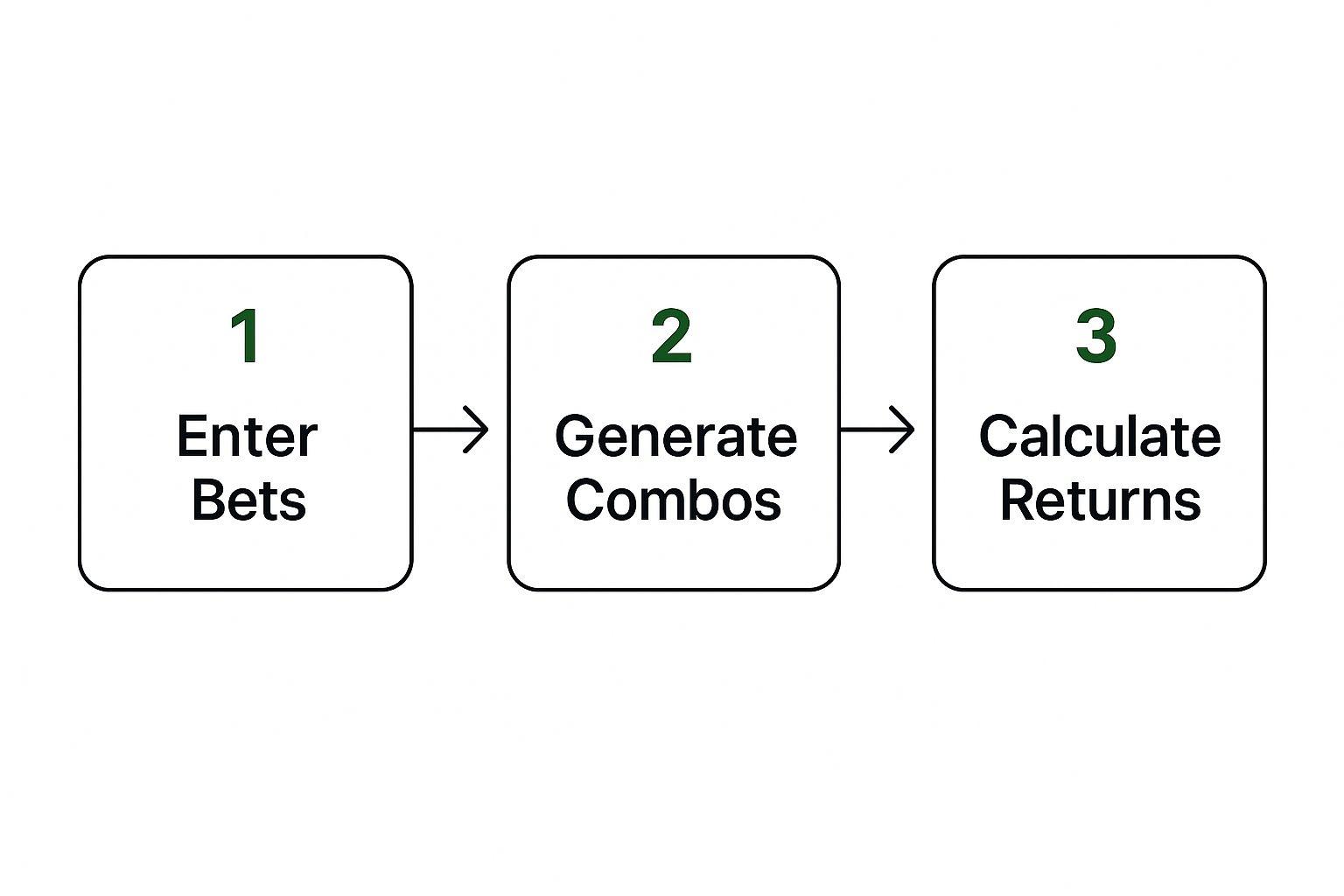
As you can see, the process is pretty logical. You feed it the odds and your stake, tell it how to combine the bets, and it spits out every possible payout scenario.
Setting Up Your Wager
Once your odds are in, the next step is deciding on your stake. This is a common point of confusion for new bettors. You'll see a field labeled something like "Stake Per Bet" or "Wager Amount." This is the amount you’re risking on each individual parlay the tool creates, not your total investment for the entire round robin.
For example, say you've picked four teams and want to bet all the "by 2s" combinations. This creates six separate two-team parlays. If you enter $10 as your stake per bet, your total risk is actually $60 (6 parlays x $10). The beauty of the calculator is that it does this math for you and shows your total exposure instantly.
Finally, you need to define the structure of your round robin. This is where you tell the calculator how to group your legs into smaller parlays.
- By 2s: This will create every possible two-team parlay from your selections.
- By 3s: This creates every possible three-team parlay.
- By 4s: This creates every four-team parlay, and so on.
The best part is that you can select multiple structures at once. With five teams, for instance, you could check the boxes for both "by 2s" and "by 3s." The tool would then calculate your returns for ten different 2-team parlays and ten different 3-team parlays, all bundled into one wager.
You can get a feel for how these inputs work together by trying our own intuitive round robin calculator. Play around with different odds and stakes to see how the potential payouts change.
Pro Tip: If you're just starting out, keep it simple. Begin with 3 or 4 teams and stick to a basic structure like "by 2s." This helps you understand how the results work before you jump into more complex wagers with dozens of combinations.
Making Sense of Your Calculator Results

Alright, you've plugged in your picks and your stake. Now comes the fun part: seeing what the calculator spits out. It’s not just a single, giant payout number. A good calculator gives you a complete picture of your bet, breaking down every possible risk and reward so you know exactly what you're getting into.
The first numbers that jump out are usually the Total Stake and the Maximum Potential Payout. The total stake is simply the full amount you're putting on the line across all the little parlays. The max payout? That’s the dream scenario where every single pick you made comes through. It's great to see, but the real magic of the tool is in the details.
Interpreting Your Total Risk and Profit
This is where a round robin calculator really proves its worth. It takes you past the all-or-nothing mindset of a standard parlay and shows you what happens when things don't go perfectly—which, let's be honest, is most of the time.
A solid calculator will clearly show your total outlay next to the potential return. The difference is your net profit. Having this laid out prevents any nasty surprises and helps you decide if the risk is truly worth the potential reward.
The whole point of a round robin is to still get paid even if a leg or two fails. This is where they shine. Let's say you've got a three-team bet: two big favorites at -250 and -300, and a juicy underdog at +300. You decide to bet the "by 2s," meaning you have three separate two-team parlays. If you put $100 on each combo ($300 total stake) and only your two favorites win, you don't lose everything. That one winning parlay still pays out around $86.67, softening the blow considerably. If you want to dive deeper into these kinds of strategies, there's a great analysis on Sportsmemo.com.
Visualizing Win/Loss Scenarios
Here's the most powerful feature. The best calculators will generate a table that maps out the payout for every single winning combination. This is so much more than a simple "what if one team loses?" question.
To illustrate, let's stick with our three-team example. You have Team A, Team B, and Team C. You've bet all the two-team combinations. Here’s how the outcomes could look:
Example Round Robin Payout Scenarios for 3 Teams
| Winning Teams | Number of Winning Parlays | Total Payout | Net Profit/Loss |
|---|---|---|---|
| Teams A, B, & C | 3 | Varies (High) | Profit |
| Teams A & B only | 1 | Varies (Medium) | Profit/Loss depends on odds |
| Teams A & C only | 1 | Varies (Medium) | Profit/Loss depends on odds |
| Teams B & C only | 1 | Varies (Medium) | Profit/Loss depends on odds |
| Only 1 Team Wins | 0 | $0 | Loss of initial stake |
| No Teams Win | 0 | $0 | Loss of initial stake |
This kind of table shows you exactly how your payout changes depending on which teams win. Hitting the parlay with two heavy favorites is very different from hitting the one with a favorite and an underdog.
This granular breakdown allows you to see precisely how much you stand to win or lose based on every possible outcome. It transforms the bet from a vague hope into a calculated risk with clearly defined results.
Laying out the scenarios like this is a game-changer. You might discover that even if only your safest picks hit, you’ll get most of your stake back. Or, you might realize you absolutely need that underdog to come through to make a decent profit. This is the kind of insight that separates casual betting from smart, strategic wagering.
Advanced Round Robin Betting Strategies
Once you've got the hang of using a parlay round robin calculator to manage risk, it's time to start thinking like a sharp. Pro bettors don't just use these tools to play defense; they use them to go on offense, strategically building wagers that hunt for maximum value and profit. This is about more than just plugging in picks—it's about building a real strategy.
A powerful technique I often use is creating an anchor for my round robin. I'll find one pick, usually a heavy favorite, that I feel incredibly confident about. This single, reliable selection becomes the foundation for all my smaller parlays.
By anchoring the bet, you're not just hoping for a random combination to hit. You’re intentionally stacking the deck to increase the odds that several of your smaller tickets will cash. It turns the round robin from a scattergun approach into a targeted attack.
Structuring for Profit
How you structure the parlays within your round robin is a critical decision. Let's say you've picked out five teams you like. A parlay round robin calculator lets you instantly see the difference between betting them in combinations of 2s, 3s, or 4s. This isn't a random choice—it's a direct reflection of your risk appetite and what you're trying to accomplish.
Combinations of 2s: This is your safest play. With five teams, you're creating ten separate 2-team parlays. This structure gives you the highest probability of getting some of your stake back, since you only need two of your five picks to be correct.
Combinations of 3s: This is the middle ground. You still get ten parlays, but now each one needs three teams to win. The payouts for each winning slip are much higher, but so is the risk of walking away with nothing.
The calculator makes this trade-off crystal clear. You might discover that betting on combinations of 3s gives you a shot at a much bigger payday without an uncomfortable leap in risk.
The Underdog Kicker Strategy
Here’s an advanced method I love: slipping one or two significant underdogs into an otherwise "safe" round robin. These longshots act as a massive payout multiplier.
The objective here isn't to have every parlay win. The goal is to cash one specific ticket: the one that pairs your big underdog with one or two of your favorites. The payout on that single combination can be large enough to turn a profit on the entire wager, even if all your other parlays lose.
Imagine you build a 4-team round robin (broken down into 2-team parlays) with three solid favorites at around -150 odds and one gutsy underdog at +400. Sure, the parlays with just the favorites will pay out modestly. But the three parlays that pair a favorite with that +400 underdog? That's where the explosive potential lies.
If just one of those "kicker" parlays hits, it can cover your entire stake and deliver a handsome profit. This kind of calculated risk is a core part of a smart betting strategy. You have to understand that not all parlays in your round robin are created equal and structure your bets to exploit that fact.
How Sportsbooks See Round Robin Bets
Have you ever noticed how sports betting apps seem to be constantly dangling parlay and round robin promotions in front of you? It's no accident. Understanding why they do this is a critical piece of the puzzle for any serious bettor.
Let's be clear: these multi-leg wagers are absolute money-makers for the house.
While a round robin is certainly a less risky option for you than a standard, all-or-nothing parlay, it still gives the bookmaker a considerable edge. Every single bet you place has a built-in house advantage—the vigorish, or "vig." When you start bundling bets together, you're also bundling that vig, which stacks the long-term mathematical odds even further in their favor.
The Appeal of Multi-Leg Wagers to the House
From the sportsbook's perspective, the magic of a round robin is twofold.
- First, it encourages you to bet more money overall. A $10 bet on three 2-team parlays isn't a $10 wager; it's a $30 total stake. More action for them.
- Second, as we just covered, the vig from each individual bet gets compounded. This built-in margin is precisely why sportsbooks push these wagers so hard.
This isn't some hidden secret. Industry leaders are refreshingly open about it. Jason Robins, the CEO of DraftKings, has openly said that a key driver of sportsbook profitability is getting more people to place parlays. Why? It all comes back to that compounded vig. If you want a deeper dive, you can explore public discussions from industry leaders on betting profitability to hear it straight from the source.
This isn't a conspiracy; it's just their business model. Their job is to maximize their hold percentage, and complex parlays are the fastest way to get there.
Turning Their Edge into Your Strategy
So, does this mean you should ditch round robins entirely? Absolutely not. The point isn't to scare you off but to arm you with knowledge. Knowing the odds are inherently stacked a bit higher against you on multi-leg bets should simply make you smarter and more selective about placing them.
This is exactly where a parlay round robin calculator shifts from a neat tool to an essential part of your defense. It lets you peer behind the curtain and see the raw numbers.
You can instantly calculate if the potential payout is worth the compounded risk and the amplified vig. By running the numbers first, you're no longer just throwing a dart. You're making a calculated decision, turning the sportsbook's favorite product into a strategic risk that you control. It helps you pinpoint the few scenarios where the reward genuinely outweighs the house's built-in advantage.
Common Questions About Round Robin Calculators

Even after you've run the numbers, a few questions can linger. When you're dealing with the complex, layered bets inside a round robin, it's totally normal for some confusion to pop up. Let's clear the air and tackle some of the most common questions bettors have when they start using a parlay round robin calculator.
Think of this as a final once-over. These quick, practical answers will help you iron out any sticking points so you can place your wagers with confidence.
Can I Include Bets From Different Sports in One Round Robin?
You sure can. This is actually one of the coolest parts of modern sports betting. You have the freedom to mix and match your picks from completely different sports, all within a single round robin wager.
For instance, you might feel great about an NFL moneyline, an NBA point spread, and a total in a big soccer match. The parlay round robin calculator doesn't care where the picks come from. It just needs the American odds for each leg to run the calculations. The math is the same whether your selections are on the gridiron, the court, or the pitch.
This opens up some creative strategies, especially on busy weekends loaded with action across multiple leagues. You could anchor a wager with a heavy football favorite while taking a shot on a more speculative basketball underdog.
What Is the Difference Between Total Stake and Stake Per Bet?
This is probably the single most important detail to get right, because it directly affects your bankroll. Mixing these two up is a classic rookie mistake that can lead to you betting way more than you planned.
Let’s break it down simply:
- Stake per Bet: This is the specific amount of cash you're putting on each individual parlay created by the round robin.
- Total Stake: This is the grand total you're risking on the entire round robin ticket. It’s calculated by multiplying your "Stake per Bet" by the number of parlays in your wager.
So, if you build a 4-team round robin "by 2s," you're actually creating six different 2-team parlays. If you set your "Stake per Bet" to $5, your "Total Stake" comes out to $30 (that’s 6 parlays x $5 each). Any good calculator will show you both numbers clearly, so you always know your total exposure before you hit "submit."
Are Round Robin Bets Actually Profitable?
Round robins can absolutely be a profitable tool in a long-term betting strategy, but they aren't some magic ticket to guaranteed riches. Their real strength is in managing risk, not chasing massive, lottery-style payouts.
The profitability of a round robin all comes down to your ability to make sharp picks consistently. The wager structure itself is just a vehicle. While the maximum payout on a round robin is lower than a traditional "all-or-nothing" parlay with the same legs, its true value is in the ability to get a return even if one of your picks doesn't hit. This can help you survive a cold streak and protect your bankroll.
A round robin's edge often comes from turning a potentially losing session into a small loss or even a breakeven—a huge victory over the long haul. Lasting profit, however, is rooted in finding bets with positive expected value. You can dive deeper into this concept by checking out our guide on what is a value bet.
What Happens in a Round Robin if a Game Is a Push?
A "push" (or a tie) happens all the time, particularly with point spreads. The good news is that in a round robin, a push doesn't automatically wreck your parlays. Instead, that specific leg is just removed from any combinations it was part of, and the odds are recalculated accordingly.
Let's say you have a 3-team parlay inside your round robin. If one of those games pushes, that specific combo simply becomes a 2-team parlay using the two remaining legs. If you had a 2-teamer and one leg pushes, it just turns into a standard straight bet on the last remaining leg.
It's always smart to double-check your sportsbook's specific house rules, but this is how the vast majority of them handle it. Using a calculator helps you see how these scenarios could play out, so a push never catches you off guard.
At ValueBetFactory, we're focused on giving you the tools and knowledge to move beyond simple guessing and into the world of strategic, data-driven betting. Explore our features and start betting smarter today.