
What Does the Line Mean in Betting A Complete Guide
Unlock Profits with betting tips!
When you hear bettors talking about "the line," they're referring to the odds, point spread, or total that a sportsbook offers on a particular game. It's the bookmaker's official number a calculated prediction designed to attract an equal amount of betting action on both sides of a wager.
Their goal isn't to be perfectly correct; it's to create a balanced market so they can profit from their commission, regardless of who wins.
What Exactly Is the Line in Sports Betting?
At its heart, the betting line is a handicap created by oddsmakers to level the playing field between two teams that aren't evenly matched. Picture it as giving the underdog a head start in a race to make things fair. The sportsbook’s main objective is to set a number that splits public opinion and the betting money right down the middle.
When they get this right, the bookie minimizes their own risk. They can simply collect their commission, known as the "vig" or "juice," from the losing bets, pay out the winners, and walk away with a small, guaranteed profit. The entire process is a fascinating mix of data and market management, which we break down in our full guide on how bookies set odds.
Think of the line as the price of a bet. And just like any other price, it moves up and down based on supply (the bookie's odds) and demand (the bettors' money).
The Three Main Betting Lines
While "the line" is a catch-all term, it most often refers to three core types of bets. Each one gives you a different way to get in on the action, whether you're picking an outright winner or just betting on how many points will be scored.
To get you started, here’s a quick rundown of the big three.
A Quick Look at the Three Main Betting Lines
This table breaks down the most common betting lines you'll encounter and what each one is really asking you to predict.
| Line Type | Core Concept | Primary Use |
|---|---|---|
| Point Spread | A handicap given to the underdog to level the matchup. | Betting on the margin of victory, not just the winner. |
| Moneyline | A straightforward bet on which team will win the game outright. | Used when you want to simply pick the winning side. |
| Totals (Over/Under) | A bet on the combined total score of both teams in a game. | Wagering on whether a game will be high-scoring or low-scoring. |
Getting a solid handle on these three lines is the first real step to understanding how sports betting works. They are the building blocks for just about every other wager you'll ever see.
Alright, we've covered why the line exists in the first place to create a balanced market. Now, let’s get into the nuts and bolts of how sportsbooks actually do it. There are three main ways they set the line, and each one gives you a completely different way to bet on a game, moving you way beyond just picking a winner.
Getting a handle on these three is non-negotiable if you want to understand what you're actually betting on.
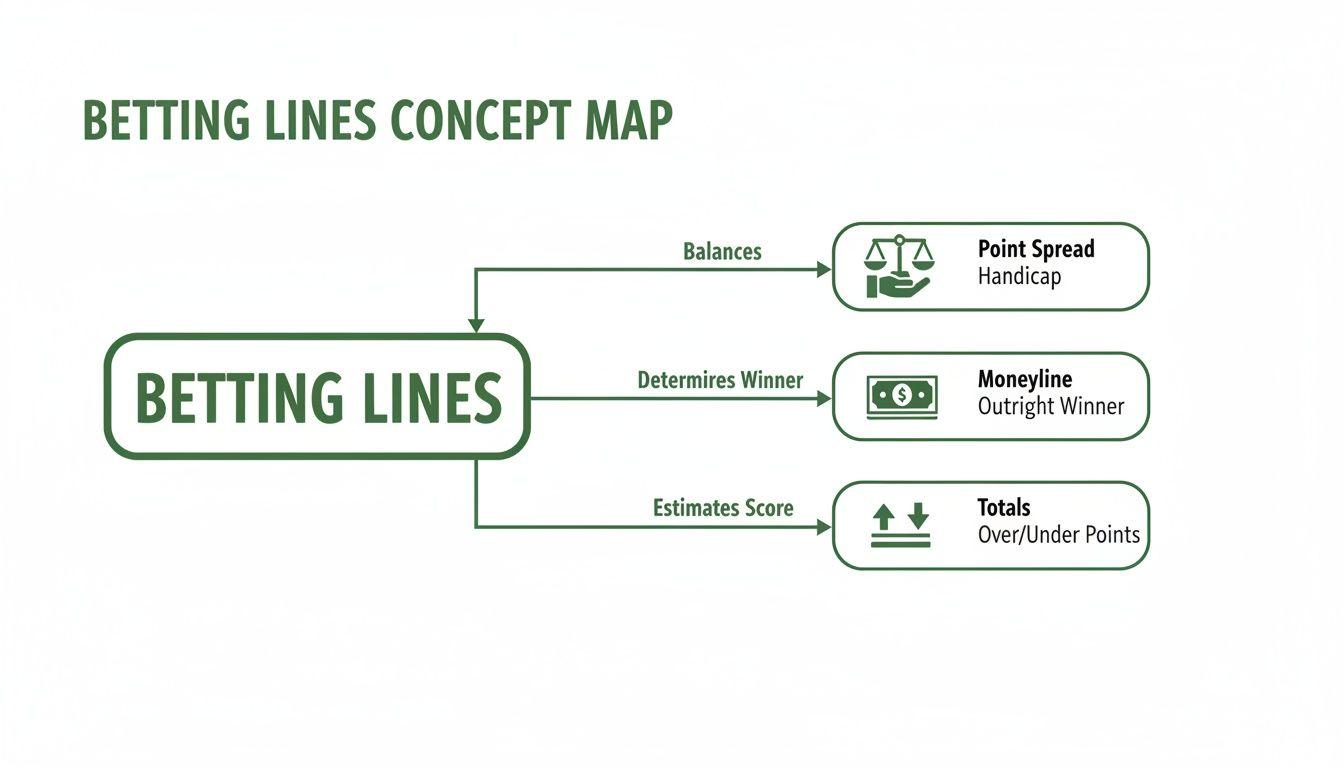
As you can see, each line type offers a unique angle. You can bet on a team to win by a certain margin, pick the outright winner, or even ignore the winner completely and just bet on how high-scoring the game will be.
The Point Spread
The point spread is the great equalizer of sports betting. Think of it as a handicap given to the underdog to level the playing field between two mismatched teams. Instead of just betting on who wins, you’re betting on the margin of victory.
You’ll see a point spread line for an NFL game that looks something like this:
- Green Bay Packers: -3.5 (-110)
- Chicago Bears: +3.5 (-110)
If you back the Packers, they don't just have to win they have to win by 4 or more points for your ticket to cash. On the flip side, if you bet on the Bears, they can win the game outright or lose by 3 or fewer points, and you still walk away a winner.
The Moneyline
The moneyline is betting in its purest form. You’re simply picking the team you think will win the game, straight up. There’s no point spread to worry about. The odds you see are a direct reflection of how likely the sportsbook thinks each team is to win.
A classic moneyline might be set up like this:
- Los Angeles Lakers: -150
- Boston Celtics: +130
A bet on the Lakers (the favorite) means you have to risk $150 to win $100. A bet on the Celtics (the underdog) is the opposite; a $100 wager would net you a $130 profit.
The moneyline answers the simplest question in sports: Who is going to win? The odds just tell you how much of a risk the sportsbook thinks that pick is.
Totals or Over/Under
Finally, we have the total, which you’ll almost always hear called the Over/Under. This bet has nothing to do with which team wins or loses. It’s all about the combined final score of both teams. The bookie sets a number, and you bet on whether the actual total will be over or under it.
For a basketball game, you might see a totals line like this:
- Over 215.5 (-110)
- Under 215.5 (-110)
If the final score is 112-105, the combined total is 217 points. Anyone who bet the "Over" wins. Simple as that. These three are just the beginning, of course.
How to Read the Numbers Plus and Minus Signs
The plus (+) and minus (-) signs are the absolute bedrock of sports betting. At first glance, they might seem confusing, but they’re actually a simple, universal language that tells you everything you need to know about a bet. Once you get the hang of it, you’ll be able to read any betting line in seconds.
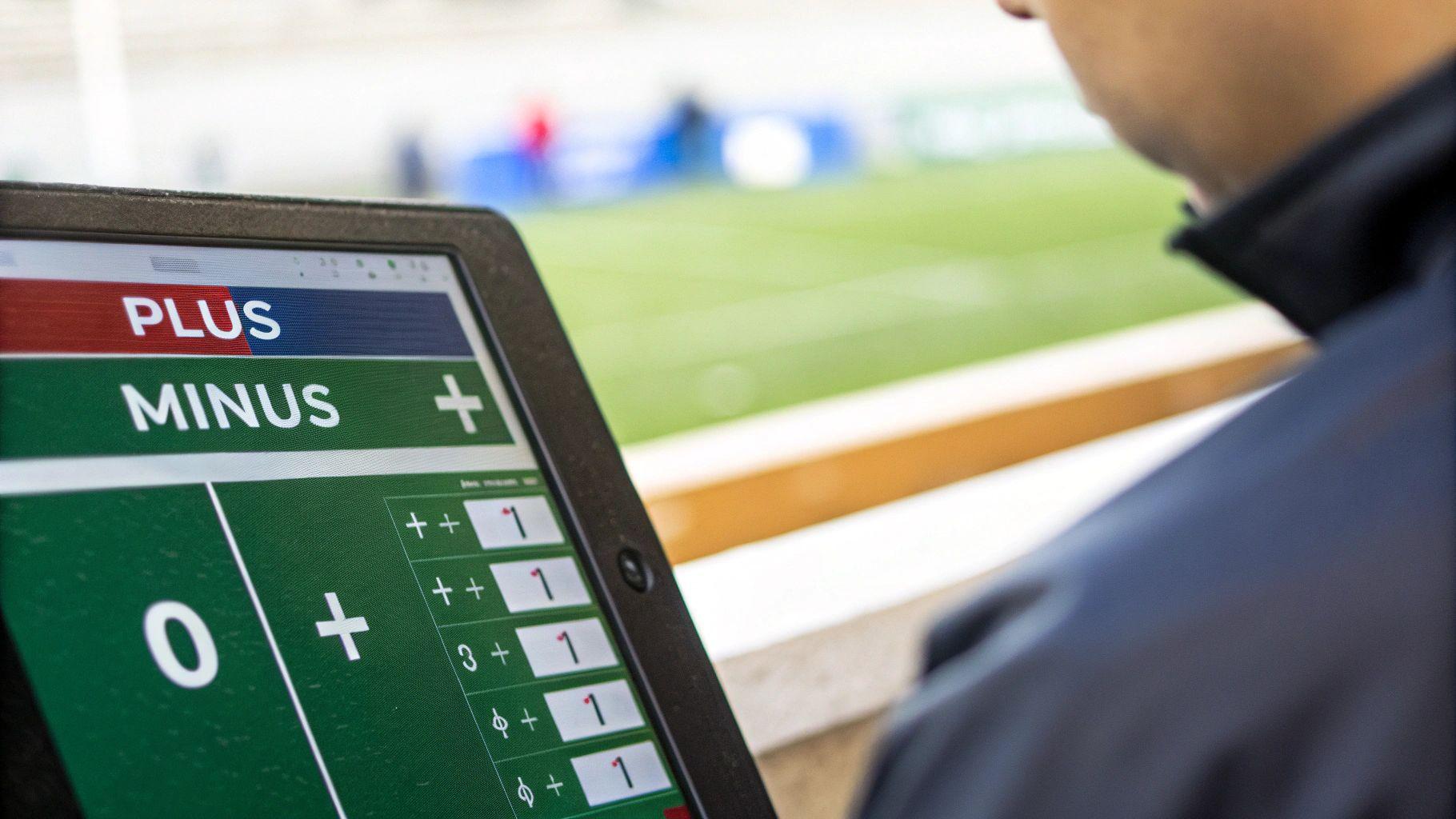
Here's the one rule to remember: the minus sign (-) always points to the favorite, and the plus sign (+) always identifies the underdog. This holds true whether you’re looking at a point spread, a moneyline, or any other type of wager.
Understanding Favorites and Underdogs
Reading the line always starts with spotting who the bookmaker expects to win. The numbers attached to these plus and minus signs then spell out the exact risk and reward for betting on either side.
Minus Odds (e.g., -150): This tells you how much money you need to risk to win $100. A -150 line means you have to bet $150 to walk away with a $100 profit.
Plus Odds (e.g., +200): This shows you how much you win for every $100 you bet. A +200 line means a $100 bet will net you a $200 profit.
This format, known as American odds, gives you a crystal-clear picture of the potential payout before you ever part with your cash.
The core idea is simple: You risk more to win less on the favorite (the likely winner), and you risk less to win more on the underdog (the less likely winner).
The Hidden Cost The Vig or Juice
Ever notice how point spreads often have -110 odds on both sides? That isn't a mistake. It’s the sportsbook's built-in commission, what industry veterans call the vig or juice. It means you have to bet $110 just to win $100, no matter which team you pick.
This small commission is exactly how sportsbooks guarantee they make money over the long haul. When you're betting against the spread at -110, that extra 10-cent margin means you have to win 52.38% of your bets just to break even. That figure has been the industry standard for decades. You can dig deeper into the history of sports betting and the spread to see how this model became so fundamental to the business.
Why Betting Lines Move and How to React
If you're new to betting, it's easy to assume the odds you see on a Monday are the same ones you'll get on a Saturday. That’s a rookie mistake. Betting lines aren’t set in stone; they’re living, breathing numbers that move all week long, a lot like prices on the stock market. Figuring out why they move is one of the biggest keys to finding real value.

The single biggest reason a line shifts is pure betting volume. If a lopsided amount of money comes pouring in on one team, sportsbooks will move the line to make the other side more attractive. Their goal isn't to perfectly predict the final score it's to balance the money on both sides so they can guarantee a profit no matter who wins.
Key Factors Causing Line Movement
Beyond just the weight of public money, a few key events can send a betting line into a tailspin. If you're not paying attention to these, you're flying blind.
- Breaking News: This is the big one. An unexpected injury to a star player can completely reshape a game. A point spread can swing from -7 to -3 in a heartbeat if a team’s starting quarterback is suddenly ruled out.
- Weather Changes: For any outdoor sport, Mother Nature is the ultimate wild card. A football game's Over/Under total can plummet if a calm day turns into a forecast for gale-force winds and a downpour.
- Sharp Money: Professional bettors the "sharps" are highly respected by sportsbooks. When they place big, early bets, the bookies often react instantly, assuming the pros know something the public doesn't. A sudden, unexplained line move is often a tell-tale sign that sharp money has hit the market.
Timing your bet can be just as important as picking the right team. Getting the "best of the number" means betting on a line before it moves against you, securing more favorable odds and potential value.
This is where the real strategy comes in. If you have a strong feeling a line is going to move, getting your bet in early can lock in a much better price. On the flip side, sometimes it pays to be patient and wait for the public money to push a line in a direction that gives you an even better number.
Learning how to read and react to these shifts is what separates casual fans from sharp bettors. Properly analyzing betting line movement is an advanced skill, but it’s one that’s absolutely essential for long-term success.
Finding Value and Outsmarting the Line
Understanding how betting lines work is step one. Actually beating them consistently? That's a whole different game. The secret is to stop thinking like a fan trying to pick winners and start thinking like an investor hunting for value. Value, in simple terms, is finding a line where you believe the sportsbook has misjudged the odds.
Every line you see is just a probability dressed up in odds. The real art of betting is developing your own informed opinion on a game and then seeing how it stacks up against the market's price. When your analysis tells you a team has a better shot at winning than the odds imply, you've found a value bet.
This isn't about gut feelings; it's about sharp, data-driven analysis. It’s the foundation of modern, successful sports betting.
The Power of Implied Probability
A moneyline of -150 on a favorite isn't just a number; it's the bookmaker saying they think that team has roughly a 60% chance to win. On the other side, a +180 underdog is being given about a 35.7% chance. That gap between the two is where the bookie makes their money.
Your job is to find the flaws in that math. If you do your homework and project a team’s "true" win probability at 62%, but the market line only implies a 57% chance, that 5% gap is your edge. That's your value. You can get more insights on how oddsmakers set these lines on sdlccorp.com.
This might sound a little technical, but it gets to the heart of a crucial concept.
The goal isn’t to win every bet. It’s to consistently place wagers where the odds are in your favor, giving you a mathematical edge over the sportsbook in the long run.
Now, running these numbers and constantly scanning the market used to be a full-time job. It required non-stop research and lightning-fast calculations. But today, technology has completely leveled the playing field.
Tools like ValueBetFactory automate this entire process. They work like a market watchdog, scanning thousands of lines across countless sportsbooks in real-time. The software instantly compares the market odds to its own data models and flags any major disagreements. This means you can spot potential value bets without having to spend hours buried in spreadsheets, turning a complex analytical grind into a simple, actionable alert.
Right, so you've got the basics of what a betting line is. But as you start placing bets, you're going to bump into a few specific situations and terms that might leave you scratching your head.
Let's quickly run through a couple of the most common questions that pop up.
What Is a Push in Sports Betting?
Ever bet on a game and end up in a dead heat with the sportsbook? That’s a push.
It happens when the final score lands exactly on the point spread or the totals line. Say you bet on the Packers at -7, and they win by exactly seven points. That’s a push. The bet is a wash neither a win nor a loss.
When this happens, it’s basically a tie. The sportsbook simply refunds your original stake back into your account, and you live to bet another day.
What Does It Mean to Buy Points?
Buying points is a little trick you can use to tweak the line in your favor, but it’ll cost you. Let's say you're looking at a spread of -3. That’s a key number in football, and a three-point win is a very real possibility, which would mean a push.
To avoid that headache, you can "buy" half a point to move the line to -2.5. Now, a three-point win is a victory for you. The push is off the table.
The catch? Sportsbooks charge you extra "juice" for this privilege. The odds on your bet will get worse (e.g., moving from -110 to -125), so you have to decide if that little bit of security is worth the higher price.
Getting a "good line" just means you’ve placed your bet at better odds than what most of the market is offering. The only way to consistently do this is by shopping around and comparing lines across multiple sportsbooks.
You might see a team at -110 on one site and -105 on another. That small difference is where pros make their living. Finding those little edges is a core habit of anyone who’s serious about being profitable long-term.
Stop guessing and start making data-driven decisions. ValueBetFactory scans thousands of odds in real-time to find discrepancies you can act on. See how it works at ValueBetFactory.