
What Does the and Mean in Sports Betting: A Clear Guide to Odds and Payouts
Unlock Profits with betting tips!
Let's get one thing straight right away: those little plus (+) and minus (-) signs next to a team's name are the entire language of sports betting. They're telling you a story about who's expected to win and, more importantly, how much money you stand to make.
The minus (-) sign always flags the favorite-the team more likely to win. The plus (+) sign, on the other hand, points to the underdog. It's that simple.
Decoding the Language of Sports Betting Odds
Staring at a betting line for the first time can feel like trying to read a foreign language. But once you get the hang of it, you’ll see the system is designed to instantly give you two crucial pieces of information: which side is favored and what your potential payout looks like. This system, known as American odds, is all built around those plus and minus signs.
Think of it like a seesaw. The favorite, marked with that minus sign, is the heavier side. They're more likely to win, so you have to risk more to win less. The underdog, marked with the plus sign, is the lighter side-they're less likely to win, so the sportsbook offers a bigger potential payout to entice you to bet on them. It’s all about risk and reward.
Plus vs Minus Odds At a Glance
To make this crystal clear, let's break down the core differences in a simple table. This is your quick-reference cheat sheet for understanding any American odds line you see.
| Attribute | Minus (-) Odds (The Favorite) | Plus (+) Odds (The Underdog) |
|---|---|---|
| Who It Represents | The team or outcome expected to win. | The team or outcome expected to lose. |
| What the Number Means | The amount you need to bet to win $100. | The amount you win for every $100 you bet. |
| Example | Odds of -150 mean you risk $150 to win $100. | Odds of +200 mean you risk $100 to win $200. |
| Payout Size | Smaller payout relative to your stake. | Larger payout relative to your stake. |
| Risk vs. Reward | Higher risk for a lower reward. | Lower risk for a higher reward. |
This table boils it all down, but let's look at the numbers a bit closer. The logic is the same no matter the sport.
Understanding Favorites and Underdogs
Every betting line in the American odds system is built around the magic number of $100. It's just a simple, standardized way to show the payouts, which makes calculating your potential winnings a breeze. This is the absolute key to figuring out what the plus and minus really mean.
The Minus Sign (-): This is your sign for the favorite. The number you see tells you how much you have to risk to make a $100 profit. For example, if you see odds of -150, it means you need to lay down $150 to win $100 (for a total return of $250).
The Plus Sign (+): This always points to the underdog. The number next to it shows you the profit you’ll pocket if you bet $100. For instance, odds of +200 mean a $100 bet will score you a $200 profit (getting back $300 in total).
This simple dynamic is the most critical concept in sports betting. Mastering the difference between plus and minus odds is the first step toward moving from casual guessing to making strategic, informed wagers.
Once you’ve got this down, you can start to read any betting line with confidence. For a deeper look at the mechanics, you can also explore this guide on how to read sports betting odds and apply these principles across different sports. Now you have the foundation to turn this basic knowledge into a practical skill for spotting real value in the market.
When you’re scanning the betting board and see a minus sign (-) next to a team’s name, you’ve just found the favorite. This is the team the sportsbook thinks is most likely to win, and betting on them comes with a unique risk-reward setup: you have to stake more than you stand to win.
Think of it this way: because the favorite is seen as the safer bet, the payout is smaller. The odds tell you exactly how much you need to risk to win a clean $100 profit. For example, if the Kansas City Chiefs are listed at -150, it means you have to bet $150 to win $100. If they pull it off, you get your original $150 back plus your $100 in winnings for a total of $250.
From Odds to Implied Probability
Beyond just calculating your potential payout, that minus sign gives you a powerful piece of information: implied probability. This is the win percentage the odds are suggesting for the favorite. It’s how the bookmakers translate those numbers into a team's chances. A favorite with -150 odds has an implied probability of 60% to win the game.
This is the kind of insight that separates casual bettors from strategic ones. It lets you ask the most important question in betting: "Does this team's actual chance of winning seem higher or lower than the 60% the odds imply?" If you believe their true chance is much higher, you might have found a fantastic value bet. On the flip side, if you think it's lower, that favorite could be an overpriced trap.
Analyzing implied probability helps you move beyond simply picking winners and start evaluating whether the odds offer good value. It’s the first step toward betting on numbers, not just teams.
Real-World Examples and The Break-Even Point
Let's put this into a real scenario. If the San Francisco 49ers are favorites at -125, you’d need to bet $125 just to win $100. This line carries an implied win probability of 55.6%.
Understanding this break-even point is absolutely vital. To consistently make a profit betting at typical -110 odds (which includes the sportsbook's commission, or 'vig'), you have to win 52.4% of the time. This is a tough benchmark that trips up a huge number of recreational bettors, with some studies showing that up to 70% of them struggle to hit this mark long-term. You can discover more insights about betting odds to see how these numbers play out.
This is the core challenge of betting on favorites. While they win more often, the smaller payouts mean a single, unexpected loss can wipe out the profits from several wins. This forces you to be selective and hunt for favorites whose odds don’t fully capture just how dominant they really are.
Finding Value When Betting on Underdogs
The plus sign (+) is where sports betting really gets interesting. It signals you're looking at an underdog, opening the door to the kind of high-reward scenarios that sharp bettors are always hunting for. Seeing those plus odds means your potential profit is bigger than your original stake.
Unlike betting on a favorite where you have to risk more to win less, the plus sign completely flips the script. It tells you exactly how much profit you stand to make for every $100 you wager.
Let's say the New York Mets are playing the Atlanta Braves, and the Mets are priced at +200. That number instantly tells you they're the underdog. If you place a $100 bet on the Mets and they pull off the win, you'd get a $200 profit, plus your initial $100 stake back. That’s a total return of $300. It’s a simple but powerful idea: risk less to win more.
The Search for True Betting Value
This is where the real strategy comes into play. That plus sign is your cue to start digging for genuine value. Value betting is the entire philosophy behind long-term profitable wagering, and it’s all about finding spots where you believe a sportsbook has underestimated an underdog's real chances of winning.
Just like with minus odds, plus odds carry an implied probability. Those +200 odds for the Mets aren't just a payout number; they suggest the bookmaker thinks they have a 33.3% shot at winning the game. The key is to take that number and stack it up against your own analysis.
When your own homework tells you an underdog's real chance to win is higher than the implied probability from the odds, you've found a potential value bet. This is the moment you stop just betting on a team and start betting on a number.
Why Underdogs Can Be So Profitable
Betting on underdogs isn't about randomly throwing darts at long shots and hoping for a miracle. It's about being selective and identifying teams that are being undervalued by the market. Over the years, bettors who pick their spots wisely have seen massive returns from backing underdogs.
For example, data from the 2010-2023 NFL seasons shows that sharp bettors who selectively wagered on every underdog at +150 or higher saw a 5.2% ROI. You can learn more about plus and minus meaning in sports betting to see just how profitable these kinds of opportunities can be.
This data drives home a critical point: while underdogs don't win as often, the bigger payouts when they do can more than cover the losses. It’s not about just picking winners; it's about finding odds that pay you more than the risk is actually worth. Getting a handle on that concept is what separates casual fans from serious, data-driven bettors.
Calculating Payouts and Reading the Odds
Alright, let's turn this theory into a practical skill you can use tonight. You don't need a math degree to get a handle on American odds; it’s all built around that simple $100 benchmark. A couple of quick formulas are all it takes to know exactly what you stand to win on any bet.
Payouts on Favorites (-)
When you see a minus sign (-), you’re looking at the favorite. The number tells you how much you need to risk to win a $100 profit.
The formula is pretty simple:
(100 / Odds) * Your Stake = Potential Profit
Let's say you want to bet $50 on a -200 favorite. The math looks like this: (100 / 200) * $50 = $25 profit. If you win, you get your original $50 back plus that $25 profit, for a total return of $75.
Payouts on Underdogs (+)
The plus sign (+) signals the underdog, and the formula is even easier. The number tells you how much profit you'll make for every $100 you bet.
Here’s the calculation:
(Odds / 100) * Your Stake = Potential Profit
So, a $50 bet on a +150 underdog would be (150 / 100) * $50 = $75 in pure profit. Your total return, stake included, would be $125. Getting this part right is crucial for managing your bankroll. If you’re ever fuzzy on this, check out our guide on whether your payout includes your wager.
From Odds To Implied Probability
Beyond just calculating your potential winnings, you can use the odds to see what the sportsbook thinks will happen. Converting odds into an implied probability gives you the percentage chance the betting market is giving an outcome. This is a game-changer for spotting value.
For minus odds, the formula is: Odds / (Odds + 100).
So, -150 odds become 150 / (150 + 100) = 0.60, or a 60% implied chance of winning.
For plus odds, the formula is: 100 / (Odds + 100).
A +200 underdog, for example, converts to 100 / (200 + 100) = 0.333, or a 33.3% chance.
This is what it really means to understand the plus and minus in sports betting. You're not just looking at payouts; you're decoding the market's opinion.
This is where backing an underdog gets exciting-a successful $100 bet can easily double your money, and then some.
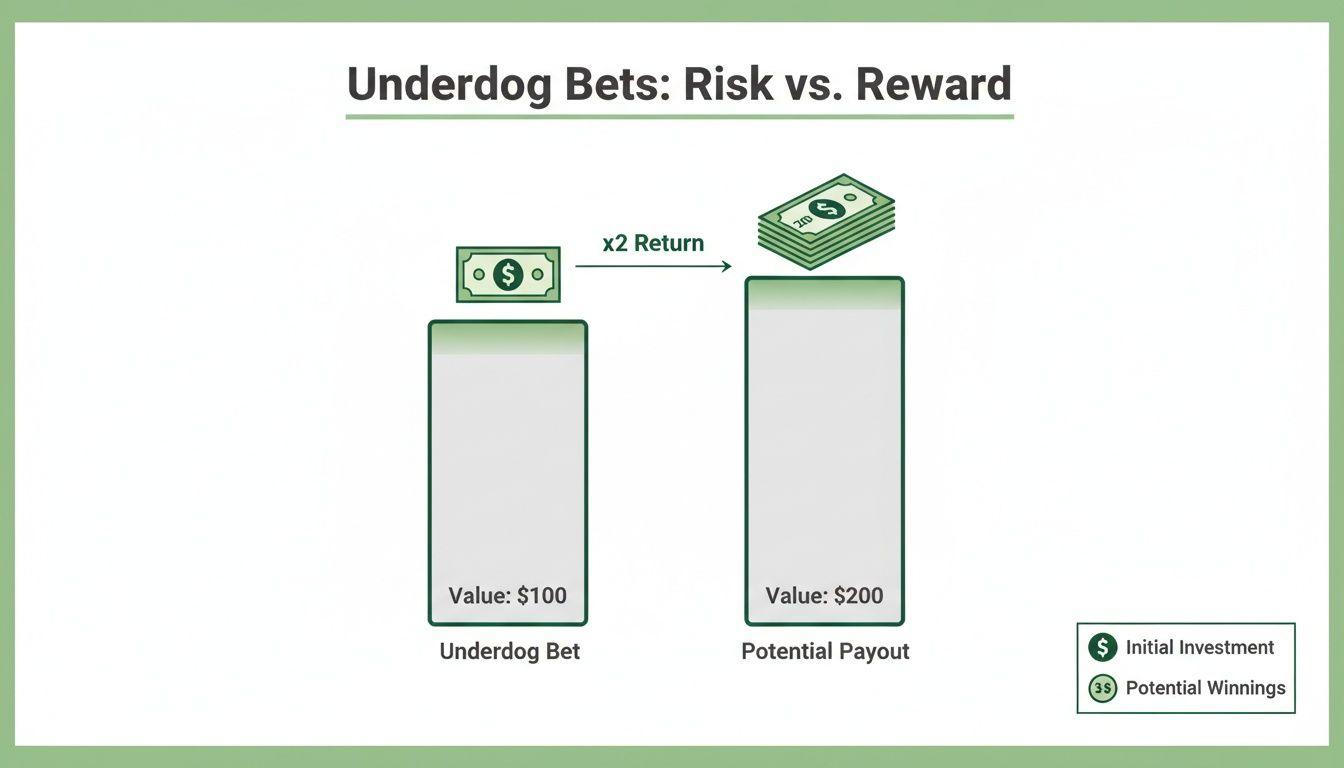
This visual really drives home the high-reward nature of finding the right underdog.
Putting It All Together: A Table for Quick Reference
To make these concepts even clearer, here’s a handy chart that breaks down how different American odds translate into implied probability and what you can expect to win.
This table shows how different American odds translate into implied probability and the potential payout for a standard $100 bet.
| American Odds | Type | Implied Probability | Payout on $100 Bet (Profit) |
|---|---|---|---|
| +300 | Underdog | 25.0% | $300 |
| +200 | Underdog | 33.3% | $200 |
| +150 | Underdog | 40.0% | $150 |
| +100 | Even Money | 50.0% | $100 |
| -110 | Favorite | 52.4% | $90.91 |
| -150 | Favorite | 60.0% | $66.67 |
| -200 | Favorite | 66.7% | $50 |
| -300 | Favorite | 75.0% | $33.33 |
As you can see, the risk and reward are baked right into the numbers. The bigger the favorite (more negative), the smaller your profit. The bigger the underdog (more positive), the larger your potential score.
A Note on Other Formats: Every now and then, you might run into odds displayed as fractions instead of the American style. Being able to quickly read any format is a key skill. If you ever need a hand, a good fraction to decimal calculator can make the conversion instantly.
Applying Your Knowledge to Real Bets
Theory is one thing, but seeing how this all plays out in the wild is where you really start to build confidence. Let's walk through a few common betting scenarios from different sports. This will help connect the dots between the plus and minus signs, what you get paid, and how to start thinking strategically.
This is how you move past simple definitions and begin to analyze betting lines like a seasoned pro. By breaking down each example, you’ll see what the and mean in sports betting from a purely tactical perspective.
NFL Point Spread Example
In football, the point spread is king. It’s the great equalizer. Imagine you’re looking at the board and see a line for an upcoming game:
Dallas Cowboys -7 (-110) vs. New York Giants +7 (-110)
This line is telling you two distinct stories. The -7 next to the Cowboys brands them as the favorite; they have to win the game by more than seven points for your bet to cash. On the flip side, the Giants are the +7 underdog. For their side to win, they can either win the game outright or just lose by six points or fewer.
And what about that -110? That’s the price of the bet, often called the "juice" or "vig." In this standard scenario, you have to risk $110 to win $100, no matter which team you decide to back.
MLB Moneyline Matchup
Baseball often skips the complexity of spreads and gets right to the point with the moneyline-a straightforward bet on who will win the game. Let’s look at a classic matchup:
Los Angeles Dodgers -160 vs. San Diego Padres +140
The minus sign is a dead giveaway: the Dodgers are the clear favorite. The -160 means you need to bet $160 to turn a $100 profit. This line carries an implied probability of 61.5%, which shows the sportsbook sees them as a heavy favorite. You can quickly convert these numbers with an odds to percentage calculator to get a feel for the market's expectation.
The Padres are the underdog, tagged with the plus sign. Those +140 odds are where the bigger rewards lie. A $100 bet here would bring back a $140 profit if they manage to pull off the upset. Their implied probability is just 41.7%, signaling higher risk for a much greater reward.
This is where strategic thinking kicks in. You have to ask yourself: are the Padres' actual chances of winning better than the 41.7% the odds suggest? If you think the answer is yes, you may have just spotted a value bet.
Three-Way Soccer Line
Soccer throws another wrinkle into the mix with the very real possibility of a draw. A typical three-way moneyline forces you to be much more specific with your prediction. It might look something like this:
- Manchester City -120 (To Win)
- Liverpool +300 (To Win)
- Draw +280
Here, Man City is the favorite at -120. Liverpool is a significant underdog at +300, offering a juicy payout if they can spring an upset. But what’s interesting is the draw. At +280, it’s also an underdog outcome, but the odds suggest it's considered slightly more likely than a Liverpool win. This structure demands precision-if you bet on either team to win and the match ends in a tie, your bet is a loser.
How Professionals Use Odds to Find Value
Understanding what the plus (+) and minus (-) symbols mean is step one, but for a professional bettor, that’s just the starting line. They don’t just read the odds-they treat them as a roadmap to hunt for weaknesses in the market. This is where you graduate to the concept of value betting, a shift in thinking that separates casual weekend punters from sharp, analytical bettors.
The core idea is beautifully simple: your goal is to find bets where you believe the real probability of something happening is higher than the probability the sportsbook is offering. It’s a game of numbers, not teams.
The Mindset of a Value Bettor
A pro looks at a line like the Green Bay Packers at -150 and doesn't just see a favorite. They see an implied probability of 60%. The critical question they ask isn't, "Are the Packers going to win?" Instead, they ask, "Will the Packers win this game more than 60% of the time?"
If their own models and deep-dive analysis suggest the true probability is closer to 65% or 70%, they've just found a value bet. This disciplined approach turns the odds from a simple price list into a strategic tool for finding profitable wagers. It demands research and, most importantly, the ability to leave your emotions at the door.
The ultimate goal is to consistently place wagers that have a positive expected value (+EV). This means that over the long run, the bets are mathematically structured to be profitable, even if some individual wagers lose.
How Line Movement Signals Opportunity
Professionals are obsessed with line movements-the way odds shift in the hours and days leading up to a game. A team might open at -150 and get bet down to -130. This could mean a flood of money is hitting the underdog, or maybe a key injury report just dropped.
These movements can create golden opportunities. For instance, if your own research pegs a -200 (66.7%) favorite as having a true 75% chance to win, that single bet carries a positive expected value of +12.5%. This is exactly the kind of market inefficiency that tools like ValueBetFactory are built to find, using algorithms to automatically flag discrepancies. You might get an alert when public betting pushes the Celtics from -5.5 (-112) to +100, creating a pocket of value. For a deeper dive, check out this article on what the plus and minus mean in sports betting.
Ultimately, this analytical approach is the final piece of the puzzle. It takes you from simply understanding what the odds mean to actively using them as a weapon to make calculated, strategic decisions that can build long-term success.
A Few Final Questions
To wrap this up, let's tackle some of the most common questions that pop up when bettors first start getting a handle on plus and minus odds. Think of this as a quick-reference guide to help solidify the concepts we've covered.
What’s the Magic Number I Need to Win to Break Even?
When you’re betting on standard point spreads, you'll almost always see odds of -110. To actually turn a profit at those odds, you need to win more than you lose. The exact break-even point is a 52.38% win rate.
That specific number is what it takes to overcome the "juice" or "vig" the sportsbook builds into the line. It might not sound like a high bar, but according to an analysis from Hard Rock Bet, only a tiny fraction of bettors-around 3%-can actually sustain that rate long-term without finding a real, repeatable edge. You can read more about betting analysis to get a better feel for the numbers behind successful betting.
Do Odds Actually Change Before a Game Starts?
Absolutely. Odds move all the time, and this is called line movement. It's a constant, living part of the betting market.
Sportsbooks will adjust their odds for a handful of key reasons:
- Lopsided Action: If a flood of money comes in on one side, the bookie will shift the odds to make the other side more attractive. They're trying to balance their books and minimize their risk.
- Breaking News: An injury to a star player, a sudden lineup change, or even a drastic shift in the weather forecast can cause odds to swing dramatically in a matter of minutes.
- Market Correction: Sometimes, the bookmakers just get it wrong. The initial line they set might have been a mistake, and sharp, professional bettors will pounce on it, forcing the market to correct itself.
What Happens if the Game Is a Tie?
This depends entirely on the sport and the type of bet you made. For sports like football or basketball where you're betting the moneyline, a tie is usually graded as a "push."
A push means the bet is voided, and your original stake is simply refunded to your account. You didn’t win, but you didn’t lose any money, either.
But be careful with sports like soccer or hockey. They often offer a three-way moneyline where the "Draw" is a specific betting option. If you bet on Team A to win and the game ends in a tie, your bet is a loser. You have to have bet specifically on the "Draw" line to get paid out in that scenario.
Ready to stop guessing and start finding true value in the odds? The tools at ValueBetFactory are designed to do the heavy lifting for you, spotting market inefficiencies and alerting you to profitable opportunities. Sign up today and start betting smarter!