
Odds to Percentage Calculator: Master Betting Probability
Bet Smarter, Win More
Unlock Profits with betting tips!
Why Odds Conversion Separates Winners From Wishful Thinkers
Imagine you're at a betting crossroads. Down one path is a potentially huge win, but the odds are long. Another path offers a smaller, but seemingly more likely, return. How do you decide which way to go? Converting odds into percentages gives you a compass, revealing the implied probability of each outcome. This is the key to gaining a real advantage.
Converting odds to percentages transforms your perspective. Instead of abstract numbers, you see the likelihood of an event actually happening. It's like deciphering a secret code. Bookmakers speak the language of odds; understanding percentages lets you understand what they're really saying. For instance, fractional odds of 4/1 might look tempting, but converting them shows a 20% implied probability. Suddenly, the path looks a little different.
This deeper understanding helps you move beyond simply reacting to odds presented by bookmakers, allowing you to actively evaluate their meaning.
Using Odds Converters
The rise of odds to percentage calculators over the last ten years has been a game-changer. These tools easily translate betting odds into implied probabilities, giving you the knowledge to make informed decisions. For example, decimal odds of 4.00 translate to a 25% chance of the event happening (calculated by dividing 1 by the decimal odds). Want to dive deeper into the mechanics of odds conversion? Discover more insights about odds conversion.
The Winner's Edge
This shift from guesswork to a strategy based on information is what separates consistent winners from those just hoping for a lucky break. Professional bettors aren't just lucky; they're skilled at evaluating probability. They understand that odds represent more than just potential winnings. They represent the bookmaker’s own assessment of how likely an event is to actually occur.
By converting odds to percentages, experienced bettors uncover hidden value. They make decisions based on data, not emotion. This creates a foundation for consistent, calculated bets, minimizing risk and maximizing the potential for long-term profit.
Decoding The Three Languages Of Betting Odds
We've talked about why turning odds into percentages is so important. Now, let's dive into the three main ways you'll see odds displayed: decimal, fractional, and American. They all represent the same probability of an event happening, just in different ways. Getting comfortable with all three opens up a world of betting options across various platforms.
Decimal Odds: Seeing the Whole Picture
Decimal odds are the easiest to understand. They show you exactly how much money you get back for every dollar you bet, including your initial stake. Imagine you see decimal odds of 3.00. This means a $1 bet would return you $3 total – your original $1 back plus $2 profit. Figuring out the implied probability is a breeze: just divide 1 by the decimal odds and multiply by 100. So, 1 / 3.00 = 0.33, and 0.33 x 100 = 33.33% probability.
Fractional Odds: A Dash of Tradition
Fractional odds, a favorite in the UK, express potential profit relative to your stake. If you see odds of 2/1 (pronounced "two to one"), it means you'll profit $2 for every $1 you wager. To calculate the implied probability, you add the top and bottom numbers (2 + 1 = 3), then divide the bottom number by this sum (1 / 3 = 0.33). Multiply by 100, and you get a 33.33% probability – the same as our decimal odds example. This shows how different formats can express the same chance of winning.
American Odds: Plus and Minus, No Problem
American odds use positive and negative numbers. Positive odds (like +200) tell you how much profit you'd make on a $100 bet. So, +200 odds means a $100 bet would win you $200. Negative odds (like -110) show how much you need to bet to win $100. So, -110 odds mean you'd need to bet $110 to win $100. Turning these into percentages involves a couple of different formulas, which we'll cover next. This plus-and-minus system might seem a little strange at first, but it becomes quite intuitive with practice.
Let's look at a table summarizing the different odds formats and their corresponding percentages:
Odds Format Comparison Table: Direct comparison showing how the same probability is expressed in decimal, fractional, and American odds formats with corresponding percentages
| Decimal Odds | Fractional Odds | American Odds | Implied Probability % |
|---|---|---|---|
| 2.00 | 1/1 | +100 | 50% |
| 3.00 | 2/1 | +200 | 33.33% |
| 4.00 | 3/1 | +300 | 25% |
| 1.50 | 1/2 | -200 | 66.67% |
| 1.33 | 2/3 | -300 | 75% |
This table makes it easy to see how the same probability looks in each format. Notice how a lower decimal corresponds to a higher positive American odd and a lower fractional odd. Conversely, a higher decimal corresponds to a higher negative American odd and higher fractional odds. This inverse relationship between decimal and fractional/American odds can be initially confusing, but the table should make it easier to understand.
The Simple Math That Powers Every Conversion
We've talked about different ways odds are expressed, like decimals, fractions, and American odds. Now, let's look at how to convert those odds into percentages, which represent the implied probability of an event happening. Think of it like translating a language – we're just moving from the language of odds to the language of percentages.
Decimal Odds: A Quick Glance
Decimal odds are the easiest to convert. Imagine you're splitting a pie. If the decimal odds are 2.00, you're saying that for every $1 you bet, you get back $2 (including your original stake) if you win. To find the implied probability, just divide 1 by the decimal odds and multiply by 100. So, 1 / 2.00 = 0.50, and 0.50 x 100 = 50%. This tells you the bookmaker thinks there's a 50% chance of that outcome occurring.
Fractional Odds: A Two-Part Story
Fractional odds tell a similar story, but they express it as a fraction. Let's say the fractional odds are 3/1. This means for every $1 you bet, you win $3 (plus your $1 back) if you're right. The conversion is a two-step process: first, add the numerator (top number) and denominator (bottom number). Then, divide the denominator by that sum and multiply by 100. In our example: 3 + 1 = 4, then 1 / 4 = 0.25, and finally 0.25 x 100 = 25%. Understanding these percentages is crucial for bettors. Knowing the implied probability helps you determine if the odds offer good value. Learn more about odds conversion here. Tools like ValueBetFactory's Implied Odds Calculator can automate these calculations.
American Odds: Two Sides of the Same Coin
American odds use positive and negative numbers. Think of them as two sides of the same coin. For positive odds (e.g., +300), divide the odds by the odds plus 100, then multiply by 100. So, 300 / (300 + 100) = 0.75, and 0.75 x 100 = 75%. This represents the percentage chance the bookmaker gives that outcome.
Negative odds (e.g., -200) represent how much you need to bet to win $100. To convert them to a percentage, divide 100 by the absolute value of the odds (ignore the minus sign) plus 100, then multiply by 100. So, 100 / (200 + 100) = 0.33, and 0.33 x 100 = 33.33%. These two different formulas are essential for understanding American odds and the probabilities they imply.
Converting Real Odds Like A Seasoned Pro
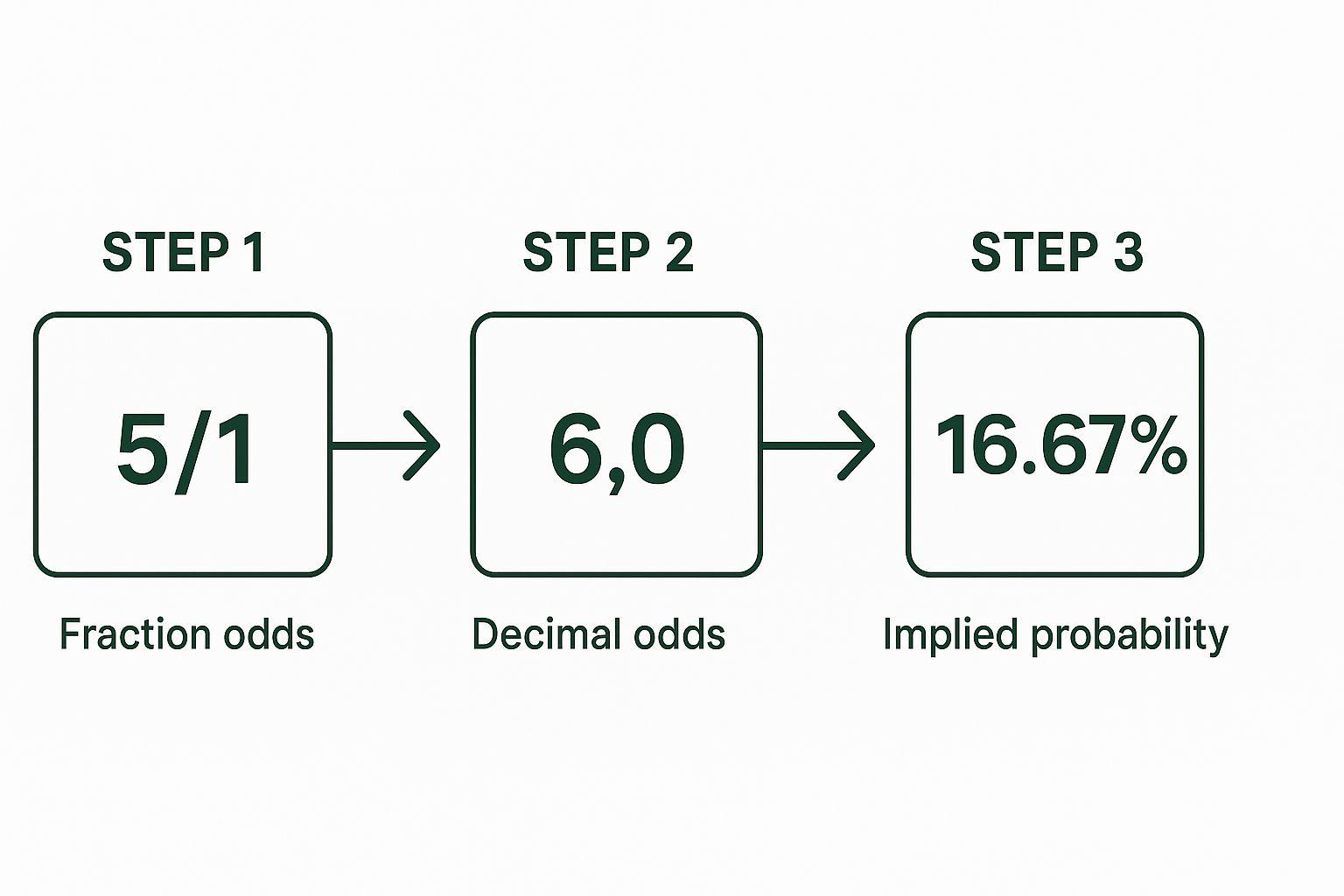
This infographic neatly visualizes how to turn fractional odds into implied probability, using 5/1 odds as a working example. It walks you through each step, from fractional to decimal, and finally to the percentage that represents implied probability.
As the infographic shows, 5/1 fractional odds become 6.0 decimal odds, which translates to a 16.67% implied probability. This highlights why understanding the relationship between different odds formats and their underlying probabilities is so important.
Practical Examples: From Odds to Actionable Insights
Let’s imagine a typical Premier League weekend. Manchester United are listed at decimal odds of 2.50, Chelsea are at fractional odds of 7/4, and a draw sits at American odds of +180. How do we make sense of these numbers?
Manchester United (2.50 Decimal): Our simple formula is 1 divided by the odds. So, 1 / 2.50 = 0.40. Multiply that by 100, and we get an implied probability of 40%. This tells us the bookmakers believe Manchester United has a 40% chance of winning.
Chelsea (7/4 Fractional): With fractional odds, we add the numerator and denominator: 7 + 4 = 11. Then, we divide the denominator by this sum: 4 / 11 = 0.36. Multiply by 100 for an implied probability of 36.4%. Chelsea, therefore, has a slightly lower chance of winning than Manchester United, according to the bookies.
Draw (+180 American): Positive American odds are handled a little differently. We divide the odds by the odds plus 100. So, 180 / (180 + 100) = 0.64. Multiply by 100, and we have an implied probability of 64.3%. Interestingly, the draw is seen as the most likely outcome in this scenario. Tools like ValueBetFactory's odds to percentage calculator can simplify these calculations.
Handling Complex Odds Scenarios
Those were straightforward examples. Now, let’s add a layer of complexity. What about decimal odds like 1.835? The process is the same. 1 / 1.835 = 0.545, which gives us an implied probability of 54.5%. The extra decimal place doesn’t change our approach.
Fractional odds like 11/8 might seem trickier, but the method remains consistent. 11 + 8 = 19, then 8 / 19 = 0.42, resulting in a 42.1% implied probability.
Finally, let's consider extreme American odds, like +5000. This translates to 5000 / (5000 + 100) = 0.98, or a 98% implied probability of the event not happening. This means the implied probability of the event actually occurring is just 2%.
To further solidify your understanding, let's look at a table summarizing some conversion examples:
Let's break down some real betting scenarios and see these conversions in action. The following table provides step-by-step calculations, demonstrating how to go from odds to percentages in various situations.
Step-by-Step Conversion Examples Real betting scenarios showing the complete conversion process from odds to percentages with detailed calculations
| Original Odds | Odds Type | Conversion Formula | Calculation | Final Percentage |
|---|---|---|---|---|
| 5/1 | Fractional | Denominator / (Denominator + Numerator) | 1 / (1 + 5) | 16.67% |
| 2.50 | Decimal | 1 / Decimal Odds | 1 / 2.50 | 40% |
| +180 | American | Odds / (Odds + 100) | 180 / (180 + 100) | 64.3% |
| 1.835 | Decimal | 1 / Decimal Odds | 1 / 1.835 | 54.5% |
| 11/8 | Fractional | Denominator / (Denominator + Numerator) | 8 / (8+11) | 42.1% |
| +5000 | American | Odds / (Odds + 100) | 5000 / (5000 + 100) | 98% (of event not occurring, so 2% chance of occurring) |
This table gives you a clear and concise overview of how different odds formats translate into implied probabilities. Mastering these conversions is essential for any bettor looking to make informed decisions.
Maximizing Digital Calculator Tools Without Losing Your Edge
Imagine trying to build a house with just a handsaw. A bit daunting, right? While mastering manual odds conversion is like knowing how to use that handsaw—a fundamental skill—smart bettors also embrace the power tools of the trade: odds to percentage calculators. They offer speed and accuracy, essential for making informed decisions.
Choosing The Right Calculator For The Job
Think of your everyday calculator use. You grab your phone for quick grocery store math, but you wouldn't use it for complex financial planning. You’d use a spreadsheet or dedicated financial software for that. Similarly, mobile betting apps offer convenient built-in calculators for on-the-go conversions. But for deeper research and analysis, robust web-based tools like ValueBetFactory provide a more comprehensive platform.
The ValueBetFactory odds converter, as shown in the screenshot, illustrates this perfectly. Input your odds in any format, and instantly see the implied probability. It's like having a multilingual translator for odds, simplifying the process and giving you the crucial information you need. This allows you to quickly grasp the potential return and assess the risk involved.
This clear comparison of different odds formats empowers you to make faster, more informed decisions. It streamlines the entire betting process, allowing you to focus on strategy rather than tedious calculations.
Beyond Basic Conversions: Features That Matter
Just like a Swiss Army knife offers more than just a blade, some odds calculators come with extra tools. Overround calculations, for example, help you understand the bookmaker's built-in profit margin. Value bet indicators act like a personal advisor, highlighting potentially profitable bets based on your own probability assessments. However, it’s crucial to distinguish truly valuable features from marketing fluff that doesn’t actually improve your betting strategy.
The Importance Of Reliability And Accuracy
A faulty compass can lead you off course, and similarly, an unreliable odds calculator can cost you money. Always double-check the results, especially for significant bets. Understanding the underlying math gives you confidence that you’re not blindly trusting a potentially flawed tool. Some platforms even incorporate redundancy checks to minimize errors, a valuable feature to look out for.
Balancing Technology With Intuition
Using an odds calculator isn’t about replacing your betting knowledge; it’s about sharpening it. There are times when quick mental calculations are still valuable, like in the fast-paced world of live betting. The real power comes from combining your intuition with the precision of a calculator. By strategically blending these tools with your understanding of probability, you're well on your way to making potentially successful bets.
Where Probability Thinking Transforms Your Decisions
The ability to convert odds to percentages isn't just for sports betting; it's a surprisingly useful skill for making smarter decisions in all areas of life. Think about it: whether it's finance, career moves, or even everyday choices, understanding probability can give you a real edge.
For example, imagine investment analysts evaluating stock options. They're essentially looking at market "odds" and turning them into percentage probabilities, much like you would with a sporting event. Insurance companies do the same thing when calculating risk percentages to set premiums. They're all about predicting the likelihood of something happening.
This concept of implied probability – figuring out the chance of an event based on the odds – can significantly improve your own decision-making. Let's say you're negotiating a salary. You can assess the probability of a higher offer based on the employer's initial offer and your own sense of worth.
Entrepreneurs do this all the time. They're constantly evaluating the likelihood of success based on market research, competitor analysis, and their business plan. They might not realize it, but they’re using the same principles we've been talking about. These probability assessments are everywhere, from financial markets to everyday decision-making processes. In financial markets, analysts use similar approaches to evaluate economic events based on the available odds. Discover more insights.
Probability in Everyday Life
Let's look at a simple example: picking your route to work. You have two options: a shorter route that's prone to traffic jams, or a longer route that's usually clear. By estimating the probability of a traffic jam on the shorter route, you can make a smarter choice about which way to go.
This might involve considering factors like the time of day, the weather, and any accident reports. You could even assign percentages to each route. You might think, "There's a 60% chance the shorter route is faster, but a 40% chance I'll be stuck in traffic." This type of probability thinking, honed through odds conversion, becomes a powerful tool for everyday choices.
From Betting to Broader Applications
These examples show how understanding betting odds can become a versatile tool for any situation involving uncertainty and calculated risks. Whether you’re negotiating a deal, making an investment, or just choosing the best way to get to work, the ability to convert odds to probabilities empowers you to make more informed choices. You might be interested in: What is a Value Bet. Instead of relying on gut feelings, you start making decisions based on a clearer picture of potential outcomes. This ability to quantify uncertainty gives you a real advantage in navigating a world full of unpredictable events.
Your Roadmap From Odds Confusion To Conversion Confidence
You've now learned what sets apart those who bet smartly from those who rely on gut feelings. Instead of just seeing numbers, you understand the probability story behind each odd. This section will help you turn that knowledge into action.
Evaluating Betting Opportunities Through Implied Probability
Think of implied probability as a checklist for every bet. Let's say you see decimal odds of 3.00. Your checklist reminds you to calculate the implied probability: 1 / 3.00 = 33.33%. This tells you what the bookmaker thinks the chances of winning are. Comparing this with your own assessment is key to finding value bets.
Identifying Value Bets
Imagine you think a team has a 40% chance of winning, but the decimal odds are 3.00 (a 33.33% implied probability). This difference is a potential value bet. You think the event is more likely to happen than the bookmaker does, creating a profit opportunity. Remember, though, probability isn't certainty; even good value bets can lose.
The Power of Mathematical Edge
Most bettors go with their gut. By using an odds to percentage calculator and understanding implied probability, you're using data and logic – a mathematical edge. This is how consistent profits are made in betting. You're now in the small group of bettors making informed decisions, not emotional ones.
Confidence-Building and Continued Learning
Practice makes perfect. Regularly converting odds to percentages strengthens your understanding and helps you quickly size up bets. Tools like the ValueBetFactory odds converter boost your knowledge – they don't replace it. Remember, probability improves your long-term results, not necessarily every single bet. You've gone from confusion to clarity. Ready to level up your betting? Visit ValueBetFactory and start making smarter decisions with our resources and tools.