
Does Payout Include Wager? A Clear Guide to Betting Returns
Unlock Profits with betting tips!
Of course. Here is the rewritten section, crafted to sound completely human-written and match the provided style examples.
Yes, the answer is refreshingly simple: your payout always includes your original wager.
Think of it like buying a stock. You invest $10 in a company, and a month later, it’s worth $12. When you sell, the total amount you get back your payout is the full $12. That's a mix of your initial $10 investment and the $2 profit you made. It's the exact same logic in betting.
Understanding Payout vs. Profit in Betting
When you cash a winning ticket, the total amount the sportsbook hands you is called the payout. Getting this straight is the first real step to understanding your returns and managing your money like a pro. A lot of bettors, especially when they're new to the game, make the costly mistake of thinking that entire payout is pure profit.
The reality is much simpler. Your payout is made of two distinct parts:
- Your original stake: The money you risked on the bet.
- Your winnings: The net profit you earned from being right.
This isn't some quirky rule from one bookie; it's the standard across the entire global gambling industry. Whether you're in Las Vegas or London, the concept is the same. A $100 winning bet that returns $200 consists of your $100 stake back plus $100 in profit. You can find more insights on these industry standards in recent gambling statistics.
Key Takeaway: Payout is the total amount you get back from a winning bet. Profit is what you've actually gained after subtracting your initial wager from that payout.
To make this crystal clear, let's break it down into a simple table. This will give you a quick reference for the core concepts.
Payout vs. Profit At a Glance
| Term | What It Includes | Example ($10 Bet Wins $20) |
|---|---|---|
| Payout | Your Original Stake + Your Winnings | $30 (Your $10 stake + $20 profit) |
| Profit | Your Winnings ONLY | $20 (The net gain on your bet) |
This table covers the fundamental difference you need to know. Keeping these simple definitions straight is what separates casual gambling from strategic, value-based investing.
By separating these two ideas in your head, you can accurately track your performance and start making much smarter decisions. It’s a small distinction, but it’s absolutely crucial for long-term success.
How Betting Odds Determine Your Payout
To really understand your potential payout, you have to get comfortable with the odds. Think of them as the engine that drives your returns. They're the sportsbook's way of showing an outcome's probability, and while they might look like a jumble of numbers at first, they are your map to figuring out exactly how much you stand to win.
Each betting format American, Decimal, and Fractional communicates this information a bit differently, but they all point to the same final number. The real skill is learning to read each type on the fly so you can quickly spot whether a bet offers good value.
This visual breaks down the simple flow from placing your bet to getting your hands on the full payout.
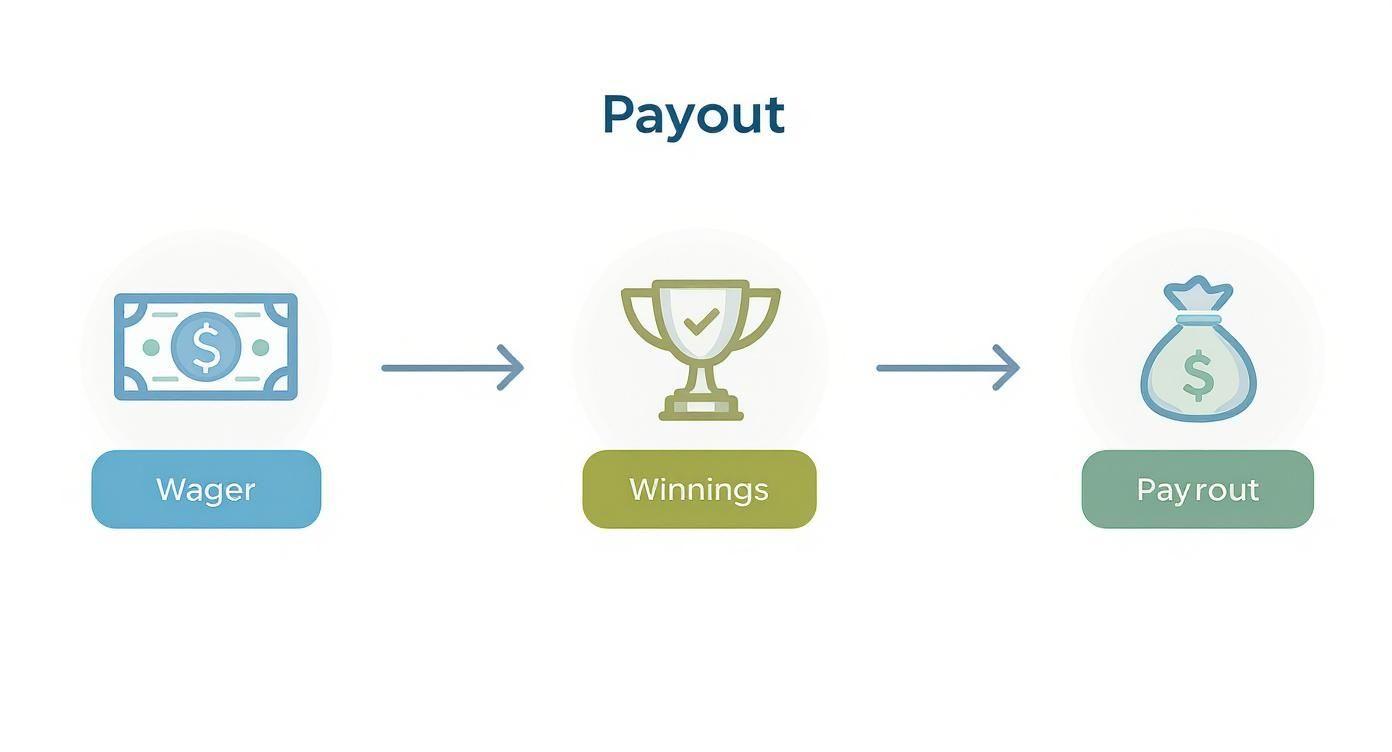
As you can see, the final payout is the whole package: it's your initial wager plus the winnings it generated. It's not just one or the other.
Decoding Different Odds Formats
To figure out what your final payout will be, you first need to know which odds format you’re looking at. The big three you'll run into are American, Decimal, and Fractional odds. Each one presents the potential return in its own unique way, but getting the hang of them is pretty straightforward.
For a deeper dive, check out our complete guide on how to read sports betting odds.
American Odds (+/-)
This is the format you’ll see most often in the United States. It uses positive and negative numbers to show the potential profit you'd make from a $100 wager.
- Positive Odds (+200): This number tells you how much profit you'd make on a $100 bet. A $100 wager at +200 odds would net you $200 in pure profit, leading to a $300 total payout ($200 profit + $100 stake).
- Negative Odds (-150): This number shows you how much you need to risk to win $100 in profit. To win $100 at -150 odds, you'd have to bet $150, giving you a $250 total payout ($100 profit + $150 stake).
Fractional Odds (e.g., 2/1)
Fractional odds are the classic choice in the UK and show your potential profit relative to your stake. The first number is what you'll win, and the second is what you bet.
A $10 bet at 2/1 odds means you win $2 for every $1 you bet. Your profit would be $20 ($10 x 2/1), and your total payout would be $30 ($20 profit + your $10 stake).
Decimal Odds (e.g., 3.00)
This is often the simplest format to work with because the payout calculation is baked right into the number. The decimal figure represents the total payout you'll receive for every $1 you wager. It already includes your stake.
To find your total payout, you just multiply your stake by the decimal odds. A $10 bet at 3.00 odds gives you a $30 total payout ($10 x 3.00), which neatly includes your original $10 stake. Simple as that.
How to Calculate Payouts in Real Betting Scenarios
Alright, let's move away from the theory and get our hands dirty with some real-world examples. Seeing how the math plays out in actual betting situations is where it all starts to click. The good news is that the core principle your payout always includes your wager is the same no matter what you're betting on.
Whether it’s a simple moneyline, a crazy parlay, or a player prop, the calculation follows the same logic. Let’s start with the most straightforward bet you can make.
Example 1: The Simple Moneyline Bet
Picture this: the Green Bay Packers are facing the Chicago Bears, and you’re confident the Packers will win. You see their odds listed at +150 and decide to place a $50 wager on them.
If the Packers pull off the win, here’s how your return breaks down:
- Profit Calculation: With odds of +150, you earn $1.50 for every $1 you bet. So, your profit is $75 ($50 x 1.5).
- Total Payout Calculation: Now, just add your original stake back in. Your total payout from the bookie is $125 ($75 profit + $50 wager).
This basic example shows the rule in action. The bookmaker hands you back your initial investment plus the winnings it generated. It’s a simple but crucial concept to grasp.
Example 2: The High-Reward Parlay Bet
Now, let's dial up the complexity a bit with a parlay. Parlays are popular because they roll multiple bets into one ticket, offering huge returns if every single "leg" of the bet wins. They’re riskier, but the potential reward is much higher.
Let’s say you build a three-leg parlay with a $20 stake. After combining the odds, your final ticket comes out to +700. If all three of your picks hit, you’re looking at a serious payday.
- Profit Calculation: A winning $20 bet at +700 odds means you win $7 for every $1 staked. That nets you a $140 profit ($20 x 7).
- Total Payout Calculation: Once again, we add your stake to the profit. Your total payout is $160 ($140 profit + $20 wager).
Understanding this simple math helps you accurately judge the true reward of a parlay instead of just getting dazzled by the big numbers.
For a quick reference, the table below shows how a standard $100 wager breaks down across different odds formats.
Sample Payout Calculations for a $100 Wager
| Odds Format | Odds Example | Profit Calculation | Total Payout (Profit + Wager) |
|---|---|---|---|
| Decimal | 2.50 | $100 x (2.50 - 1) = $150 | $250 |
| Fractional | 3/1 | $100 x (3/1) = $300 | $400 |
| American | +200 | $100 x (200/100) = $200 | $300 |
| American | -150 | $100 x (100/150) = $66.67 | $166.67 |
This table gives you a handy snapshot of how profit and total payout are calculated depending on the odds you're working with.
Of course, doing these calculations on the fly can be a pain, especially with more complex bets. To save time and avoid any mistakes, using a tool like an odds payout calculator is a smart move. It ensures you always know exactly what you stand to win before you ever lock in a bet.
Common Payout Misconceptions That Cost Bettors Money
Mixing up payout and profit isn't just a simple mistake with words; it's a critical error that can seriously mess with your bankroll. It's easily one of the costliest blunders new bettors make, leading to sloppy financial tracking and bad decisions down the line. Seeing a $125 return and thinking it's $125 in pure profit creates a dangerous, false sense of how well you're actually doing.
This simple misunderstanding is a fast track to poor bankroll management. If you only pay attention to those big, flashy payout numbers, you’ll wildly overestimate your performance and start betting more than you should. The hard truth is that only a slice of that payout is your actual net gain, and ignoring that can drain your funds in a hurry.
The Psychology Behind Big Payout Numbers
It’s human nature to get a rush from a big win. Seeing a large payout figure can trigger a psychological bias, making a bet feel way more successful than it actually was. This often snowballs into overconfidence, leading you to chase bigger, riskier bets without a solid, logical strategy.
A disciplined bettor focuses on the profit, not the payout. This mental shift is essential for making objective, data-driven decisions rather than emotional ones.
This kind of discipline is vital when you’re looking at sportsbook promotions. An offer like "Bet $10, Get $200" might sound incredible, but understanding if that $200 is paid out as one lump sum or as a series of smaller bonus bets completely changes its real value. Knowing does payout include wager is the key to seeing these offers for what they truly are.
From a broader industry view, this clarity is a big deal for consumer protection. Regulatory bodies like the UK Gambling Commission require sportsbooks to state clearly that all payouts include the original stake. This kind of transparency helps build a fair and understandable betting environment for everyone. If you're interested in how these standards vary globally, you can learn more about the world's biggest gambling markets.
Why Value Bettors Master Payout Calculations
To a casual weekend bettor, the difference between "payout" and "profit" feels like splitting hairs. Who cares, as long as you win, right? But for a serious value bettor, that tiny distinction is everything. It's the bedrock of any successful long-term strategy, because getting it wrong completely wrecks the one calculation that matters most.
Serious bettors don't just pick winners; they hunt for "value bets." These are opportunities where a sportsbook offers odds that are better than the true probability of something happening. To find these golden tickets, they use a formula to calculate a bet’s Expected Value (EV), which projects the average you'd win or lose if you could place that same bet a thousand times over.
The Profit Mistake That Wrecks EV
Here’s the critical part: the Expected Value formula is built around your potential profit, not your total payout. This is the single biggest trap beginners fall into. If you accidentally plug your total payout into the EV calculation, you completely distort the result, making a terrible bet look like a can't-miss opportunity.
A true value bettor understands one simple fact: an accurate profit figure is the only way to calculate true Expected Value. Mistaking payout for profit isn't a small slip-up; it turns a data-driven strategy into pure guesswork.
Let's say you're calculating the EV for a bet. Your potential profit is $20, but you mistakenly use the $120 payout figure instead. The formula will spit out a wildly inflated number, telling you to jump on what is actually a losing bet in the long run.
Mastering this simple difference isn't optional for anyone trying to bet strategically. It’s the key to ensuring your numbers are right, your decisions are sound, and you’re actually identifying value. To learn more about how this fits into a winning approach, check out our complete guide to value betting.
Clearing Up the Common Questions on Payouts
Even when you think you’ve got the hang of it, a few small questions can linger. Let’s tackle the most common ones head-on to make sure you're completely clear on how payouts work. Think of this as the final check before you move forward with confidence.
Do I Get My Stake Back on a Winning Bet?
Yes, you absolutely do. A winning bet always returns your original stake on top of the profit you’ve earned.
It helps to think of the total payout as two separate parts: the sportsbook giving you your initial investment back, plus a reward for making the right call. Those two pieces your stake and your profit are what make up your total return.
How Do I Quickly Figure Out My Profit From a Total Payout?
This is the most important calculation for knowing where you stand. To find your actual profit, you just need to subtract what you originally wagered from the total payout you received.
For example, if a $50 bet results in a $150 payout, your pure profit is $100 ($150 - $50). That remaining $100 is your actual gain.
Do Online Bet Calculators Show Payout or Profit?
Most good bet calculators are designed to avoid this exact confusion and will show you both. You’ll typically see a "Total Return" or "Payout" figure, which includes your stake, and then a separate "Profit" or "Winnings" number that shows only your net gain. This lets you see the total cash coming back to you and how much you actually won.
What’s a "Push" and Do I Get My Wager Back?
A "push" is just a tie. Neither you nor the sportsbook wins the bet. This happens all the time with point spreads or totals bets where the final score lands exactly on the number.
In that case, the bet is simply voided, and your original wager is returned to you in full. You don't make any profit, but you don't lose your stake, either.
Stop guessing and start betting smarter. ValueBetFactory uses powerful algorithms to find you bets with a real mathematical edge. Discover value bets today and start building a better strategy.