
What Does Puck Line Mean in Hockey Betting?
Unlock Profits with betting tips!
Think of the puck line as hockey’s version of the point spread. It’s always set at a fixed 1.5 goals, and this simple tweak adds a whole new layer of strategy compared to just picking a team to win or lose. Instead of betting on who will win, you're betting on the margin of victory.
Decoding the Puck Line in Hockey Betting
When you first get into hockey betting, the moneyline is the most straightforward option. You just pick the team you think will win the game, plain and simple.
But the puck line changes the game by adding a handicap. This levels the playing field, especially in matchups that look lopsided on paper, making them far more interesting to bet on.
This fixed 1.5-goal spread creates two basic scenarios:
- Betting the Favorite (-1.5): For this bet to cash, your team can't just win they have to win by two or more goals. A 3-2 victory won't cut it.
- Betting the Underdog (+1.5): This gives you two ways to win. Your bet is a winner if the underdog pulls off the upset or if they lose by only one goal.
In short, the puck line is hockey's answer to the point spread, always locked in at that 1.5-goal mark. It demands more from the favorite but gives the underdog a fighting chance.
The image below breaks down the key differences between a puck line bet and a standard moneyline wager, showing you how the spreads, odds, and potential payouts stack up.
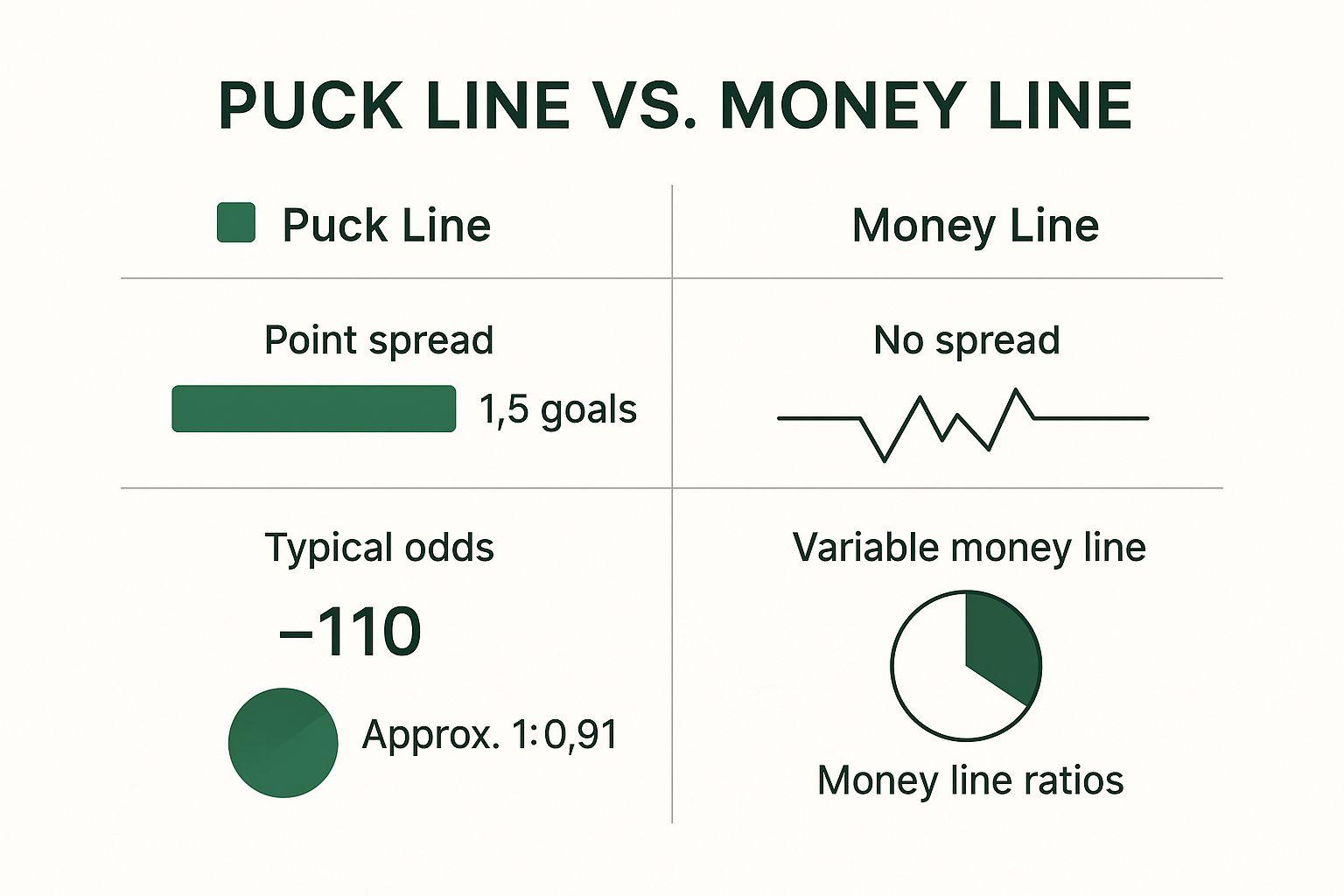
As you can see, the core trade-off is simple: you give up the certainty of a simple win for much better odds. The puck line offers more attractive payouts precisely because it requires a specific margin of victory.
Puck Line vs Moneyline At a Glance
To make it even clearer, let's break down the fundamental differences between betting the puck line and sticking with the moneyline.
| Betting Type | What You Bet On | Typical Payouts |
|---|---|---|
| Puck Line | The margin of victory. The favorite must win by 2+ goals; the underdog can lose by 1 goal or win outright. | Higher payouts on favorites (often plus-money) and lower payouts on underdogs. |
| Moneyline | The outright winner of the game, regardless of the score. | Lower payouts on favorites (often heavy minus-money) and higher payouts on underdogs. |
Ultimately, the choice comes down to your confidence level. If you think a heavy favorite is going to dominate, the puck line offers great value. If you think an underdog can keep it close, the puck line gives you a safety net that the moneyline doesn't.
How Puck Line Betting Works in Action
Theory is great, but let’s get down to the ice level with a real game scenario to see what the puck line really means. Imagine the Boston Bruins are squaring off against the Detroit Red Wings, and the sportsbook shows you this:
- Boston Bruins: -1.5
- Detroit Red Wings: +1.5
In this matchup, the Bruins are clearly the favorite. That -1.5 tells you they need to win the game by at least two goals for your bet to cash. A 4-2 final? You win. A 5-1 blowout? You’re golden. But if they only win by a single goal, say 3-2, your bet doesn't cover the spread.
Now, flip it around for the underdog Red Wings. The +1.5 gives them a helpful one-goal buffer. A bet on Detroit is a winner if they pull off the upset and win the game outright or if they just lose by a single goal. Even a 3-2 loss means your Red Wings ticket is a winner. This is the core concept behind how a point spread levels the playing field, a topic you can dive into deeper in our guide to understanding the point spread.
Reading the Odds and Payouts
It's not just about the goal spread, though. Sportsbooks attach odds to each side of the puck line, and this is what tells you the potential payout and reflects the risk involved.
Let's look at another quick example. The Carolina Hurricanes might be the favorite at -1.5 but have +210 odds. This means a $10 wager could net you a $21 profit. Meanwhile, the underdog New York Rangers could be at +1.5 with -258 odds, which means you'd have to risk $25.80 just to win $10.
See the difference? Betting on the favorite to cover the puck line offers a much juicier payout because, frankly, it’s a harder feat to accomplish.
This risk-reward dynamic is the heart and soul of puck line betting. It forces you to make a choice: do you think the favorite is going to win decisively, or can the underdog keep the game tight?
That decision is where you find the value. You can either chase a bigger payday by backing a dominant team or play it a bit safer by betting that a competitive underdog will stay within striking distance.
Understanding Puck Line Odds and Payouts

So, why would you even bother with the puck line instead of just picking a winner? It all comes down to the odds and getting a better payout for your money.
Betting on a heavy favorite with a standard moneyline bet often returns pennies on the dollar. For instance, a powerhouse team might have moneyline odds of -300. This means you’d have to risk a hefty $300 just to win $100. For most bettors, that kind of risk just isn't worth the tiny reward.
This is where the puck line steps in to create a real opportunity for value.
How American Odds Work
American odds are pretty straightforward once you get the hang of them. They show up with either a plus (+) or minus (-) sign, telling you exactly what you stand to win or what you need to risk, all based on a $100 bet.
- Minus Odds (-): This is the amount you have to bet to win $100. For example, -150 odds mean you need to risk $150 to profit $100.
- Plus Odds (+): This is how much you’ll profit for every $100 you bet. For example, +120 odds mean a $100 bet will win you $120.
Now, let's connect this back to the puck line. That same dominant team with -300 moneyline odds might have puck line odds of +120 at -1.5 goals. All of a sudden, your $100 bet could net you $120 in profit instead of a measly $33.33.
The puck line transforms a low-reward bet on a favorite into a high-value opportunity by asking a simple question: Can they win by two or more goals?
This dramatic shift in the odds is what makes puck line betting so attractive. The payouts are a world away from what you see on the moneyline. Favorites at -1.5 on the puck line will usually offer odds somewhere between -110 and +130, turning a tough-to-swallow price like -200 or -300 into something much more appealing. You can find more great info on NHL puck line payouts on rg.org.
Winning Strategies for Puck Line Betting
Alright, knowing what a puck line is gets you in the door. But learning how to actually use it to find real value? That’s how you start winning. Certain game situations and matchups create predictable outcomes, making them perfect hunting grounds for a smart puck line bet.
One of the most classic plays is backing a heavy favorite on the puck line at home. You’re looking for a mismatch where a top-tier team is hosting a struggling opponent, especially a team that’s on the second night of a back-to-back on the road. Fatigue is a killer in the NHL, and a dominant home team can absolutely feast on a tired squad, making a multi-goal win much more likely.
Of course, it’s not always about the favorite. Taking the underdog at +1.5 is an incredibly powerful strategy, especially when you sniff out a game that’s going to be a low-scoring grinder.
Finding Value in Close Games
Picture a matchup between two teams known for their rock-solid defense and elite goaltending. These games are almost always tight, often decided by a single, nail-biting goal. This is where betting the underdog at +1.5 gives you a massive cushion. They can lose the game by one goal, and your ticket still cashes. You've turned a potential loss into a win.
Before you pull the trigger on any puck line bet, here are a few key factors you absolutely have to look at:
- Special Teams Performance: If a team with a lethal power play is up against an opponent with a leaky penalty kill, they’re far more likely to score in bunches and cover that -1.5 spread.
- Recent Form and Fatigue: Is a team red-hot, or have they been living out of a suitcase on a long road trip? A gassed team is way more likely to make the kind of sloppy mistakes that lead to a blowout loss.
- Goaltender Matchup: An elite goalie can steal a game single-handedly. If a hot netminder is in goal for the underdog, that +1.5 puck line starts looking pretty juicy.
The secret to a winning puck line strategy is identifying specific mismatches. It’s not just about a "good" team versus a "bad" team. It's about finding those specific statistical or situational advantages that one team has over the other.
This is what elevates your game. When you dig into these details, you stop guessing who will win and start making educated predictions on how they'll win. That margin of victory is everything when it comes to mastering the puck line.
When to Bet Puck Line Favorites vs Underdogs
Deciding whether to lay the -1.5 goals with a favorite or take the +1.5 with an underdog is the central challenge of puck line betting. It’s a strategic choice that depends entirely on the context of the game. Here’s a quick breakdown to help you spot the right opportunity.
| Consideration | Bet the Favorite (-1.5) | Bet the Underdog (+1.5) |
|---|---|---|
| Pace & Scoring | Expect a high-scoring game with lots of offensive chances. | Anticipate a tight, low-scoring defensive battle. |
| Goaltending | The favorite has an elite goalie facing a weak or backup goalie. | Both goalies are top-tier, or the underdog's goalie is elite. |
| Special Teams | The favorite has a dominant power play vs. a poor penalty kill. | The underdog has a strong penalty kill that can neutralize the favorite. |
| Fatigue Factor | The underdog is on the second game of a back-to-back road trip. | Both teams are well-rested, creating a more even matchup. |
| Motivation | The favorite is in a "must-win" situation (e.g., playoff push). | It's a rivalry game where the underdog is highly motivated to keep it close. |
Ultimately, betting the -1.5 favorite is a bet on dominance and a multi-goal victory, often driven by offensive firepower or a significant situational edge. In contrast, taking the +1.5 underdog is a bet on competitiveness a belief that the underdog can either pull off the upset or, at the very least, keep the game within a single goal.
Analyzing Puck Line Trends and Statistics
If you want to move beyond just gut feelings, you have to look at the numbers. Smart betting is always grounded in statistical reality, not just intuition. By digging into historical data, we can see exactly how often favorites actually cover the -1.5 spread and how frequently underdogs keep the game within one goal.
League-wide stats reveal a fascinating trend in the NHL. While a good number of games are decided by two or more goals, one-goal games are incredibly common. This balance is the entire key to understanding the risk and reward of a puck line wager. Underdogs at +1.5 might cash more often, but the payouts are smaller for a reason.
On the flip side, favorites at -1.5 dangle those bigger rewards precisely because they are statistically less likely to cover the spread.
The Statistical Edge
A deep dive into recent NHL seasons paints a very clear picture. The data shows that favorites at -1.5 goals win by two or more goals roughly 38-42% of the time. In sharp contrast, a +1.5 puck line bet on the underdog succeeds approximately 58-62% of the time, making it the statistically safer wager when it comes to covering. You can explore a bit more on how often underdogs cover on Gaming Today's guide to puck line betting.
Understanding this statistical balance separates casual bettors from sharp, analytical ones. The most successful bettors know that winning more frequently on underdogs with smaller payouts can be just as profitable as hitting less frequent, high-value bets on favorites.
This data-driven approach is fundamental to long-term success. You’re not just picking the better team anymore; you're evaluating the probability of a specific outcome. To get a better handle on using data for smarter wagers, check out our guide on applying statistics for sports betting. This knowledge is what helps you identify where the true value lies in any given matchup, empowering you to make much more informed decisions.
Common Puck Line Betting Mistakes to Avoid

Knowing what a puck line is gets you in the door, but avoiding the classic rookie mistakes is how you stay in the game. Too many bettors fall into the same predictable traps that can absolutely torpedo a bankroll. The good news? Spotting them is half the battle.
One of the biggest blunders is blindly backing heavy favorites on the -1.5 puck line. It feels like a safe bet, but it's a trap. What new bettors don't appreciate is just how hard it is to win by two goals in the NHL. Parity in this league is no joke, and even the best teams grind out one-goal victories all the time. Picking the better team isn't enough; you need a rock-solid reason to believe they’ll win comfortably.
Another huge mistake is getting tunnel vision and completely ignoring the all-important situational factors that really decide games.
Overlooking Key Contextual Clues
A team’s performance is about so much more than who’s on the roster. Bettors constantly trip up by failing to account for the external pressures that can swing a final score.
- Grueling Travel Schedules: Is the team playing its third road game in four nights? They're going to be running on fumes compared to a well-rested home team.
- Key Player Injuries: Don't underestimate this. The absence of a star player, especially a top goalie or leading scorer, can completely gut a team's game plan.
- Forgetting to Line Shop: Settling for the first odds you see is just leaving money on the table. Different sportsbooks offer different lines and payouts, and hunting for the best value is non-negotiable.
Developing a disciplined and analytical approach is crucial. This means treating each bet as a calculated decision, not an emotional guess, and managing your funds carefully.
This disciplined mindset naturally leads to proper bankroll management. To get a handle on this foundational skill, check out our guide on what is a unit in sports betting. It’ll help you build a much more structured and sustainable strategy.
Your Top Puck Line Questions Answered
Alright, let's wrap this up by hitting a few of the most common questions that come up when you're getting the hang of the puck line. Nailing down these details is the final step to betting these lines with real confidence.
Is the Puck Line Always 1.5 Goals?
Yep, for the most part. The standard, default puck line you'll see for every single NHL game is set at 1.5 goals. It's the bedrock of puck line betting.
While you might occasionally see "alternate" lines, that -1.5/+1.5 spread is the constant you can always count on. This consistency is one of the things that makes hockey betting so unique.
What Are Alternate Puck Lines?
Think of alternate puck lines as a way to adjust your risk. If you’re absolutely convinced a heavy favorite is going to blow out their opponent, you could bet them at -2.5 goals instead of the standard -1.5. The trade-off? You get a much juicier payout if you're right.
On the flip side, maybe you want some extra insurance on an underdog. You could take them at +2.5 goals, giving them a bigger cushion. The odds won't be as good, but your chances of cashing the ticket go up.
Alternate puck lines are a strategic tool for more experienced bettors. They let you customize a wager to match your confidence level, trading security for better odds or vice versa.
Can a Puck Line Bet Push?
Nope. A standard -1.5/+1.5 puck line can never end in a push (a tie where your stake is returned).
Since a hockey game can't be decided by half a goal, your bet is always going to be a clear winner or a clear loser. This is a great feature because it removes the ambiguity of a push, giving you a definitive result every time.
At ValueBetFactory, we provide the data and insights to help you spot these opportunities and make smarter betting decisions. Our tools analyze odds across the market to pinpoint value. Explore ValueBetFactory today and start betting with a statistical edge.