
What Is a Unit in Sports Betting? Master Your Betting Strategy
Unlock Profits with betting tips!
Key Insights

- What is a Unit?: A unit is a consistent percentage of your total betting bankroll, typically between 1% and 5%. It standardizes your bet size to manage risk and track performance accurately.
- Why Use Units?: Using units removes emotion and guesswork from betting. It promotes discipline and allows for a clear measure of success (units won/lost) regardless of your bankroll size.
- Calculating Your Unit: To find your unit size, first determine your total betting bankroll (money you can afford to lose). Then, choose a percentage based on your risk tolerance (e.g., 1% for conservative, 3% for standard, 5% for aggressive) and calculate the dollar amount.
- Common Mistakes: The biggest errors are letting emotions override your unit plan (chasing losses or getting overconfident), miscalculating your bankroll, and betting more than 5% on a single wager.
So, what exactly is a "unit" in sports betting?
Think of it as a consistent, standardized measure for your bet size. Instead of thinking in random dollar amounts, a unit is typically 1% to 3% of your total betting bankroll. It’s the secret sauce for taking emotion out of the equation and injecting some serious discipline into your wagering strategy.
The Real Role of a Betting Unit

A unit is much more than just a percentage; it's the cornerstone of solid bankroll management. By making every bet size consistent-whether it's one unit, two units, or half a unit-you get a clear, stable way to track your actual performance. It stops mattering whether you won $5 or $500 on a single bet.
This is what allows bettors with vastly different bankrolls to talk the same language and compare strategies on a level playing field. We’re all speaking in terms of "units won" or "units lost." It gives you a much truer picture of whether your strategy is actually working over the long haul.
A betting unit is what turns random gambling into a structured financial approach. It’s the discipline that separates the casual punters chasing a big score from the sharps who are methodically managing their risk.
Let's break it down with a simple example. Here’s how the dollar value of your unit adjusts as your bankroll changes:
| Total Bankroll | Your Unit Size (at 2%) |
|---|---|
| $500 | $10 |
| $1,000 | $20 |
| $5,000 | $100 |
See how that works? Your bet size grows as you win and shrinks when you hit a rough patch. This built-in protection is what prevents a bad losing streak from wiping you out. Getting this concept down is your first real step toward becoming a smarter, more sustainable sports bettor.
So, What Exactly Is a Betting Unit?

Let's get right to it. A betting unit is simply a consistent percentage of your total betting bankroll that you assign to a single bet. Think of it as your personal yardstick for wagering. It’s the secret sauce that separates disciplined, long-term bettors from those who ride a chaotic emotional rollercoaster.
Imagine trying to build a house without a tape measure. You'd be guessing at every cut, and the final structure would be a mess. Betting without a unit system is the same kind of gamble-you're just throwing money at games without any real structure or discipline.
By establishing a unit, you stop making decisions based on gut feelings or the sting of a recent loss. Instead, every wager becomes a calculated part of a larger strategy. This is the first and most critical step in shifting your mindset from a casual gambler to a serious sports investor.
Why This Shift in Perspective Is a Game-Changer
At its core, the unit system is about one thing: consistency. It creates a level playing field for tracking your performance. It doesn't matter if you're working with a $200 bankroll or a $20,000 one; the principles are identical.
A bettor who sets their unit at $20 can directly compare their betting skill and strategy with someone whose unit is $200. We're no longer talking about dollar amounts; we're talking about pure performance.
When you track your wins and losses in units, you're measuring the quality of your decisions, not the size of your bankroll. This takes your ego out of the equation and forces you to focus on what truly matters: making smart bets.
This simple change helps you detach from the emotional swings that plague most bettors. A tough loss doesn't feel as devastating, and a big win doesn't send you into an overconfident frenzy. Each bet is just 1 unit-a calm, measured risk that's part of your overall plan. You can dive deeper into this foundational concept with our guide on units in sports betting.
Ultimately, a solid unit strategy is your best defense against the emotional highs and lows that cause most people to burn through their bankrolls. It provides the structure you need to properly evaluate your skills over time, which is the only way to build sustainable profit.
Alright, let's move from theory to practice and figure out your personal betting unit. This all starts with one crucial, honest number: your bankroll. This is the pool of money you’ve specifically set aside for betting-and only for betting. It's not your emergency fund or next month's car payment; it's capital you are 100% prepared to risk.
Once you know your bankroll, you can apply the percentage model. This isn't just a fancy term; it's the foundation of disciplined betting. It keeps your wagers in proportion to your funds, which is the key to staying in the game long-term.
The chart below shows why this structured approach matters. You can see how unit-based betting, which is tied to your bankroll, often generates a much healthier Return on Investment (ROI) than just betting a flat amount on every game.
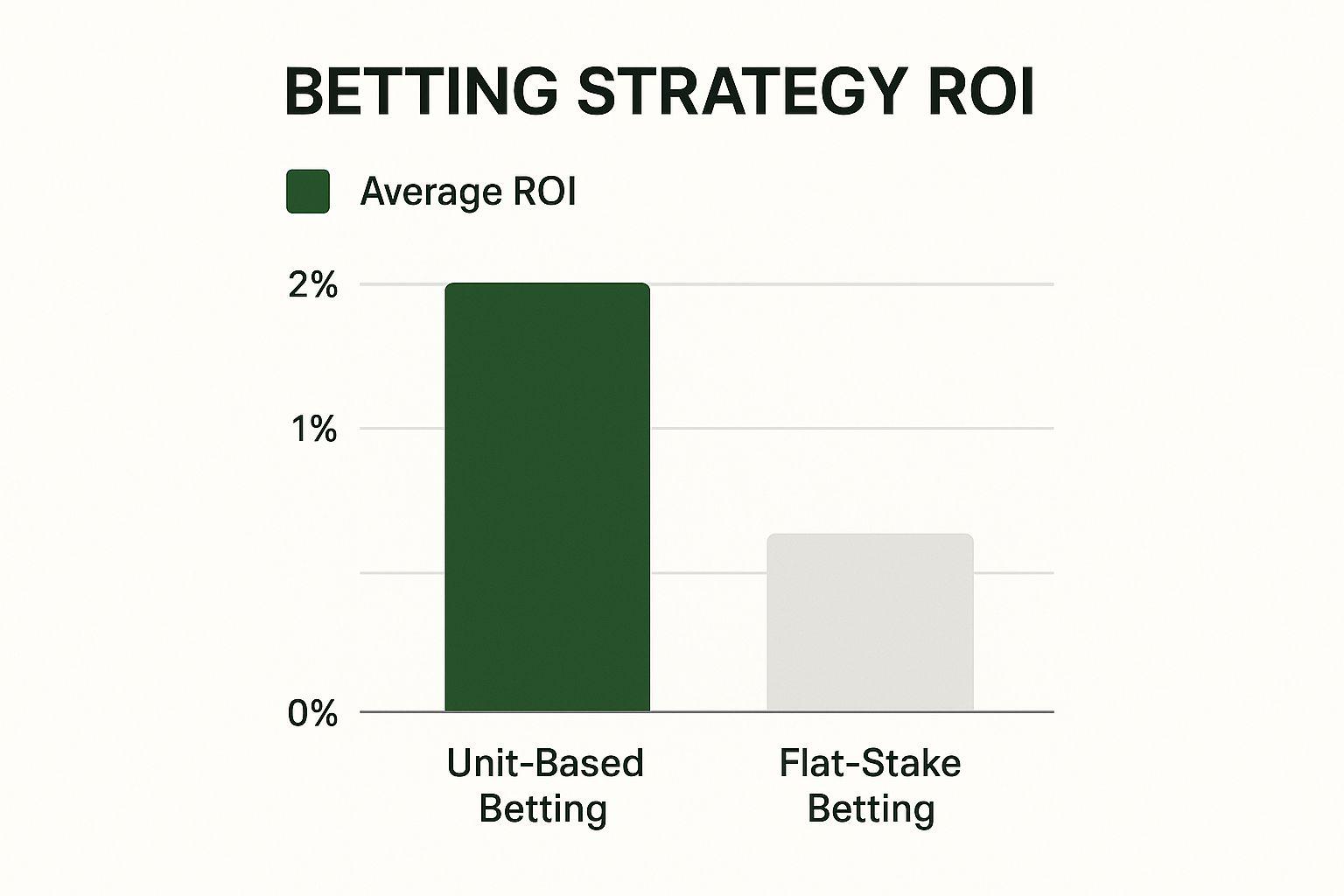
The numbers don't lie. A disciplined, bankroll-aware strategy simply produces better results over the long haul.
Choosing Your Risk Level
Your perfect unit size is a direct reflection of your personality and how much risk you're comfortable with. Most bettors fit into a few common profiles, each with its own percentage. The whole point of using a "unit" is to turn betting from a guessing game into a measured strategy, which is why it's such a critical part of proper bankroll management.
Here’s a simple breakdown of the common approaches:
- Conservative (1% to 2%): This is where most people should start. If you're new to betting or just naturally cautious, this approach is for you. It’s all about protecting your bankroll, allowing you to ride out the inevitable losing streaks without taking a major hit.
- Aggressive (3% to 5%): This is for the seasoned bettors who have a proven edge and a stomach for volatility. It can definitely grow your bankroll faster, but be warned-it can also drain it just as quickly when things go south.
Before you do anything else, ask yourself this one question: "How much can I truly afford to lose?" Your answer is what should guide your unit percentage. Betting has no guarantees, so you have to be prepared for the worst-case scenario.
To make this crystal clear, let's look at how these percentages translate into actual dollar amounts.
Calculating Your Unit Size Based on Bankroll
The table below gives you a practical look at what a 1.5%, 3%, or 5% unit looks like for different bankroll sizes.
| Total Bankroll | Conservative Unit (1.5%) | Standard Unit (3%) | Aggressive Unit (5%) |
|---|---|---|---|
| $500 | $7.50 | $15 | $25 |
| $1,000 | $15 | $30 | $50 |
| $2,500 | $37.50 | $75 | $125 |
| $5,000 | $75 | $150 | $250 |
Find your bankroll on the left and see how the numbers change based on your chosen risk level. This should help you lock in a unit size that makes sense for your specific financial situation.
Putting Your Unit Strategy to the Test
- Start with Flat-Betting: The best way to begin is by betting the exact same amount-one unit-on every single wager. This is the cornerstone of disciplined betting and gives you a clean, simple way to track your performance.
- Add Layers with Variable Units: Once you've got the hang of it, you can start varying your wager size based on your confidence. A common approach is to use 0.5 units for longshots and up to 2 units for your strongest plays.
- Bet with Your Head, Not Your Gut: This system is all about logic. You risk more because your research points to a stronger edge, not because you have a "lucky feeling." It's designed to take emotional highs and lows out of the equation.
Applying Units to Your Betting Strategy

So, you've calculated your unit size. Now what? It's time to put that number to work. The easiest and most recommended starting point is the flat-betting model.
This strategy is refreshingly simple: every bet you place is for one unit. It doesn't matter if you're backing a heavy favorite or taking a flyer on an underdog; the stake is always the same. This approach is fantastic for building discipline because it forces you to focus on making good picks, not on how much money to risk.
Graduating to Variable Unit Betting
After you’ve gotten comfortable with flat-betting, you can move on to a more advanced method: variable unit betting. This is where you adjust your stake based on how confident you are in a particular bet. Think of it as a way to strategically press your advantage when you've uncovered a golden opportunity.
A typical variable scale might look like this:
- 0.5 Units: A low-confidence play. This could be a bet on a huge underdog or a speculative prop bet you find interesting.
- 1 Unit: Your bread-and-butter bet. This is for games where your analysis shows a solid edge.
- 1.5 to 2 Units: Your five-star, high-conviction play. This is reserved for wagers backed by deep research and strong data.
For instance, you might risk 1.5 units on a home team you feel the market has completely undervalued, but only 0.5 units on a longshot parlay. This kind of structured flexibility is a key part of any serious sports betting strategy. The critical part is that your confidence level comes from analysis, not from emotion.
By sticking to a unit system, you transform betting from a gamble into a measured investment strategy, protecting your bankroll from those heat-of-the-moment decisions we all regret later.
Common Mistakes to Avoid With Unit Betting
Adopting a unit system is a fantastic move toward smarter betting, but it isn't a magic wand. There are a few classic pitfalls that can trip up even the most well-intentioned bettors, turning a disciplined strategy into a fast track to an empty account. Knowing what these mistakes are is the best way to steer clear of them.
The most dangerous trap by far is emotional decision-making. This beast has two heads: chasing losses after a bad run and getting arrogant after a hot streak. Both will tempt you to ditch your carefully calculated unit size for a "sure thing" or a desperate prayer. That's the quickest way to zero out your bankroll.
Another huge blunder is getting the foundation wrong-miscalculating or, worse, ignoring your bankroll altogether. Your unit is only as solid as the bankroll it's tied to. If you're betting with money you can't afford to lose, you're building your strategy on a bed of anxiety, not logic.
Keeping Your Strategy on Track
To really make this work, you have to treat your unit system as law. It's non-negotiable. That means fighting the urge to go off-script, no matter how much your gut is screaming at you. You have to trust the system you put in place.
Here are the most common ways bettors self-sabotage and how to sidestep them:
- Chasing Losses: You just lost three bets in a row. The temptation to double your next wager to win it all back is immense. The Fix: Don't do it. Stick to your 1 unit. Your system is built to absorb losses; let it do its job.
- Winner's High: A nice winning streak can make you feel like a genius who can't lose. This often leads to bumping your bet size up "just because." The Fix: Enjoy the win, but when it's time for the next bet, it's still just 1 unit. Consistency is what got you on the streak in the first place.
- "I've Got a Feeling!": Throwing your unit plan out the window because a certain game just feels right. The Fix: Remind yourself why you started using units-to build profit over the long haul, not for a one-time thrill. Trust the math, not the magic.
The whole point of a betting unit is to take emotion out of the equation. The second you let a "gut feeling" override your calculated unit, you've completely undermined the system's power.
Truly effective sports betting bankroll management is all about setting rules and having the discipline to follow them, especially when it’s hard. Avoiding these simple mistakes is what allows your unit strategy to protect your bankroll and help it grow over time.
Key Takeaways
- Re-evaluate, don't react: Resist the temptation to change your unit size after every win or loss. Set a fixed schedule-like monthly, quarterly, or by season-to adjust it based on your current bankroll.
- Unit value vs. units risked: Your unit’s dollar amount (say, $20) is your fixed stake. What changes is the number of units you risk on a given bet (0.5 units, 1 unit, 1.5 units), depending on your confidence level.
- The system is your safety net: When your bankroll takes a hit, your unit size must shrink at your next re-evaluation. This is a crucial, built-in mechanism that protects your capital during a losing streak.
- Stick to the 1-5% rule: For almost everyone, risking more than 5% of your bankroll on a single bet is a fast track to ruin. This range is the time-tested standard for smart, sustainable betting.
Ready to stop guessing and start making data-driven wagers? ValueBetFactory uses powerful analysis to find betting opportunities for you. Explore our platform and see how we can help you bet smarter. Learn more at ValueBetFactory.
Frequently Asked Questions
What is a unit in sports betting?
A unit is a fixed percentage of your total betting bankroll, typically 1% to 3%. It serves as your standard bet size, helping to manage risk and provide a consistent way to measure your betting performance.
Why is using units so important in betting?
Using units enforces discipline by removing emotion and guesswork from deciding your stake size. It allows you to track your success based on strategic skill (units won or lost) rather than fluctuating dollar amounts, which is essential for long-term profitability.
How do I calculate my unit size?
First, define your total bankroll (the amount of money you are prepared to risk). Then, choose a risk percentage you are comfortable with (1% is conservative, 3% is standard). For a $1,000 bankroll and a 2% unit size, your unit would be $20.
What is the difference between flat betting and variable betting?
Flat betting means you wager the exact same amount (one unit) on every bet, regardless of confidence. Variable betting involves adjusting your wager size (e.g., 0.5 units, 1 unit, or 2 units) based on how confident you are in a particular pick, allowing you to risk more on high-value opportunities.
How often should I re-evaluate my unit size?
It's best to re-evaluate on a set schedule, such as monthly, quarterly, or at the start of a new sports season. This prevents emotional, short-term reactions and ensures your unit size stays aligned with your actual bankroll over time.
Should my unit size change based on the odds?
No, the dollar value of your one unit should remain constant between re-evaluation periods. However, you can vary the number of units you risk on a bet. For example, you might risk 1 unit on a standard play but only 0.5 units on a longshot with high odds. Your confidence, not the odds, should dictate the number of units wagered.