
How Does Point Spread Betting Work for Beginners
Unlock Profits with betting tips!
Point spread betting isn't about simply picking who will win or lose. Instead, it’s a bet on the margin of victory. Think of it like giving the underdog a head start in a race to even things out. This "spread" is what turns a potentially one-sided matchup into a fascinating and balanced wager.
What Is Point Spread Betting
We've all seen games where picking the winner feels like a sure thing. But what if you had to predict by how much they'd win? That’s the real question behind a point spread bet. It’s a clever way sportsbooks transform a predictable contest into a genuine 50/50 proposition for bettors.
The sportsbook establishes a "spread," which is essentially a handicap. The team expected to win gets points taken away from their final score (for betting purposes), while the team expected to lose gets points added. Your job is no longer to just pick a winner, but to figure out if a team will overperform or underperform the bookmaker's expectation.
The Favorite vs The Underdog
Every point spread has two sides, each with a specific role:
- The Favorite: This is the team oddsmakers expect to win. You'll spot them by the minus sign (-) next to their spread number (e.g., -7.5). For your bet on the favorite to cash, they must win the game by a margin larger than the spread.
- The Underdog: This is the team expected to lose. They're marked with a plus sign (+) next to their spread number (e.g., +7.5). A bet on the underdog wins if they either win the game outright or lose by a margin smaller than the spread.
Grasping this dynamic is the first step. While the point spread is one of the most common ways to bet on sports, it’s just one piece of the puzzle. You can learn about more ways to wager by exploring our guide to the different types of sports bets.
The Goal of the Spread: A point spread's primary purpose is to balance the action. By applying this virtual handicap, sportsbooks encourage an equal amount of money to be wagered on both sides of the contest.
You might be surprised at how good oddsmakers are at this. A comprehensive study revealed that point spreads account for roughly 86% of the variation in actual game outcomes. That level of accuracy is what makes beating the spread a true challenge of your sports insight and analytical skill.
Point Spread Betting At a Glance
To make this even clearer, let's break down the components of a typical point spread bet. This table shows you exactly what each part of the line means.
| Component | What It Means | Example (Team A -7.5 vs Team B +7.5) |
|---|---|---|
| Favorite | The team expected to win. Identified by a minus (-) sign. | Team A is the favorite. |
| Underdog | The team expected to lose. Identified by a plus (+) sign. | Team B is the underdog. |
| The Spread | The number of points used as the handicap. | The spread is 7.5 points. |
| "Covering the Spread" | This is what a team must do for a bet on them to win. | Team A wins if they win by 8 or more points. Team B wins if they win outright or lose by 7 or fewer points. |
As you can see, the half-point (-7.5) is crucial here—it prevents the possibility of a "push" or a tie, ensuring there's always a winning and losing side to the bet.
How to Read Point Spread Betting Lines
Alright, so you get the concept of a point spread. But looking at the actual betting line on a sportsbook can feel like trying to decipher code. It’s a jumble of teams, numbers, and symbols that can be intimidating at first.
Don't worry. Once you learn what each piece of information means, it all clicks into place. Every line tells you a story about the game, and soon you'll be reading them like you've been doing it for years.
The first thing to do is find the favorite and the underdog. It's simple:
- The team with the minus sign (-) is the favorite. They're the ones expected to win.
- The team with the plus sign (+) is the underdog. They're expected to lose.
This is the foundation for understanding any spread bet.
Understanding the Numbers
Let's walk through a real-world NFL example to make this crystal clear. Say you log into your favorite sportsbook and see this:
Kansas City Chiefs -7.5 (-110) Las Vegas Raiders +7.5 (-110)
In this matchup, the Chiefs are the favorite, which is why they have a -7.5 next to their name. The Raiders are the underdog, so they're getting a +7.5 point cushion.
That number in the parentheses, (-110), is the price you pay to place the bet, also known as the "juice" or "vig." It’s the sportsbook's commission. A -110 price means you have to bet $110 to win $100.
So, what does it take to win? If you bet on the Chiefs (-7.5), they need to win the game by 8 points or more. If you back the Raiders (+7.5), you win your bet if they win the game outright or lose by 7 points or fewer.
This image breaks down exactly how the spread is applied to the final score to determine the winner.
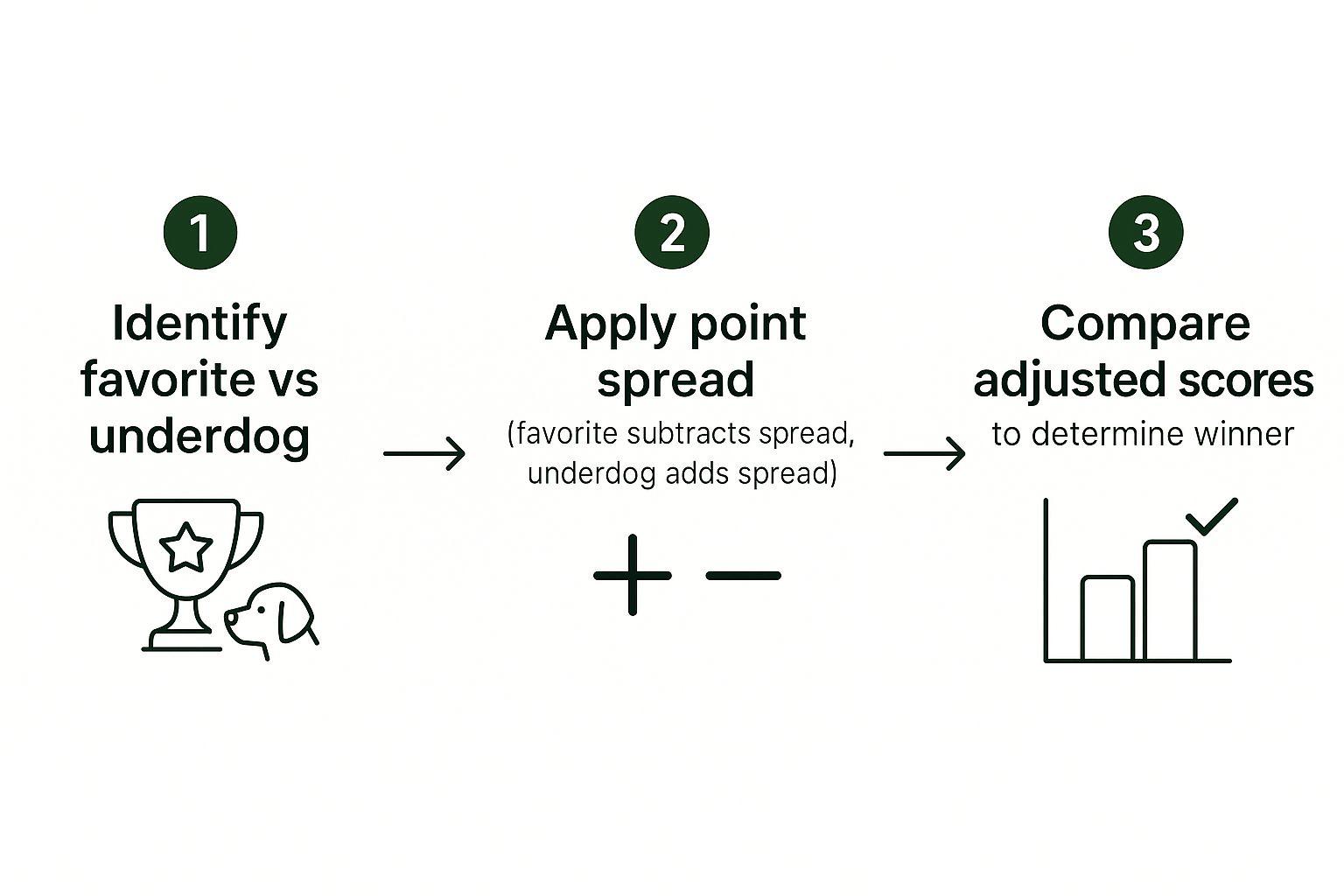
As you can see, you’re not just betting on who wins the game, but by how much. You add or subtract the spread from the final score to see which team "covered."
Why the Half-Point Matters
Ever wonder about that extra .5 point on the spread? It's called "the hook," and it's there for a very important reason: to prevent a tie.
In betting, a tie is called a "push," and when it happens, all bets are refunded. If the spread was Chiefs -7 and they won by exactly 7 points, nobody would win or lose. The hook (-7.5) ensures there's a decisive outcome for every single bet.
Getting comfortable reading these lines is a key skill for any bettor. The global sports betting market was valued at around $100.9 billion in 2024 and is expected to climb to $187.39 billion by 2030. This explosive growth, detailed in a report from Grand View Research, is fueled by online platforms that make betting more accessible than ever. By mastering the point spread, you’re setting yourself up to navigate this exciting market with confidence.
Why Spread Betting Odds Are Not Even Money
When you look at a point spread, you're seeing the sportsbook's best attempt to create a perfect coin flip. The spread is designed to make either team an equally attractive bet. So why aren't the odds +100 (even money)? Why do you almost always see that -110 next to both sides, forcing you to risk $110 just to win $100?
That difference is how the house gets paid. It's the sportsbook's built-in commission, known in the betting world as the vigorish, or more commonly, the "vig" or "juice." You can think of it as a small service fee for taking your action. Getting a handle on the vig is fundamental because it's the real price you pay to place a bet.
How the Vig Guarantees Sportsbook Profit
The vig is the magic ingredient that allows sportsbooks to profit no matter which team actually covers the spread. Their main goal isn't to outsmart you on a single game; it's to attract the same amount of money on both the favorite and the underdog.
When they get that balance right, the juice ensures they come out ahead.
Let’s walk through a quick example.
- Balanced Action: Imagine 11 people each bet $110 on the Chiefs (-7.5), and another 11 people each bet $110 on the Raiders (+7.5).
- Total Wagers: The sportsbook is now holding $2,420 in total bets (22 bets x $110).
- The Payout: Regardless of who wins, they only need to pay out $2,200 to the 11 winning bettors (each winner gets their $110 stake back plus $100 in profit).
That leftover $220 is the sportsbook’s guaranteed profit, all generated by the vig. It's the cost of doing business.
The standard -110 line translates to a sportsbook commission of about 4.5%. It might not sound like much, but that small slice is the bedrock of their entire business model, enabling them to operate profitably across millions of wagers.
What It Means When the Vig Changes
While -110 is the industry standard, you’ll frequently see the juice move to numbers like -115, -120, or even -105. These shifts are direct signals from the sportsbook about how the money is flowing.
If a lopsided amount of cash comes in on one team, the book will make that side more expensive to bet (e.g., shifting the odds to -118) while making the other side cheaper (e.g., moving it to -102). This is a smart, subtle way for them to encourage betting on the less popular side and rebalance their risk without having to change the actual point spread.
For a sharp bettor, these line movements are valuable intel. They tell you which side the market is heavily favoring. Learning to read and interpret these juice adjustments is a crucial component of any successful sports betting strategy.
Why Point Spreads Change Before a Game

One of the first things you'll notice about point spreads is that they rarely stay put. The number you see on Monday morning might look completely different by kickoff on Sunday. This isn't random. A point spread is a living number, constantly reacting to new information and, most importantly, money.
Think of the opening line as a starting price tag. From there, two major forces come into play that can push and pull the spread in either direction: the flow of betting money and critical new information about the game.
The Influence of Betting Money
By far the most common reason a line moves is because of lopsided betting. A sportsbook's goal isn't to predict the winner; it's to get roughly equal money bet on both sides of a game. This is how they guarantee a profit.
When a flood of cash comes in on one team, it throws that balance off and creates a huge financial risk for the book.
So what do they do? They adjust the price. If everyone is jumping on the favorite at -3, the sportsbook will likely move the line to -3.5 or even -4. This move makes the favorite a little less attractive and the underdog a little more tempting, encouraging bets on the other side to help even out their ledger. It’s their number one risk management tool.
When a spread moves, it's often a direct reaction to where the majority of the money is going. Bettors are, in essence, voting with their wallets, and the sportsbook is adjusting the price based on that demand.
How New Information Changes the Game
The other major reason a line shifts is the emergence of game-changing news. The world doesn't pause just because a betting line has been released, and any significant development can force oddsmakers to rethink their initial assessment.
This kind of news can take a few different forms, each powerful enough to send a spread scrambling:
- Key Player Injuries: This is the big one. If a starting quarterback gets hurt in practice mid-week, the spread can swing by several points in a matter of minutes. The drop-off between a star player and their backup can easily be worth a touchdown to the line.
- Weather Changes: For outdoor games, weather is a huge variable. A clear forecast that suddenly turns to heavy rain, snow, or high winds can dramatically suppress scoring. This usually causes the spread to shrink, as bad weather often acts as an equalizer and leads to closer, lower-scoring contests.
- Team News and Reports: Other things, like a surprise player suspension or even rumors of locker-room drama, can be enough to make oddsmakers tweak the line.
Once you get a feel for these dynamics, you can start to read the story behind a line's movement. Seeing a spread change is no longer just a random event; it's a clue that helps you decide whether to place your bet now or wait for a potentially better number.
How Spreads Work in Different Sports
The core idea of the point spread—giving the underdog a head start—is universal. But how it's applied can look completely different from one sport to the next. The way games are scored is the biggest factor here. After all, a 7-point spread is a classic in football, but a 7-run spread in a baseball game would be absolutely wild.
You can't just take a strategy that works for the NFL and expect it to translate perfectly to the NBA or MLB. Getting a feel for these sport-specific nuances is a must if you want to make smart bets.
Spreads in Football and Basketball
Football and basketball are what most people think of when they hear "point spread." Since they're high-scoring sports with a lot of scoring variance, the spreads can be set with a ton of precision. Sportsbooks can adjust the number to reflect just how lopsided (or even) a matchup is.
- NFL Spreads: You'll see a huge range here. A tight matchup might have a spread as low as 1 point, while a powerhouse team playing a struggling one could see a spread of 14 points or more. Watch for key numbers like 3 and 7—they represent a field goal and a touchdown, so they have a massive impact on betting outcomes.
- NBA Spreads: With scores regularly hitting triple digits, basketball spreads can get pretty big, too. It’s common to see double-digit spreads, which just reflects how quickly teams can pile on points.
Because scoring comes in different chunks (1, 2, 3, and 6 points), oddsmakers can really dial in the spread to create what they hope is a balanced wager. The question for you is always the same: will the favorite win by more than the spread?
While point spreads are designed to level the playing field, your job as a bettor is to spot when the bookmaker gets it wrong. Finding lines that don't accurately reflect a team's true chances is the core of value betting, a must-learn strategy for anyone looking to be profitable in the long run.
The Puck Line and Run Line
Things change when we get to lower-scoring sports like hockey and baseball. A flexible point spread just doesn't work when most games are decided by a goal or two. So, sportsbooks use a fixed, standardized spread instead.
This is where you'll hear different terms:
- Hockey's Puck Line: In hockey, the spread is almost always -1.5 goals for the favorite and +1.5 for the underdog. Instead of moving the spread itself, the sportsbooks adjust the odds (the juice) to show the difference in team quality.
- Baseball's Run Line: It's the same story in baseball. The run line is consistently set at -1.5 runs for the favorite and +1.5 for the underdog. To cover, the favorite has to win by at least two runs. The underdog can lose by a single run, and your bet still wins.
Spread Betting Across Major Sports
This table gives you a quick visual breakdown of how the point spread concept is adapted for the unique scoring dynamics of different sports.
| Sport | Spread Name | Typical Spread Value | Key Consideration |
|---|---|---|---|
| Football | Point Spread | Varies (e.g., -3, -7) | The point number is adjusted to balance the odds. |
| Basketball | Point Spread | Varies (e.g., -5.5, +12) | Higher scores mean larger, more variable spreads. |
| Hockey | Puck Line | Always 1.5 | The odds (juice) change, not the number of goals. |
| Baseball | Run Line | Always 1.5 | Like hockey, the odds are adjusted instead of the run number. |
By tailoring the type of spread to how each sport is played and scored, bookmakers create a competitive and engaging market for every game on the board.
Common Questions About Point Spread Betting
Once you've got the hang of the basics, a few more specific questions always pop up. Point spread betting has its own little quirks and jargon that can throw you for a loop at first. Think of this as your go-to guide for those "what if" scenarios that inevitably arise.
Getting these details straight is key. It helps you understand exactly how your bets will cash (or not cash) and what your options are in different situations. Let's clear up a few of the most common questions.
What Happens If a Game Ends in a Push?
A "push" is just the betting world's term for a tie. It happens when the final score lands exactly on the point spread.
Let's say the Green Bay Packers are a -7 favorite against the Chicago Bears. If the Packers win the game 24-17, the margin of victory is exactly 7 points. That’s a push.
When this happens, you don't win, but you don't lose either. The sportsbook simply refunds your original wager. It’s like the bet never happened. This is precisely why you see so many half-points in spreads (like -7.5). That half-point makes a push impossible, ensuring there's always a clear winner and loser.
Is It Better to Bet on the Favorite or the Underdog?
This is the million-dollar question, but the honest answer is: neither is inherently "better." The entire point of the spread is to level the playing field and make both sides an equally attractive bet. Oddsmakers are very good at their jobs, and their goal is to set a line that, in theory, gives each team about a 50% chance of covering.
Key Takeaway: Smart betting isn't about blindly taking favorites or always chasing the underdog. It's about finding value. Your job is to find spots where you believe the sportsbook's line is off the mark. Are the favorites better than the spread implies? Can the underdog keep it closer than everyone thinks? That's where you find your edge.
What Does It Mean to Buy Points?
"Buying points" is a feature some sportsbooks offer that lets you move the spread in your favor—for a price, of course.
Imagine the Kansas City Chiefs are a -3.5 point favorite. You could "buy" half a point to shift the line down to -3. This is a huge advantage because a 3-point win is now a push for you instead of a loss. You've just improved your chances of cashing the ticket.
The catch? You have to pay for it with worse odds. Instead of the standard -110 juice, you might have to lay -125 or more. It’s a classic trade-off: you accept a smaller potential payout in return for a higher probability of winning the bet.
At ValueBetFactory, we give you the tools and insights to move past the basic questions and start making sharp, data-backed wagers. Our platform is designed to help you spot valuable lines and understand why the market is moving, turning your sports knowledge into a real strategic advantage. Explore how we can help you bet smarter.