
Walkover Tennis Betting Explained for Bettors
Unlock Profits with betting tips!

You've placed a tennis bet, feeling good about it, and then you get a notification: the match isn't happening. One of the players has pulled out. What happens to your money? This is where understanding the term walkover is crucial for every tennis bettor. Get this wrong, and you're in for a world of confusion and potential disputes with your bookmaker.
Understanding Walkover Tennis Betting Essentials
Think of it like buying a ticket for a big concert, but the main act cancels hours before the show. You'd expect a full refund, no questions asked. A walkover in tennis is exactly like that. It’s when a player withdraws from a match before a single ball has been hit.
Because the event you wagered on never actually started, the rule is simple and universal across all sportsbooks. All pre-match bets are voided, and your stake is returned. It doesn't matter who you backed to win or lose; the bet is simply canceled.
The Critical Difference Between a Walkover and a Retirement
Now, this is where things get messy for bettors. A walkover is clean and simple. A retirement, on the other hand, is when a player withdraws after the match has already started. This is usually because of an injury picked up mid-match.
This is the fork in the road where the betting chaos begins. Once even one point has been played, bookmakers have wildly different, often confusing, rules for how they settle bets. Grasping this distinction is the first step to navigating the minefield of tennis betting rules. For a complete rundown on the basics, our guide on how to bet in tennis is a great place to start.
The single most important factor determining your bet's fate is whether the match officially started. A walkover happens before the first serve, leading to voided bets. A retirement happens after, leading to a maze of bookmaker-specific rules.
Knowing the difference isn't just about terminology; it's about protecting your bankroll and understanding how your money is at risk. To make it crystal clear, let's break it down.
Walkover vs Retirement A Bettor's Quick Reference
Here’s a quick-reference table that cuts through the noise, showing how each type of match interruption typically affects your bets. Think of it as your cheat sheet before placing your next tennis wager.
| Scenario | What It Means | Typical Pre-Match Bet Impact | Typical In-Play Bet Impact |
|---|---|---|---|
| Walkover | A player withdraws before the match begins. | All bets are voided, and stakes are returned. | Not applicable, as no in-play betting is possible. |
| Retirement | A player withdraws during the match due to injury or another reason. | Settlement depends entirely on the bookmaker's specific rules (e.g., first set complete). | Varies widely; some markets may be settled, while others are voided. |
Keep this table handy. Just knowing whether the match started or not will give you a huge advantage in figuring out what will happen to your stake when a player pulls out.
Navigating Different Bookmaker Settlement Rules
Once a tennis match gets underway, the simple world of walkovers is over. If a player retires mid-match, you’re thrown into a confusing landscape where every sportsbook seems to play by its own set of rules. This inconsistency is hands-down the biggest source of frustration for tennis bettors, because a winning bet at one bookie could be a voided stake at another.
Understanding these differences isn't just a good idea; it's essential for protecting your bankroll. Bookmakers generally fall into one of three camps based on how they handle bets when a player quits. Knowing which rule your sportsbook follows helps you predict how your bets will be settled and avoid those nasty surprises.
The most common rule variations all hinge on one key question: how much of the match needs to be played for bets to count? The answer can completely change your betting strategy and how much risk you're taking on.
The First Ball Served Rule
This is one of the most straightforward policies out there. Under the First Ball Served rule, as soon as the first point of the match is played, all match winner bets are considered live. If a player retires after that, the player who advances to the next round is crowned the winner for betting purposes.
Imagine you bet on Player A to win. The match starts, a few points are played, and then Player B rolls their ankle and has to retire.
- Your Bet on Player A: You win. Player A officially advanced, so your bet is settled as a winner.
- A Bet on Player B: That’s a loss.
This rule is a favorite among bettors who want a clean, simple outcome once the action starts. It cuts out the ambiguity, but it also means you could lose a bet on a player who was completely dominating before a freak injury forced them to stop.
The One Set Completed Rule
This rule adds an extra condition, requiring a bit more of the match to play out before any bets are settled. For a match winner bet to stand, at least one full set must be completed. If a player pulls out before the first set is finished, all match winner bets are voided, and your stake is returned.
If the first set isn't in the books, it’s like the core of the match never really happened. Bookies using this rule treat it as a 'no contest' for match winner bets, returning everyone's stake to avoid settling a bet on an incomplete game.
Let's say you back Player A, who takes the first set 6-4. Early in the second set, Player B retires.
- Under this rule: Your bet on Player A is a winner.
- If Player B had retired in the first set: All match winner bets would be void.
This policy offers a nice middle ground, making sure a meaningful part of the match has been played before a winner is declared. Many bettors feel this is a much fairer approach than the first ball rule. This flowchart shows how the simple question of whether a match starts is the first critical fork in the road.
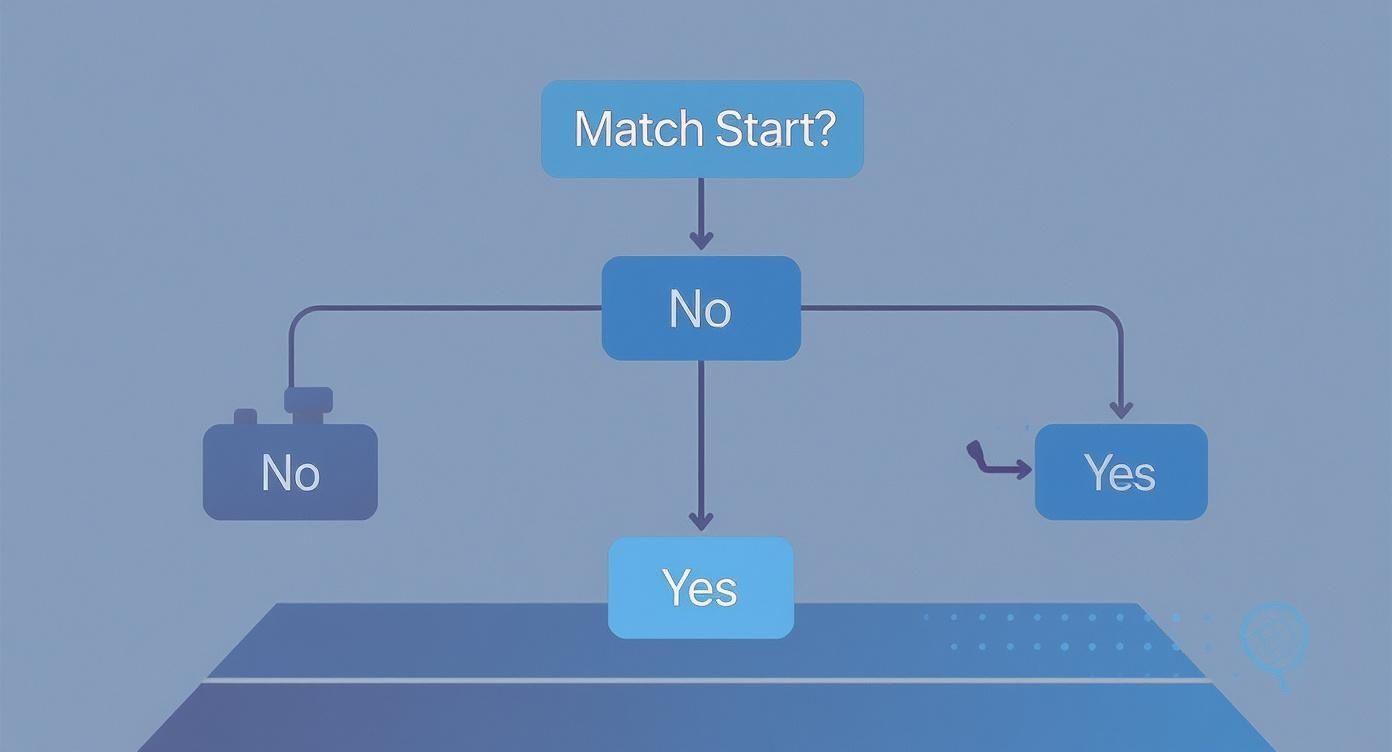
As the chart makes clear, once a match begins, the path to settlement gets a lot more complicated and depends entirely on your bookie's fine print.
The Match Completed Rule
Finally, we have the strictest policy of all: the Match Completed rule. Just as the name suggests, for any match winner bets to be settled, the entire match must be played to its natural conclusion. If a player retires at any point-whether it's the first game or on match point-all bets on the match winner are voided.
This rule is the safest for bettors because it completely shields you from losing a bet due to a mid-match injury. The flip side, of course, is that you can't win a bet on a player who was just one point away from victory before their opponent retired.
This table breaks down how these different rules can impact your bets, helping you figure out which bookmaker's policy best aligns with your betting style.
How Bookmaker Rules Handle Tennis Retirements
This table compares how different bookmaker rules affect bet settlement in a mid-match retirement, helping you choose the right platform.
| Rule Type | Settlement Condition | How Winning Bets Are Settled | How Losing Bets Are Settled | Best For Bettors Who... |
|---|---|---|---|---|
| First Ball Served | Match must start. | Paid out if backed player advances. | Settled as a loss. | Want definitive results once the match starts and are willing to risk injury-related losses. |
| One Set Completed | At least one full set must be played. | Paid out if backed player advances after 1st set. | Settled as a loss after 1st set. | Prefer a balance, ensuring a significant portion of the match is played before bets are settled. |
| Match Completed | The full match must be played to conclusion. | Voided and stake returned. | Voided and stake returned. | Are risk-averse and want to be fully protected against losing money due to player injuries. |
Because these differences are so stark, it is absolutely critical to check your bookmaker's specific tennis rules before you place a bet. You can usually find this info buried in their "Terms and Conditions" or a dedicated "Sports Rules" section. Never assume one bookie’s rules are the same as another’s-that assumption is a fast track to seeing a winning ticket get voided.
Real World Examples of Walkovers and Retirements

Rules on a page are one thing, but seeing how they explode in a high-stakes match is another. When you look at how real walkovers and retirements have played out in major tournaments, you start to grasp their true impact on the betting world. These aren't just minor footnotes; they're events that can completely upend the market.
By studying these moments, you learn to see the patterns. You can anticipate how odds will shift when a similar situation pops up. A single player pulling out doesn't just cancel one match-it sends shockwaves through the entire tournament, creating both dangerous betting traps and massive opportunities for value.
Cascading Effects on Outright Tournament Bets
The most dramatic example of a walkover's power is when a top seed withdraws before a tournament even starts. This is where the real ripple effect begins. It completely reshuffles the deck and forces oddsmakers to recalculate the entire outright winner market from scratch.
Imagine a Grand Slam where one half of the draw is loaded with a dominant favourite. Bettors rush to back them, causing the odds for everyone else in that section to drift way out. Then, that favourite pulls out with an injury. Suddenly, a massive void opens up.
- Sudden Value Appears: All the players in that now-wide-open half of the draw have a much clearer shot at the final. Their outright odds will get slashed almost instantly.
- The Other Half Strengthens: At the same time, the top players in the opposite half might also see their odds shorten, simply because the field of true contenders just got smaller.
Walkovers have thrown a wrench into major Grand Slams time and time again. When Roger Federer pulled out of the 2017 US Open with an injury, it fundamentally changed the tournament landscape and forced bookies to make drastic odds adjustments across the board. Similarly, Maria Sharapova's walkover at the 2018 Australian Open eliminated a major contender and redistributed the probability of winning across the entire women's field. You can read more about how these events impact betting on bet.co.tz.
Retirement Scenarios and In-Play Market Chaos
Retirements create a totally different kind of chaos-one that plays out in real-time and puts your knowledge of bookmaker rules to the ultimate test. A high-profile player quitting mid-match can swing fortunes based entirely on the fine print of your sportsbook's settlement policy.
Think about the 2019 US Open final between Bianca Andreescu and Serena Williams. If Williams had retired due to an injury while trailing in the second set, the outcome of your bet would have been a complete lottery, depending entirely on which bookie you used.
A retirement turns a simple tennis match into a complex settlement puzzle. A bettor using a 'First Set Completed' bookmaker would have won their bet on Andreescu, while another bettor using a 'Match Completed' bookie would have seen their winning ticket voided. Same match, same outcome, completely different results.
This is exactly why knowing the settlement rules isn't just a "nice to have"-it's a critical part of any solid walkover tennis betting strategy. It's the difference between cashing a ticket and getting your stake back.
Spotting Red Flags Before They Happen
The best bettors don't just react to withdrawals; they try to see them coming. While you can never be 100% certain, some clear patterns can signal a much higher risk of a player retiring mid-match.
Key Indicators to Watch For:
- Grueling Previous Match: Did a player just survive a five-hour, five-set war? Their body is going to be screaming, raising the odds of an injury or simple exhaustion in their next match.
- Visible On-Court Treatment: If a player keeps calling for the trainer, gets a knee or shoulder heavily strapped, or is visibly wincing in pain, the chances of a retirement go through the roof.
- Tight Tournament Scheduling: Players who are grinding through back-to-back tournaments with almost no rest are prime candidates to break down physically.
Picking up on these signs can give you a huge edge for in-play betting. It might be your cue to cash out, hedge your position, or just stay away from a match that feels too risky. By paying attention to these real-world clues, you stop being a passive spectator and become an active risk manager.
Proactive Strategies to Manage Retirement Risk
Knowing the rules is half the battle. The other half is actively managing the risks that come with them. A proactive approach to walkover tennis betting means you're not just reacting when a player retires; you're anticipating it and shielding your bankroll before it even happens.
This moves you beyond simply picking a winner. It's about adding a layer of strategic risk management to your process, starting with spotting high-risk situations before you even place a wager. A bit of homework on player fitness, recent match intensity, and punishing travel schedules can help you flag players who are far more likely to break down. This pre-match diligence is your first and best line of defense.
Pre-Match Research and Identifying High-Risk Players
Before you lock in any bet, a thorough check of a player's recent history is non-negotiable. You're looking for red flags that the general betting public might have glossed over. A player carrying a known injury into a tournament or who has a track record of mid-match withdrawals is a massive risk.
Key areas to research:
- Recent Match Load: Did the player just survive a grueling five-set marathon? A player who has spent over 10 hours on court in the past week is running on fumes and far more likely to be fatigued.
- Travel Schedule: A player competing in Asia one week and North America the next isn't just battling an opponent; they're fighting jet lag and physical strain, which cranks up the retirement risk.
- Historical Injury Data: Some players are just notoriously injury-prone. A quick search of their history can reveal patterns of withdrawals, especially on certain surfaces or during the most intense parts of the season.
- On-Court Behavior: Watch for the subtle signs in their previous matches. Are they constantly stretching a particular muscle between points, wincing after a long rally, or calling for the trainer more than usual?
This kind of analysis helps you assign your own "retirement risk factor" to a match. From there, you can adjust your stake size accordingly or decide to avoid the match entirely if the risk feels way too high.
Hedging Across Bookmakers with Conflicting Rules
This is where your knowledge of different settlement rules becomes a powerful weapon. You can actually exploit the inconsistencies between bookmakers to create a safety net or, in some cases, a potential arbitrage opportunity. This strategy is known as hedging.
The idea is to place opposing bets on the same match at two different sportsbooks that have conflicting retirement rules. For example, you could back Player A at a "First Ball Served" bookmaker and then back Player B at a "Match Completed" bookmaker. You can explore this concept in more detail in our guide on hedging in sports betting.
By strategically placing bets across bookmakers with different rules, you can create scenarios where it's impossible to lose your entire stake due to a retirement. In some cases, you can even guarantee a profit regardless of the outcome.
Imagine Player A is the favorite. You bet on them to win at a "First Ball Served" bookie. You then place a smaller, carefully calculated bet on their opponent, Player B, at a "Match Completed" bookie.
- If Player A wins the match fully: You win your main bet on Player A and lose the smaller one on B. Profit.
- If Player B wins the match fully: You lose your main bet but win the smaller one, which cushions your overall loss.
- If Player A is leading and Player B retires: Your bet on Player A is a winner at the first bookie, while your bet on Player B is voided at the second. You secure a nice profit.
This is definitely an advanced tactic that requires some careful calculation, but it's an excellent way to neutralize the unpredictable nature of mid-match retirements.
Utilizing the Cash Out Feature Strategically
The cash out feature is another vital tool for managing risk in real-time. If you're watching a match and the player you backed starts showing clear signs of injury or extreme fatigue, cashing out allows you to either salvage part of your stake or lock in a small profit.
Don't think of cashing out as a panic move. See it as an intelligent risk management decision based on new information that just became available. If a player takes a medical timeout and comes back with their thigh heavily strapped, the probability of them finishing that match just dropped significantly. Cashing out at that moment-even for a reduced return-is often the smartest play you can make to protect your capital from a total loss.
Finding Betting Edges in Walkover Data

Smart betting isn’t just about picking winners; it’s about finding value where the market has overlooked risk. Most bettors are laser-focused on player form and head-to-head stats, but digging into the data on when walkovers actually happen can give you a serious edge. This becomes especially true as tournaments grind on and the physical toll on players starts to mount.
The probability of a walkover isn't a flat line. That risk climbs dramatically the deeper players get into a tournament, a factor that many casual bettors completely fail to price into their wagers. By understanding these statistical patterns, you can adjust your own risk assessment and spot odds that just don't reflect the heightened danger of a pre-match withdrawal.
Pinpointing High-Risk Tournament Stages
The historical data tells a clear and actionable story: walkovers are far more likely in the middle-to-late rounds. The grind of tough matches, stacked one after another, leads to a much higher rate of players pulling out from injury or pure exhaustion.
Specifically, the quarterfinals are a statistical hotspot. A deep dive into thousands of tour-level matches shows that 1.1% of quarterfinal matches end in a walkover, a rate that blows other rounds out of the water. The round-of-16 isn't far behind at 1.0%, while the semifinals see a drop to 0.6%. Contrast that with the early rounds, where walkovers happen less than 0.15% of the time. You can explore a deeper breakdown of this data and discover more insights about these walkover statistics on Tennis Abstract.
This isn't just trivia; it's a powerful tool for any serious bettor. It turns an abstract risk into a number you can actually use.
Applying Data to Your Betting Model
Knowing that walkover risk spikes in the quarters lets you look at the odds with a much more critical eye. When you're thinking about a bet on a player in a quarterfinal match-especially one who's had a brutal path to get there-you absolutely have to factor in this elevated risk.
The market often prices late-round matches based purely on player skill and recent form, underestimating the statistical likelihood of a walkover. This oversight creates a potential value gap for bettors who incorporate this data into their analysis.
Here’s how you can turn this knowledge into a practical advantage:
- Adjust Perceived Value: If you see tight odds in a quarterfinal involving a player with a history of injuries, the higher walkover probability might be enough to kill the value on that side of the bet.
- Inform Outright Bets: This data should also shape your outright tournament bets. A player facing a punishing path through these high-risk rounds might be a much riskier long-term investment than their odds suggest.
Ultimately, integrating this kind of analysis is what a data-driven approach is all about. For more on how to use numbers in your strategy, check out our guide on using sports betting data to make sharper decisions. By treating walkover probability as a key variable, you move from just making predictions to performing a sophisticated risk assessment.
A Few Final Questions on Walkovers
Even with the rules laid out, a few specific scenarios always pop up. Think of this as a quick-fire round to tackle the most common questions bettors have when navigating the tricky world of tennis walkovers and retirements.
What Happens to My Accumulator Bet if One Match Is a Walkover?
This is a classic one. If one leg of your accumulator is a walkover, the bookmaker almost always just voids that specific leg and recalculates your bet. Your acca is still live, but it’s no longer a five-fold-it’s now a four-fold with reduced odds.
Of course, the golden rule is to always double-check your bookie's rules. They're the final word.
Does a Disqualification Count as a Retirement for Betting?
No, and this is a big one. Bookies treat these two events completely differently. A disqualification is usually settled as a straightforward loss for the DQ'd player. If you backed their opponent, your bet is a winner. Simple as that.
A retirement, on the other hand, opens up that whole messy world of bookmaker-specific rules about whether a set was completed or not.
The distinction between a disqualification and a retirement can be the difference between a winning ticket and a voided one. While a DQ usually results in a clear win/loss settlement, a retirement is subject to the bookmaker's specific 'match completion' rules.
Where Do I Find a Bookmaker’s Specific Tennis Retirement Rules?
Every bookmaker has their full rulebook on their website, though sometimes you have to do a little digging. Look for a link in the footer that says "Help," "Rules," or "Terms and Conditions." Once you're in there, find the "Sports Rules" section and then click into "Tennis."
Taking a few minutes to read that page before you place a bet is the single best thing you can do to avoid any nasty surprises down the road.
Are In-Play Bets Treated Differently Than Pre-Match Bets?
Absolutely. A pre-match walkover is simple-everything gets voided. But when a retirement happens in-play, things get a lot more complicated. This is where you'll see the biggest differences between bookies.
For example, bets on markets that have already been settled (like "First Set Winner") will usually stand. If you bet on Player A to win the first set and they did, that's a winning ticket, even if they retire in the second. However, the main "Match Winner" market could still be voided depending on the bookie’s rules. It’s why knowing the in-play policy for your bookmaker is so critical.
Gain a statistical advantage by turning complex betting data into clear opportunities. ValueBetFactory provides real-time alerts and educational tools to help you make more informed decisions. Start your trial today.