
How to Bet in Tennis: Your Ultimate Betting Guide
Unlock Profits with betting tips!
To bet on tennis and actually win, you have to ditch the guesswork. It’s all about a strategic grind: analyzing matchups, understanding the odds, and, most importantly, managing your money like a pro. This is what separates the casual punters from the bettors who turn a consistent profit. It’s about building discipline from your very first bet.

Starting Your Tennis Betting Journey
Welcome to the strategic side of tennis betting. If you're looking for a clear roadmap to making informed wagers instead of just hoping for the best, you’re in the right place. Tennis is a unique beast for betting. It’s a pure one-on-one battle, which means things like player psychology, physical shape, and head-to-head history are everything.
Unlike team sports, there’s no bench to call on or a coach to reset the momentum mid-game. A single rolled ankle, a momentary lapse in focus, or even a sudden shift in the weather can completely flip a match on its head. It’s these variables that make tennis betting both a massive challenge and incredibly rewarding.
Why Data Is Your Greatest Asset
Modern tennis betting is all about the data. The days of betting on a gut feeling are long gone; analytical tools and deep performance metrics now give you a serious edge. This isn't just a recent trend, either. We're talking about a market backed by more than two decades of detailed information.
Since January 2000, every match result from men’s ATP tournaments and their corresponding betting odds have been archived. The women's WTA tour data has been available since 2007. This is a massive dataset covering everything from Grand Slams to the smaller International Series events, giving you a deep well of information to draw from. By digging into these long-term trends, you can build and test your own predictive models with real confidence.
If you're new to this data-first mindset, our complete guide on how to start sports betting is the perfect place to build your foundation.
Core Concepts to Master
To succeed, there are a few fundamental concepts you absolutely have to nail down. These aren't just buzzwords to memorize; they are the tools you'll use every single day to find value and protect your capital.
Before we dive deep, let's get a high-level view of the key components that form the bedrock of any solid tennis betting strategy. Understanding these concepts is non-negotiable if you want to move beyond simple guessing and start making calculated, informed wagers.
Key Tennis Betting Concepts at a Glance
| Concept | Brief Explanation | Why It Matters |
|---|---|---|
| Reading the Odds | Converting odds into implied probability to see what the bookmaker thinks will happen. | This is how you spot discrepancies between the bookie's odds and your own assessment, which is where value is found. |
| Betting Markets | The different types of bets available, like match winner, set betting, handicaps, and totals (over/under games). | Exploring beyond simple match-winner bets opens up more nuanced opportunities to find an edge that others might miss. |
| Bankroll Management | A disciplined staking plan that dictates how much of your capital to risk on any single bet. | This is the single most critical skill. It ensures you can survive losing streaks and stay in the game long enough to profit. |
These are the pillars we’ll explore throughout this guide. Mastering them is the first step toward building a sustainable and profitable approach to betting on tennis.
The key to successful tennis betting is a structured approach. Building discipline from your very first bet is the foundation for long-term profitability and helps you avoid the common mistakes that trap most beginners.
Understanding Tennis Betting Odds and Markets
To make any money betting on tennis, you first have to learn to speak the bookmaker’s language. The odds and markets you see aren't just numbers on a screen; they tell a story about the match who's the favorite, by how much, and what the most likely outcomes are. Cracking this code is your first real step toward placing smarter, more strategic wagers.
The most common starting point is the Match Winner (or Moneyline) market. It’s dead simple: you pick who wins. That’s it. While it’s a straightforward way to get in the game, the real opportunities are often buried in the more detailed markets.
Exploring Deeper Tennis Markets
Once you move past simply picking a winner, you unlock a world of strategic possibilities. These deeper markets let you bet on specific parts of a match, giving you more ways to find an edge based on your own analysis.
- Set Betting: This is where you bet on the exact final score in sets. For a best-of-three match, you could back a player to win 2-0 or 2-1. Because it’s a more precise prediction, this market almost always offers juicier odds than a straight Match Winner bet.
- Handicap Spreads: This market is designed to level the playing field between a heavy favorite and an underdog. A favorite might get a -1.5 sets handicap, meaning they must win by at least two clear sets (e.g., 2-0) for your bet to cash. On the flip side, an underdog with a +1.5 set handicap wins your bet if they either win the match outright or lose by just one set.
- Over/Under Totals: Here, you forget about who wins and instead wager on the total number of games played. A bookie sets a line, like 21.5 games, and you bet on whether the final total will be over or under that mark. This is a fantastic market if you expect a brutal, back-and-forth battle but aren’t confident in picking the winner.
Think about this real-world scenario: a -1.5 set handicap on Novak Djokovic in a five-set Grand Slam is a much different beast than in a three-set ATP 250 match. In a major, he has far more time to recover from a slow start and still cover that spread, which is a key factor to weigh.
How to Read and Interpret Betting Odds
Odds come in a few different flavors, but they all communicate the same two things: your potential payout and the bookie's view on the probability of an outcome.
Here are the three main formats you'll run into:
- Decimal Odds: This is the standard across Europe and Australia. The number shows your total return for every unit you stake. Odds of 1.80 mean a $10 bet returns $18 total ($8 profit plus your $10 stake back).
- Fractional Odds: Popular in the UK, these are shown as a fraction (like 4/5). This tells you the profit relative to your stake. A $5 bet at 4/5 odds earns you a $4 profit.
- American Odds: Used in the US, this format uses a plus (+) or minus (-). A minus sign (-150) shows how much you need to bet to win $100. A plus sign (+120) shows how much profit you'll make on a $100 bet.
The most powerful skill you can develop is not just reading odds, but translating them into what they truly represent: implied probability. This is how you start to think like a professional bettor.
The Power of Implied Probability
Every set of odds is just the bookmaker's opinion, expressed as a number. That opinion is what we call implied probability. Calculating it reveals the statistical chance the bookie has assigned to something happening.
For decimal odds, the formula is refreshingly simple: (1 / odds) * 100.
Let's say a player has odds of 2.50 to win. The math is (1 / 2.50) * 100 = 40%. The bookmaker is essentially saying that player has a 40% chance of winning. If your own analysis tells you their true chance is closer to 50%, you’ve just spotted a potential value bet. To really get this down, our guide explains exactly how to convert odds to probability.
The reliability of these odds has been validated through huge amounts of data. Since June 2020, platforms have made historical sports odds widely available, with snapshots every 5 to 10 minutes. This lets sharp bettors track how odds shift based on news and betting volume.
Mastering this skill finding where a bookmaker's assessment might be off is the heart and soul of profitable tennis betting.
How to Develop a Winning Tennis Betting Strategy
Having a solid grip on odds and markets is the first step, but a genuinely winning approach goes way deeper. It’s about making a crucial shift in your mindset from simply picking winners to actively hunting for value where the bookmaker's odds don't quite match reality. This is the absolute core of any sustainable tennis betting strategy.
To do this, you have to become your own analyst. Instead of just taking the odds at face value, you learn to weigh the critical factors that can swing a match one way or the other. It's this analytical process that separates casual punters from those who turn a consistent, long-term profit.
Analyzing the Core Match Factors
Successful tennis betting isn't a game of luck; it's a skill built on sharp research and recognizing patterns. Before you even think about placing a wager, you need to dissect the matchup from every possible angle, looking far beyond simple player rankings.
Several key variables have a huge impact on how a match will play out:
- Playing Surface: A player’s game can change dramatically between clay, grass, and hard courts. A clay-court specialist might look completely lost on the fast grass of Wimbledon, while a big server could see their main weapon neutralized on slow, high-bouncing clay.
- Recent Player Form: Don't just glance at their season-long record. How has a player looked in their last few tournaments? A top-ranked player coming off a string of ugly first-round exits might be far more vulnerable than their ranking implies.
- Head-to-Head (H2H) Record: Sometimes, one player just has another's number due to style or psychology. A lopsided H2H record, even when the underdog has a better overall ranking, can be a massive red flag or a golden opportunity.
Beyond these big three, you have to consider the situational stuff. Is a player battling travel fatigue after a long flight? How motivated are they for this particular tournament? Do they have a history of choking under pressure in big matches? Every little detail adds another layer to your analysis.
Player Analysis Checklist for Different Surfaces
The court surface is arguably the most influential factor in tennis. A player's strengths and weaknesses can be magnified or minimized depending on whether they're on clay, hard court, or grass. Here’s a quick checklist to guide your analysis.
| Attribute | Clay Court Specialist | Hard Court Specialist | Grass Court Specialist |
|---|---|---|---|
| Movement & Defense | Exceptional; slides well and grinds out long rallies. | Solid all-around movement; good balance on a neutral surface. | Quick, explosive first step; comfortable moving on a slick surface. |
| Serve & First Strike | Less reliant on a huge serve; focuses on placement. | A powerful, flat serve is a major weapon. | Dominant serve is critical; serve-and-volley tactics are effective. |
| Rally Tolerance | Extremely high; built for long, grueling points. | Strong baseline game; can handle medium-to-long rallies. | Prefers short points; aims to end rallies quickly. |
| Shot Selection | Uses heavy topspin to control the high bounce. | Flatter, more aggressive groundstrokes. | Utilizes slices and low shots to disrupt rhythm. |
| Mental Game | Patient and resilient; doesn't get frustrated by long points. | Aggressive mindset; looks to dictate play from the start. | Confident in their net game; plays with attacking intent. |
Using a framework like this helps you quickly identify stylistic matchups and mismatches, which is often where the real value is hiding.
The Concept of Value Betting
Here’s the secret sauce: winning isn't about picking the most winners. It's about finding and exploiting value. A value bet exists when you believe the actual probability of an outcome is higher than the implied probability baked into the bookmaker's odds.
Let's break that down. Imagine a match where Rafael Nadal is playing on his beloved clay. The bookie offers odds of 1.25 for him to win, which translates to an implied probability of 80% (1 / 1.25).
But after you've done your homework factoring in his flawless record on clay, his opponent's struggles on the surface, and his current red-hot form you estimate Nadal's true chance of winning is closer to 90%. That 10% gap between your assessment and the bookie's odds is your value. Betting on Nadal here is a smart move, even at short odds, because you've identified that the price is better than it should be.
Finding value is all about spotting market inefficiencies. It’s an analytical skill that requires you to trust your own research over the bookmaker's pricing, and it forms the very foundation of a profitable strategy.
How Research Informs Your Bets
Diving into the data is what turns a gut feeling into an educated prediction. Hard numbers don't lie. Statistical analysis has shown that factors like the court surface, tournament level, and even the match round can heavily sway betting outcomes. For example, data from the ATP Masters 1000 tournaments in Rome shows specific trends where betting returns can dip by as much as -13.27% in certain quarterfinal markets. This highlights a clear disconnect between expected performance and bookmaker odds. You can read the full research on tennis statistics to see exactly how these factors create valuable opportunities.
This infographic breaks down the risk and reward for some common tennis betting markets.
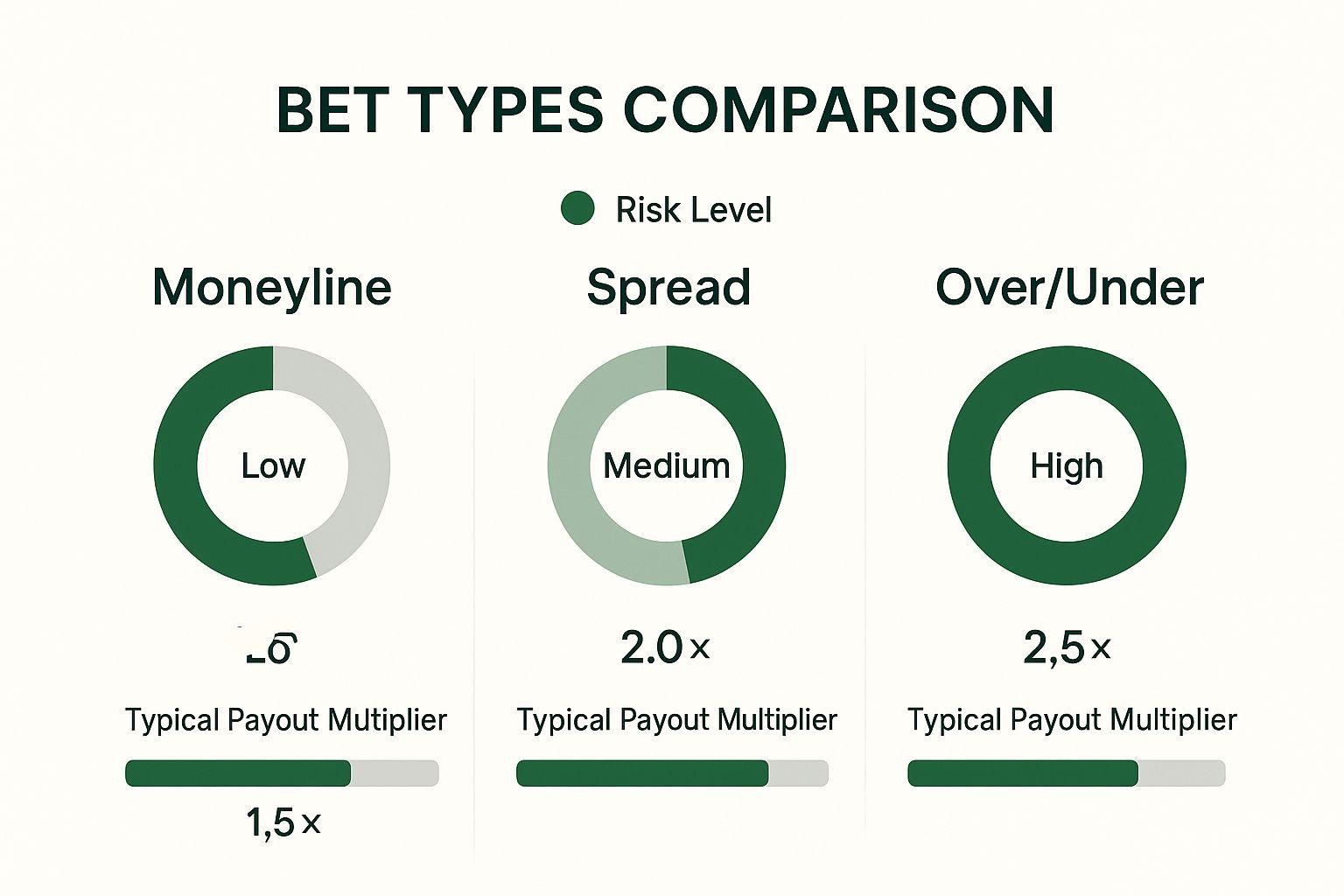
As you can see, Moneyline bets on heavy favorites are lower risk with smaller payouts. On the other hand, Spread and Over/Under bets bring more variables into play but offer a shot at a much higher return.
Your research process should be structured to find these patterns consistently. Here's a simple checklist to guide your pre-match deep dive:
- Surface Analysis: Check both players' career win/loss records on the specific court surface. A player with a 75% win rate on clay is a far more reliable bet there than on grass, where their record might be under 50%.
- Form Check: Look at their results from the last three tournaments. Did they make deep runs, or did they get bounced in the early rounds by lower-ranked opponents? Recent history tells a compelling story.
- H2H Context: Go beyond just the raw head-to-head score. When did those matches happen, and on what surface? A win from five years ago on a completely different surface is almost irrelevant compared to a recent clash under similar conditions.
By systematically working through these factors, you can build a complete picture of the match, form your own probability estimates, and confidently pinpoint where the value is hiding. This disciplined approach is how you learn to bet on tennis strategically.
Mastering Bankroll Management for Long-Term Success

You can have the sharpest analytical mind and the best value-finding strategy in the world, but without disciplined bankroll management, you are destined to fail. That isn't an exaggeration; it's the single most crucial component of any successful betting system. Think of it as the defensive wall that protects your capital and keeps you in the game long enough for your skills to pay off.
Your bankroll is a specific amount of money set aside exclusively for betting. This is non-negotiable. It has to be completely separate from the money you use for rent, bills, or groceries. The moment you start thinking of it as a business investment instead of disposable entertainment cash, you've taken the first step toward a professional mindset.
This separation creates a vital psychological buffer. It frees you up to make objective, data-driven decisions without the emotional weight that comes with risking money you can’t afford to lose.
Setting Up Your Staking Plan
Once you've established your bankroll, the next move is to lock in a staking plan. This is just a set of rules that dictates exactly how much you'll risk on any single bet. A consistent plan is what stops you from making those classic mistakes, like betting way too big after a nice win or chasing losses after a bad beat.
The goal here is simple: protect your capital from a catastrophic loss. Even the best bettors on the planet hit losing streaks it's an unavoidable part of the game. A smart staking plan makes sure that a run of bad luck won't wipe you out, giving your strategy the time it needs to prove profitable over the long haul.
Bankroll management isn't about being timid; it's about being sustainable. It's the discipline that ensures you survive the inevitable downturns and thrive during the upswings, turning short-term variance into long-term profit.
Practical Staking Strategies to Use Now
For anyone learning how to bet on tennis, two staking models really stand out for their simplicity and effectiveness. The key is to just pick one and stick to it with unwavering discipline.
One of the most straightforward and highly recommended methods for beginners is Fixed Staking, often called flat betting.
- How It Works: You decide on a fixed unit size, usually between 1% to 3% of your starting bankroll, and you wager that exact amount on every single bet, no matter what.
- Example: With a $1,000 bankroll and a 2% unit size, every single bet you place is $20. It doesn’t matter if your bankroll grows to $1,200 or shrinks to $800; your stake stays locked at $20.
- Why It's Effective: This method is dead simple to follow and is fantastic for preventing you from chasing losses or getting overconfident. It imposes structure and strips emotion from the equation, which is perfect for building good habits.
This approach gives you a stable foundation for your betting. For a deeper dive into structuring your funds, our complete guide on sports betting bankroll management offers more advanced techniques.
Advancing to a Percentage Staking Model
As you gain more confidence and your bankroll starts to grow, you might consider a more dynamic approach. The Percentage Staking model adjusts your bet size based on the current size of your bankroll, allowing your stakes to scale with your success.
With this strategy, you still commit to a specific percentage, like 2%, but it’s calculated against your current bankroll, not your starting one.
Let's see how this plays out:
| Bankroll Scenario | Your Bankroll | 2% Stake Amount |
|---|---|---|
| Starting Point | $1,000 | $20.00 |
| After a Winning Streak | $1,200 | $24.00 |
| After a Losing Streak | $800 | $16.00 |
This dynamic model has two massive advantages. First, it maximizes your returns during winning streaks by compounding your profits. Second, it gives you a built-in defense mechanism during losing streaks by automatically reducing your stake size, which helps preserve your capital. The key, as always, is consistency. Pick a percentage you are comfortable with and apply it to every single wager without exception.
Avoiding Common Tennis Betting Mistakes
Knowing how to break down a match and manage your money are huge steps. But the final piece of the puzzle is learning to sidestep the common traps that snag even seasoned bettors. Trust me, learning from other people's mistakes is a lot cheaper than making them all yourself.
Mastering how to bet on tennis is really about building disciplined habits and spotting these pitfalls before they drain your bankroll.
Don't Bet With Your Heart
The most dangerous and widespread mistake is emotional betting. This is the classic blunder of wagering with your heart instead of your head. It usually looks something like betting on your favorite player to win, even when all the data screams they’re the clear underdog in that specific matchup.
Loyalty is great for a fan, but it’s a disaster for a bettor. The market couldn't care less who you like; it only cares about probabilities. To get around this, you have to treat every single bet as a cold, calculated business decision.
If your analysis points to your favorite player losing, you either bet against them or even better just don't bet on that match at all. Simple as that.
The Trap of Over-Betting and Lazy Research
Another quick way to empty your account is over-betting. This usually happens when you get impatient or a little too confident and start firing off wagers on matches without doing the necessary homework. You might feel the itch to have action on every big match of the day, but that's a surefire path to ruin.
Effective betting is all about quality, not quantity. It's far better to place two or three well-researched, high-value bets than ten impulsive ones based on a whim. The fix? Create a strict research checklist and refuse to place a bet unless you've gone through every single step.
This discipline stops you from making uninformed wagers and forces you to be selective. A professional bettor might analyze twenty matches just to find one or two that offer genuine value.
A classic error is misreading head-to-head stats out of context. A 5-0 record for one player looks totally dominant, but if those matches were five years ago on a different court surface, that stat is practically worthless. Always dig into the context behind the numbers.
Critical Errors in Match Analysis
Even when you mean well, it’s easy to make analytical mistakes that completely skew your perception of a match. These errors often come from overlooking key variables that have a massive impact on the outcome.
Here are a few critical mistakes to watch out for:
- Ignoring Court Surfaces: A player who is a world-beater on clay can look completely average on a fast grass court. You absolutely must analyze a player's performance history on the specific surface of the upcoming match. A top seed with a poor record on grass is a prime candidate for an early-round upset at Wimbledon.
- Forgetting to Shop for the Best Odds: Settling for the first odds you see is like throwing money away. Different bookmakers offer slightly different prices, and over time, even a small difference of 0.10 in decimal odds can have a huge impact on your profit. Always have accounts with multiple bookmakers to make sure you're getting the best possible price for every single bet.
By consciously avoiding these common errors, you create a much stronger foundation for your betting strategy. It's about building a process that promotes objectivity, rewards patience, and protects you from your own biases. That’s the disciplined mindset you need for long-term success.
Frequently Asked Questions About Tennis Betting

As you start digging into tennis betting, you're going to have questions. It's only natural. This section is all about giving you clear, straightforward answers to the stuff that comes up most often, helping you build confidence and sharpen your strategy.
What Is the Easiest Bet to Win in Tennis?
If we're talking about sheer simplicity, the easiest bet is a Moneyline pick on a heavy favorite, especially in the early rounds of a tournament. The odds will be short meaning you won't get a huge payout but the statistical chance of a top-ranked player beating a qualifier is obviously very high.
But here's the catch: "easy" and "profitable" are two very different things in betting. The real skill isn't just picking obvious winners. It's about finding value. A smart, sustainable strategy focuses on bets where the odds offered are better than the player's actual chances of winning, no matter how "easy" the win might seem on paper.
Is Tennis a Good Sport for Betting?
Absolutely. Tennis is a fantastic sport for betting, mostly because it's a one-on-one battle. Unlike team sports where dozens of variables can throw a wrench in the works, tennis is a direct matchup between two athletes. This makes player-specific data like current form, head-to-head records, and surface preferences incredibly powerful.
Since there are no substitutions or timeouts for coaching, a player's mental and physical state on the day is everything. This creates a rich environment for sharp bettors who can analyze these factors and spot valuable opportunities that the general market might have missed.
What Happens if a Player Retires Mid-Match?
This is a classic question and a huge risk you need to understand. If a player pulls out with an injury, how the bookmakers settle your bets can vary wildly from one site to another.
Here are the most common rules you'll run into:
- One Set Completed: A lot of bookies require at least one full set to be finished for bets to stand. If a player retires after the first set, the player who moves on is declared the winner for betting purposes.
- Bet Voided: Some sportsbooks will simply void all match bets if a player retires at any point. Your stake is returned, no matter the score.
- First Ball Served: A few bookmakers consider bets "live" the moment the first serve is hit. In this case, the player who officially advances wins the bet, and the retiring player loses.
It is absolutely critical to check the specific retirement rules for every sportsbook you use. Assuming the rules are the same everywhere is a rookie mistake that can easily cost you a winning bet.
Can You Bet on Tennis Matches In-Play?
Yes, and in-play (or live) betting is one of the most exciting ways to wager on tennis. It lets you place bets while the action unfolds, with odds that update in real-time after every single point.
This opens up some incredible opportunities. For example, if a heavy favorite drops the first set, their live odds to win the whole match will suddenly get much longer. If your analysis tells you they're likely to battle back, you can pounce on much better odds than you ever could have gotten pre-match.
Live betting is all about reading the momentum of a match and acting fast before the odds catch up.
Ready to stop guessing and start making data-driven decisions? ValueBetFactory uses advanced algorithms to find market inefficiencies and alert you to high-value betting opportunities in real time. Start your free trial today and turn your tennis knowledge into a strategic advantage.