
A Bettor's Glossary of Sports Betting Terms
Unlock Profits with betting tips!
Diving into sports betting can feel like you're trying to learn a whole new language. The scene is packed with its own unique sports betting terms and slang, describing every possible wager, type of odds, and betting strategy out there. Getting a handle on this lingo is your first real step toward making smarter bets, managing your money properly, and walking into a sportsbook with confidence.
Why Learning Sports Betting Terms Is a Must
Having a solid grasp of betting terminology is absolutely essential for success, especially as the industry continues to explode in popularity. This glossary is your foundation, your toolkit for getting the job done right before you start digging into specific bet types and advanced strategies.
Without understanding the language, you're just guessing, and that can lead to some expensive mistakes. For instance, if you don't know the difference between a moneyline bet and a point spread, you could easily place a wager that completely misaligns with what you actually think will happen in the game.
The Foundation for Smarter Betting
Learning the key definitions isn't just about sounding like you know what you're talking about. It has a direct impact on your ability to make sharp, informed decisions and spot bets that have real value. If you're brand new to all this, our guide on how sports betting works is the perfect place to start.
Getting the core concepts down is the single biggest leap a new bettor can take toward long-term success. It shifts your entire focus from just trying to pick winners to strategically weighing risk against reward.
The global sports betting market is growing at a staggering pace, recently valued at around $107.4 billion. Projections show it expanding at a compound annual growth rate (CAGR) of roughly 9.3% from 2025 to 2034. This boom is fueled by widespread legalization, the rise of mobile betting apps, and a surge of interest in e-sports. You can get more details on these market growth trends.
This guide will give you the essential vocabulary you need to jump into this massive, expanding market with your eyes wide open.
Fundamental Betting Types and Core Concepts
Before you can place a smart bet, you have to know the language. Staring at a betting board for the first time can feel like trying to crack a code, but the good news is that most of it boils down to just a few core concepts. These are the fundamental building blocks you’ll find at any sportsbook, and getting a handle on them is your first real step toward reading the lines like a pro.
This infographic gives you a quick visual breakdown of the essential wagers you'll run into on any given game day.
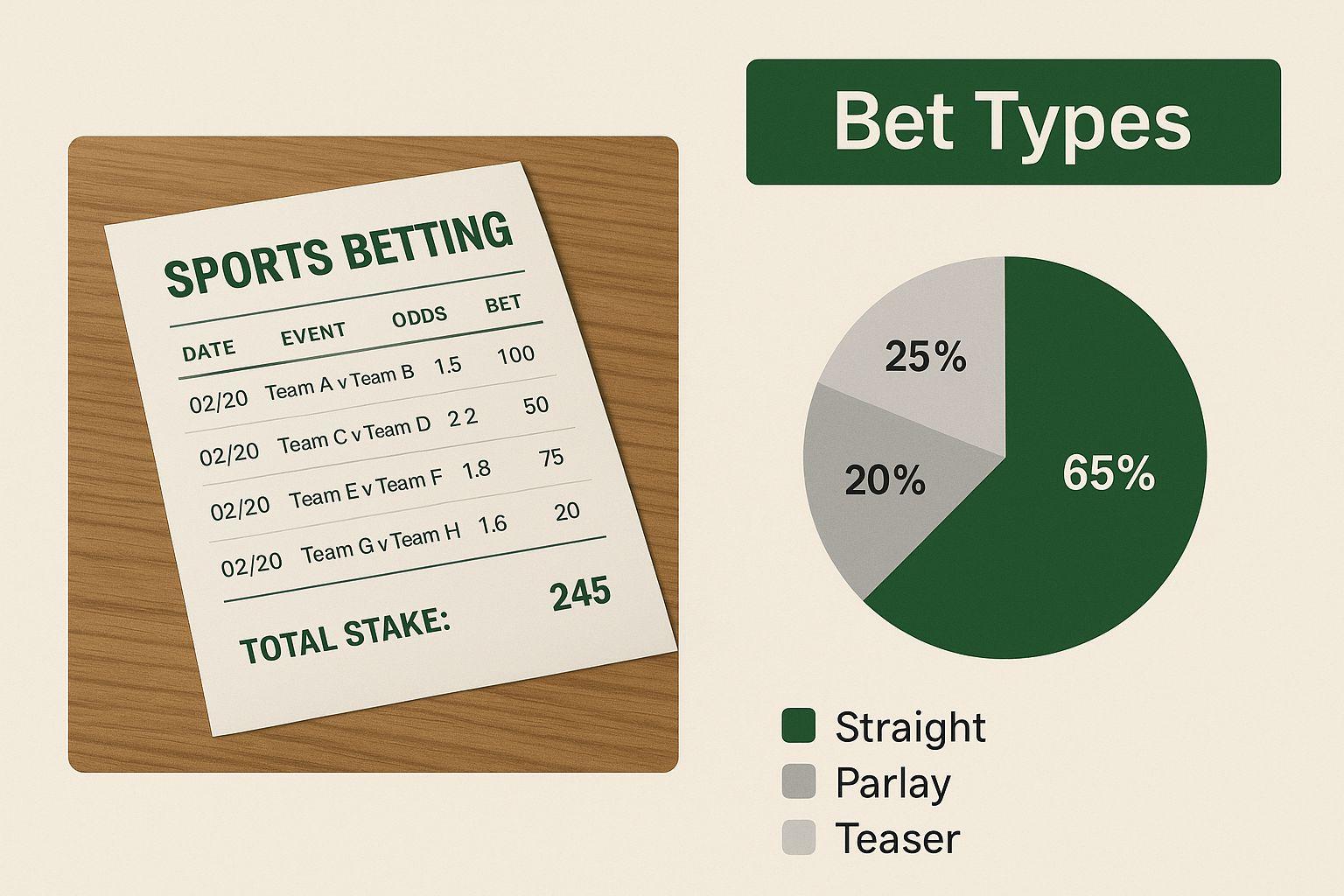
As you can see, each of the main bet types is really just asking a different question about the game. It could be as simple as "who will win?" or a bit more complex, like "how many total points will be scored?"
To give you a quick reference for the absolute essentials, this table breaks down the core bet types you'll see everywhere.
Quick Guide to Core Bet Types
This table provides a simple snapshot of the most common sports bets. Keep these definitions in mind as we dive deeper into each one.
| Term | Definition | Example |
|---|---|---|
| Moneyline | A straightforward bet on which team will win the game outright. | You bet on the Lakers to beat the Celtics, and if they win, you win. |
| Point Spread | A bet on the margin of victory, designed to level the playing field between two teams. | The Chiefs are -7 favorites; they must win by more than 7 points for your bet to cash. |
| Totals (Over/Under) | A wager on the combined total points scored by both teams in a game. | The total is set at 220.5 points; you bet on whether the final score will be over or under that number. |
These three bets form the foundation of sports betting. Let’s unpack exactly how each one works.
The Moneyline Bet Explained
This is betting in its purest form. A Moneyline bet is as simple as it gets: you’re just picking which team you think will win the game. Forget about the margin of victory or any other stats; this is a straight-up "who wins" wager.
Moneyline odds always show you two things: the favorite (marked with a minus sign, ‘-’) and the underdog (marked with a plus sign, ‘+’). If you see the Los Angeles Lakers at -150 and the Boston Celtics at +130, the Lakers are the clear favorites.
- To win $100 on the Lakers (-150), you would have to risk $150.
- A $100 bet on the underdog Celtics (+130) would pay out $130 in profit if they pull off the upset.
This structure is all about risk and reward. The sportsbook makes you risk more to win less on the favorite, while tempting you with a bigger payout for taking a chance on the underdog.
Understanding the Point Spread
The Point Spread is the great equalizer in sports betting, designed to create a 50/50 proposition even when one team is much better than the other. Instead of just picking a winner, you're betting on the margin of victory. This is often just called "betting the spread."
Let's look at a classic NFL point spread:
Kansas City Chiefs -7 (-110)
San Francisco 49ers +7 (-110)
Here, the Chiefs are favored to win by 7 points. If you bet on Kansas City, they don’t just have to win the game, they have to win by more than 7 points for your ticket to cash. On the flip side, a bet on the 49ers wins if they win the game outright OR if they lose by 6 points or fewer. The (-110) you see next to the spread is the price of the bet, often called the juice or vig.
Decoding Totals or Over/Under Bets
A Totals bet, more commonly known as an Over/Under, takes the winner and loser completely out of the equation. With this wager, you’re simply betting on the combined final score of both teams. The sportsbook will set a number, and your job is to predict whether the actual total will be higher (Over) or lower (Under) than that line.
Imagine a basketball game between the Golden State Warriors and the Denver Nuggets where the total is set at 225.5 points.
- A bet on the Over wins if the teams combine for 226 points or more.
- A bet on the Under wins if their combined score is 225 points or less.
Totals are a fantastic way to get in on the action when you have a strong opinion on how a game will play out, fast-paced and high-scoring or a defensive slugfest, without having to pick a side. It’s one of the most common sports betting terms you'll find for any game on the board.
Advanced and Exotic Wager Terminology
Once you've got the basics down, you can start exploring the more creative side of sports betting. This is where you move beyond simple win/loss bets and into a world of wagers that are more complex, riskier, and, frankly, a lot more fun. These are the bets that can lead to some massive payouts if you get them right.
Understanding these advanced and exotic bet types is what separates a casual bettor from someone who's really digging for unique angles and value. While the potential rewards are huge, just know that the complexity, and the risk, goes up right alongside them.
The All-Or-Nothing World of Parlays
A Parlay is a single bet that ties two or more individual wagers (called "legs") together. Here's the catch: for the parlay to win, every single leg has to hit. If even one leg loses, the entire ticket is toast. It's the ultimate all-or-nothing proposition.
So why bother? The payout potential is enormous. The odds of each leg are multiplied, creating much longer odds and a significantly bigger return than if you had bet on each game separately.
For instance, you could cook up a three-leg NFL parlay:
- Leg 1: Kansas City Chiefs -7
- Leg 2: Green Bay Packers Moneyline
- Leg 3: Over 48.5 in the Cowboys vs. Eagles game
If all three of those things happen, you're looking at a massive payday. But if the Chiefs only win by six, your whole ticket is worthless. Parlays are the definition of high-risk, high-reward.
Adjusting the Odds with Teasers and Pleasers
A Teaser is a specific type of parlay that only works with point spreads or totals, but it comes with a twist. You get to move the line in your favor, making the bet easier to win. The trade-off is a much smaller payout.
Let's say you like two NFL teams who are both 7-point favorites. A standard 6-point teaser lets you adjust both lines down to -1. Now, they only need to win by more than a single point for their legs of the teaser to cash.
A Pleaser is the exact opposite. It's a parlay where you move the line against yourself, making the bet significantly harder to win. Why would anyone do this? The payout is huge if you nail it. It's a bet for the bold, to say the least.
Betting Beyond the Final Score with Prop Bets
Proposition Bets, better known as Prop Bets, are wagers that have nothing to do with the final outcome of a game. Instead, you're betting on specific player performances, in-game events, or statistical milestones that might happen during the contest.
Prop bets have absolutely exploded in popularity. They let you get in on the action on a much deeper level. It's no longer just about who wins or loses; it's about the individual moments and performances that make sports so compelling.
The menu of prop bets is practically endless, but they generally fall into a few key categories:
- Player Props: These bets are all about an individual player's stats. Think betting on a quarterback to throw for over or under 2.5 touchdowns, a basketball player to score more than 25.5 points, or a baseball player to hit a home run.
- Game Props: These are tied to events within the game itself, but not the final score. Great examples include which team will score first, whether the game will go into overtime, or the total number of turnovers.
- Novelty Props: You see these most often during huge events like the Super Bowl. They're fun, sometimes silly bets that are completely unrelated to the game. Think betting on the length of the national anthem or the color of the Gatorade dumped on the winning coach.
Props open up a whole new universe of betting angles, giving you creative ways to find value in almost any part of a sporting event.
How to Read Odds and Calculate Payouts
Those numbers you see next to a team's name are the absolute core of sports betting. They do a lot more than just tell you who's the favorite; they're a code that reveals exactly how much you can win and what the sportsbook thinks the real probability of that outcome is. Getting a handle on them is the first real step to becoming a sharp bettor.
There are three main ways bookies display odds around the world. While they might look completely different at first glance, they all communicate the exact same thing: the relationship between the money you risk and the profit you stand to make.
American Odds The Plus and Minus System
In the United States, American Odds are king. You'll spot them instantly by the plus (+) or minus (-) sign sitting in front of a number, like +150 or -200. The entire system is built around the idea of either winning or wagering $100.
- The Minus Sign (-): This tells you you're looking at the favorite. The number shows how much you have to bet to win a $100 profit. For instance, odds of -150 mean you need to risk $150 to make a clean $100.
- The Plus Sign (+): This points to the underdog. The number shows how much profit you'll make on a $100 bet. Odds of +130 mean a $100 wager will bring back $130 in profit if it wins.
This format makes it really easy to see the risk on a favorite versus the potential reward on an underdog.
Decimal Odds The European Standard
You'll find Decimal Odds all over Europe, Australia, and Canada. They are without a doubt the simplest format to understand because the number represents your total payout (your stake plus your profit) for every $1 you bet.
Calculating your return is a breeze: just multiply your stake by the decimal odds. If you bet $10 on odds of 2.50, your total return is $25, that's your original $10 stake back, plus $15 in profit. Any decimal over 2.00 is an underdog (or a coin flip), while anything under 2.00 is a favorite.
This simplicity is making decimal odds more and more common everywhere. It's a global market, after all. The Asia-Pacific region alone makes up nearly 47% of all sports wagers placed worldwide, and as digital betting grows, understanding different formats becomes key.
Fractional Odds The UK Tradition
Mainly used in the UK and Ireland, Fractional Odds show you the potential profit relative to your stake. Odds of 5/1 (you'd say "five-to-one") mean you'll win $5 for every $1 you risk.
So, a $10 bet at 5/1 odds would earn you a $50 profit. Your total payout in this case would be $60, which includes the $50 profit plus your original $10 stake returned.
Here's the key takeaway: odds aren't just about the money. They also represent implied probability, the likelihood of an outcome happening, according to the bookmaker. Learning how to convert odds into probability is one of the most powerful skills for finding real value in the market.
Key Payout and Commission Terms
Beyond the three main formats, you'll need to know a few other terms to truly understand your returns.
- Vig or Juice: This is just the commission the sportsbook charges for taking your action. It’s their built-in profit margin, and it's the reason why the odds on a point spread are typically -110 on both sides, not a perfect +100. That extra 10% is how the house makes its money.
- Push: This happens when a bet ends in a tie. For example, if you bet on a team favored by -7 and they win by exactly 7 points, the bet is a "push." Your original stake is simply refunded. Nobody wins, nobody loses.
Key Terms for Live Betting and Specific Sports
The world of sports betting has gotten incredibly dynamic, especially with the explosion of wagering that happens after a game has already started. This fast-paced environment brings a whole new set of terms you need to know to make quick, smart decisions. On top of that, different sports have unique betting markets that come with their own lingo.

Getting a handle on this specialized language is crucial for navigating both the real-time action and the specific quirks of your favorite sports.
Unpacking Live Betting Terminology
Live betting lets you place wagers on a game while it's in progress, with odds that shift based on the action unfolding on the field or court. It's a game-changer for how many people interact with sports.
- In-Play Betting: This is just the official term for live betting. It covers any wager placed after an event has officially kicked off. The odds are constantly updated in real time to reflect the score, momentum, and anything else happening in the game.
- Cash Out: This feature, offered by most sportsbooks, gives you the option to settle your bet before the event is over. You can lock in a profit if your bet is winning or cut your losses if it looks like a dud. The amount you're offered is based on the live odds at that exact moment.
The rise of mobile platforms and features like in-play betting has been a massive driver of market expansion. In fact, North America is on track to be the fastest-growing region for sports betting, thanks in large part to ongoing legalization and the slick mobile tech that makes it all so engaging. You can check out more insights about the global growth of sports betting.
Sport-Specific Betting Terms
Beyond the standard wagers, many sports have unique betting options that are really just variations of the point spread or totals. These sport-specific terms are essential if you plan on betting on certain games.
Understanding the difference between a Run Line and a Puck Line is as fundamental as knowing the rules of the sports themselves. They are tailored versions of the point spread, adjusted for the lower-scoring nature of baseball and hockey.
Here are a few of the most common sport-specific terms you'll run into:
- Run Line (Baseball): This is baseball's version of the point spread. The standard Run Line is almost always set at -1.5 runs for the favorite and +1.5 runs for the underdog. It's the odds, not the spread, that change from game to game.
- Puck Line (Hockey): Just like the Run Line, the P Puck Line is the point spread for hockey games. It’s also typically set at -1.5 goals for the favorite and +1.5 for the underdog.
- Grand Salami: This is a unique totals bet you'll see mostly in hockey and baseball. It lets you wager on the total number of goals or runs scored across all games scheduled for a particular day. You simply bet Over or Under the number set by the sportsbook.
Getting to Grips with Betting Slang and Jargon
To really get inside the world of sports betting, you need to speak the language. Forget the official definitions for a second; we're talking about the slang you'll hear on podcasts, see thrown around on social media, and use to chat with other bettors. Nailing these terms is the first step to moving past the basics and starting to think like a seasoned pro.
One of the first you'll likely hear, or feel, is a Bad Beat. This is for that bet you were sure was a lock, only to see it fall apart at the last second in the most unlucky way imaginable. Picture this: your team is up by three with possession and ten seconds on the clock, then a wild turnover and a buzzer-beater three sinks your bet. That's a bad beat, and every bettor has a story about one.
Chalk, Dogs, and the Core of Every Bet
At the heart of any matchup, you'll find the Chalk and the Dog. These are just quick, easy ways to talk about the favorite and the underdog.
- Chalk: Betting the "chalk" means you're backing the heavy favorite. The name is a throwback to the old horse racing days when the most popular horse's odds were written on a chalkboard. So many people bet on it that the constant updates would smudge the name into a chalky mess.
- Dog: This is just short for underdog, the team everyone expects to lose. Putting your money on the "dog" usually means you're getting much better odds, so the payout can be huge if they pull off an upset.
Understanding these two terms is fundamental. If someone says their bet slip is "chalky," it means it's loaded with favorites, offering low returns but a decent shot at winning. On the flip side, a bettor who loves playing "dogs" is always on the hunt for that big, unexpected payday.
Who's Who in the Betting World
The community also has labels for different kinds of bettors, and the biggest divide is between a Sharp and the "public."
A Sharp is a professional bettor, the kind of person who makes a living finding an edge. They use complex models, deep analysis, and a disciplined strategy to pinpoint value in the odds. Their money is so respected that a wave of "sharp money" can actually move the betting lines across the industry.
On the other side of the coin, you have the public, or the casual bettor. These are the folks who might bet with their heart, on their favorite team, or based on something they just saw on TV. Sharps often make their money by betting against popular opinion, a move known as "fading the public."
The Big Picture: Industry Terms You Need to Know
Finally, there are a few key terms that help you understand the sheer scale of the betting market for any event. The most important one is the Handle.
The Handle is simply the total amount of money wagered on a particular game or event at a sportsbook. When you hear about the Super Bowl handle, for example, they're talking about the billions of dollars bet on that one game worldwide. To put it in perspective, the total legal sports betting handle in the U.S. blew past $100 billion in 2023 alone. This one term gives you a perfect snapshot of an event's betting popularity and the health of the entire industry.
Essential Bankroll Management Concepts
Picking winners is only half the battle. If you want to have any real long-term success in sports betting, you absolutely have to master a disciplined financial strategy. Honestly, understanding the terms related to your money is probably the single most important skill you can develop. Without a rock-solid plan, even the hottest winning streak can end with a busted account.
When you get these concepts down, betting stops feeling like pure gambling and starts looking more like a structured investment. It’s all about protecting your capital, making calculated financial decisions, and making sure you can stay in the game long enough to let your strategies actually work. This is the stuff that separates casual bettors from those who are serious about their craft.
Defining Your Financial Framework
Every successful betting strategy is built on a clear financial foundation. These are the core terms that will define how you manage your funds from day one.
- Bankroll: This is the total pot of money you've set aside specifically for betting. It has to be an amount you are completely comfortable losing, and it should be kept totally separate from money you need for real life.
- Unit: A unit is your standard, consistent bet size. It’s usually set as a percentage of your total bankroll, typically somewhere between 1% and 5%. Using a unit system keeps your betting consistent and stops emotions from dictating how much you wager, protecting you from catastrophic losses.
Let's say you have a $1,000 bankroll. If you decide on a standard 1% unit, then your unit size is $10. That means all your standard bets are $10, no matter how confident you feel about a particular game. This is the kind of discipline that underpins responsible betting. For a much deeper dive, our complete guide on sports betting bankroll management lays out detailed strategies.
Think of it this way: Your bankroll is your business's capital. A unit is your standard operating expense. Treating them with that level of seriousness is the first step toward building a sustainable betting portfolio.
Strategic Financial Maneuvers
Once you've got your budget set, there are some more advanced strategic bets you can use to manage risk and lock in profits. These techniques are crucial for protecting your investments in specific situations.
One of the most powerful tools in any bettor's arsenal is hedging. Hedging is when you place a bet on the opposite side of your original wager. Sure, it guarantees you a smaller profit than if you just let the first bet ride, but it also completely eliminates the risk of walking away with nothing.
Imagine you've got a multi-leg parlay with just one game left to win a huge payout. By placing a hedge bet on the opposing team in that final leg, you can lock in a guaranteed profit no matter who wins. It’s a classic financial maneuver and a key part of smart risk management.
Got Questions? We’ve Got Answers.
Alright, let's wrap this up by tackling some of the most common questions that pop up when bettors are first getting their heads around the lingo. Think of this as a quick-fire round to make sure these key concepts are locked in.
Getting comfortable with this vocabulary is the first real step toward placing smarter bets and actually understanding what the pros are talking about.
What’s the Difference Between the Spread and the Moneyline?
This is one of the first hurdles every new bettor needs to clear. The moneyline and the point spread are two fundamentally different ways to bet on who wins a game.
- Moneyline: This is as simple as it gets. You're just picking the outright winner of the game. It doesn’t matter if they win by one point or fifty.
- Point Spread: Now we're betting on the margin of victory. The favorite has to win by more than a specific number of points, while the underdog can either win the game or lose by less than that number.
In short, the moneyline is all about who wins, while the point spread is about how much they win by.
Can You Explain What Vig or Juice Means?
The vig (short for vigorish), or juice, is just the cut a sportsbook takes for handling your bet. It’s their built-in profit margin, the reason the house always has an edge, and it ensures they make money no matter who wins.
You see this most clearly on point spread bets. Instead of giving you even money (+100) for a 50/50 shot, they'll set the odds at -110 for both sides. That little extra you have to risk, betting $110 to win $100, is the juice.
That commission is exactly why you have to win more than 50% of your bets just to break even. In fact, at -110 odds, the magic number is 52.38%. Understanding the vig is critical to seeing how the whole business of sports betting really works.
What Does It Mean to Hedge a Bet?
Hedging is a strategic play where you bet on the opposite side of your original wager. It’s a way to either lock in a guaranteed profit or cut your losses on a bet that’s looking shaky. Think of it as a form of insurance.
For example, let's say you hit the first three legs of a four-team parlay. You could place a "hedge" bet on the other team in that final game. No matter who wins that last matchup, you've guaranteed you'll walk away with a profit.
Ready to put your knowledge to the test? ValueBetFactory uses advanced algorithms to find betting opportunities in real time. Our platform provides the tools and educational resources you need to make smarter, data-driven decisions. Explore our features and start betting with an edge at ValueBetFactory.