
Sports Betting How It Works A Beginner's Guide
Unlock Profits with betting tips!
At its heart, sports betting is a pretty straightforward deal: you put money on a specific outcome in a sporting event. Every wager you place boils down to three core elements: your prediction, the amount you risk (your stake), and the potential payout set by the sportsbook. It's less of a random guess and more of a calculated risk based on what you know.
How Sports Betting Actually Works

Think of it like this: you and a friend are about to watch a football game. You’re convinced Team A is going to win, but your friend is all in on Team B. To raise the stakes, you both toss $10 into a pot. If Team A wins, you scoop the whole $20. If Team B pulls it off, your friend takes the cash. That simple, friendly wager is the essence of betting.
In the official world of sports wagering, a sportsbook formalizes this entire process.
- The Bettor (That's You): You're the one analyzing the game, making a call on who will win, and deciding how much money, the stake, you're willing to risk on that prediction.
- The Sportsbook (The "House"): This is the company that takes your bet. They're the ones who set the terms of the wager (the "odds") and pay you your winnings if you get it right.
The sportsbook basically acts as a broker, holding all the money wagered on an event and making sure the winners get paid. This system is what allows you to bet on almost any game you can think of, without having to track down someone willing to bet against you personally.
The Three Pillars of a Sports Bet
No matter how simple or complex a bet seems, it's always built on the same three foundational pieces. Getting a handle on these is the first real step to understanding how sports betting works.
To make it even clearer, let's break down the three fundamental elements involved in every single wager you'll ever place.
| Component | What It Means | Simple Example |
|---|---|---|
| Selection | This is your actual prediction, the specific outcome you're betting will happen. | Betting on the Los Angeles Lakers to win their next game. |
| Stake | The amount of money you risk on your selection. If you lose, the stake is gone. | You decide to risk $20 on the Lakers winning. |
| Odds | Set by the sportsbook, this number shows the payout and the implied probability. | The odds on the Lakers are -150, meaning you'd win $10 for every $15 you bet. |
Once you understand how these three pillars interact, you've grasped the core mechanic of sports betting.
Key Takeaway: The relationship between your stake and the odds is everything. It dictates your potential payout. A bigger stake or longer odds (on an underdog, for instance) means a much larger potential return on your investment.
This basic structure is the engine behind a massive global industry. The sports betting market was valued at around USD 103.05 billion and is projected to skyrocket to nearly USD 233.76 billion by 2032. This explosive growth is fueled by more relaxed regulations and the sheer convenience of online betting platforms. You can learn more about these sports betting market trends on maximizemarketresearch.com.
Now, let's dive deeper into how odds are set and the different types of bets you can make.
Cracking the Code: How to Read Sports Betting Odds
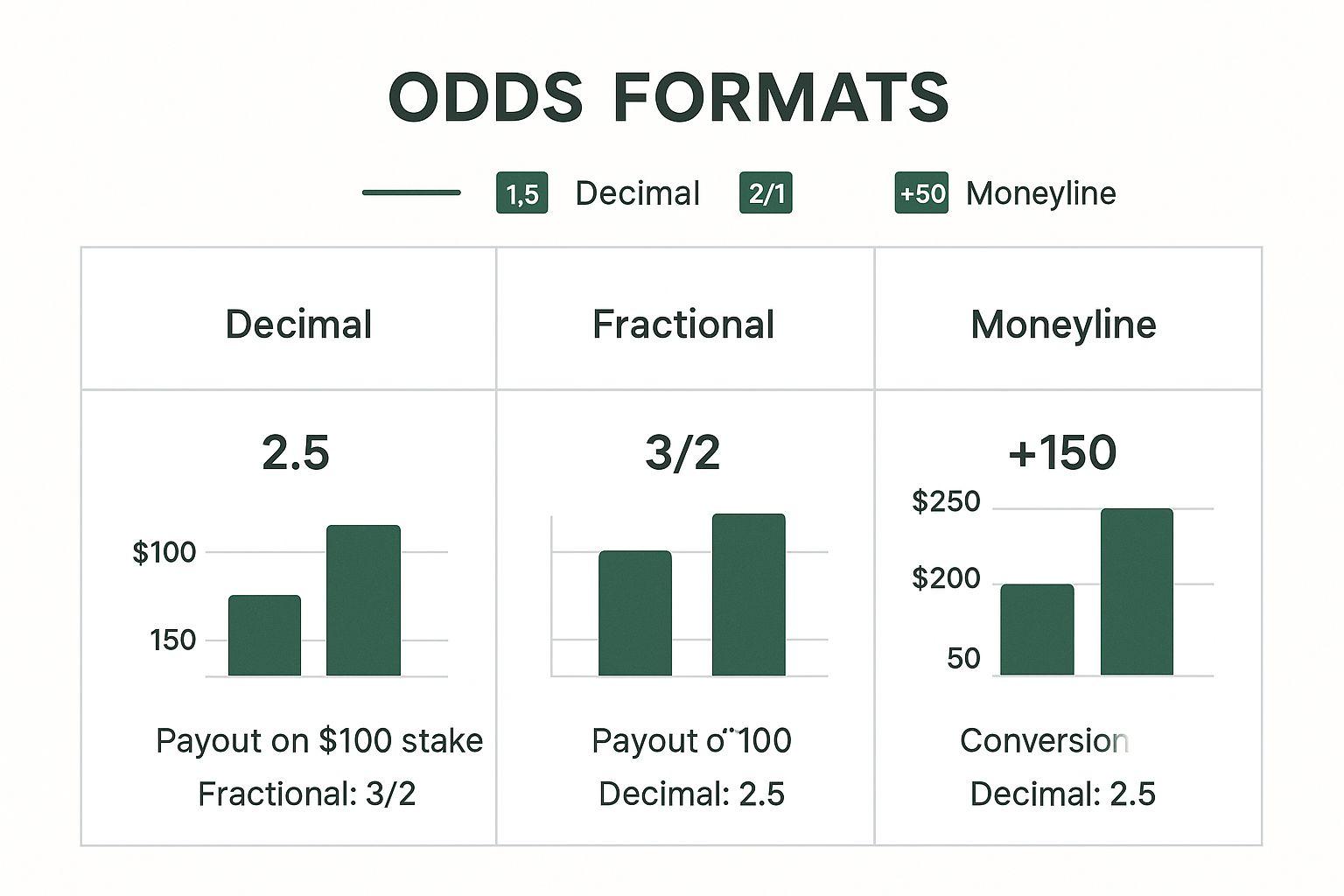
At first glance, betting odds can look like a jumble of numbers and symbols. But they're really just the sportsbook's way of telling you two key things: how much you can win and the implied probability of that win happening. Think of this section as your personal decoder ring.
We'll walk through the three main formats you'll run into. They all tell the same story, just in a different dialect. Getting fluent in all three is a non-negotiable skill for any serious bettor.
American Odds: The Plus & Minus System
In the US, you'll almost always see American odds. The whole system is built around the idea of a $100 bet, using a plus (+) for the longshot and a minus (-) for the favorite. It's a quick way to see who's expected to win and what the payout looks like.
- Minus Sign (-): This points to the favorite. The number tells you how much you need to risk to win a $100 profit.
- Plus Sign (+): This highlights the underdog. The number shows how much profit you'll make if you risk $100.
Let's use a classic NBA rivalry as an example.
Example: Boston Celtics -150 vs. Miami Heat +130
- The Celtics are the favorites. The -150 means you have to bet $150 to win $100. If they pull it off, you get $250 back (your $150 stake + $100 profit).
- The Heat are the underdogs. A $100 bet on them at +130 would net you $130 in profit. A win gets you $230 back (your $100 stake + $130 profit).
Of course, you don't have to bet exactly these amounts. The payouts scale perfectly whether you're betting $10 or $1,000. This format just gives you a clear, instant picture of the risk and reward.
Decimal Odds: The Simple Multiplier
Decimal odds are the standard pretty much everywhere else in the world, Europe, Canada, Australia, and many people find them the easiest to understand. The number you see represents the total payout you’ll receive for every $1 you wager, including your original stake.
The math couldn't be simpler.
Total Payout = Stake x Decimal Odds
Imagine we're looking at an English Premier League match.
- Manchester United: 2.50
- Chelsea: 3.00
- Draw: 3.20
If you put $100 on Manchester United at 2.50, your total return would be $100 x 2.50 = $250. That $250 is made up of your original $100 back plus $150 in profit. The bigger the decimal, the bigger the underdog and the bigger the potential payout.
As sports betting expands globally, more bettors are getting comfortable with different odd formats. The number of users worldwide is projected to hit 231.9 million by 2029, with the average revenue per user climbing to around USD 389.52. You can find more detail on this trend in this report on global sports betting user growth on gammastack.com.
Fractional Odds: The Old-School Classic
Fractional odds are the original language of the British bookmaker and are still a mainstay in UK horse racing. They look like a simple fraction, and that's exactly what they are: they tell you the potential profit in relation to your stake.
If you see odds of 5/1 (read "five-to-one"), it means for every $1 you bet, you stand to win $5 in profit.
Let's take a big boxing match.
- Fighter A: 1/2 (a heavy favorite)
- Fighter B: 6/1 (a major underdog)
For Fighter A, the 1/2 odds mean you have to bet $2 just to win $1 in profit. A $100 bet would only get you $50 in winnings.
On the other hand, a successful $100 bet on Fighter B at 6/1 would bring in a hefty $600 profit. This format makes the pure profit crystal clear, as it separates it from your initial stake.
Getting a handle on these three formats is huge. It means you can look at any betting board, anywhere in the world, and know exactly what’s going on. Most online sportsbooks let you toggle between formats with a click, but a true bettor knows how to read them all.
Understanding the Most Popular Bet Types
Okay, so you've got a handle on reading odds. The next logical step is figuring out what, exactly, you can put your money on. Sports betting is so much more than just picking who's going to win. The most common wagers give you different ways to attack a game, each with its own rhythm and strategy.
Getting a feel for these core bets is the key to finding the right angle for any given matchup. Let's break down the "big three" of sports betting: the Moneyline, the Point Spread, and the Total (often called the Over/Under). We'll go beyond just defining them and get into why a sharp bettor picks one over the others.
The Moneyline Bet
The Moneyline is as simple as it gets. You're picking the team or player you think will win the game, period. It doesn't matter if they scrape by with a one-point victory or blow out their opponent by fifty, a win is a win.
Because it's so straightforward, the Moneyline is a fantastic starting point for anyone new to betting. The catch? The payouts can swing wildly depending on who you back.
- Betting on the Favorite: Taking a heavy favorite on the Moneyline won't make you rich. The oddsmakers see them as the likely winner, so the payout is small. For instance, a -400 favorite means you have to risk $400 just to profit $100.
- Betting on the Underdog: This is where things get exciting. Backing an underdog can lead to a huge payday if they pull off the upset. A $100 wager on a +300 underdog would return a $300 profit.
The Moneyline is your go-to when you have a gut feeling about an underdog's chances or when two teams are so evenly matched that picking a winner feels like a coin toss.
The Point Spread
This is where sports betting gets a lot more strategic. With the Point Spread, you aren't just betting on who wins, but by how much. The sportsbook sets a "spread" to essentially level the playing field between the favorite and the underdog, making the game more competitive from a betting perspective.
The favorite has to win by a certain number of points (e.g., -7.5) to "cover the spread." The underdog gets a head start (e.g., +7.5), and can either win the game outright or lose by less than the spread for their backers to win the bet.
Example: Los Angeles Lakers -5.5 vs. New York Knicks +5.5
- If you bet on the Lakers -5.5, they need to win the game by 6 points or more for you to cash your ticket.
- If you bet on the Knicks +5.5, they can either win the game or lose by 5 points or fewer, and you still win.
Point spread bets usually have odds around -110 for both sides, which creates a much more balanced bet than a lopsided Moneyline. It’s the bread and butter for sports like football and basketball where scores are high and victory margins can be all over the place.
The Totals or Over/Under
What if you don't have a strong read on who will win, but you're convinced it's going to be a high-scoring shootout or a defensive slugfest? That's the perfect time for a Totals bet, also known as the Over/Under.
The sportsbook sets a number for the total combined points scored by both teams. All you have to do is decide if the final score will go over or under that number.
Let’s use a soccer match, where Over/Under betting is huge.
- Game Total: Over 2.5 goals / Under 2.5 goals
- Betting the Over: You win if the teams score a combined 3 goals or more (final scores like 2-1, 3-0, or 2-2 are winners).
- Betting the Under: You win if the teams score a combined 2 goals or fewer (think 1-0, 0-0, or 1-1).
This bet lets you put your knowledge of team offenses, defenses, pace of play, and even weather to good use without having to pick a winner. Finding spots where you think the bookmakers have misjudged a game's scoring potential is a classic betting strategy. If you're interested in digging into that kind of advanced thinking, you can learn more about what is a value bet in our detailed guide.
Choosing the Right Bet for the Game
Each of these wager types serves a different purpose. The key is to match your insight about a game with the bet that gives you the best chance to capitalize on it. Here's a quick breakdown to help you decide.
| Bet Type | What You Are Betting On | When to Use It |
|---|---|---|
| Moneyline | The outright winner of the game, regardless of the score. | When you're confident in an underdog's upset potential or when two teams are evenly matched. |
| Spread | The margin of victory. | In high-scoring games like football or basketball, especially when there's a clear favorite. |
| Total | The combined final score of both teams (over or under). | When you have a stronger opinion on game flow (offense/defense) than on the actual winner. |
Ultimately, choosing the right wager comes down to aligning your prediction with the best available market. Nailing these fundamentals is your first real step toward making smarter, more strategic betting decisions.
How Sportsbooks Make Money

It’s a common misconception that sportsbooks make their living by simply outsmarting the public and winning more bets than they lose. While that can certainly pad their profits, their real business model is much simpler and far more reliable. It's built around a guaranteed commission on every wager, a concept known as the vigorish, or vig.
This small, built-in fee is the engine that drives the entire sports betting industry. The best way to think of a sportsbook isn't as a high-stakes gambler, but more like a financial middleman. They're not betting against you; they're facilitating the bet and taking a small cut for their service, no matter who wins.
The Concept of Vig or Juice
To really get a handle on the vig, let's look at a bet with a true 50/50 shot, like a coin flip. In a perfectly fair world with no commission, the odds on both heads and tails would be even money (+100). If you bet $100, you’d win $100 profit. Simple.
But a sportsbook will never offer +100 on both sides of a coin flip. Instead, you'll see odds like -110 for each outcome. That small adjustment is the vig in action. Now, to win that same $100, you have to risk $110.
Here’s how it works in practice:
- Bettor A puts down $110 on Team A (to win $100).
- Bettor B puts down $110 on Team B (to win $100).
The sportsbook has collected a total of $220 from both bettors. When the game ends, one person wins. The bookmaker pays out $210 to the winner, their original $110 stake back, plus their $100 in winnings. That extra $10 left over? That's the sportsbook's guaranteed profit. This is the house edge, and it’s built into almost every bet you place.
The House Edge Explained: A sportsbook's main goal isn't to perfectly predict a game's outcome. It's to set odds that attract a roughly equal amount of money on both sides of a bet. When they nail this balance, they guarantee themselves a profit from the vig, completely removing their own risk.
How Balanced Action Guarantees Profit
This constant need to balance the books is why you see betting lines move throughout the week. Let’s say 75% of all the money wagered comes in on the Kansas City Chiefs as a 7-point favorite. The sportsbook is now sitting on a huge potential loss if the Chiefs cover the spread.
To protect themselves, they'll adjust the line to -7.5 or maybe even -8. This makes betting on the Chiefs a little harder and makes the other side, their opponent, a much more tempting option. This encourages new money to come in on the underdog, helping to balance out the total amount wagered on each team.
Their dream scenario is getting the same amount of money on both sides, creating a risk-free profit from the juice. This strategic line movement is fundamental to their operation, and you can dive deeper into the nuts and bolts of how bookmakers make money in our full guide.
And it’s an incredibly profitable model. The global sports betting market was valued at around USD 53.78 billion and is on track to hit USD 93.31 billion by 2030, with a growth rate of about 11.65% a year. This boom is fueled by the explosion of online betting platforms. You can get more details on the growth of the online sports betting industry on globenewswire.com.
Understanding the vig is a game-changer. It forces you to realize that to win in the long run, you're not just trying to outpick other bettors. You also have to consistently beat the built-in tax the house charges on every single bet.
Developing a Basic Betting Strategy
Knowing the odds and the rules of the game is one thing. But if you want to move from just playing for fun to betting with a purpose, you need a strategy. This isn't about some secret formula for guaranteed wins; it’s about having a solid game plan that protects your money and sharpens your decision-making.
The foundation of any smart betting approach really boils down to two key ideas. First, you have value betting, the art of finding wagers where the odds seem a bit too generous for the real probability of something happening. The second, and arguably more important, is bankroll management. This isn't just a good idea; it's the bedrock of survival in sports betting.
Embracing these principles helps you shift your thinking. You stop just trying to pick winners and start making calculated investments that can weather the inevitable cold streaks.
Finding Value in the Odds
If there’s one concept that separates successful bettors from the rest, it’s value betting. A value bet is simply a situation where you believe the real chance of an outcome is better than what the sportsbook’s odds are telling you. You’re essentially finding a flaw in the market price.
Think of it like shopping. If you're an antique expert and know a particular chair is worth $100, but you find it at a flea market for $70, you buy it. You spotted value. Betting is the same game; you’re hunting for odds that are "on sale."
Of course, this means you have to do your own homework. You can't just blindly trust the numbers the bookie gives you. A real sports betting strategy means digging into stats, team form, injuries, and other factors to form your own educated opinion on a game's true probabilities.
Key Insight: Don't confuse a winning bet with a good bet. If you wager on a massive underdog with terrible odds and they pull off an upset, you got lucky. A truly good bet is one that has positive expected value (+EV), no matter if it wins or loses.
Mastering Bankroll Management
The second pillar holding up any successful strategy is bankroll management. It's a fancy term for a simple practice: set aside a specific amount of money just for betting (your bankroll) and only risk a small, consistent chunk of it on any single bet.
Without this discipline, even the sharpest bettors will eventually go broke. Why? Because a long losing streak isn't just possible, it's inevitable. Proper bankroll management is what ensures you live to bet another day.
Here are the non-negotiable rules to live by:
- Set a Budget: Decide on a total sum you are willing to lose over a set period, like a season or a year. That’s your bankroll. Treat it like a business expense.
- Use a Unit System: A common and effective method is to define your standard bet size (a "unit") as 1% to 3% of your total bankroll.
- Stay Consistent: It doesn’t matter if you’re on a winning streak or stuck in a slump, stick to your unit size. Never, ever chase your losses by making bigger bets.
This structured approach takes the emotion out of the equation. When you lose, you don't panic. When you win, you don't get greedy. It gives you the stability you need to think long-term.
The Importance of Research and Discipline
At the end of the day, a winning strategy is built on two things: diligent research and emotional control. One of the quickest ways to drain your bankroll is to bet with your heart by always backing your favorite team, even when the numbers don't add up.
Instead, every decision needs to be driven by objective analysis. That means looking at:
- Team Statistics: Go deeper than just wins and losses. Look at specific offensive and defensive metrics.
- Situational Factors: Is a team playing on short rest? How do they perform on the road? These details matter.
- Market Trends: Pay attention to how the public is betting and why the lines might be moving.
When you combine this kind of research with a firm commitment to value betting and strict bankroll management, you start betting smarter. It becomes a methodical process that rewards patience and discipline far more than a lucky hunch ever will.
Placing Your First Bet with Confidence

Alright, you've got the basics down, you understand odds, know the different bet types, and have a strategy in mind. Now it's time for the fun part: putting that knowledge into action. Placing your first real wager can seem a little daunting, but it’s actually a simple process once you see it broken down.
Your first decision is choosing where to play. You'll need to find a reputable, licensed sportsbook that operates legally where you live. Beyond that, look for one with competitive odds and an app or website that you find easy to navigate. Once you've picked your book, you’ll create an account, which usually just means providing some basic info to verify you are who you say you are.
Next, you'll need to deposit some funds. Sportsbooks offer all sorts of options, from credit cards and debit cards to online banking and e-wallets. Pick whatever you're most comfortable with, but remember the bankroll rules we discussed. Start small with an amount you're totally fine with losing.
From Finding a Game to Finalizing Your Bet
Once you're logged in and funded, finding a game is a breeze. Most sportsbook apps and sites lay things out very clearly, with a menu of sports listed on the side or across the top. Just tap on a sport like football or basketball, and you'll see a full list of the day's games and all the available betting markets for each.
See a bet you like? Simply click or tap on the odds. When you do, a little window or sidebar will pop up, this is your bet slip. Think of it as your digital shopping cart where you finalize the details before checking out.
Crucial Checkpoint: Always, always double-check your bet slip before you hit confirm. Make sure the team is right, the bet type is correct, and then type in how much you want to stake. You’ll see the potential payout right there. This one final look can save you from a costly mis-click.
Once you’ve entered your stake and you're sure everything looks right, hit the "Place Bet" or "Confirm" button. That's it! You're officially in the game. From your initial analysis to a live ticket, that’s the entire process from start to finish.
Just remember the golden rule of bankroll management: bet with your head, not over it. Keep it fun, wager responsibly, and stick to your limits.
Got Questions? We've Got Answers
Even after breaking down the essentials, a few questions always seem to come up. It's totally normal. Let's tackle some of the most common ones head-on to clear up any lingering confusion and get you feeling confident.
Is This Even Legal Where I Live?
That's the million-dollar question, and the answer is: it depends entirely on where you are. In the U.S., things changed dramatically after a huge Supreme Court decision in 2018. That ruling basically gave each state the green light to make its own rules about sports betting.
Since then, a bunch of states have jumped on board, but it's still not legal everywhere. The most important thing you can do is check your local laws. Seriously, don't skip this step. Only bet with sportsbooks that are licensed and regulated in your specific state or country. It’s the only way to know your money and data are safe.
Pro Tip: Never, ever use an offshore or unlicensed betting site. If something goes wrong, you have zero protection. Stick to the regulated guys, it’s just not worth the risk.
What’s the Deal with That -110 Number?
You’ll see -110 everywhere, especially next to point spreads and totals. Think of it as the sportsbook's built-in fee for taking your bet. In the industry, we call it the "vig" or "juice."
It's pretty simple when you break it down: that -110 means you have to bet $110 to win $100. If your bet wins, you get back $210 (your original $110 stake plus your $100 profit). This small, built-in edge is how sportsbooks make their money and stay in business, regardless of who wins the game.
How Do Sportsbooks Come Up with the Odds Anyway?
It’s a mix of art and science. Sportsbooks start by using sophisticated computer models, detailed team power ratings, and the sharp opinions of their own oddsmakers to set an opening line. But here’s the secret: their main goal isn't just to perfectly predict the outcome.
Their real job is to set a line that gets roughly the same amount of money bet on both sides. When they achieve that balance, they lock in a profit from the vig, no matter what happens in the game. If too much money starts flowing to one side, you'll see them adjust the odds in real-time to encourage betting on the other side and balance their books.
Ready to move beyond the basics and start making smarter, data-driven decisions? ValueBetFactory uses powerful algorithms to find discrepancies in the market, highlighting potential value opportunities with real-time alerts. Learn more and start your journey at ValueBetFactory.