
Mastering Probability to Odds Conversion
Unlock Profits with betting tips!

At its core, converting a probability into odds is just a translation. You're taking the likelihood of something happening and framing it as a ratio of how many times it won't happen versus how many times it will.
Let's say an event has a 25% probability of occurring. That means there's a 75% chance it won't. The ratio is simply 75 to 25, which you can simplify down to 3-to-1 odds against. Simple as that.
The Real Connection Between Probability and Odds
Before we get into the nuts and bolts of the formulas, it’s really helpful to get an intuitive feel for how probability and odds relate. Think of them as two different languages telling the same story about an uncertain outcome. Probability gives you a straight-up chance of an event happening out of all possibilities. Odds, on the other hand, frame it as a head-to-head matchup between failure and success.
Take a standard six-sided die. The probability of rolling a '4' is one out of six, or about 16.7%. That's a direct, easy-to-understand statement of likelihood.
Odds tell the story from a slightly different angle. They look at the five ways you can lose (rolling a 1, 2, 3, 5, or 6) and compare that to the single way you can win (rolling that 4). This gives us odds of 5-to-1 against it happening. Both the 16.7% probability and the 5-to-1 odds are describing the exact same reality, just in a different dialect.
Understanding the 'Why' Behind the Conversion
Once you grasp this fundamental connection, every probability to odds conversion feels less like a math problem and more like a simple translation. This isn't just about crunching numbers; it’s about learning to see risk and reward the way professionals do. Bookmakers, statisticians, and even financial analysts rely on this core concept every single day.
And it’s not just for betting. This relationship is a cornerstone in many data-driven fields.
Statistically, the use of odds and their conversion to probabilities underpins major fields beyond betting, notably epidemiology and medical research, where the odds ratio serves as a critical measure of association between two events or groups.
This powerful metric has been used for decades to evaluate risks in clinical trials and public health studies. An odds ratio greater than one suggests a higher likelihood in one group, while a value less than one indicates the opposite. It’s a concept with a reach far beyond the sportsbook.
Building Your Foundation
Developing this intuitive sense is the real first step toward mastering the technical side. When you see a probability, you should automatically start picturing that underlying ratio of losses to wins.
Here are the key ideas to lock in:
- Probability is simply the number of ways you can win divided by the total number of possible outcomes.
- Odds are the ratio of the ways you can lose to the ways you can win.
- They are two sides of the same coin, each offering a unique perspective on the likelihood of something happening.
With this foundation in place, you’re ready to tackle the specific formulas for different odds formats. If you want to jump ahead and see how the reverse works, our guide on how to convert odds to probability is a great place to start. Understanding this two-way relationship is the key to unlocking a much deeper insight into how betting markets actually function.
Converting Probability to Decimal Odds
If you're new to the world of betting odds, decimal odds are the perfect place to start. They're popular across Europe, Australia, and Canada for a good reason: they're incredibly straightforward. A single number tells you the total you’ll get back for every dollar you stake, including your original bet.
This makes turning a probability into decimal odds a breeze.
The formula couldn't be simpler: Decimal Odds = 1 / Probability.
Just make sure you're using the decimal version of your probability. So, a 50% chance is 0.50, a 25% chance is 0.25, you get the idea.
Putting the Formula to Work
Let's walk through a real-world scenario. Say you've analyzed a tennis match and figure one player has a 40% chance of winning. How do you turn that into decimal odds?
You just pop it into the formula.
- Probability: 40% (or 0.40)
- Decimal Odds: 1 / 0.40
- Result: 2.50
That 2.50 tells you everything. For every $1 you bet, you’ll get $2.50 back if you win. That's your original $1 stake plus $1.50 in profit. The higher the decimal number, the bigger the underdog, and the more you stand to win.
On the flip side, a heavy favorite with a high chance of winning will have very low decimal odds. A team you've pegged with a 90% probability of victory (0.90) would have odds of just 1.11 (1 / 0.90). This immediately signals a low-risk, low-reward bet.
This table gives you a great visual for how these conversions look side-by-side with other formats.
As you can see, a low implied probability like 10% balloons into high decimal odds (10.00), whereas a high probability like 80% shrinks down to tight odds (1.25).
What I've always appreciated about decimal odds is their transparency. The number itself gives you the full picture of your potential return without needing any extra math. It bundles your stake and profit into one clean, simple figure.
Getting comfortable with this conversion is the first real mechanical skill you need. Once you can effortlessly flip a probability into its decimal equivalent, you can start comparing odds from different bookmakers and sniffing out where the real value lies. It's the bedrock of any data-driven betting strategy.
Translating Probability into Fractional Odds
While decimal odds are all about clean, simple math, fractional odds are the classic language of the bookmaker, especially if you're betting in the UK or Ireland. They might look a little old-school, but they tell you exactly what you need to know: your potential profit relative to your stake.
The formula to get from a probability to fractional odds is pretty direct.
Fractional Odds = (1 / Probability) - 1
Just like with decimal odds, the first thing you have to do is turn your percentage into a decimal. Let's say you've figured out an event has a 25% chance of happening. That's 0.25 as a decimal.
Pop that into the formula: (1 / 0.25) - 1. That works out to 3. This number becomes the top of your fraction (the numerator), with 1 on the bottom, giving you odds of 3/1. Simple as that.
This visual helps put it all together, showing how different odds formats are just different ways of saying the same thing.
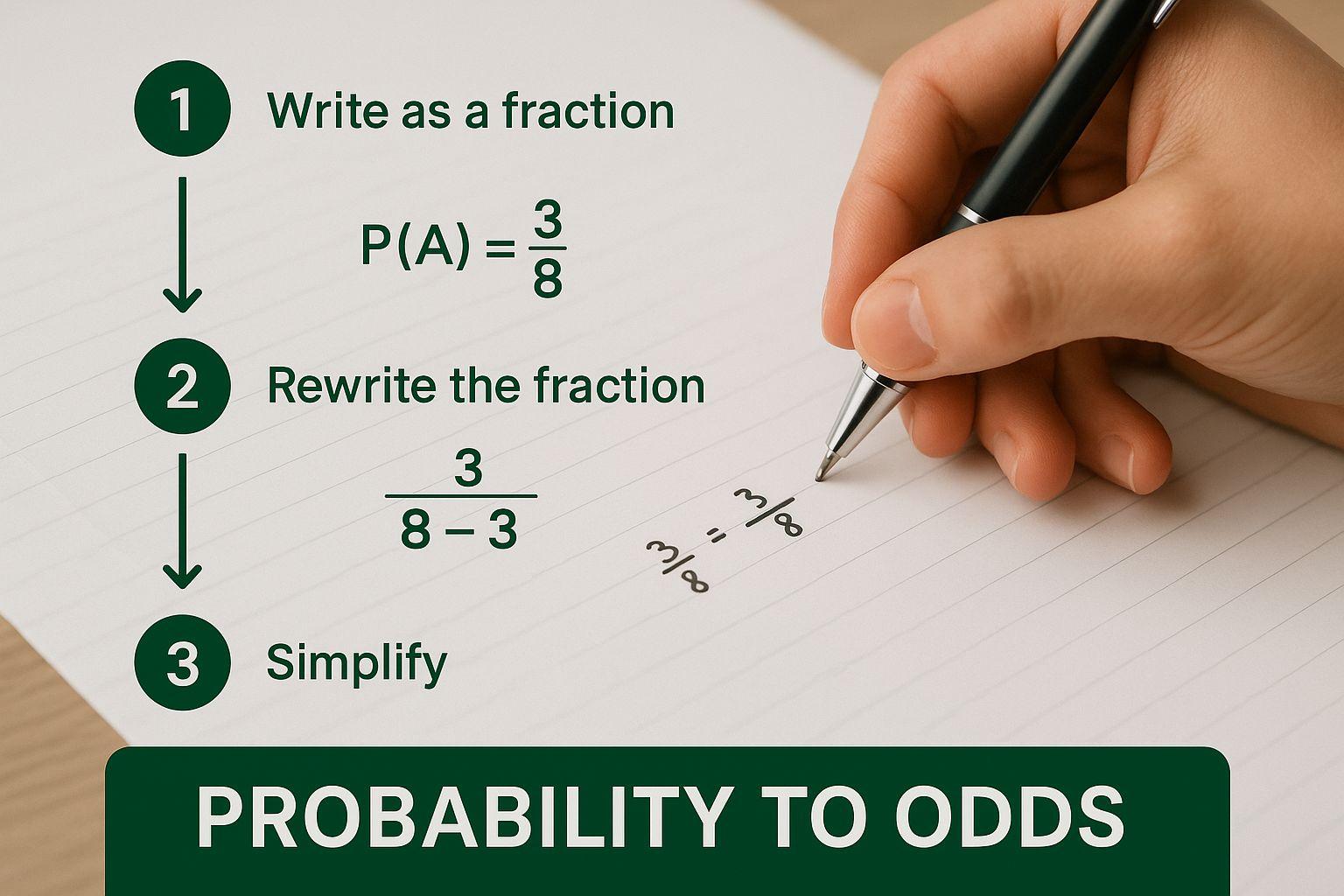
At the end of the day, whether it's fractional, decimal, or American odds, you're just looking at the same underlying probability dressed up in a different outfit.
What About The Messy Numbers?
It's one thing to work with a neat and tidy 25%, but real-world betting is rarely that clean. What happens when your analysis points to a less convenient number? Let’s imagine you’ve handicapped a horse race and believe a particular horse has a 54.5% shot at winning.
First, convert that to a decimal: 0.545.
Now, let's run it through the formula:
- (1 / 0.545) - 1 = 1.8348 - 1 = 0.8348
Okay, so what do we do with 0.8348? This is where a little experience comes in. You need to find the closest simple fraction. In this case, 0.8348 is incredibly close to 0.8333, which is the decimal equivalent of 5/6. So, for all practical purposes, a 54.5% probability is the same as 5/6 fractional odds.
This brings up a great point about how fractional odds work in practice. Odds of 5/6 literally mean you must risk $6 to win a $5 profit. If you flip that around to find the implied probability, 6 / (5 + 6), you get roughly 54.5%. This is the core math bookies have used for centuries.
Probability to Fractional Odds Conversion Examples
Getting comfortable with these conversions is a huge advantage, letting you spot value on the fly. This table gives you a quick reference for some of the most common probabilities you'll encounter and what they look like as fractional odds.
| Implied Probability (%) | Calculation Steps | Resulting Fractional Odds |
|---|---|---|
| 10% (0.10) | (1 / 0.10) - 1 = 9 | 9/1 |
| 20% (0.20) | (1 / 0.20) - 1 = 4 | 4/1 |
| 50% (0.50) | (1 / 0.50) - 1 = 1 | 1/1 (Evens) |
| 75% (0.75) | (1 / 0.75) - 1 = 0.333 | 1/3 |
| 90% (0.90) | (1 / 0.90) - 1 = 0.111 | 1/9 |
You can see a clear relationship here: the higher the probability, the lower the fractional odds. Anything with a probability over 50% becomes an "odds-on" favorite (like 1/3 or 1/9), meaning your potential profit is less than your initial stake.
If you don't want to do the math in your head every time, you can always work backward and check your numbers with a good odds to percentage calculator. Getting this skill down is absolutely crucial for navigating betting markets where fractional odds still reign supreme.
Mastering Probability to American Odds
American odds, which you'll often see called moneyline odds, are the go-to format in the United States. Their defining feature is the use of positive and negative numbers, giving you an instant read on the favorite and the underdog. It's all built around the idea of a theoretical $100 bet.
Unlike other formats, the probability to odds conversion for American odds isn't a one-size-fits-all formula. The calculation you use depends entirely on whether the implied probability is above or below 50%.
This split is the main thing you need to get your head around. Once it clicks, the system is incredibly intuitive for understanding risk and reward from a US betting perspective.
Converting for Underdogs (Probability < 50%)
When an outcome is less likely to happen than not, it’s the underdog. You'll see this represented by a positive number (like +150, +200, etc.). This number tells you exactly how much profit you stand to make from a $100 wager.
The formula for these longshots is: ((1 - Probability) / Probability) * 100
Let’s run through a real-world example. Imagine an up-and-coming tennis player has a 25% chance of winning their next match. Since 25% is well below the 50% cutoff, we use the underdog formula.
- First, turn the percentage into a decimal: 0.25
- Now, plug that into the formula: ((1 - 0.25) / 0.25) * 100
- Let's solve it: (0.75 / 0.25) * 100 = 3 * 100 = +300
A 25% probability works out to +300 in American odds. A winning $100 bet here would net you a cool $300 in profit. The bigger the positive number, the bigger the upset would be.
Converting for Favorites (Probability > 50%)
Now for the other side of the coin. If an outcome has a greater than 50% chance of occurring, it’s the favorite and gets a negative number (like -110, -250). This negative figure tells you how much money you need to risk to win a $100 profit.
The formula for favorites is: -(Probability / (1 - Probability)) * 100
Let's say a dominant NFL team is given a 75% probability of winning their Sunday game. This is clearly over 50%, so we have to switch to the favorite formula.
- Convert the percentage to a decimal: 0.75
- Pop it into the formula: -(0.75 / (1 - 0.75)) * 100
- This breaks down to: -(0.75 / 0.25) * 100 = -3 * 100 = -300
So, a 75% probability is expressed as -300 odds. To win $100 on this bet, you would need to wager $300. The larger the negative number (e.g., -400, -500), the more heavily the team is favored to win.
The dual-formula system for American odds can feel a bit clunky at first, but it's incredibly efficient once you're used to it. It immediately forces you to think in terms of favorites versus underdogs, which is central to how sports betting is discussed and analyzed.
Getting this specific type of probability to odds conversion down is non-negotiable for anyone looking to bet with US-based sportsbooks. It gives you a crystal-clear picture of the market's expectations for any game or event.
Putting It All Together: From Theory to Smart Bets
Knowing the formulas is one thing, but the real magic happens when you start applying them to find genuine value in the betting markets. This is where the rubber meets the road. Experienced bettors are constantly running these numbers, comparing their own calculated probabilities against what the bookmakers are offering, always on the hunt for a profitable edge.
Imagine you've done your homework and believe a team has a 60% chance of winning. You then look at the bookie's odds and see they imply only a 52% chance. That gap is exactly what you're looking for, it's a potential value bet. This simple comparison is the bedrock of any successful sport betting strategy.
This isn't just a niche skill; it's how the entire global betting market operates. For a bookmaker to stay in business, they have to be masters at this. When you see fractional odds of 1/100, you're looking at decimal odds of 1.01, which implies a massive 99% probability. On the other end of the scale, longshot odds like 9/5 are telling you the bookie thinks there's only a 35.7% chance of that outcome happening.
To give you a clearer picture, let's see how a single probability looks across the different formats.
Common Odds Formats at a Glance
This table shows how a 25% probability translates into each of the three major odds formats. Notice how different they look, even though they all represent the same likelihood.
| Format | Converted Odds from 25% Probability | What It Represents |
|---|---|---|
| Decimal | 4.00 | Total return for a 1-unit stake, including your stake back. |
| Fractional | 3/1 | Profit for a 1-unit stake (you win 3 units for every 1 you risk). |
| American | +300 | Profit for a 100-unit stake (you win 300 units if you risk 100). |
Seeing them side-by-side really highlights why it's so important to be fluent in all three. You need to be able to spot the underlying probability no matter how the odds are presented.
Sidestepping Common Calculation Errors
Even seasoned pros can make simple mistakes that throw off their entire analysis. Being mindful of these common slip-ups will keep your numbers accurate and your decision-making sharp.
One of the easiest traps to fall into is using a percentage directly in the formula instead of its decimal form. It sounds basic, but it happens. Always, always convert 25% to 0.25 before you start punching numbers into a calculator.
Another tricky area is American odds. It's easy to forget that the formula flips depending on whether the probability is over or under 50%. If you use the underdog formula for a favorite (or vice-versa), your final odds will be wildly inaccurate.
The goal isn't just to get an answer; it's to get the right answer reliably. Double-checking your inputs, especially when dealing with the two distinct American odds formulas, is a simple habit that will save you from costly miscalculations down the line.
Finally, a classic rookie mistake with fractional odds is forgetting to simplify. If your calculation spits out 75/25, that’s technically correct but practically useless. Simplifying it down to its most common form, 3/1, makes it instantly recognizable and easy to compare.
A Practical Toolkit for Accuracy
To make sure you're getting it right every time, build a mental checklist. Running through these three points before you finalize any conversion will help you avoid the most common errors.
- Decimal First: The first step, every single time, is to convert your probability into a decimal. 40% becomes 0.40, 5% becomes 0.05, and so on.
- American Odds Rule: When calculating American odds, pause and ask: is my probability over or under 50%? Then, consciously choose the correct formula for that scenario.
- Simplify Fractions: If you've calculated fractional odds, your last step is to reduce them. 4/2 becomes 2/1, 15/10 becomes 3/2. Make them clean and easy to read.
By making these checks second nature, you’ll move from just knowing the math to applying it like a professional. It builds the confidence you need to act decisively when you spot a real opportunity.
Got Questions? We've Got Answers
Even when you have the formulas down cold, a few questions always seem to surface. Here are some of the most common things people ask about turning probabilities into betting odds, with straightforward answers to clear things up.
Why Are Odds Formats So Different Everywhere?
Honestly, it just boils down to tradition and what people in different parts of the world got used to. Each format evolved to highlight a specific part of the wager, making it feel intuitive to the locals who grew up with it.
- Fractional Odds (like 5/1): The classic UK format, born from the world of horse racing. Their beauty is in showing you the pure profit you’ll make compared to what you risk.
- Decimal Odds (like 6.00): You'll see these all over Europe and Australia. They’re built for simplicity because they show the total return, your original stake included. No extra math needed.
- American Odds (like +500): Developed for the US market, this format is all about the $100 benchmark. It quickly tells you how much you'd profit on a $100 bet or how much you need to risk to win $100.
What's This "Implied Probability" I Keep Hearing About?
Implied probability is simply the bookmaker's odds turned back into a percentage. It’s the chance of something happening according to the odds on offer.
This is arguably the most important concept in sports betting, period. It's how you find value. If your own research suggests a team has a 60% shot at winning, but the bookie's odds imply only a 50% chance, you've just spotted a value bet. This is the entire game, finding where your assessment and the bookie's odds don't line up.
Can't I Just Use an Online Calculator for All This?
Of course. And for day-to-day betting, you absolutely should! An odds conversion calculator is your best friend for getting fast, error-free numbers. They save a ton of time.
But that doesn't mean you should ignore the math behind it. Knowing how the formulas work gives you a much better feel for the odds. You'll start to do quick mental calculations on the fly and immediately recognize when a line looks a bit off.
Think of a calculator as a fantastic tool that ensures precision, not as a crutch. Understanding the mechanics yourself is what separates casual bettors from sharp ones.
Do Bookie Odds Represent the True Probability?
No, they don't. This is a crucial piece of the puzzle that every single bettor must grasp. A bookmaker's odds are not a pure reflection of probability; they include a built-in profit margin known as the vigorish or "vig".
It’s why if you add up the implied probabilities for every possible outcome of a game, the total will always be more than 100%. Take a coin toss. The true probability is 50/50. A bookie, however, might offer odds implying a 52.4% chance for both heads and tails. That adds up to 104.8%, and that extra 4.8% is their guaranteed cut. Your job is to find bets where the value is strong enough to overcome that built-in house edge.
At ValueBetFactory, our entire mission is to equip you with the tools to see past the surface-level odds. Our platform is designed to help you pinpoint those valuable spots where the bookie's implied probability is out of sync with reality. Check out our resources and start betting smarter by visiting us at ValueBetFactory.