
How to Start Sports Betting: Beginner's Guide to Getting Started
Unlock Profits with betting tips!
Starting your sports betting journey is simpler than you might think. It really just comes down to a few key actions: making sure it's legal where you live, picking a solid online sportsbook, setting up your account, and making a small first deposit. The best way to approach this is to see it as an exciting new hobby—one where you focus on smart learning, not as a shortcut to getting rich.
Your First Steps into the World of Sports Betting
Jumping into sports betting for the first time can feel a little intimidating, but if you break it down into a few manageable steps, it’s not so bad. Forget about placing massive bets right out of the gate. The real goal here is to build a solid foundation, and that starts with the most basic requirement of all: making sure you can legally place a bet.
The rules around sports betting are always changing. They can be wildly different from one country to the next, and even between states or provinces. Your first move should always be a quick search to confirm it's legal in your area. Something as simple as "is sports betting legal in [your location]" will get you the answer you need. Playing by the rules means your money is protected and you're dealing with reputable, regulated companies.
Finding a Home for Your Bets
Once you've confirmed you're good to go legally, it's time to choose an online sportsbook. Think of this as your home base—it's where you'll find odds, place your bets, and manage your funds. As a beginner, you want to stick with platforms known for being trustworthy, easy to use, and having good customer support if you get stuck. Don't let flashy sign-up bonuses be the only thing that convinces you; a secure and reliable site is far more valuable while you're learning the ropes.
The sports betting market is absolutely massive and growing like crazy. It was valued at roughly USD 103.05 billion in 2024 and is expected to balloon to USD 233.76 billion by 2032. This incredible growth shows just how much interest there is, but it also means it's more important than ever to start off on the right foot in such a crowded space. You can dig into more data on the global betting landscape to see the trends for yourself.
My Advice: Don't just sign up for the first sportsbook you see advertised. Spend 15-20 minutes clicking around on two or three different sites. Get a feel for the layout. See which one makes it easiest to find the sports and games you're actually interested in. It's a small time investment that pays off.
Getting Set Up and Funded
After you've picked a sportsbook you like, creating an account is pretty standard stuff, a lot like signing up for any other website. You'll have to provide some basic personal info to prove you are who you say you are and that you're old enough to bet. This is a normal and necessary step for any licensed operator.
Finally, you’ll make your first deposit. This is where discipline starts to really matter. Begin with a small amount you are completely okay with losing—maybe $50 or $100. This initial pot of money is your bankroll. Treat it like tuition for your betting education, not as an investment you expect to double overnight. Adopting this mindset is the foundation of responsible betting and helps keep the fun in it without the financial stress.
To make things even clearer, I've put together a quick checklist to guide you through these initial actions. Think of it as your launch plan.
Beginner's Quick-Start Checklist
This table breaks down the essential first moves for anyone new to sports betting. Following these steps will get you started safely and smartly.
| Action Item | Why It's Important | Beginner Tip |
|---|---|---|
| Confirm Legality | Ensures you are betting within the law and your funds are protected by local regulations. | A quick Google search like "sports betting rules in [your state/country]" is all you need. |
| Choose a Reputable Sportsbook | Your funds and personal data are on the line. Trust is non-negotiable. | Look for well-known brands like Bet365, DraftKings, or FanDuel. Read a few user reviews. |
| Create Your Account | This is your personal portal for all betting activity. | Have a government-issued ID ready, as you'll need it for identity verification. This is a good sign of a secure platform. |
| Make a Small Initial Deposit | This sets your starting bankroll and establishes a budget for learning. | Only deposit what you can afford to lose. Think of your first $50 or $100 as your "learning fund." |
With these foundational steps complete, you've officially moved from a spectator to a participant. You’ve set up a secure home base and funded it responsibly, paving the way for the more strategic and analytical parts of betting that come next.
Alright, you've got your starting bankroll set aside. Now comes one of the most crucial decisions you'll make as you get into sports betting: picking the right online sportsbook.
This isn't just about grabbing the one with the flashiest ad. Think of your sportsbook as your home base—it's your stadium, your bank, and your primary tool all rolled into one. The right one makes everything feel smooth and secure. The wrong one? It can lead to a world of frustration and put your money at risk.
The sheer number of options out there can feel like a tidal wave, but you can cut through the noise by focusing on a few non-negotiable fundamentals. It's like scouting a team; you're looking for solid all-around strengths, not just one flashy player.
The Core Pillars of a Quality Sportsbook
Before you even glance at the welcome bonuses, you need to vet the essentials. These are the things that ensure your money is safe and you’re getting a fair shake.
Licensing and Regulation: This is your first, most critical checkpoint. A licensed sportsbook is legally bound to operate fairly, protect your funds, and answer to a regulatory body. You can usually find this info in the website's footer. If a site isn't licensed by a reputable authority, just walk away. It's operating without any oversight, and that’s a massive risk you don't need to take.
Market Variety and Depth: Does the book actually offer the sports you care about? Some sites are fantastic for NFL but have terrible options for international soccer or niche sports like tennis. Go deeper than that, too. For a single game, do they offer more than just the basic moneyline and spread? The more options, the better.
Competitive Odds: Here’s a secret all seasoned bettors know: not all sportsbooks offer the same odds on the same game. Those tiny differences might look insignificant at first, but they have a massive impact on your profitability over time. Get in the habit of "line shopping"—comparing the odds for a game across two or three sites before placing a bet. It's a fundamental discipline.
The technology behind these platforms is evolving at a breakneck pace. As a newcomer learning how to start sports betting, this is good news for you. The global sports betting market is projected to grow by an incredible USD 221.1 billion between 2025 and 2029, and much of that is fueled by digital innovation. Top-tier platforms are using AI to sharpen their odds and secure their operations, creating a safer and more transparent environment. You can read more about how technology is shaping the betting market to understand why choosing a modern, regulated site is a no-brainer.
Deconstructing the Welcome Bonus
Welcome bonuses are the shiny lures designed to get you in the door, but they almost always come with strings attached. A bigger dollar amount doesn't automatically mean a better deal. The devil is in the details—specifically, the wagering requirement (sometimes called a rollover). This is the total amount you must bet before you can actually withdraw the bonus funds.
Let's break down a real-world scenario to see what I mean.
| Sportsbook A | Sportsbook B |
|---|---|
| Bonus: 100% deposit match up to $200 | Bonus: 50% deposit match up to $500 |
| Wagering Requirement: 5x (deposit + bonus) | Wagering Requirement: 15x (bonus only) |
If you deposit $200 at Sportsbook A, you get a $200 bonus. Your total wagering requirement is 5 x ($200 deposit + $200 bonus), which comes out to $2,000. You have to place $2,000 worth of bets before that bonus money is truly yours to keep.
Now, let's say you deposit $1,000 at Sportsbook B to max out their offer and get the $500 bonus. Your requirement is 15 x $500, which is a whopping $7,500. You'd have to wager nearly four times as much money just to unlock a bonus that's only 2.5 times larger. For most beginners, the smaller, more achievable bonus from Sportsbook A is the far smarter play.
Key Takeaway: Always, always read the terms and conditions of a bonus. A low wagering requirement is often much more valuable than a huge bonus amount.
Finally, trust your gut and listen to the community. Before you commit, spend some time on independent forums reading what actual users are saying. Are there constant complaints about slow payouts or nonexistent customer service? Those are giant red flags. A clean, easy-to-use interface on both desktop and mobile is also essential for an enjoyable experience.
By doing this due diligence, you can confidently pick a sportsbook that will act as a reliable partner on your betting journey.
Decoding the Language of Betting Odds and Bet Types
Stepping into the sports betting world for the first time can feel a lot like trying to learn a new language. You're hit with a wall of numbers, plus and minus signs, and jargon that seems totally foreign. But trust me, it's a lot simpler than it looks. Getting a handle on odds and the basic bet types is your first real step toward betting with confidence.
Think of odds as the price tag on a bet. They tell you two key things: the sportsbook's estimated probability of something happening, and just as importantly, how much you stand to win. While you'll see a few different formats out there, we'll stick with American odds, which are the standard in North America.
Understanding American Odds
American odds are all based on a $100 wager and are super easy to spot because they always have a plus (+) or minus (-) sign. Once you see it in action, it clicks.
The Minus Sign (-): This tells you who the favorite is and shows how much you need to risk to win $100. For example, if the Los Angeles Lakers are listed at -150, it means you have to bet $150 to win $100. If they win, you get your $150 back plus your $100 profit.
The Plus Sign (+): This points to the underdog and shows how much you’ll win for every $100 you bet. So, if the New York Knicks are at +130, a winning $100 bet gets you $130 in profit.
Of course, you don’t have to bet exactly $100. It's just a ratio. A $15 bet at -150 odds wins you $10, and a $10 bet at +130 wins you $13. This visual breaks down a smart way to approach those first few bets.
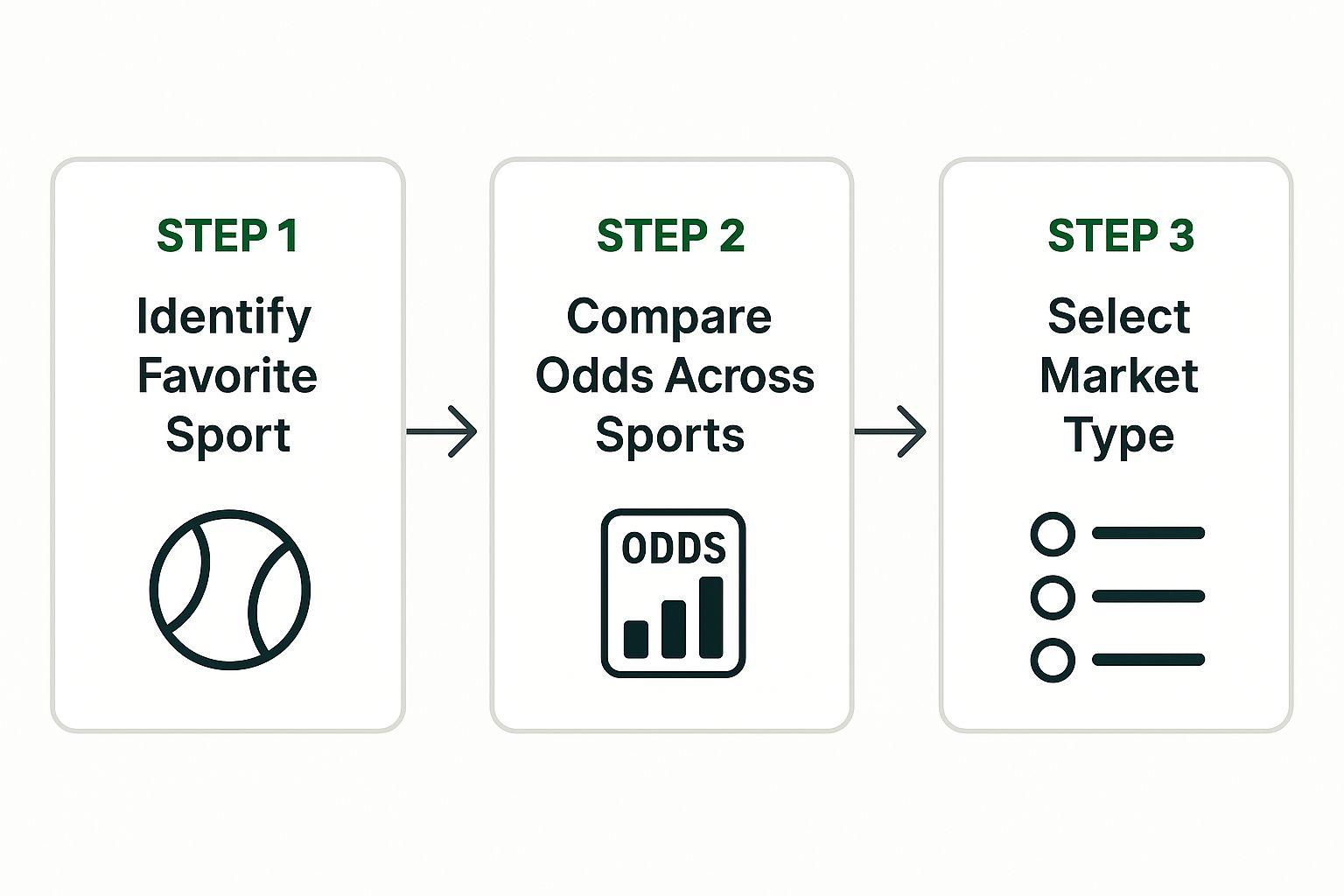
It’s all about a simple, repeatable process: stick to a sport you know, look for the best price, and choose a bet you actually understand. This is how you start building good habits and avoid just guessing.
The Most Common Bet Types
Once you can read the odds, you need to decide what you're actually betting on. There are tons of options, but as a beginner, you really only need to master three fundamental bet types. Get these down, and you’ll have a solid foundation for betting on almost any sport.
First, let's look at the three most common wagers you'll encounter. They each offer a different way to engage with a game.
Common Bet Types Explained
This table breaks down the essentials, showing you what each bet means and a real-world scenario where you might place one.
| Bet Type | What You're Betting On | Example Scenario |
|---|---|---|
| Moneyline | Simply picking the team that will win the game outright, with no point spread involved. | The Green Bay Packers are playing the Chicago Bears. If you bet on the Packers' moneyline, you just need them to win the game, whether it's by one point or fifty. |
| Point Spread | Betting on the margin of victory. The favorite must win by more than the spread, and the underdog can lose by less than the spread (or win) for your bet to cash. | The Kansas City Chiefs are a -7.5 point favorite against the Denver Broncos. If you bet on the Chiefs, they must win by 8 points or more. If you bet on the Broncos (+7.5), they can lose by up to 7 points, or win the game, for your bet to be successful. |
| Totals (Over/Under) | Betting on the combined total score of both teams in a game. You bet on whether the final score will be over or under the number set by the sportsbook. | The total for a Celtics vs. Heat game is set at 215.5 points. If you bet the Over, you need the teams' combined scores to be 216 or more. If you bet the Under, you need the total to be 215 or less. |
These three bets are your bread and butter. You'll see them on every single game, and they are the perfect place to start.
My Advice for Beginners: Start with moneyline bets. They are the most straightforward—you’re just picking a winner. As you get more comfortable, then you can dip your toes into point spreads and totals, which require a bit more analysis of how a game might play out.
By understanding how to read odds and what these core bet types mean, you've unlocked the fundamental language of sports betting. For a deeper dive into more advanced wagers, you can explore our guide on the many types of sports bets.
The Most Important Rule: Bankroll Management for Longevity
If you only master one skill on your sports betting journey, make it this one. I'm not talking about picking more winners or dissecting complex odds. The single biggest thing that separates bettors who stick around from those who flame out is disciplined bankroll management. It’s the very foundation of any smart approach, turning a pure gamble into a calculated, strategic investment.
Think of your bankroll as your business capital, not just gambling money. It's a finite resource you have to protect, manage, and use intelligently. The real goal isn't just to win your next bet; it's to stay in the game long enough for your edge to actually pay off. To do that, you have to get emotion out of the equation, which is where a solid system becomes your best friend.

Adopt the Unit System
The best way to manage your funds is to stop thinking in dollars and start thinking in units. It’s a simple but powerful shift. A unit is just a set percentage of your total bankroll. For anyone just starting out, I can't recommend this enough: define one unit as 1% of your bankroll. This is often called flat-betting because your wager size stays consistent relative to your capital.
Let's walk through a real-world example. Say you've set aside $500 to start.
- Your Bankroll: $500
- Your Unit Size (1%): $5
With this system, every single bet you place is $5. Period. It doesn't matter if it feels like a "sure thing" or if it's a longshot you have a great feeling about—the bet size is always the same. This one simple rule is your best defense against the two biggest enemies of a new bettor: emotional decisions and a brutal losing streak. When a bet loses, it’s just a one-unit loss, not a devastating gut punch.
A disciplined unit system ensures that a cold streak—and trust me, every single bettor has them—doesn't wipe you out. It gives you the staying power to ride out the variance and focus on making smart, analytical picks.
The Dangers of Chasing Losses
Without a unit system, it's incredibly easy to fall into the "chasing losses" trap. We've all been there. You suffer a bad beat and your first instinct is to win it all back right now by throwing a bigger, often irrational, bet on the next game. That’s emotion talking, not strategy, and it’s the fastest way to drain your bankroll to zero.
The flat-betting model stops this destructive habit in its tracks. By committing to a fixed unit size, you take away the temptation to double down after a loss. Your decisions stay calculated and consistent, which is the mark of a sharp bettor. For a deeper dive into building a truly sustainable approach, we highly recommend reading our detailed guide on sports betting bankroll management.
Treat Your Betting Like a Strategic Asset
To properly manage your bankroll, you have to track your performance. You don't need fancy software to get started. Honestly, a simple spreadsheet is one of the most powerful tools you can have.
Your tracker just needs a few key columns:
| Date | Bet Description | Odds | Stake (Units) | Result (Win/Loss) | Profit/Loss ($) |
|---|---|---|---|---|---|
| 11/15 | Lakers -4.5 | -110 | 1 Unit ($5) | Win | +$4.55 |
| 11/15 | Chiefs/Bills Over 52.5 | -110 | 1 Unit ($5) | Loss | -$5.00 |
| 11/16 | Yankees Moneyline | +120 | 1 Unit ($5) | Win | +$6.00 |
This simple act of recording every bet forces you to be accountable and gives you hard data on what's actually working. It fundamentally shifts your mindset from just casually wagering on games to analyzing performance and managing a financial asset. This discipline is what builds longevity and, eventually, profitability in sports betting.
Developing Your First Betting Strategy
Ready to move past just picking winners and losers? This is where sports betting gets really interesting. It’s time to shift from hopeful guessing to making calculated, educated picks. That means building your very first betting strategy.
Don't worry, this doesn't mean you need to create some complex, scary algorithm. In fact, keeping it simple is your best friend when you're just starting out. A good strategy is just a framework—it gives your betting structure, helps take emotion out of the equation, and forces you to think critically about why you're putting your money on the line. It's the core difference between being a fan who hopes for a win and a bettor who actively hunts for an edge.
Specialize Before You Generalize
The quickest way to find an advantage is to stick to what you already know. Seriously. Instead of trying to bet on every sport under the sun, zero in on one you genuinely follow and understand. Maybe even narrow it down to one or two specific leagues or conferences within that sport.
Your existing knowledge is a huge asset. You probably already have a feel for team dynamics, player styles, and coaching quirks that the average person doesn't. This kind of specialized focus lets you spot subtleties others miss, giving you a head start before you even glance at the odds.
Think about it. If you're a die-hard college basketball fan, you might know that a certain unranked team has a ridiculously strong home-court advantage and always plays top-25 teams tough. That's the kind of insider knowledge where profitable opportunities are born.
Key Takeaway: Don't try to be a jack-of-all-trades. Master one thing first. Your deep knowledge of a single sport is far more valuable than a surface-level understanding of many.
The 15-Minute Homework Habit
Once you've picked your sport, it's time to build a non-negotiable habit: doing a bit of homework before every single bet. It only takes about 15-20 minutes per game, but the impact on your decision-making is massive.
Think of it as a quick pre-flight check. Here’s what you should look at:
- Recent Form: How have the teams looked in their last 3-5 games? A team on a hot streak might be overvalued by the public, while a solid team in a temporary slump could be a bargain.
- Key Injuries: Is a star player out or even just playing at less than 100%? The absence of a quarterback in football or a top point guard in basketball can completely alter the outcome of a game.
- Head-to-Head History: How have these two teams matched up in the past? Sometimes, one team just has another's number. It's a psychological edge that stats alone don't always show.
This simple research helps you build a story for the game that goes deeper than the team records. It gives your bet context and allows you to back it with logic, not just a gut feeling.
Finding Value: The Art of Spotting Favorable Odds
This brings us to the absolute bedrock of successful sports betting: finding value. A value bet exists when you believe the real probability of something happening is higher than the probability implied by the sportsbook's odds.
Let's walk through a real-world scenario. Say the Green Bay Packers are playing the Detroit Lions, and the Packers are listed at +150 to win. Those odds suggest they have roughly a 40% chance of winning the game.
But after doing your homework, you find out the Lions' star receiver is out with an injury and their run defense has been getting gashed. Your analysis leads you to believe the Packers actually have closer to a 50% shot at pulling off the upset. Boom. You've just found value. The sportsbook is offering a better payout than what the true probability seems to justify.
Once you get the hang of this, you can learn to build a more advanced betting strategy to take your skills to the next level.
Remember, your goal isn't to win every single bet—that’s impossible. The real goal is to consistently place bets where the odds are tilted in your favor. Over the long haul, this disciplined approach of hunting for value is what separates casual gamblers from profitable bettors.
Common Beginner Mistakes and How to Avoid Them
Look, everyone makes mistakes when they first start betting on sports. It's just part of the game. But you don't have to fall into the same costly traps that catch most rookies. Knowing what these pitfalls are from the get-go will save your bankroll and set you on a path to building smarter betting habits.
Let's dive into the most common blunders I see and, more importantly, how you can sidestep them.
Letting Your Heart Overrule Your Head
This is the big one: emotional betting. It almost always involves betting on your favorite team. You're so invested in them winning that you completely overlook red flags like key player injuries or a brutal schedule. Hope isn't a strategy, and betting with your heart is a fast way to drain your account.
Think of a die-hard Chicago Bulls fan betting the house on them to beat the Boston Celtics, even when the Bulls are on a losing streak and the Celtics are playing championship-level basketball. That’s a bet based on loyalty, not logic.
- The Fix: For your first few months, make one rule non-negotiable: you are not allowed to bet on any games involving your favorite team. This creates a necessary distance, forcing you to analyze games objectively without bias clouding your judgment.
Spreading Yourself Too Thin
When you first log into a sportsbook, the sheer number of games and sports can feel like a candy store. The rookie mistake is to sprinkle small bets on a dozen different events, hoping to get lucky. This "shotgun approach" is a recipe for disaster because you can't possibly research that many games properly. Your bets are no better than random guesses.
You might toss $5 on a Premier League match, $5 on an NBA game, and another $5 on an NHL game, all without any real analysis.
By trying to bet on everything, you give yourself an edge in nothing. It's far better to become an expert in one small area than to be a novice in many. This focus is what leads to finding real value.
Falling for the Parlay Trap
Parlays are seductive. The idea of combining several bets into one for a massive payout is what sportsbooks love to push. And they push them for a reason—they are wildly profitable for the house. While the potential winnings look incredible, the actual probability of hitting one is incredibly low. Every bet, or "leg," you add to a parlay exponentially increases the sportsbook's built-in advantage.
A beginner might get starry-eyed over a $10 bet that could win $1,500 by picking eight NFL winners. What they fail to see is that the true odds of winning are far, far worse than the payout suggests.
- The Fix: As a beginner, just say no to parlays with more than two or three legs. If you absolutely can't resist, keep the stake tiny and treat it like a lottery ticket—pure entertainment. Your real bankroll and focus should be on single, well-researched wagers where you actually have an edge.
Common Questions from New Bettors
Starting out in sports betting can feel like learning a new language. You're going to have questions, and that's perfectly normal. Getting solid, straight-up answers is the best way to build your confidence and make sure you're starting off on the right foot. Let's dig into some of the most common things beginners ask.
How Much Money Should I Start With?
Honestly, there’s no magic number. The most important rule—and I can't stress this enough—is to only start with an amount you are completely comfortable losing. This is your starting bankroll.
For most people dipping their toes in, a bankroll somewhere between $100 and $500 is a realistic starting point. The aim here isn't to strike it rich on your first week. It’s about learning the fundamentals: how to read odds, manage your money, and research your picks. Never, ever use money meant for rent, bills, or other life essentials.
My Two Cents: Think of your first bankroll as your tuition fee. It’s the price of your education in sports betting. Adopting this mindset takes the pressure off and lets you focus on learning and enjoying the process.
Should I Bet on Sports I Already Follow?
Without a doubt. Your existing knowledge of a sport, its teams, and its players is the biggest edge you have when you're just starting out. It’s a genuine head start.
When you stick to what you know, you can see beyond the basic stats. You'll have a much better feel for the context of a game, player form, and potential upsets. This is where you can make more informed decisions instead of just betting blind.
What’s the "Vig" or "Juice"?
You'll hear these terms all the time. The “vig” (short for vigorish), or “juice,” is simply the cut the sportsbook takes for accepting your wager. It's their built-in profit margin, ensuring they make money over time, no matter the outcome of a single game.
Here's a classic example:
- On a typical point spread or totals bet, the odds are usually -110.
- This means you have to bet $110 to win $100.
- That extra $10 is the sportsbook's vig.
Realizing that this commission is baked into every bet is crucial. It helps you understand why becoming profitable in the long run is a real challenge that requires a smart approach.
Ready to stop guessing and start making data-driven decisions? ValueBetFactory uses powerful algorithms to find betting opportunities for you. Check out our tools and start betting smarter today!