
Convert Odds to Percentages for Smarter Betting
Unlock Profits with betting tips!
To really get a handle on betting, you need to know how to convert odds into percentages. It's the skill that turns confusing numbers like 5/1 or -150 into a straightforward probability. This simple conversion tells you exactly what a bookmaker thinks the chances of a particular outcome are.
Why Converting Odds Is a Bettor's Superpower
If there's one skill that can fundamentally change how you bet, it's this. Learning to translate odds into an implied probability strips away the confusing formats and gives you a single, universal number to work with. Suddenly, you can see the world through the bookmaker's eyes.
Armed with this knowledge, you gain a massive advantage. It allows you to quickly compare odds across different sites and formats-Fractional, Decimal, and American-to spot where the real value is hiding.
Turning Numbers into Clear Insights
The idea here is pretty simple. Odds are just another way of expressing probability; they are two sides of the same coin. This connection is built on the classic concepts of "odds for" and "odds against" something happening.
A great starting point is knowing that even odds-like 1/1 (fractional) or 2.0 (decimal)-always translate to a 50% probability. This means the bookie sees the outcome as a coin flip. If you want to dive deeper, you can explore more about the mathematical foundation of how odds and probability are linked.
Key Takeaway: Converting odds to a percentage is your first step in identifying a "value bet"-a situation where you believe the true probability of an outcome is higher than what the bookmaker's odds suggest.
This skill is all about answering the crucial questions before you put your money down:
- What likelihood is the bookmaker giving this team to win?
- Do I think the actual chances are better than what these odds imply?
- How does this price compare to what other sportsbooks are offering?
Mastering this unlocks a much more analytical and, ultimately, more profitable approach to betting.
Translating Fractional Odds into Percentages
Fractional odds are the classic format you'll see all over UK sports betting, especially in horse racing. They might look a bit old-school with the slash, like 9/1, but converting them into a percentage is actually pretty simple. Once you can do that, you've unlocked the implied probability-what the bookie thinks the chances are.
The formula looks a little clunky at first, but you'll get the hang of it fast: Denominator / (Denominator + Numerator) * 100.
Let's use a real-world example. Say you're looking at the Grand National, and a horse is priced at 9/1. Here, the numerator is 9, and the denominator is 1.
Pop those numbers into the formula: 1 / (1 + 9) * 100 = 10%.
Just like that, you can see the bookmaker’s odds give that horse a 10% chance of winning. It's a quick and dirty way to get a feel for the real probability behind the price.
Handling Odds-On Favorites
So what happens when you see a heavy favorite? You’ll run into "odds-on" prices, where the fraction is essentially flipped upside down, like 1/4. This is the bookie’s way of telling you an outcome is highly likely. The great part is, the formula doesn't change one bit.
Imagine Manchester City is playing at home and they're priced at 1/4 to win. The calculation is: 4 / (4 + 1) * 100 = 80%.
That confusing fraction instantly becomes a clear 80% implied probability of a win. This is why knowing the formula is so powerful-it works every time. If you want to dive deeper, we have a complete guide on converting odds to probability that covers even more scenarios.
The key takeaway here is that no matter if you're looking at a huge underdog or a rock-solid favorite, the math stays the same. This one formula gives you the confidence to quickly size up any fractional price.
To make things even easier, here's a quick cheat sheet for some of the most common fractional odds you'll come across.
Quick Guide to Fractional Odds and Implied Percentages
| Fractional Odds | Calculation (Denominator / (D+N)) | Implied Probability (%) |
|---|---|---|
| 1/4 | 4 / (4 + 1) | 80.0% |
| 1/2 | 2 / (2 + 1) | 66.7% |
| 4/6 | 6 / (6 + 4) | 60.0% |
| 1/1 (Evens) | 1 / (1 + 1) | 50.0% |
| 6/4 | 4 / (4 + 6) | 40.0% |
| 2/1 | 1 / (1 + 2) | 33.3% |
| 5/1 | 1 / (1 + 5) | 16.7% |
| 10/1 | 1 / (1 + 10) | 9.1% |
Keep this table handy, and you'll soon be able to recognize the implied probability of common odds at a glance.
The chart below gives you a great visual on how different odds translate into probabilities. It really highlights that inverse relationship: as the odds get bigger, the implied chance of it happening gets smaller.
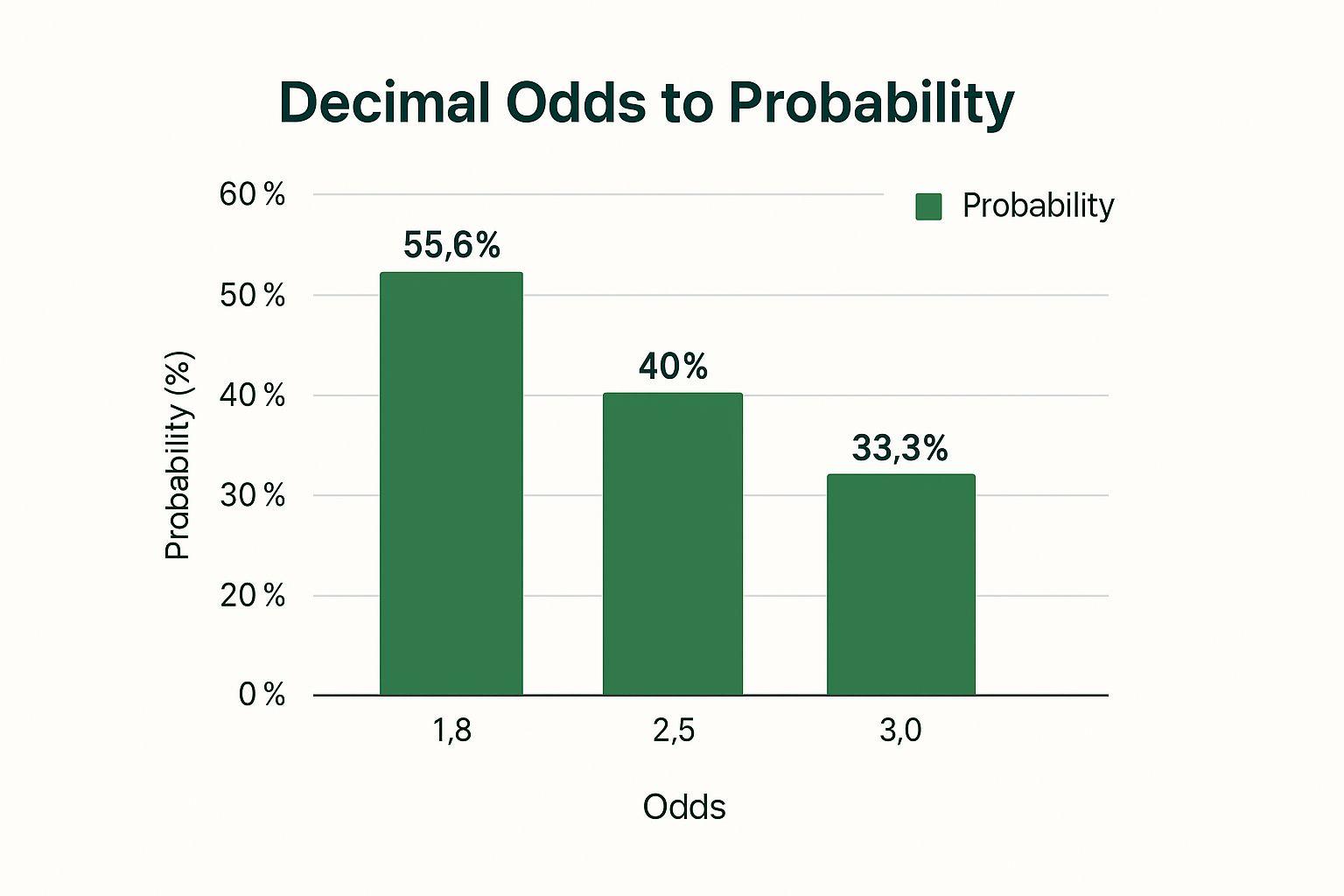
As you can see, low odds mean a high probability, and high odds mean you're looking at more of a longshot. Simple as that.
How to Read Decimal Odds Like a Pro
If you've ever looked at odds from European or Canadian sportsbooks, you've seen decimal odds. Many seasoned bettors, myself included, find them the easiest to work with. Why? Because turning them into a percentage is a one-step calculation, with no confusing signs or fractions to wrestle with.
The magic formula is dead simple: (1 / Decimal Odds) * 100. That’s it. This quick bit of math gives you the implied probability in an instant.
Let's say you're sizing up a tennis match and see a player listed at 2.50. Plug that into the formula: (1 / 2.50) * 100. You get 40%. That's the bookmaker's implied probability of that player winning the match. Simple and clean.
The Simple Math Behind Decimal Odds
Now, picture a heavy favorite in a soccer match, priced at 1.25. The same logic applies. A quick tap on the calculator for (1 / 1.25) * 100 reveals an 80% implied probability. This is exactly why many pros prefer decimals-they make it incredibly fast to compare prices and hunt for value across different bookmakers.
Decimal odds tell you the total return for every $1 you bet, including your original stake back. To get the implied probability, you just divide 1 by the odds. So, if you see odds of 4.00, that’s a 25% chance (1/4.00 = 0.25). This universal approach is a big reason why it's so helpful to understand how to standardize odds conversion no matter where you're betting.
Pro Tip: You'll never see decimal odds below 1.00. That's because the number always accounts for getting your stake back. Odds of 2.00 are what's known as "even money"-a perfect 50% shot.
The table below gives you a nice visual of how the different odds formats stack up.
As you can see, a 50% probability is shown as 1/1 in fractional odds and +100 in American odds. But in decimal odds, it’s a clean 2.0, directly showing you the multiplier on your bet.
Making Sense of American Moneyline Odds
If you've spent any time looking at a US sportsbook, you've seen American odds. With their plus (+) and minus (-) signs, they can look a little strange at first, especially if you're used to fractions or decimals. But once you get the hang of it, they're pretty straightforward.
The key thing to remember is that everything revolves around the idea of a $100 bet. Positive odds tell you how much profit you stand to make on a $100 wager, while negative odds show you how much you need to risk just to win $100. Let's break down how to turn both into simple percentages.
Calculating Probability for Underdogs (Positive Odds)
You'll always see positive odds, the ones with a plus sign (+), attached to the underdog. That number is pure profit potential on a $100 bet. So, if a team is listed at +200, a winning $100 wager would net you $200.
To turn those odds into a probability, the formula is simple:
100 / (Positive Odds + 100)
Let's use a real-world example. Say the Kansas City Chiefs are +150 to win the Super Bowl.
- First, plug the odds into the formula: 100 / (150 + 100)
- This simplifies to 100 / 250, which equals 0.40.
- That gives the Chiefs a 40% implied probability of winning.
Calculating Probability for Favorites (Negative Odds)
The favorite in any matchup gets the negative odds, shown with a minus sign (-). This number tells you how much you have to bet to win $100. Odds of -150, for instance, mean you have to put down $150 to see a $100 profit.
The math here is a bit different. Just be sure to drop the minus sign when you run the calculation.
Negative Odds / (Negative Odds + 100)
Imagine the Los Angeles Lakers are heavy favorites at -220 to win their next game.
- You'd calculate: 220 / (220 + 100)
- That works out to 220 / 320, or 0.6875.
- So, the bookmaker is giving them a 68.8% implied chance of winning the game.
Key Takeaway: The sign is your signal. A plus (+) means underdog, and a minus (-) means favorite. Remembering that simple distinction is all you need to know which formula to use. It's a quick mental check that will keep you from making a mistake when you're converting odds into a true probability.
Finding the Hidden Cost in Betting Odds
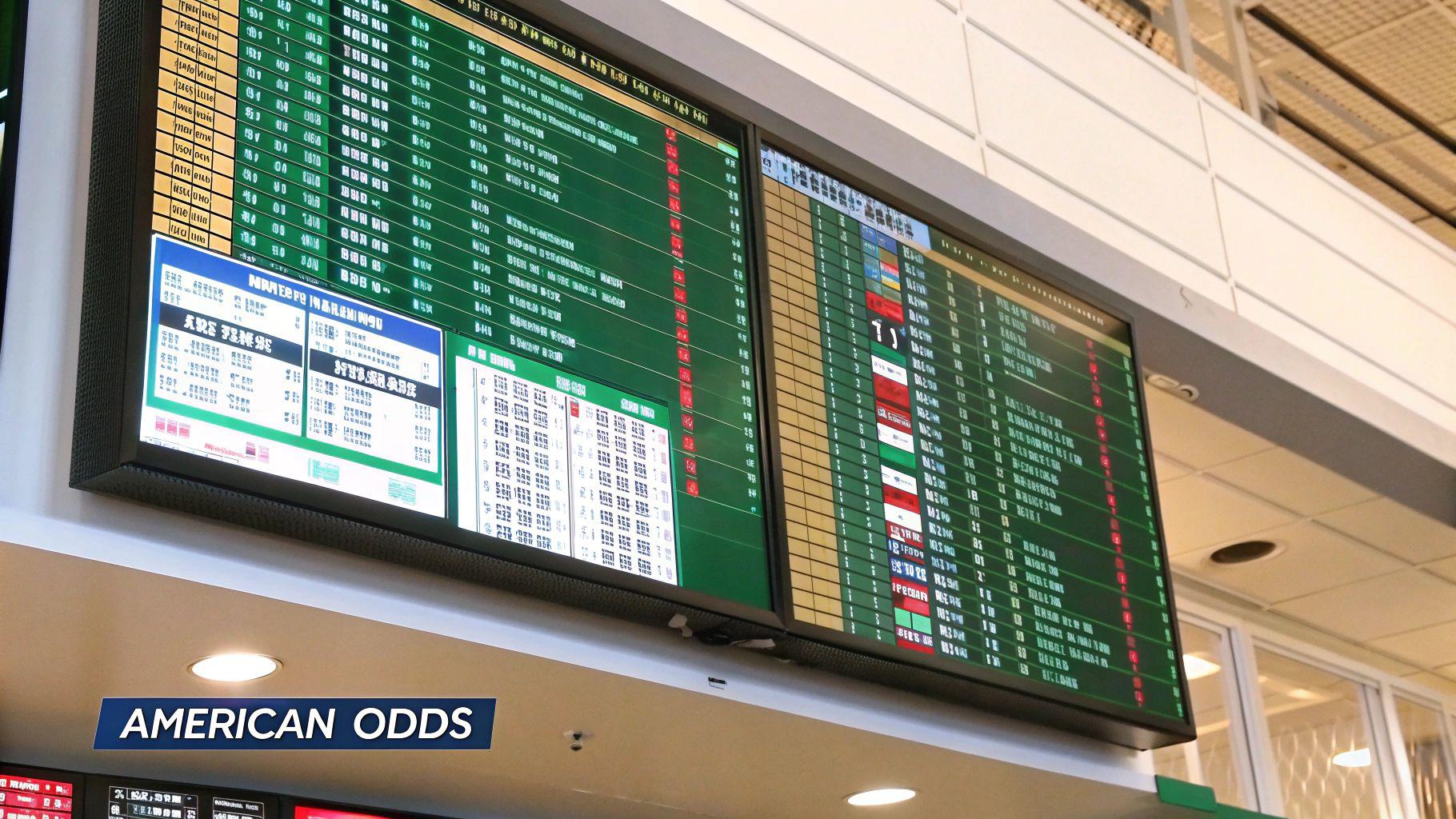
Ever run the numbers on a betting market and found the total probability adds up to more than 100%? That’s not a glitch. It’s the bookmaker’s built-in profit margin, often called the overround or “vig.” Think of it as the hidden cost of placing your bet.
Let’s use a simple coin toss as an example. A fair toss gives you a 50% chance of heads and a 50% chance of tails, which translates to decimal odds of 2.00 for each. But a bookie needs to turn a profit, so they won't offer you fair odds. Instead, you might see them offer 1.91 on both heads and tails.
Understanding the Bookmaker's Edge
So, what does that 1.91 price really mean? When you convert those odds into percentages, you'll find each outcome has an implied probability of 52.36%. Add them together, and you get a total of 104.72%.
That extra 4.72% is the bookmaker's edge. It's their guaranteed profit margin, ensuring they come out ahead over the long haul, no matter which side wins.
This is exactly how bookmakers operate. They intentionally build this overround into every market. If you were to add up the implied probabilities for every horse in a race, for instance, you might find the total comes to something like 112.6%. This tells you the bookie has built in a hefty 12.6% margin.
Spotting a high overround is a massive red flag for poor value. The closer that total percentage is to 100%, the more competitive the odds are-and the better it is for you.
Getting into the habit of calculating this margin before you place a bet is a game-changer. It shows you the true cost of your wager and helps you pinpoint which betting sites consistently give you a fairer shake.
If you want to speed things up, our free odds to percentage calculator can do the heavy lifting for you, instantly revealing both the implied probability and the bookie's cut.
Putting It All Together for a Winning Strategy
Okay, so you've got the math down. Converting odds to percentages is a crucial first step, but it's only half the battle. The real magic happens when you use this skill to actually shape your betting strategy and hunt down wagers where the odds are tipped in your favor. This is the moment you graduate from just calculating numbers to making genuinely smarter bets.
The entire game is about comparing the bookmaker's implied probability to your own assessment of what's likely to happen. If your research tells you a team has a 50% shot at winning, but the bookie's odds only reflect a 40% chance, you've just found a value bet. That gap is your profit margin.
Finding value is the bedrock of any long-term successful betting. It’s all about consistently backing opportunities where the potential payout is greater than the statistical risk the odds suggest.
A Practical Checklist Before You Bet
Before you lock in any wager, get in the habit of running through a quick mental checklist. This simple process keeps you from making emotional guesses and will sharpen your analytical eye over time.
- Do the Conversion: First things first, what probability is the bookmaker actually offering with these odds?
- Form Your Own Opinion: Based on your own homework, what do you think the real probability is?
- Spot the Value: Is your estimated probability higher than what the odds imply? If yes, you've got a potential bet.
- Check Your Bankroll: How much should you stake? The bet size should reflect the level of value you've found and fit within your budget.
Turning Probability into Profit
Let's walk through a real-world example. Say you're looking at an NFL game, and the Green Bay Packers are priced at +120 to beat the Chicago Bears. A quick conversion tells you those +120 odds carry an implied probability of 45.5%.
But you've done your homework. You've analyzed recent form, looked at the injury reports, and considered the head-to-head history. Your analysis leads you to believe the Packers' true chance of winning is closer to 50%.
Since your number (50%) is higher than the bookie's (45.5%), you've identified a value opportunity. This is exactly how you stop being a passive bettor and start using probability to actively find an edge and beat the books.
Common Questions About Converting Odds
Even once you have the formulas down pat, a few questions always seem to trip people up when they're first learning to convert odds into percentages. Let's tackle some of the most common sticking points so you can feel confident in your calculations.
First off, many new bettors quickly realize that not all odds formats are created equal when it comes to quick mental math.
Which Odds Format Is Easiest to Convert?
Without a doubt, decimal odds are the simplest to convert.
The formula is a single, clean calculation: (1 / decimal odds) * 100. There's no messing around with different formulas for favorites and underdogs like you have with American odds. This is exactly why so many experienced bettors use decimal odds for fast probability checks.
Another crucial point of confusion is what that final percentage figure really means. It's not a magic number predicting the future.
Does Implied Probability Show the True Chance of Winning?
Not exactly. Implied probability is the bookmaker's assessment of the chances, and it always has their profit margin baked right in. The true probability is always a bit lower than what the odds suggest.
That said, it's still the most powerful tool we have for gauging the market's expectation for an event. It's the foundation for finding value bets-situations where your own analysis tells you the real chances are better than the bookie's implied odds.
This brings us to the most important question of all: why do the numbers never seem to add up perfectly?
Why Do Probabilities for an Event Add Up to Over 100 Percent?
That extra percentage is the bookmaker's margin, often called the "juice" or "overround." Bookies build a small profit into the odds for every possible outcome, guaranteeing they make money regardless of the result.
Seeing a total probability of 103% is far better for you as a bettor than seeing 107%. A lower number means the bookmaker is taking a smaller slice of the pie. Getting a handle on this is your first step toward calculating the real expected value of your bets, which is the absolute cornerstone of making a profit in the long run.
At ValueBetFactory, we provide the tools and insights you need to make smarter, data-driven betting decisions. Our platform helps you spot favorable odds and capitalize on them. Learn more at ValueBetFactory.