
Alternate Spread Meaning Explained
Unlock Profits with betting tips!
Think of the last video game you played. Remember how you could tweak the difficulty setting? Bumping it up to "Hard" made the game tougher but the bragging rights sweeter. Dialing it down to "Easy" made for a chill experience, but the reward felt a little smaller.
That’s pretty much the core idea behind alternate spreads in sports betting. You're not stuck with the one-size-fits-all line the sportsbook gives you; you get to adjust the difficulty yourself.
What Is an Alternate Spread
An alternate spread is just what it sounds like: a different version of the main point spread offered by a sportsbook. It gives you the power to move the line up or down, which instantly changes the odds and your potential payout. This lets you turn a standard bet into one that perfectly matches your prediction for the game.
This whole concept is built on the basics of point spread betting. If you're new to the game, it’s a good idea to get a solid grip on understanding the point spread before you start tinkering with alternate lines.
The Basic Trade-Off
Playing with alternate spreads is all about a simple, powerful trade-off between risk and reward. You're the one in control.
- Buying Points: Let's say you like a favorite at -7, but you're not totally confident they'll win by more than a touchdown. You can adjust the line to -3, making your bet much safer. This is called "buying points." Your chances of winning go up, but your payout will be significantly lower.
- Selling Points: On the flip side, maybe you think that -7 favorite is going to absolutely crush their opponent. You can make the bet harder by moving the line to -10. This is "selling points." It’s a riskier play, for sure, but the reward if you're right is much, much bigger.
By picking an alternate spread, you’re basically telling the sportsbook exactly how you think a game will play out. A small adjustment shows you're being cautious. A big one signals you're banking on a blowout or believe an underdog will keep things surprisingly tight. It transforms a generic bet into a highly customized wager.
How Moving the Line Changes Your Payout and Risk
When you start playing with alternate spreads, you're directly fiddling with the risk-to-reward ratio of your bet. Think of it as a negotiation with the sportsbook. Every single point you shift the line has an instant, opposite effect on your potential payout. This trade-off is the core mechanic that makes alternate spreads such a powerful-and sometimes dangerous-tool.
If you "buy" points to make a bet safer, you're essentially paying for that extra security with a smaller potential return. For instance, moving a favorite from a tricky -7 down to a much more comfortable -3 dramatically boosts your chances of cashing the ticket, but your payout will shrink accordingly.
On the flip side, "selling" points makes the bet a whole lot harder to win but supercharges the potential profit if you nail it.
This infographic shows exactly how adjusting a spread from the standard -7 down to an alternate -3 completely changes the risk and reward on a bet.
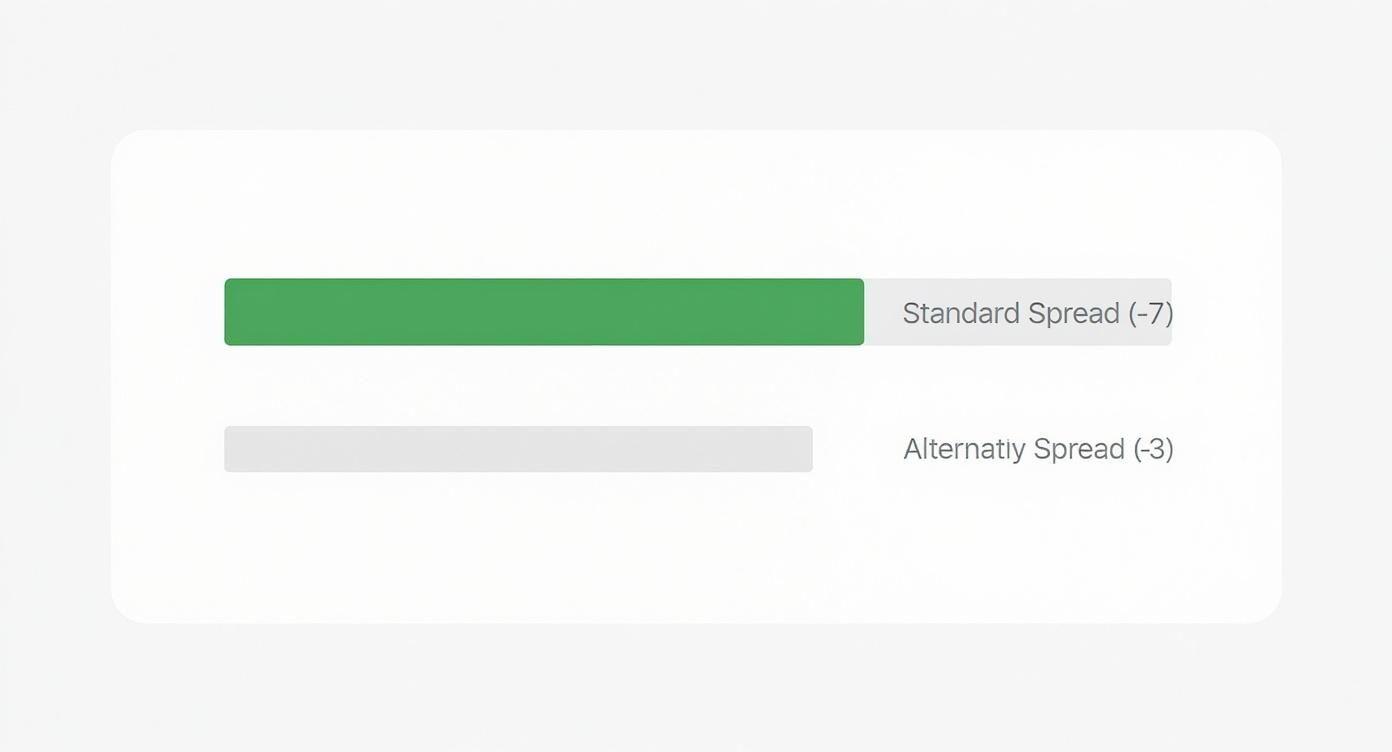
As you can see, making the bet safer by buying four points drastically slashes the potential winnings, giving you a clear picture of the financial trade-off you're making.
The Math Behind the Odds
The pricing on these lines isn't just pulled out of thin air; sportsbooks use complex models to calculate the odds for every single alternate spread they offer. While standard point spreads usually hang around -110 on both sides (that's the book's built-in advantage, or "juice"), alternate lines are priced very differently.
Shifting a spread by just one full point can move the odds by 20-30 cents, quickly turning a -110 line into something like -135 or -140.
To see this in action, let's look at a hypothetical NFL game where the standard spread is -3.5 at -110 odds. Here’s how the payouts and probabilities change as you start moving that line.
Standard vs Alternate Spread Payout Example
| Spread Selected | Odds | Implied Probability | Potential Profit on $100 Bet |
|---|---|---|---|
| -3.5 (Standard) | -110 | 52.4% | $90.91 |
| -2.5 (Alternate) | -150 | 60.0% | $66.67 |
| -1.5 (Alternate) | -210 | 67.7% | $47.62 |
| -4.5 (Alternate) | +120 | 45.5% | $120.00 |
| -6.5 (Alternate) | +200 | 33.3% | $200.00 |
As the table makes clear, buying just one point (from -3.5 to -2.5) costs you over $24 in potential profit on a $100 bet. Selling points offers a huge reward, but your chances of winning drop off a cliff with every point you add.
The core principle is simple: the easier you make the bet, the less it pays. The harder you make it, the more you stand to win. Every point adjustment is a calculated decision that affects both the implied probability and your bankroll.
Getting a feel for this dynamic relationship is what separates sharp bettors from the public. Bettors who can master this concept are able to find pockets of value where others just see a jumble of numbers. Analyzing how much the odds change with each point is a huge part of identifying profitable alternate spread opportunities, a concept that's closely tied to understanding general betting line movement.
Strategic Reasons to Use Alternate Spreads
Knowing what an alternate spread is is one thing. Knowing when to actually use one is what separates the casual bettor from the sharp. Moving the line isn't a random guess; it's a calculated move driven by your specific read on a game.
Savvy bettors really only pull this trigger in two main scenarios.
The first is all about reducing risk. You might feel great about a team winning, but the official point spread just feels a little too tight for comfort. In this spot, you can "buy" points to give yourself a nice safety net.
The second is the complete opposite-it’s about maximizing rewards. This is the aggressive play you make when you're anticipating a total blowout. If your research screams that a favorite is going to win by a massive margin, you can "sell" points to lock in much better odds and a far bigger payout.
Tailoring Your Bet to the Game
How you apply this strategy often comes down to the sport you're betting on. In football, for instance, some numbers are way more important than others because of how teams score. Moving a spread across key numbers like 3 or 7 can be a game-changing move.
Let's say a favorite is listed at -7.5. Buying just one point to get them to -6.5 is a huge advantage. Now, you win if they secure a simple touchdown victory, giving you a massive cushion against a missed extra point or a last-second field goal ruining your bet.
Basketball is a different beast. Scoring is constant, and final margins can be all over the place. Here, you might use an alternate spread when you see a fast-paced, high-scoring game on the horizon where one team is just built to run away with it. Predicting a 20-point rout when the sportsbook only sees an 8-point win is the perfect time to sell points and cash in on those juicy plus-money odds.
The core idea behind alternate spreads is aligning the bet with your conviction. A small tweak to the line shows cautious optimism. A big one signals a bold prediction about how the game will unfold. It’s all about making the bet fit your analysis, not the other way around.
Putting Alternate Spreads Into Practice
Theory is great, but seeing alternate spreads in the wild is where it all really clicks. Let's walk through a couple of real-world examples from the NFL and NBA to show you how you can bend the line to match your own read on a game. We'll start with the standard line and then see what happens when we look for safer or riskier options.
For each scenario, we'll calculate the payout on a simple $100 wager so you can see the direct impact that buying or selling points has on your wallet.
NFL Game Scenario
Picture this: the Kansas City Chiefs are set to play the Denver Broncos. Your sportsbook has the standard point spread at Chiefs -6.5 (-110). This is the baseline bet-the Chiefs need to win by a full touchdown (7 points or more) for you to cash your ticket.
Buying Points (The Safer Bet): You're pretty sure the Chiefs will win, but that -6.5 makes you nervous. A last-second field goal could ruin your day. So, you decide to buy a few points, moving the line to Chiefs -2.5 (-240). Now, they only need to win by a field goal. The trade-off? Your potential profit on a $100 bet drops to just $41.67. You've bought yourself a much bigger safety net in exchange for a smaller payout.
Selling Points (The Riskier Bet): On the flip side, maybe you think the Chiefs are going to absolutely dismantle the Broncos. You sell points to get more attractive odds, taking a new line of Chiefs -10.5 (+180). To win this one, the Chiefs need to dominate and win by at least 11 points. The risk is way higher, but if your prediction is right, that same $100 wager now brings in a sweet $180 profit.
This is the core idea of alternate spreads in action. You're tailoring the bet to your specific prediction-whether it's a nail-biter or a blowout-and the odds adjust to match the new level of risk.
NBA Game Scenario
Now, let's swap the gridiron for the hardwood. The Boston Celtics are facing the Orlando Magic, and the bookie’s standard line is Celtics -8.5 (-110).
Buying Points (The Safer Bet): In a high-scoring sport like basketball, an 8.5-point spread can feel tight. To give yourself some breathing room, you buy points and take an alternate line of Celtics -4.5 (-190). Now, a win by 5 points or more gets the job done. For a $100 bet, your potential profit is $52.63.
Selling Points (The Riskier Bet): Feeling like the Celtics' offense is about to put on a clinic? You can sell points and take a much bolder line like Celtics -12.5 (+150). This requires a complete demolition, a win by 13 points or more. If you nail the call, your $100 bet turns into a $150 profit.
Before you lock in a bet, it’s always a good idea to see exactly how different odds impact your potential return. You can play around with the numbers using an odds and payout calculator to get a feel for the risk and reward. As these examples show, a single game can offer a dozen different ways to bet, all depending on how confident you are in your analysis.
How Alternate Line Betting Came To Be
Alternate spreads weren't just invented out of thin air; they grew out of a real need for more flexibility in sports betting. For a long time, bettors were stuck with whatever single, static point spread the bookmaker offered. This old-school system was rigid, leaving no room for you to act on your own read of the game. You were forced into a simple win-or-lose bet based on one number.
As online sports betting started to take off, the technology finally caught up to what bettors really wanted. Bookmakers realized there was a huge appetite for more control. The introduction of alternate lines in the early 2000s was a huge shift, letting bettors finally tailor wagers to their exact confidence level. This innovation went from a niche feature to a must-have on pretty much every major betting site.
From Niche to Mainstream
The growth was explosive. By 2015, something like 85% of regulated sportsbooks in North America were offering alternate spreads. Today, these bets make up an estimated 15-20% of all point spread action, which translates to billions in handle every year. For the industry, the meaning of alternate spreads became crystal clear: flexibility isn't just a nice-to-have, it's a core part of what modern bettors expect. You can read a full breakdown of the growth of alternate spreads on StreakForTheCash.com.
This whole evolution was driven by two groups: casual bettors looking for safer, lower-risk wagers and sharp bettors hunting for very specific value. It gave everyone the power to look past the bookie's default line and bet on their own terms, completely changing how we think about risk and reward.
Common Mistakes to Avoid with Alternate Lines
Alternate spreads give you incredible flexibility, but all that freedom can lead to some costly mistakes if you’re not careful. Knowing the common pitfalls is the first step to using these lines for profit and steering clear of the traps that catch so many bettors. The biggest and most frequent mistake? Simply overpaying for a false sense of security.
It’s easy to get sucked into buying a few points just to make a wager feel safer, but a lot of bettors do it without actually checking if it's a good deal. Paying -180 odds for a spread that should statistically be closer to -150 is a guaranteed way to lose money in the long run. You're just handing the sportsbook way too much of an edge.
Ignoring Key Numbers and Value
Another huge error is not understanding the power of key numbers, especially in football. Moving a spread from -7.5 down to -6.5 is a massive jump in value because it crosses the key number of 7. It's far more significant than moving a line from -5.5 to -4.5, yet sportsbooks might price both of those moves pretty similarly. If you don't spot that difference, you're not getting paid properly for the risk you're taking.
The goal isn’t just to make a bet easier to win. It's to find a line where the sportsbook has undervalued the probability of that outcome happening. A smart alternate spread means you’ve found an edge in the pricing, not just a more comfortable point spread.
Finally, you have to resist the temptation to chase those massive, unrealistic payouts. Selling a ton of points just to get juicy odds like +500 often requires a perfect, lopsided game that rarely happens. Unless your analysis strongly points to a complete blowout, these bets are almost always terrible value and will bleed your bankroll dry over time.
To keep yourself out of trouble, always ask these three questions:
- Am I paying a fair price? Compare the alternate line's odds to the implied probability. Is it a good deal?
- Does this move cross key numbers? In a sport like football, getting across 3 or 7 adds a ton of real value.
- Is my prediction realistic? Chasing huge payouts on wild outcomes is a recipe for disaster.
By focusing on genuine value instead of just comfort or long-shot dreams, you can turn alternate spreads from a risky gamble into a calculated part of your betting toolkit.
A Few Final Questions on Alternate Spreads
To wrap this up, let's tackle some of the most common questions bettors have about alternate spreads. Think of this as a quick-reference guide to help solidify the concepts we've covered.
Are Alternate Spreads a Good Bet?
They absolutely can be, but it all comes down to the odds. A profitable alternate spread isn’t about making a bet feel “safer”; it’s about spotting a line where you believe the sportsbook has mispriced the true probability of that outcome.
You always have to ask yourself: do these new odds really justify the risk I'm taking on the adjusted spread? If the answer is yes, you've likely found a solid opportunity.
What Sports Are Best for Alternate Spreads?
Alternate spreads really shine in sports with high point totals and key scoring numbers, which is why you see them used so often in football (NFL) and basketball (NBA). That said, they aren't limited to just those two.
You'll also find them in baseball as alternate run lines and in hockey as alternate puck lines. Just be aware that the strategy behind using them can change quite a bit from sport to sport.
The key is to find value in the new odds, regardless of the sport. An alternate line is only a smart play if the potential payout accurately reflects the risk you’re taking on the adjusted point spread.
How Do Sportsbooks Profit from Alternate Spreads?
Sportsbooks make their money by building a commission, known as the vig or juice, into every single line they offer. On a standard spread at -110 odds, you have to risk $110 just to win $100.
When you shift over to an alternate spread, the odds change, sometimes dramatically. But don't be fooled-each new price still has that house edge baked right in, ensuring the bookmaker keeps their mathematical advantage over the long run, no matter which line you decide to take.
Ready to stop guessing and start finding real value in the odds? ValueBetFactory uses advanced algorithms to scan the market for you, identifying betting opportunities where the odds are in your favor. Start making data-driven decisions today.