
Unlock Success with AI Sport Betting Strategies
Unlock Profits with betting tips!
AI in sports betting is all about using artificial intelligence to chew through mountains of data. The goal? To help bettors make smarter decisions by spotting patterns and probabilities that are flat-out invisible to the human eye. It’s a fundamental shift, moving betting away from a game of chance and turning it into a data-driven strategy.
The New Game Plan for AI Sport Betting

The world of sports betting is finally moving beyond gut feelings and surface-level stats. Think of artificial intelligence as your own personal data analyst, working around the clock to process an insane amount of information to find genuinely profitable opportunities.
Let’s be clear: this isn’t some magic crystal ball that guarantees every bet will be a winner. Instead, it’s an incredibly powerful tool designed to help you manage risk and, most importantly, spot real value in the market. This shift is creating a clear divide between old-school betting and the new, data-first approach.
The Rise of Data-Driven Decisions
The arrival of AI has been a game-changer, especially for boosting predictive accuracy and creating a more personalized betting experience. The numbers tell the story. The global AI in sports market was valued at USD 8.92 billion and is expected to rocket to an estimated USD 27.63 billion by 2030, growing at a blistering CAGR of 21.1%. You can learn more about these market projections and the growth of AI in sports.
This explosive growth points to a massive change in how bettors are approaching their craft. Instead of just glancing at who won the last game, AI systems are now analyzing hundreds of variables all at once.
An AI model can process player performance metrics, historical matchups, weather conditions, and even public sentiment to calculate the most probable outcomes. It finds the subtle connections that even seasoned experts might miss.
Traditional Betting vs AI-Powered Betting
To really understand the shift, it helps to see the two approaches side-by-side. The new method is defined by its ability to operate without human emotion and at incredible speeds. This table lays out the core differences.
| Aspect | Traditional Betting | AI Sport Betting |
|---|---|---|
| Data Source | Relies on manual research, recent form, and personal intuition. | Processes massive datasets, including historical stats, player metrics, and real-time data. |
| Bias | Highly susceptible to emotional bias (e.g., team loyalty, "gut feelings"). | Operates purely on objective data, completely removing emotional factors. |
| Speed | Slow and limited. A human can only analyze so much information. | Blazing fast. AI can monitor thousands of markets and analyze data in real-time. |
| Scope | Typically focuses on a few key variables per game. | Analyzes hundreds of variables simultaneously to find hidden correlations. |
As you can see, the difference is night and day. AI isn't just a small upgrade; it’s a complete overhaul of the decision-making process.
The contrast between these two worlds is stark. The AI-powered approach is defined by its ability to operate at a scale and speed that humans simply can't match. Consider these key distinctions:
- Data Analysis: Old-school betting often involves manual research, which is naturally limited in scope. AI, on the other hand, can process decades of data in seconds.
- Bias Removal: Human bettors are easily swayed by team loyalty or the thrill of a recent big win. AI operates purely on objective data, stripping emotional bias from the equation.
- Speed and Scale: AI systems can monitor thousands of betting markets in real-time, identifying fleeting opportunities that a person could never hope to catch on their own.
Ultimately, AI equips you with a systematic method for evaluating bets. It’s all about turning subjective opinions into calculated probabilities, setting you up for a much smarter way to engage with sports betting.
How AI Models Forecast Sporting Outcomes
At its core, an AI sports betting model works a lot like a hyper-advanced weather forecaster. But instead of predicting rain or shine, it crunches immense volumes of data to calculate the probability of different outcomes in a game. The whole process is about turning a mountain of complex stats into a clear forecast of what's most likely to happen on the field.
The engine driving this forecasting ability is machine learning, a branch of AI where systems learn from data without being explicitly programmed. Think of it like a rookie athlete watching hundreds of hours of game tape. At first, they might only see the basic plays. But over time, they start to recognize subtle patterns, team tendencies, and opponent weaknesses. AI models do the exact same thing, just with millions of data points and at impossible speeds.
This is where a concept called supervised learning comes into play. The AI is fed a massive diet of historical sports data where the final results are already known. For example, it might analyze every single NBA game from the last decade, complete with player stats, team form, injuries, and, of course, the final score. The model’s job is to figure out the relationship between all that input data and the eventual outcome.
From Historical Data to Real-Time Predictions
The real magic of AI in sports betting isn't just about looking backward; it's about applying that hard-won knowledge to the future. Once a model has been "trained" on all that historical data, it can start making predictions for upcoming games. It takes in new, real-time information and runs it through its complex internal logic.
This is what makes AI so incredibly powerful for in-play betting. The models can react instantly to new developments as they happen:
- Key player injuries: A star quarterback leaving the game dramatically shifts his team's chances of winning, and the AI adjusts its probability in a split second.
- Weather changes: Sudden rain in a soccer match might favor a team known for its strong defensive record in wet conditions. The model factors this in immediately.
- In-game momentum: A basketball team going on a 10-0 run is a strong signal of a momentum shift that the AI will build into its live odds calculation.
The infographic below gives a great visual of how these different data points all flow together to produce genuinely useful predictive insights.
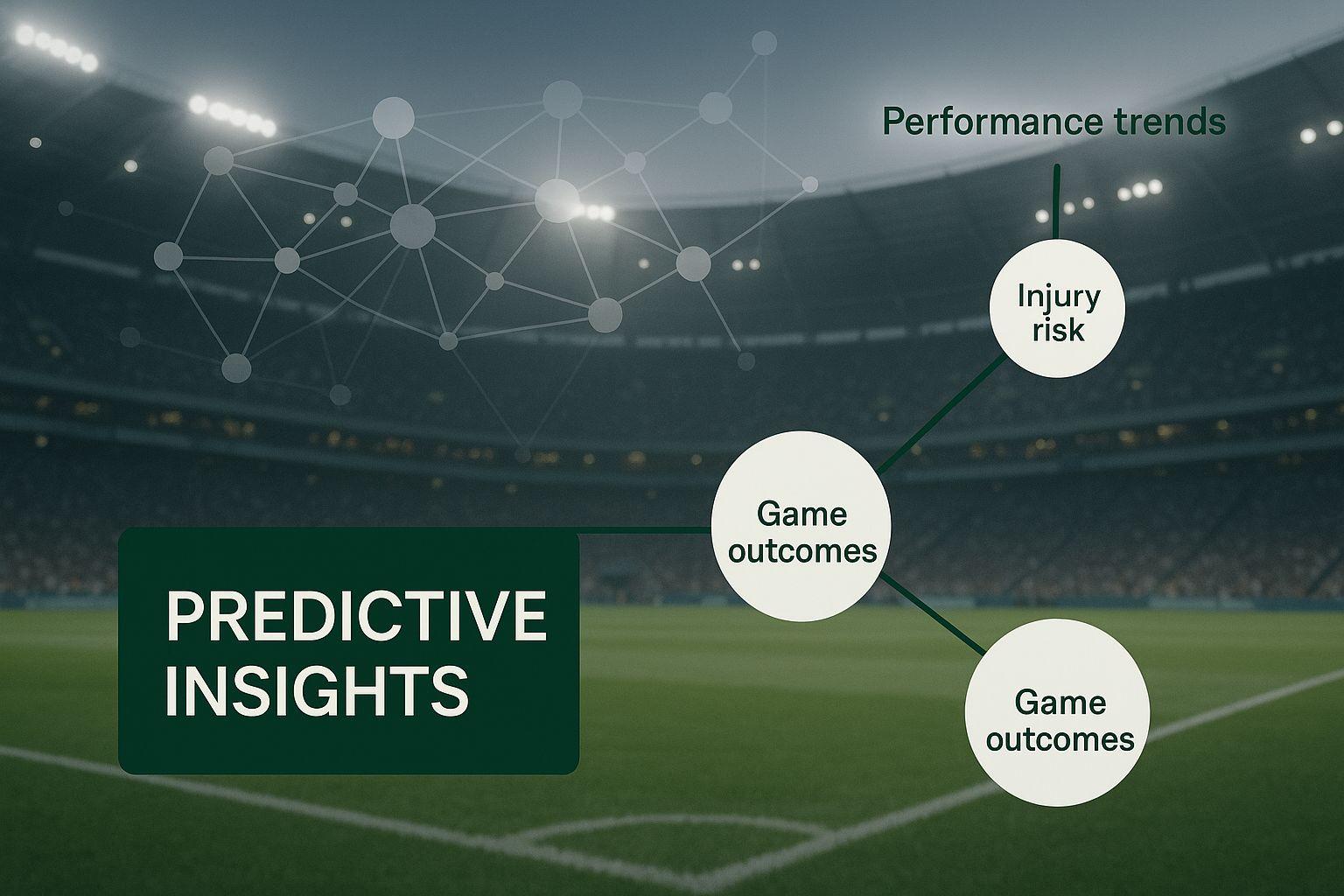
As the visualization shows, an AI's real strength comes from its ability to blend static historical data with dynamic, live events to create a holistic and constantly evolving prediction.
The Brains Behind the Operation: Neural Networks
So, how does an AI actually process these incredibly complex relationships? Many of the most advanced models use what are known as neural networks algorithms designed to mimic the problem-solving processes of the human brain. A neural network has layers of digital "neurons" that work together to weigh the importance of all the different variables.
Think of a neural network like a team of expert sports analysts. One expert focuses purely on offensive stats, another on defense, and a third on historical head-to-head matchups. They all feed their insights to a head analyst who pieces it all together to make the final call. A neural network automates this entire process, making sure every single piece of data is considered objectively.
This intricate system allows the AI to find non-obvious correlations that a human analyst might completely miss. If you want to get deeper into the mechanics, you can explore more about how various sports betting algorithms work to find an edge. In the end, by combining massive datasets with intelligent processing, AI models give us a calculated, data-driven forecast that stands in sharp contrast to a simple gut feeling.
Understanding the Data That Fuels AI Predictions
An AI betting model is like a high-performance engine; it’s only as good as the fuel you put in it. In AI sport betting, that fuel is the vast, sprawling datasets these systems need to chew on to come up with sharp predictions. To really get a handle on how AI finds an edge, you have to first appreciate the two very different types of data it analyzes.
First up, you have structured data. This is the clean, neatly organized stuff that fits perfectly into a spreadsheet. It’s the bedrock of any traditional sports analysis, painting a clear, numerical picture of what’s already happened.
This foundational layer of data includes things like:
- Player Statistics: Points per game, assists, shots on goal, passing accuracy you name it.
- Team Performance Metrics: Win-loss records, defensive stats, offensive output, and historical head-to-head results.
- Betting Odds: Historical and real-time odds from a ton of bookmakers, which give you a read on market sentiment.
This kind of information is absolutely essential, but it only tells you part of the story. The real analytical horsepower of AI comes from its ability to process the second, much messier type of data.
Beyond the Numbers with Unstructured Data
The second type is unstructured data, which is all the qualitative information that doesn’t have a nice, tidy format. Think of it as the context, the narrative, and the human drama surrounding the game itself. This is where AI’s knack for finding hidden connections really shines, because it can make sense of information a human analyst would struggle to put a number on.
AI excels at turning this apparent "noise" into actionable intelligence. It scans news articles, social media chatter, and press conferences to gauge factors like team morale or public pressure, transforming qualitative sentiment into a measurable variable for its predictive models.
This ability to process massive amounts of text and sentiment is a total game-changer. Our guide on how to automate data analysis gives you more context on how these processes work to give bettors a serious advantage. By pulling in both structured and unstructured inputs, an AI builds a far more complete and nuanced picture of an upcoming game.
Turning Raw Data into Betting Intelligence
Combining these data types is exactly what’s needed in an industry that's exploding. The global sports betting market was valued at nearly USD 107.40 billion, with things like AI and real-time data streaming playing a huge role in that growth. These tools are key for everything from personalizing the betting experience to tightening up security. You can dig into more of these sports betting market trends and their growth for a broader look.
At the end of the day, AI algorithms sift through all this information, hunting for patterns a human would almost certainly miss. For instance, an AI might find a weird correlation between a specific referee's tendencies and a team's performance, or notice that a star player's negative social media buzz often comes right before a subpar game. This is how raw data gets turned into a powerful tool for placing smarter, more informed wagers.
Putting AI to Work in Your Betting Strategy

Knowing the theory behind AI is one thing, but seeing it in action is where the rubber really meets the road. This isn't just an abstract concept for tech blogs; it's a powerful, practical tool you can plug directly into your betting workflow to gain a real, measurable edge.
There are a few core areas where ai sport betting truly shines. Each application moves past simple number-crunching and gives you a distinct strategic advantage, turning mountains of raw data into genuinely actionable opportunities.
Let's break down three of the most powerful ways AI is making an impact.
Predictive Modeling for Precise Probabilities
At its heart, an AI is a forecasting engine. It chews through thousands of data points far more than any human could ever hope to process to calculate the precise probability of all sorts of game outcomes. And we're talking about much more than just picking a winner or loser.
A good predictive model can forecast an incredible range of possibilities, like:
- The total points scored in a basketball game.
- The likelihood of a specific soccer player scoring a goal.
- The probability of a tennis match going to a third set.
By spitting out a specific percentage chance for each outcome, the AI gives you a data-driven baseline of what's most likely to happen, completely free from human bias or gut feelings. If you're curious about the mechanics, our guide explains how to build a sports betting model from scratch.
Identifying Value Bets Against the Market
This is where an AI really helps you find your edge. A value bet is any wager where you believe the real probability of an outcome is higher than what the bookmaker's odds are suggesting. AI is exceptionally good at sniffing out these little gaps in the market.
The logic is beautifully simple:
- First, the AI calculates its own "true" odds for an event using its predictive model.
- Next, it scans the odds available across dozens of sportsbooks.
- When it finds a bookie offering odds that are way better than its own calculation, it flags a potential value bet.
For example, a bookmaker might list an underdog football team at +300 (a 25% implied probability). But if the AI model calculates that team’s actual chance of winning is closer to 35%, it has just spotted a massive value opportunity.
Dominating In-Play Betting with Real-Time Analysis
Live betting is pure chaos. It’s fast-paced, emotional, and an incredibly difficult environment for a human to make consistently rational decisions. For an AI, though, it's the perfect playground.
An AI can process live data feeds in milliseconds, making lightning-fast adjustments as the game unfolds. It's constantly updating its predictions based on every single play, momentum shift, player substitution, and tactical change. This allows it to spot fleeting betting opportunities that are flat-out impossible for a person to see and react to in time. That real-time brain gives you a colossal advantage during a live match.
To give you an idea of just how integrated this is becoming, the table below highlights the most common AI applications and the direct benefit they offer to bettors.
AI Betting Applications and Their Impact
| AI Application | What It Does | Primary Benefit for Bettors |
|---|---|---|
| Predictive Modeling | Analyzes historical and real-time data to forecast game outcomes and assign precise probabilities. | Provides an unbiased, data-driven foundation for assessing the "true" chances of an event. |
| Value Bet Detection | Compares its own calculated "true" odds against the odds offered by various sportsbooks. | Automatically identifies wagers where the bookmaker's odds are better than the actual probability. |
| Real-Time Analysis | Processes live game data instantly to update predictions and odds during an in-play match. | Uncovers fleeting live betting opportunities that are impossible for humans to spot manually. |
| Sentiment Analysis | Scans news, social media, and forums to gauge public opinion and its effect on market odds. | Helps identify overhyped or undervalued teams by separating public perception from statistical reality. |
Each of these applications turns a different type of data into a strategic weapon, moving betting from a game of hunches to a game of calculated advantages.
Getting Real About the Pros and Cons of AI Betting
Artificial intelligence is a genuine game-changer in sports betting, but let's be clear: it's not a magic crystal ball. For every powerful advantage an AI brings to the table, there's a limitation you need to be aware of. The key is to treat it like an expert co-pilot, not a flawless autopilot that you can just set and forget.
This realistic approach starts with appreciating what AI sport betting actually does best. The benefits are tangible and directly impact your ability to make smarter, more calculated decisions. AI models offer objective, lightning-fast analysis, stripping away the emotional baggage that so often leads us to make bad wagers.
The Clear Advantages of Leaning on AI
The core strengths of using AI in your betting strategy boil down to its speed, objectivity, and sheer analytical horsepower. These systems offer concrete benefits that are simply impossible for a human to match on their own.
- Eliminates Emotional Bias: An AI couldn't care less about your favorite team, a gut feeling, or the thrill of a potential Hail Mary payout. It operates purely on data, ensuring every single recommendation is rooted in cold, hard probability.
- Finds Hidden Value: By running its own numbers and comparing them to the market, AI excels at spotting undervalued teams and inefficient betting lines. These are the profitable gaps that the average bettor completely misses.
- Processes Massive Data: In the time it takes you to read this sentence, an AI can analyze hundreds of variables for a single game from player performance metrics to weather patterns uncovering subtle correlations the human eye would never catch.
These advantages all work together, creating a systematic, data-driven method for finding a genuine edge. But these powerful systems aren't without their blind spots.
Understanding the Limitations and Risks
Thinking you can just blindly follow an AI model without any human oversight is a huge mistake. The same data-driven logic that makes these tools so powerful is also the source of their biggest weaknesses. It's critical to know these pitfalls before you dive in.
One of the biggest risks is an over-reliance on historical data. AI models learn from the past, which means they can get completely blindsided by sudden, unprecedented events. They are masters at spotting patterns but can be caught flat-footed by the true randomness of sports.
An AI has no way of understanding the unquantifiable human element of a game. It cannot factor in a sudden surge of team morale after a heartfelt halftime speech or the psychological pressure of a championship final.
This leads to another key limitation: a total failure to grasp context. An algorithm might see that a star quarterback is statistically sound, but it can't know if he's nursing a minor, un-reported injury or is distracted by off-field drama. These "human moments" are where your own judgment becomes invaluable.
Finally, the cost and technical skill needed for top-tier tools can be a real barrier. While plenty of user-friendly services exist, the most powerful custom models demand a serious investment of both time and money. Keeping these limitations in mind ensures you use AI for what it is a powerful tool to sharpen your edge, not a guaranteed ticket to riches.
Getting Started with AI Sport Betting Tools
Jumping into the world of AI-powered sports betting isn't as complicated as it sounds. You don't need a degree in data science to get started. There are a couple of main paths you can take, each designed for different levels of hands-on involvement.
For most people, the simplest way in is through user-friendly AI prediction services. These platforms do all the heavy lifting for you, running their complex models behind the scenes and spitting out easy-to-understand insights and betting suggestions.
If you're someone who likes to get their hands dirty with the data, you can go a different route. Data platforms give you the raw materials and analytical tools to do your own digging, which gives you a much deeper sense of control over the whole process.
Choosing the Right Tool for You
With more and more AI tools popping up, picking the right one is key. It's easy to get drawn in by flashy marketing, but you need to look past the promises and focus on what actually matters for long-term success.
A great first step is to create a simple checklist to size up any service you're considering. This forces you to make a decision based on real performance and reliability, not just hype.
Here are the core criteria to zero in on:
- Transparency: Does the service give you a peek under the hood? They won't reveal their secret sauce, but a good platform will offer some insight into their methodology.
- Historical Accuracy: Look for a proven track record. The platform absolutely must provide verifiable performance data from past seasons or events.
- Cost vs. Value: Don't just look at the price tag. Compare the subscription fees against the features and, most importantly, the quality of the insights you're getting.
- Sports Coverage: This one's simple but crucial. Make sure the tool actually covers the sports and leagues you know and care about.
A responsible approach is the cornerstone of any sustainable betting strategy. When you're testing a new tool, start with small, manageable stakes. This lets you see how it performs without taking on any significant risk. Track every single bet so you can learn what's working and what isn't.
Practicing Responsible Bankroll Management
No matter what tool you end up choosing, smart financial discipline is non-negotiable. Bankroll management is the simple practice of setting aside a specific chunk of money for betting and only wagering a tiny percentage of it on any single game.
This strategy is your shield. It protects you from catastrophic losses and ensures you can survive the inevitable losing streaks that hit every single bettor.
Making this a habit from day one is the single best thing you can do to stay in the game long enough for your data-driven approach to pay off.
A Few Common Questions About AI Sports Betting
It's only natural to have a few questions when you're looking at a different way of doing things. Let's clear up some of the most common sticking points and myths about using AI in sports betting.
Can AI Guarantee a Win in Sports Betting?
Absolutely not, and this is a crucial point to understand. An AI is an incredibly powerful analytical tool, not a crystal ball. It sifts through mountains of data to pinpoint probabilities and find potential value hiding in the odds.
But at the end of the day, sports are beautifully unpredictable. A star player has an off night, a lucky bounce changes everything no algorithm can ever account for pure, random chance. AI gives you a massive analytical edge, but it doesn't eliminate the risk inherent in betting.
Do I Need to Be a Data Scientist to Use AI Betting Tools?
Not in the slightest. While building a predictive AI model from the ground up is a highly technical skill, the whole point of services like ours is to make that power accessible to everyone.
Think of it this way: you don't need to know how to build a car engine to be a great driver. Most modern AI betting tools have clean, user-friendly interfaces that deliver the insights directly to you. Your job isn't to write the code; it's to learn how to interpret and act on the data it gives you.
A common misconception is that using AI for betting analysis is some form of cheating. In reality, it’s no different from using advanced statistical software to get an edge. The bookmakers themselves use incredibly sophisticated AI to set their odds in the first place. Using AI tools simply levels the playing field, giving you access to the same kind of analytical firepower.
Ready to put data-driven insights to work for your own betting strategy? Explore ValueBetFactory and see how our tools can help you spot high-value opportunities as they happen. Start making more calculated decisions today by visiting ValueBetFactory.