
A Bettor's Guide to WNBA Betting Odds
Unlock Profits with betting tips!
Staring at a page of WNBA betting odds can feel like trying to crack a code. All those numbers, pluses, and minuses look complicated, but they’re really just telling a story about an upcoming game. They’re the market’s best guess at what’s going to happen, translated into numbers you can wager on. Learning to read that story is the first and most important step toward making smart, informed bets.
Your Introduction To WNBA Betting Odds
Before you even think about placing a bet, you have to know what the numbers are telling you. Odds aren't just random figures; they are the sportsbook's calculated assessment of what might happen in a game, designed to attract wagers on all possible outcomes.
Think of it this way: every game has a few different potential endings. The betting markets just give you a way to put your money on the version you think is most likely to play out.
The Three Core Betting Questions
At their heart, WNBA odds are designed to answer three simple questions about any matchup. Each question lines up perfectly with one of the most popular types of bets, giving you a few distinct ways to get in on the action.
Who will win the game? This is the Moneyline bet. It’s as straightforward as it gets, you’re simply picking the team you believe will win outright.
What will the margin of victory be? This question is handled by the Point Spread. Here, you’re not just picking a winner; you're betting on whether the favorite will win by more than a certain number of points, or if the underdog will keep the game close (or even win).
How many total points will be scored? This is the world of Totals, often called the Over/Under. You wager on whether the combined final score of both teams will go over or under a specific number set by the sportsbook.
Once you get a handle on these three core markets, you've built a solid foundation. Pretty much every other WNBA bet you'll see, from player props to championship futures, is just a variation on these basic principles of predicting game outcomes.
This guide will walk you through these concepts one by one. We'll demystify the numbers, show you how different markets work, and give you the confidence you need to read WNBA betting odds like a pro.
How to Read Different Types of Betting Odds
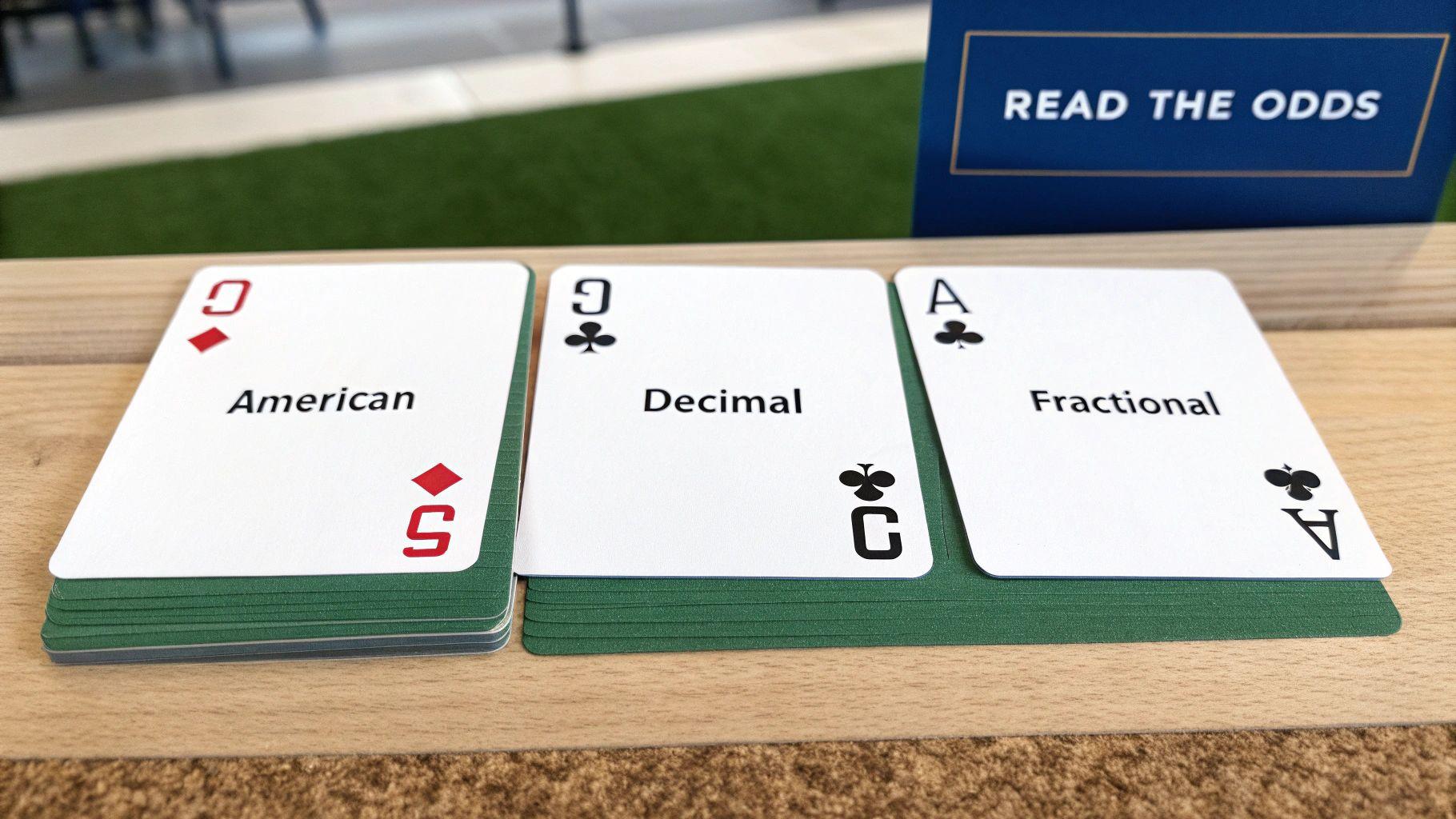
Once you’ve got a handle on the basic bets, the next hurdle is decoding the numbers themselves. Sportsbooks display WNBA betting odds in a few different formats, but the three you’ll run into most are American, Decimal, and Fractional.
They might look completely different, but don't let that throw you. They all communicate the exact same two things: which team is the favorite and how much you stand to win.
Think of them as different languages telling the same story. The goal is to get fluent enough to understand what each one is saying so you can spot the best value, no matter how it’s presented.
Understanding American Odds
American odds are the standard format you'll find at virtually all US sportsbooks. They’re super easy to spot because of the plus (+) and minus (-) signs in front of the numbers. These symbols instantly tell you who’s the favorite and who’s the underdog.
The Minus Sign (-): This always points to the favorite. The number tells you exactly how much money you need to bet to win $100. If you see odds of -150, it means you have to risk $150 to make a $100 profit.
The Plus Sign (+): This signals the underdog. The number shows you how much profit you’ll make on a $100 wager. Odds of +130, for example, mean a $100 bet will net you $130 in profit if it wins.
This whole system is built around the familiar idea of a $100 bill, which makes it incredibly easy to quickly size up the risk and potential reward. For a more detailed breakdown, you can learn more about how to read sports betting odds in our complete guide.
Simplifying Payouts With Decimal Odds
Decimal odds, which are common in Europe, Canada, and Australia, are often considered the most straightforward of the bunch. The number simply shows you the total amount you’ll get back for every $1 you bet, including your original stake.
The math couldn't be easier: Stake x Decimal Odds = Total Payout.
Let's say a team has odds of 2.50, and you bet $10. Your total return would be $25 (your $10 stake back plus $15 in profit). As a quick rule of thumb, any number over 2.00 is an underdog, while anything under 2.00 is a favorite.
The key takeaway is that every betting format is just a different way to express the same probability. Getting comfortable converting between them mentally is a crucial skill for any serious bettor looking for an edge.
To really see how these formats connect, let’s look at the same hypothetical bet across all three styles. Pay close attention to how the implied probability, the team's statistical chance of winning according to the bookmaker, never changes.
Comparing Betting Odds Formats
| Bet Type | American Odds | Decimal Odds | Fractional Odds | Implied Probability |
|---|---|---|---|---|
| Favorite | -200 | 1.50 | 1/2 | 66.7% |
| Underdog | +150 | 2.50 | 3/2 | 40.0% |
As you can see, -200, 1.50, and 1/2 are just different ways of saying the same thing. Mastering these formats ensures you never miss a value opportunity just because it's presented in a way you're not used to.
Alright, let's get into the fun part: the different ways you can actually bet on a WNBA game. Once you move past the basics of how odds are displayed, you open up a whole world of betting markets. Each one is like a different lens for viewing the game, asking a unique question about how it might play out.
Getting a feel for these options is your key to finding the best angle for any given matchup. The real pros don't just bet on who will win; they find the smartest question to ask about the game and bet on that.
The Big Three WNBA Markets
First, you’ve got what I call the "big three" markets. These are the bread and butter of WNBA betting, the ones you'll see front and center on any sportsbook. They’re the foundation for a reason: they're simple, direct, and all about the final score.
The most straightforward of all is the Moneyline. This one’s easy. You’re just picking which team you think will win the game, straight up. It doesn't matter if they win by a single point in overtime or by a 30-point blowout. If your team gets the W, your ticket cashes.
Next up is the Point Spread. This is where things get a bit more interesting. The spread essentially handicaps the game to create a more even betting proposition. The favorite has to win by more than a certain number of points (say, -6.5), while the underdog can either win the game outright or just lose by less than that number (like +6.5) for your bet to win.
Finally, there are Totals, which you'll often hear called the Over/Under. The sportsbook sets a line for the total combined points scored by both teams. Your job is simple: decide whether the final score will add up to more (Over) or less (Under) than that number.
Digging Deeper with Player Props and Futures
While the big three are all about the game's outcome, sometimes the real value is hiding in the details. This is where a deep knowledge of individual players and league trends really starts to pay off.
Player Props: These are bets focused entirely on a single player's performance. Think you know how A'ja Wilson will play tonight? You could bet on her to score over 24.5 points. See a great matchup for Chelsea Gray? You might bet on her to dish out over 7.5 assists. Props let you capitalize on specific player-vs-player scenarios you've identified.
Futures: These are the long game. Futures are bets on outcomes that won't be settled for weeks or even months. The most popular one is, of course, picking the WNBA Champion way before the season ends. Because you're trying to predict something so far in advance, these bets can offer some massive payouts if you call it right.
A savvy bettor might look at a matchup and think the point spread is too sharp to touch. But maybe they notice that a star player has absolutely owned her defender in past games. Instead of forcing a bet on the spread, they'll pivot to a player prop on that star's point total, finding a much clearer edge in a more specific prediction.
This is the strategic heart of betting. The moneyline, spread, and totals are about the game. Props and futures are about the narratives and individual stories playing out over the season. Your analysis should guide you to the right market. For instance, if you believe a team is being criminally underrated by everyone, a futures bet on them to win the title could offer way more bang for your buck than just betting on them game after game.
Ever logged into your sportsbook to place a bet, only to find the point spread has shifted three points since you last checked? It’s not random. This is a calculated reaction by the oddsmakers, and understanding why it happens is key to finding an edge.
Betting lines aren’t set in stone. Think of them as living numbers that react to specific pressures, much like stock prices on Wall Street.
The most common reason for this movement is the flow of money. Sportsbooks aren't in the business of gambling; they're in the business of collecting a commission (the "vig"). To guarantee a profit, their goal is to get roughly equal betting action on both sides of a wager.
If an overwhelming amount of cash comes in on one team, say, the Las Vegas Aces at -7.5, the sportsbook’s risk becomes lopsided. To balance their books, they'll move the line to -8 or even -8.5. This makes the Aces a less attractive bet and the underdog more appealing, encouraging wagers on the other side.
The Impact of New Information
The second major force behind line movement is the arrival of new, game-altering information. This is where sharp bettors often find their biggest advantages. Unlike the NBA with its deeper rosters, an injury to a single star player in the WNBA can have a massive impact.
Imagine the Phoenix Mercury are set to play, and the point spread is set at Phoenix +4.5.
Suddenly, 30 minutes before tip-off, news breaks that a key forward rolled her ankle in the pre-game shootaround and is a last-minute scratch. This is a huge development. The market will react almost instantly to this news.
The line could swing dramatically within minutes. You might see the WNBA betting odds for Phoenix jump from +4.5 all the way to +7.5 or even higher. Oddsmakers must immediately adjust their pricing to reflect the team's diminished chances without a key player.
This highlights a crucial lesson for bettors: the timing of your wager can be just as important as your pick. Spotting these shifts and understanding why they happen is a core skill, as explained in our deeper look into the mechanics of betting line movement.
If you want to get serious about betting, you have to move past gut feelings and start digging into the data. By looking at historical patterns and statistical trends, you can spot valuable insights that casual bettors almost always miss. This is how you find a real edge when you're staring down the WNBA betting odds.
One of the most powerful and consistent trends in the WNBA is the sheer strength of home teams. Sure, home-court advantage is a thing in every sport, but its impact in the WNBA is often so pronounced you can actually quantify it.
The Power of Home Court Advantage
When you look at the data from recent seasons, a clear pattern emerges that savvy bettors can absolutely use. One of the most reliable trends is how well home teams and favorites perform. The numbers show home teams have won 175 out of 311 games, that’s a winning percentage of 56.3%.
When it comes to betting against the spread (ATS), home teams have covered 50.8% of the time. Home favorites are especially solid, winning their games 69.4% of the time and covering the spread in 48.6% of those matchups. If you want to go deeper, you can explore more WNBA betting trends to round out your analysis.
Understanding these baseline numbers is critical. It gives you a benchmark to judge whether a specific betting line is accurately factoring in the historical advantage of a team playing on its own floor.
This visual below breaks down the core dynamics that make betting lines shift, from a flood of money coming in on one side to game-changing news like a key player getting injured.
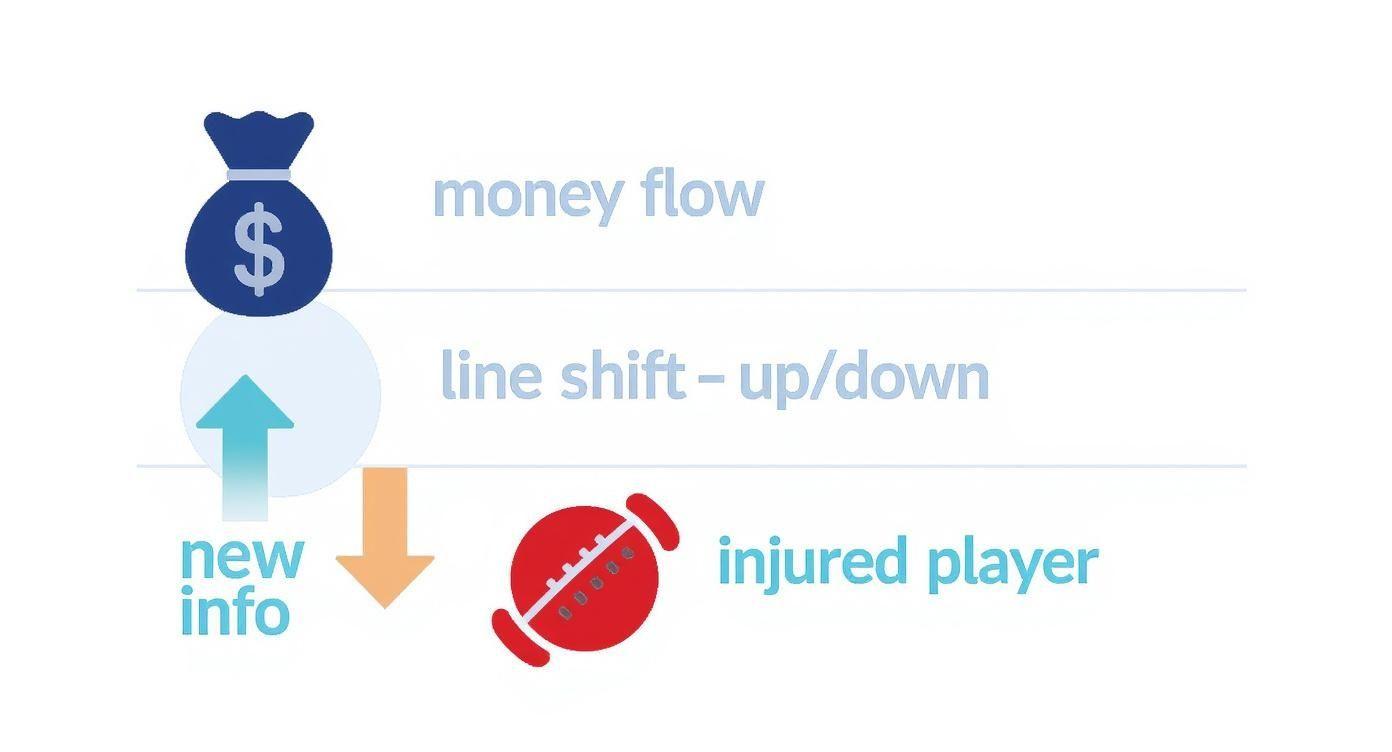
It’s a simple illustration of how sportsbooks are constantly reacting to betting volume and breaking news to keep their odds balanced. For bettors who understand these market forces, that movement creates opportunity.
Looking Beyond Wins and Losses
While home court is a huge piece of the puzzle, you can uncover even more value by digging into team-specific trends. It’s not just about who wins, but how they perform against what the market expects.
The goal isn’t just to pick the winner; it's to identify where the public perception and the sportsbook's odds have failed to account for a specific statistical reality. This is where a data-driven approach separates casual picks from strategic wagers.
Some teams are machines when it comes to outperforming their point spreads, while others consistently let bettors down. These are the kinds of patterns that often fly right under the radar of the general betting public.
Here are a few actionable angles to consider:
- Pace of Play: Does a team love to run the floor, leading to high-scoring shootouts? That’s vital information when you’re looking at Totals (Over/Under) bets.
- Defensive Efficiency: How many points does a team give up per possession? A team with a lockdown defense might be a great candidate to cover the spread as an underdog simply by keeping games tight.
- Performance on Back-to-Backs: How does a team hold up when playing on consecutive nights? Fatigue is a massive factor, and some rosters are just built to handle it better than others.
By adding these statistical layers to your handicap, you start to build a much more complete picture of the matchup. This approach transforms betting from a game of chance into a skill, one based on identifying and acting on trends that the data proves are real.
How to Find True Value in WNBA Odds

This is where everything changes. The secret to successful sports betting isn't just about picking winners; it's about consistently finding value. In betting, value exists whenever you believe a sportsbook's odds don't quite line up with the real probability of an outcome.
Think of it like shopping for a pair of sneakers. If you know a specific pair is worth $150 but you find them on sale for $110, you’ve found value. Betting is the exact same game, you're on the hunt for odds that pay out better than they logically should. This simple shift in thinking moves you from being a fan with a hunch to being an investor with a plan.
Calculating Implied Probability
The first step in any value hunt is to translate the sportsbook’s odds into a simple percentage. This number is called the implied probability, and it represents the bookmaker's "guess" at how likely something is to happen. Once you have that percentage, you can compare it to your own analysis.
Let's say the Las Vegas Aces are listed at -150 odds to win a game. The implied probability of those odds is 60%. If your own research and analysis tell you the Aces actually have a 65% chance of winning, then you’ve just found a value bet. The sportsbook is undervaluing their true chances.
Value betting is the discipline of consistently placing wagers only when the probability of a given outcome is greater than the implied probability of the odds. This is the single most important concept for long-term profitability.
This process forces you to justify every single wager with a data-backed opinion, pulling you away from the trap of betting with your gut. Our deep-dive guide on how to identify value betting opportunities walks you through this entire strategy, step-by-step.
Where Value Appears in the WNBA
Value doesn't appear randomly; it often pops up in specific, predictable situations. A common source is a market overreaction, where the public piles money on a team after a huge win, forcing the books to artificially inflate their odds in the next game. Another is when a team is quietly outperforming expectations, but the market is slow to catch on.
Historical WNBA betting odds can reveal some fascinating patterns. For instance, in one recent season, only four teams actually performed better than their point spreads on average, with the Dallas Wings leading the pack. Even though they had a losing record, their net rating was in the top half of the league, a clear sign they were far more competitive than the market was giving them credit for. You can explore more of these specific WNBA betting trends to see how data uncovers this hidden value.
Common Questions About WNBA Betting
Let's dig into a few questions that pop up all the time for anyone serious about betting on the WNBA. Getting straight answers here can help you think more clearly, bet with more confidence, and start spotting opportunities that most people miss.
What Is the Most Profitable WNBA Betting Market?
There's no single "magic" market, since your success will always come down to where your knowledge is deepest. That said, many sharp bettors consistently find their edge in player props and totals (over/under).
Why? Because these markets often get less attention from oddsmakers compared to the NBA. This can lead to softer lines where a real understanding of individual player matchups or a team's pace of play can give you a significant advantage.
How Does WNBA Betting Differ From NBA Betting?
The differences are huge, and ignoring them is a fast way to lose money. For starters, WNBA rosters are smaller, which means an injury to a single star player can have a much bigger impact on the odds and the outcome.
The betting volume is also much lower. This means two things: the lines might not be as sharp to begin with, but they're also way more likely to move quickly and dramatically. Even things you might take for granted, like home-court advantage, have a completely different statistical weight in the W.
Here's a perfect example of why this matters: a star player being a "game-time decision" in the WNBA is a code-red situation. Her absence can single-handedly swing a point spread by several points, far more than a similar situation would in an NBA game. You have to treat that uncertainty with extreme caution.
Where Can I Find Reliable WNBA Betting Data?
For the basics, the official WNBA.com is your starting point. It has all the foundational box score stats you'll need.
But to find a real edge, you need to go deeper. For advanced analytics that reveal the trends that don't show up in a box score, sites like Her Hoop Stats are absolutely essential. And to track live odds, see how lines are moving, and look at historical betting data, industry-standard resources like Covers and Action Network give you the market intelligence needed to make truly informed wagers.
Ready to stop guessing and start finding true value in WNBA odds? ValueBetFactory uses advanced tools to scan the market for you, sending real-time alerts when profitable opportunities arise. Start your free trial at ValueBetFactory.com and make smarter bets today.