
What Percentage of Sports Bettors Are Profitable? Only 3% Make It Long Term
Unlock Profits with betting tips!

The hard truth? Making a real, long-term profit from sports betting is incredibly rare. While millions see it as a thrilling hobby, only a tiny sliver of them consistently end up in the black. Industry experts and insiders all point to the same stark number: just 3% of sports bettors are profitable over the long haul.
That means for every 100 people placing bets, 97 of them are losing money. It's not just a run of bad luck, either; it's baked right into the system.
Unpacking the Reality of Sports Betting Odds
For the overwhelming majority, betting is a net financial loss. This is by design. Sports betting isn't a fair game of chance; it's a battle against a very smart opponent, the sportsbook, who has a built-in mathematical advantage on every single wager you place.
This advantage is called the vigorish, or "vig" for short.
Think of the vig as the sportsbook's commission for taking your action. It’s the reason you have to risk $110 just to win $100 on a typical point spread bet. Even if you hit exactly half your bets, that small, relentless commission slowly grinds your bankroll down over time.
The House Always Has an Edge
This is the exact same concept as the "house edge" in a casino. Just like the green '0' and '00' slots on a roulette wheel guarantee the casino its cut, the vig ensures the sportsbook stays profitable. Because of this, you can't just break even by winning 50% of your bets. To overcome the vig, you need to win at a clip of around 52.4%.
This is the single biggest reason what percentage of sports bettors are profitable is such a brutally low number. The game is tilted against you from the very start.
To join that exclusive 3% club, you have to do more than just pick winners. You have to be sharp enough to consistently find odds that are mispriced, effectively beating both the vig and the market itself.
The Profitable Bettor Reality Check
So, what separates the tiny fraction of winners from the vast majority? It's not about luck or "hot streaks." It's about mindset, discipline, and a completely different approach to the game.
This table gives you a quick snapshot of the two worlds.
| Characteristic | The 97% (Recreational Bettors) | The 3% (Profitable Bettors) |
|---|---|---|
| Primary Goal | Entertainment, "action" on a game, chasing a big score. | Long-term bankroll growth, finding mathematical value. |
| Betting Decisions | Gut feelings, team loyalty, recent trends, media narratives. | Statistical models, finding odds discrepancies, objective data. |
| View on Losses | Frustration, chasing losses with bigger bets, blaming "bad luck." | Accepted as part of variance, trusts the process, analyzes mistakes. |
| Bankroll Management | No formal plan, betting random amounts, risking too much. | Strict staking plan (e.g., Kelly Criterion), disciplined risk control. |
| Key Metric | Win/loss record ("How many winners did I pick?"). | ROI, closing line value ("Did my bets have a positive EV?"). |
As you can see, the differences are stark. Profitable bettors treat it like a financial market, hunting for undervalued assets. The rest are simply playing a game designed for them to lose.
How to Properly Measure Betting Success
A winning weekend feels great, but it doesn't mean you're a profitable bettor. Most people track their success with a simple win-loss record, but the pros know this is a classic rookie mistake. True profitability isn't about how many bets you hit; it's about how much money you make relative to how much you risk.
This is where Return on Investment (ROI) becomes the only yardstick that matters. ROI measures your total profit as a percentage of your total amount wagered (your "handle"). It cuts through the noise and tells you exactly how efficiently your money is working for you.
For example, if you bet a total of $1,000 across 100 wagers and your net profit is $50, your ROI is 5%. In the sharp world of sports betting, a consistent 5% ROI is the gold standard, a clear sign of a winning strategy that very few can maintain over the long haul.
Beating the Market with Closing Line Value
Another critical metric the pros live by is Closing Line Value (CLV). Think of the betting market like the stock market. The "closing line" is the final price (the odds) right before a game starts, which is considered the most accurate and "efficient" point.
Getting positive CLV means you consistently place bets at better odds than this final closing line. If you bet on a team at +150 and the odds close at +130, you've beaten the market and locked in positive CLV. It's one of the most powerful predictors of long-term success because it proves you can spot value before the rest of the market catches on.
The image below paints a clear picture of the divide between bettors who understand these metrics and those who don't.
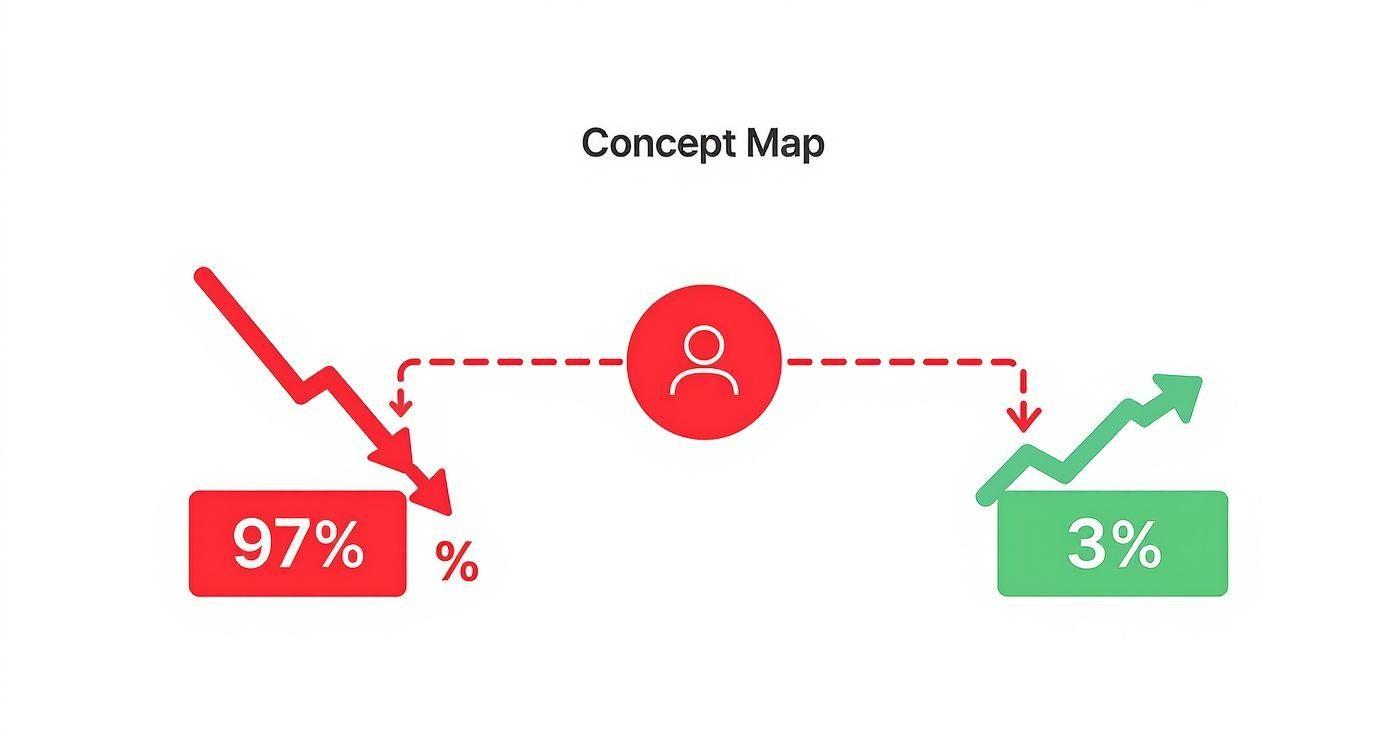
This visual starkly contrasts the downward spiral of the 97% with the steady growth achieved by the disciplined 3%. That small group isn't just getting lucky; they're focusing on metrics like ROI and CLV to grind out a real edge.
Why Sample Size Is Everything
Finally, none of these numbers mean a thing without a large enough sample size. Imagine flipping a coin. If you get heads six times in ten flips, you haven't broken the laws of probability; you've just seen short-term variance play out.
The same is true in betting. A winning week or even a winning month is statistically meaningless. You need a sample size of several hundred, if not thousands, of bets to know for sure whether your strategy has a real, sustainable edge or if you've just been riding a lucky streak.
The law of large numbers dictates that over time, your results will move closer to their true expected value. Without a large sample size, you're just guessing.
Consistently measuring ROI and CLV over a high volume of wagers is the only way to truly know if you're a profitable sports bettor. To even begin, you need a reliable way to track your sports bets and analyze your performance with cold, hard data.
Why the Vast Majority of Bettors Lose Money
Understanding that only a tiny sliver of bettors actually turn a profit is one thing. Knowing why they lose is the first real step toward joining the winning side. The hurdles aren't just about getting unlucky; they're about structural disadvantages and psychological traps that are hardwired to work against the average person.
The single biggest barrier is the sportsbook's built-in commission, known as the vigorish or "vig." It's a fee baked into every line, making sure the house always has a mathematical edge. Because of the vig, you have to win well over 50% of your bets just to break even, a mathematical wall that almost everyone crashes into over time.
This built-in disadvantage is then supercharged by the very nature of the betting market itself.
The Challenge of an Efficient Market
Sports betting markets are incredibly efficient. This means that as money floods in from sharp, professional bettors and syndicates, the odds are constantly adjusting, getting closer and closer to the true probability of an outcome. By the time a game is about to start, most of the obvious value, the "easy money," has been squeezed out.
Think of it like trying to find a dollar bill on the ground in a busy city square. The first few people who walk through might get lucky, but it doesn’t take long for all the obvious opportunities to get snatched up. Most recreational bettors, who often place wagers right before game time, are left betting into a razor-sharp market where finding a real edge is next to impossible.
The constant sharpening of odds means that profitable opportunities have an incredibly short shelf life. The market’s efficiency is designed to grind down the potential profits for anyone who isn't quick and analytical enough to spot value before it vanishes.
Psychological Traps and Biases
Beyond the market's structure, the most common reasons bettors go broke are rooted in human psychology. Our brains simply aren't wired for the cold, statistical thinking required for long-term betting success.
Several cognitive biases consistently lead bettors down the wrong path:
- Confirmation Bias: This is the classic tendency to remember your wins and conveniently forget your losses. A few good picks can create a dangerous illusion of skill, encouraging you to ignore the larger, unprofitable pattern.
- Chasing Losses: After a painful loss, the emotional urge to win that money back right now is incredibly powerful. This almost always leads to bigger, undisciplined bets on bad odds, digging an even deeper hole.
- Betting with Your Heart: Wagering on your favorite team is one of the most common and costly mistakes. Emotional attachment completely clouds your judgment, causing you to overlook objective data and bet based on loyalty instead of value.
These psychological hurdles are just as tough to clear as the sportsbook's vig. Even the pros, who are masters of discipline, operate on razor-thin margins. While amateurs fantasize about hitting 70% of their bets, the reality is that the best in the world rarely top a 56% win rate, with most grinding out a profit between 53% and 56%.
Overcoming these structural and mental barriers demands a complete shift in mindset, from thinking like a fan to operating like a calculated investor.
The Core Habits of the Winning 3 Percent
So, what separates the tiny fraction of bettors who actually make money from the 97% who consistently lose? It’s not about luck or some secret insider knowledge. The difference comes down to discipline and strategy.
Winning bettors don't treat this like a lottery. They approach it with the calculated mindset of a financial analyst, following a set of core habits that strip emotion out of the equation and maximize their mathematical edge. These aren't secrets; they're the foundational principles that anyone can adopt to start betting smarter.
Master Your Bankroll Management
Before you even think about placing another bet, you have to get your head around bankroll management. This is, without a doubt, the single most important skill for long-term survival. Without it, even the sharpest betting strategy in the world will eventually crash and burn.
Bankroll management is just a set of rules you create for how much of your betting capital you’ll risk on any single wager. Its only job is to protect you from variance, the inevitable losing streaks that happen to everyone, even the pros. A solid strategy ensures you can ride out those rough patches without going broke, giving your long-term edge the time it needs to shine.
The easiest and most effective way to start is with a flat-staking plan. This just means you bet the same amount, typically 1% to 2% of your total bankroll, on every single bet. For a more detailed breakdown, our complete guide to sports betting bankroll management covers this and other key techniques.

Hunt for Positive Expected Value
At the heart of every single winning strategy is the hunt for value, also known as finding positive Expected Value (+EV). This is the concept that turns betting from a guessing game into a mathematical pursuit. A +EV bet is simply a wager where you believe the real chance of something happening is higher than the probability implied by the bookmaker's odds.
Think of a simple coin toss. The true probability of heads is exactly 50%. If a bookie offered you odds of +110 (which implies a 47.6% chance) on heads, that is a fantastic value bet. You’d take that bet every single time, knowing that over the long run, the math is firmly in your favor.
Profitable bettors couldn’t care less about picking the team that’s most likely to win. They only care about finding spots where the odds on offer are a better price than the real probability of the outcome. It's the only way to beat the bookie's built-in commission (the vig) and turn a long-term profit.
Keep Meticulous Records
You can't improve what you don't measure. Every single bettor in that top 3% keeps detailed, obsessive records of every wager they make. This goes way beyond just tracking wins and losses to see if you’re up or down for the week. It’s about collecting data to analyze your own performance and find your blind spots.
A good betting log needs to track:
- Sport and League: To see where your real strengths are.
- Bet Type: Are you crushing it on totals but losing on moneylines?
- Odds: Essential for calculating your true ROI.
- Closing Line: The ultimate test of whether you're beating the market (getting CLV).
- Notes: A quick line on why you made the bet helps you spot emotional biases later.
By looking at this data, you can spot the leaks in your game, double down on what’s working, and make objective, data-driven decisions. It’s a habit that forces you to be honest with yourself, a crucial step toward understanding why so few people actually win at this.
To pull these concepts together, think of them as the three pillars that hold up any successful betting operation. Each one is non-negotiable.
Key Pillars of a Winning Betting Strategy
| Strategy Pillar | Core Principle | Why It's Critical |
|---|---|---|
| Bankroll Management | Never risk too much of your capital on a single bet, typically 1-2% per wager. | It's your defense against bad luck and losing streaks, ensuring you survive to bet another day. |
| Value Hunting (+EV) | Only bet when the odds are better than the true probability of the outcome. | This is the only way to gain a mathematical edge over the bookmaker and ensure long-term profit. |
| Meticulous Records | Track every bet to analyze performance, identify strengths, and eliminate weaknesses. | It removes emotion and guesswork, turning your betting into a data-driven business. |
Without all three, your strategy is built on shaky ground. Master these, and you're well on your way to leaving the 97% behind.
Using Technology to Find Your Edge

The core habits of a profitable bettor, discipline, value hunting, and precise record-keeping, are simple in theory but a monumental pain to execute by hand. Manually sifting through dozens of sportsbooks for the best odds or calculating value on hundreds of games is an impossible grind. It’s just not practical.
This is where technology completely changes the game. It takes the most exhausting parts of betting and puts them on autopilot, freeing you up to focus on making smart decisions instead of drowning in data entry. These tools are the great equalizer, giving sharp individuals the same speed and efficiency that professional syndicates rely on.
Instead of spending hours searching for a single value bet, the right software can scan the entire market in the blink of an eye. This shift directly tackles the biggest hurdles that keep most people from ever turning a profit.
Automating the Hunt for Value
The single biggest advantage technology gives you is the power to automate the search for value. Purpose-built software constantly compares odds across a huge number of sportsbooks, instantly flagging any discrepancy that signals a potential edge for you.
Think of it as having a team of analysts working for you 24/7, tirelessly doing the heavy lifting by:
- Scanning the Market: They monitor odds from countless bookmakers in real-time.
- Calculating Value: They run the numbers, comparing the available odds against a true probability to find +EV spots.
- Sending Alerts: They ping you the second a profitable bet appears, giving you a chance to act before the odds shift.
This automation is what turns a data-driven strategy from a nice idea into a practical, repeatable process.
Locking in Guaranteed Profits
Beyond value betting, technology also opens the door to strategies like arbitrage. This is a purely mathematical play where you bet on all possible outcomes of an event across different sportsbooks, with odds that guarantee you a small, risk-free profit no matter who wins.
Arbitrage isn’t about predicting a winner. It’s about exploiting temporary price mistakes between competing bookmakers. Manually finding these opportunities is next to impossible because they can vanish in seconds.
Arbitrage calculators and scanners are designed to spot these fleeting chances instantly. They not only find the opportunity but also tell you exactly how much to stake on each side to lock in your profit.
By embracing these tools, you can systematically build your bankroll. For those who want to get under the hood, our guide explains how to automate data analysis to find these edges consistently. It’s the practical application of turning market data into actionable, profitable wagers.
Your Top Betting Questions, Answered
After digging into the numbers and strategies, a few key questions always bubble to the surface. Let's tackle them head-on, cutting through the noise to give you the straight answers you need to bet with more confidence.
A lot of bettors just want to know if it's even possible to win consistently without quitting their day job. The short answer? It all depends on what you mean by "consistently."
Can You Make a Living from Sports Betting?
Let's be brutally honest: making a full-time living from sports betting is incredibly rare. It demands a massive bankroll, elite-level analytical skills, and the kind of discipline most people just don't have.
For the vast majority, the more achievable goal is to generate a consistent, long-term side income. That alone is a huge accomplishment that puts you in a tiny minority of bettors. To get there, you have to stop treating betting like a hobby and start approaching it like a serious investment, driven by data, not gut feelings.
Key Takeaway: Forget the "get rich quick" fantasy. The real prize is methodical growth. Aiming for a steady, positive ROI is a tough but attainable goal if you adopt a professional mindset and use the right tools.
What Is a Realistic Win Rate to Aim For?
This is where a lot of bettors get tripped up. The idea of hitting 70% or 80% of your bets is a complete fantasy over the long run. Thanks to the sportsbook's built-in commission (the vig), you need to win around 52.4% of your bets at standard -110 odds just to break even.
The best sports bettors in the world rarely sustain a win rate above 60%. A more realistic and highly successful target is to consistently hit between 54% and 56%. That small edge, combined with sharp bankroll management, is what separates the profitable few from everyone else. Chasing an impossibly high win rate will only lead you to make bad bets and drain your account.
How Many Bets Do I Need to Know If I'm Profitable?
A great weekend or even a hot month feels amazing, but it tells you almost nothing about your actual skill. That's variance at play, the natural ups and downs of probability. A short-term lucky streak can easily fool you into thinking you've cracked the code.
To get a real sense of your performance, you need a much bigger sample size. Most experts agree you need at least 500 bets, and preferably over 1,000 bets, to confidently know if you have a genuine, sustainable edge. That volume helps wash away the influence of luck, letting your true ROI shine through. This is exactly why meticulous record-keeping is non-negotiable.
Ready to stop guessing and start making data-driven decisions? ValueBetFactory provides the tools you need to find your edge. Our platform scans the market in real-time to alert you to profitable value betting opportunities, giving you the power to bet smarter, not harder. Turn theory into profit and join the winning side today.