
What is ai arbitrage: How Smart Bets Beat the Odds
Unlock Profits with betting tips!
So, what exactly is AI arbitrage? In simple terms, it's the process of using artificial intelligence to automatically scan and pinpoint price differences for the same bet across dozens of different bookmakers. The technology then calculates whether placing calculated bets on all possible outcomes can lock in a guaranteed, risk-free profit, no matter who actually wins the game.
Unlocking Profits With Market Inefficiencies
Imagine you're a super-powered shopper. You have the ability to instantly check the price of the exact same pair of sneakers across thousands of online stores at once. In a blink, you spot Store A selling them for $80 while Store B has them listed for $110. You immediately buy from Store A and sell to a pre-arranged buyer at Store B's price, locking in a $30 profit before the prices have a chance to sync up.
This is the core idea behind AI arbitrage in the betting world. It has nothing to do with predicting a winner or getting lucky. Instead, it's a purely mathematical play focused on exploiting temporary pricing mistakes, or inefficiencies, between different sportsbooks.
Deconstructing AI Arbitrage
At its heart, the term mashes together two powerful concepts:
- Arbitrage: This is a classic financial strategy. It’s the practice of buying and selling an asset at the same time in different markets to profit from a price difference. The profit is simply the gap between the two prices.
- Artificial Intelligence (AI): This is the engine that makes modern arbitrage betting possible. AI systems can watch hundreds of bookmakers, track millions of odds, and run complex calculations in milliseconds a task that is flat-out impossible for a human to do.
An AI arbitrage system isn't trying to outsmart the game; it's built to outsmart the market. It finds mathematical certainties in a world of chance by focusing only on pricing errors, not on athletic performance.
This approach completely flips the script on what it means to bet. Instead of analyzing teams and guessing what will happen, you're analyzing data and executing a calculated, data-driven trade. Your profit comes from the market's own temporary screw-ups, not from correctly picking a winner or loser. The AI just gives you the raw speed and processing power needed to find and pounce on these tiny windows of opportunity before they vanish.
AI Arbitrage vs Traditional Betting at a Glance
The difference between these two worlds becomes razor-sharp when you put them side-by-side. One is all about playing the odds and hoping for the best, while the other is built on mathematical certainty and lightning-fast execution. This quick comparison table lays it all out.
| Aspect | AI Arbitrage | Traditional Betting |
|---|---|---|
| Profit Source | Exploiting price differences across bookmakers | Correctly predicting the outcome of an event |
| Risk Level | Very low (theoretically risk-free) | High (risk of losing the entire stake) |
| Required Skill | Speed, data analysis, multi-account management | Sports knowledge, statistical analysis, luck |
| Goal | Secure a small, guaranteed profit from market errors | Win a large payout from a single correct bet |
As you can see, they're fundamentally different ballgames. AI arbitrage is more like high-frequency trading than it is traditional sports gambling. The goal isn't to hit a home run on one bet but to consistently make small, guaranteed gains by being faster and more efficient than the market itself.
How AI Finds Hidden Profit Opportunities
The world of online betting is chaotic. Hundreds of bookmakers, thousands of events, and odds that shift every single second. For a human, it's information overload. For an AI, it's a structured field of opportunity, and its work boils down to three core functions that operate at an impossible speed and scale.
It all starts with a monumental task: data aggregation.
Imagine trying to open a hundred browser tabs at once, constantly refreshing each one and scribbling down the odds for every football match, tennis game, and basketball quarter. You couldn't do it. But an AI does this without breaking a sweat, continuously scanning and scraping odds from a massive network of bookmakers in real-time. This gathers millions of data points every second.
This raw data is the fuel for everything that comes next.
Turning Raw Data Into Actionable Intelligence
Once the AI has vacuumed up the odds, the real work begins. The system’s algorithms instantly start crunching the numbers, hunting for mathematical discrepancies. This isn't just a simple comparison; it involves a few critical steps:
- Normalizing Odds: Bookies use different formats decimal, fractional, American. The AI instantly translates them all into a single, standardized format so it can compare apples to apples.
- Accounting for Rules: It knows the subtle rule differences between bookmakers, like how a tennis player's retirement is handled. This ensures the comparison is genuinely fair.
- Calculating Arbitrage: This is the big one. The AI runs constant calculations to see if placing opposing bets on the same event across different bookies locks in a guaranteed profit.
This workflow shows how the AI systematically scans the market, finds a low-value price to bet on, and then pinpoints the corresponding high-value odds needed to complete the arbitrage opportunity.
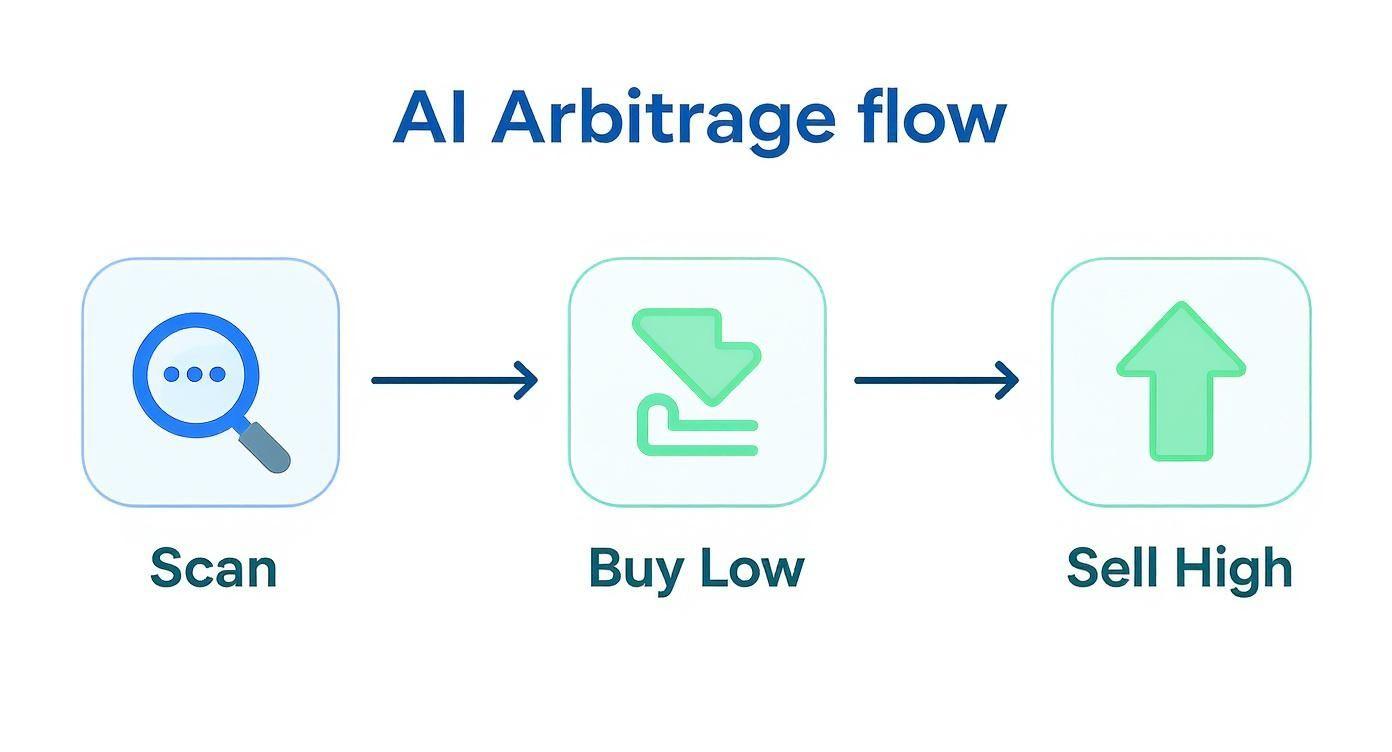
The key takeaway here is that AI arbitrage isn't about luck or picking a winner. It's a methodical process of finding and exploiting market mistakes before they get fixed.
A Concrete Example of AI Arbitrage
Let's make this tangible with a simple tennis match. Player A is taking on Player B. The AI scans the entire market and spots the following odds on two different sites:
- Bookmaker 1: Offers odds of 2.10 for Player A to win.
- Bookmaker 2: Offers odds of 2.05 for Player B to win.
To the human eye, these numbers look pretty ordinary. To the AI, it's a flashing red light a clear market inefficiency and a potential arbitrage opening. The system immediately calculates the total implied probability, and if that number falls below 100%, a risk-free profit is on the table.
In this scenario, placing a $100 bet on Player A at Bookmaker 1 returns $210 on a win. At the same time, placing a $102.44 bet on Player B at Bookmaker 2 also returns $210 on a win. The total investment is $202.44, but the guaranteed return is $210. That's a $7.56 profit locked in, no matter who wins the match.
This mathematical certainty is the heart of AI arbitrage. The system isn't predicting an outcome; it's just executing a trade based on faulty market pricing.
The Critical Role of Speed
The final piece of the puzzle and the most important one is speed.
These pricing mistakes, or "arbs," are incredibly short-lived. They often exist for just a few seconds before the bookmakers' own algorithms catch the error and correct the odds. A human could never find the opportunity, do the math, and place the bets fast enough.
An AI system, on the other hand, runs this entire cycle of data collection, analysis, and calculation in milliseconds. This lightning-fast execution is what allows it to capitalize on these tiny windows of profit before they slam shut. For those curious about how AI is applied to forecasting, our detailed guide on AI betting prediction explores another side of this technology.
It's this blend of massive scale, deep analysis, and pure speed that lets AI consistently uncover hidden profit opportunities that are completely invisible to the naked eye.
The Evolution and Economic Impact of AI Arbitrage
To really understand what AI arbitrage is, you have to look at where it came from. This isn't some brand-new trick; it's just the latest chapter in the long story of using technology to find a market edge. Long before AI, sharp bettors hunted for arbitrage opportunities by hand a painfully slow process that rarely paid off.
The first big leap forward came with automated bots and scripts. These early systems could scan odds much faster than any person, but they were clunky. They followed rigid rules and couldn't really adapt to the fluid, complex world of betting markets. Now, artificial intelligence has completely rewritten the rulebook, turning a niche tactic into a powerful, data-driven discipline.
A Powerful Parallel from Crypto Trading
The best way to picture this shift is to look at the world of cryptocurrency. Just a few years ago, the crypto market was like the Wild West. You could find massive price differences for the same coin on different exchanges, and early trading bots could easily scoop up huge profits from these gaps.
But as more traders started using these tools, the market got smarter. It became more efficient. The easy money dried up. Since 2021, AI arbitrage has fundamentally reshaped cryptocurrency trading, changing both profit margins and market behavior. In the early days of 2021-2023, it wasn't uncommon for traders to find double-digit price gaps. By 2025, the market has matured so much that a typical arbitrage opportunity is now just 0.1% to 2%. This squeeze shows just how efficient the market has become. You can find more great insights about these crypto arbitrage market shifts on wundertrading.com.
This exact same pattern is happening in sports betting right now. The big, obvious opportunities that simple bots used to catch are vanishing. As bookmakers get better tech and more bettors use automated tools, the profit windows get smaller and slam shut faster. This trend makes one thing crystal clear: to succeed today, you need more powerful, more sophisticated AI.
The evolution of arbitrage betting is a technological arms race. As the market gets more efficient, the tools required to find an edge must become exponentially more powerful. Manual arbitrage is no longer a viable strategy in this high-speed environment.
The Economic Ripple Effect
The economic impact of this evolution is huge. When profit margins shrink, every single fraction of a percent matters. This puts enormous pressure on bettors to run their operations with laser-like precision. The days of stumbling upon a juicy 5% arb are mostly gone; the new game is about executing a high volume of trades with margins often well below 1%.
This new reality forces you to think about financial details that didn't matter as much before:
- Fee Management: Transaction fees, deposit charges, and withdrawal costs can completely wipe out a thin profit margin. Successful arbitrageurs have to meticulously factor every single one of these costs into their calculations.
- Bankroll Velocity: To make real money from tiny margins, you have to turn over your bankroll quickly. This means placing a much higher volume of bets and being able to move your funds between bookmaker accounts efficiently.
- Technological Investment: To stay in the game, you need access to a top-tier AI platform. A subscription to a premium service isn't an optional extra anymore it's a necessary investment to get the speed and data you need to compete.
Why Advanced AI Is No Longer Optional
This shrinking-margin environment is exactly why advanced AI platforms are now essential. They do a lot more than just find arbs; they handle a whole range of critical tasks that are impossible to do manually or with simpler bots.
Here’s what modern AI brings to the table:
- Unmatched Speed: It can spot, calculate, and act on an opportunity in milliseconds long before it disappears.
- Market-Wide Scope: It can scan hundreds of bookmakers and thousands of markets at the same time, a feat no human team could ever dream of matching.
- Precision Calculation: It instantly factors in all the little details commissions, fees, and different rule sets to confirm if a bet is truly profitable, ensuring a tiny edge isn't eaten up by hidden costs.
In short, the economic landscape of sports arbitrage has grown up. All the low-hanging fruit has been picked, and the market now rewards those who come equipped with the most advanced technological tools. This evolution has cemented AI’s role not just as an advantage, but as a fundamental requirement for anyone serious about this strategy.
Real-World Examples of AI Arbitrage in Action

Theory is one thing, but seeing how AI arbitrage plays out in a real-world scenario is what makes the whole idea click. These opportunities pop up in two main flavors: before an event even starts (pre-match) and right in the middle of the action (live or in-play). Each one comes with its own unique challenges and rewards, perfectly showcasing the power of AI-driven speed and analysis.
Let's walk through a couple of concrete examples one from the calm of a pre-match market and another from the chaos of a live game to show you exactly how these profit windows are found and capitalized on.
Pre-Match Arbitrage: A Calculated Tennis Match
Imagine a men's tennis final between Novak Djokovic and Carlos Alcaraz. The match is still hours away, so the odds are fairly stable. Behind the scenes, an AI platform is scanning the market around the clock when it suddenly flags a pricing mismatch.
- Bookmaker A has Novak Djokovic to win at odds of 1.80.
- Bookmaker B has Carlos Alcaraz to win at odds of 2.35.
To the average bettor, these odds probably look normal. But the AI's algorithm instantly calculates that the combined implied probability is under 100%, signaling a guaranteed profit. It recommends a total stake of $200 and tells you the exact amounts to bet on each player.
The Arbitrage Calculation
To lock in the profit, the AI calculates the perfect stakes:
- Bet $114.63 on Djokovic at Bookmaker A (potential return: $206.33)
- Bet $85.37 on Alcaraz at Bookmaker B (potential return: $200.62)
It doesn't matter who wins the match. The bettor is guaranteed to walk away with a small, risk-free profit. This kind of pre-match opportunity is a textbook example of how AI exploits stable but misaligned prices across different bookmakers.
Live Arbitrage: The Fast-Paced Football Scenario
Now, let's dive into the fast and furious world of live betting. A Premier League match between Manchester United and Liverpool is in full swing. Manchester United scores an unexpected goal, and the live odds market descends into chaos as bookmakers scramble to adjust their prices.
This temporary madness is where an AI truly shines. In the seconds after the goal, the "Over 2.5 Goals" market explodes with activity.
The AI system detects a fleeting arbitrage opportunity that lasts for just 12 seconds:
- Bookmaker X, slow to react, still has "Over 2.5 Goals" at 2.10.
- Bookmaker Y reacts instantly, dropping the odds for "Under 2.5 Goals" to 2.05 as the chance of more goals shoots up.
A human bettor would never spot this. The AI, however, immediately sends an alert. The profit margin might be tiny maybe just 1.2% but it’s a mathematically certain return. The user gets a notification, places the calculated stakes with a couple of clicks, and locks in the profit before Bookmaker X can correct its odds. This highlights why speed is everything in live arbitrage, a domain where AI isn't just helpful it's essential.
To act on these opportunities, you have to know how to read and interpret the alerts your platform provides. You can get the full rundown in our detailed guide on how to understand the alert feed, which breaks down every part of a notification. These alerts are the bridge between an AI's discovery and your successful trade, giving you all the critical info needed to act fast.
The Good, The Bad, and The Reality of AI Arbitrage
Jumping into a strategy like AI arbitrage means you have to look at the whole picture. The technology brings some incredible advantages to the table that can completely change how you bet, but it's not some magic button for risk-free cash. To succeed, you need to have a rock-solid understanding of both the upsides and the very real risks involved.
The number one benefit is pure, raw efficiency. A human being simply can't keep up with a machine that scans thousands of markets across hundreds of bookies, 24/7. This relentless monitoring means that no opportunity, no matter how fleeting, ever slips through the cracks.
This leads right into the next huge advantage: taking emotion out of the equation. Betting decisions fueled by gut feelings, biases, or the thrill of a big game are a fast track to an empty bankroll. An AI couldn't care less who's playing; it operates on pure, cold mathematics. It finds a profitable price gap and signals the bet without fear, greed, or hesitation, making sure every move is 100% data-driven.
The Clear Advantages of an AI-Driven Approach
Beyond just speed and logic, the real beauty of AI arbitrage is how it creates a systematic way to find value. The core strengths let you operate on a scale that would be unthinkable for a human to manage alone.
Here’s a breakdown of the key upsides:
- Comprehensive Market Coverage: Instead of manually flipping between a handful of your favorite bookmakers, an AI system gives you a bird's-eye view of the entire market at once. This massively increases your chances of spotting those rare pricing mistakes.
- Unmatched Speed: Arbitrage opportunities are notoriously short-lived we’re talking seconds, not minutes. An AI can spot, calculate, and alert you to these chances in milliseconds, giving you just enough time to act before the odds get corrected.
- Guaranteed Profit on Paper: The math behind arbitrage is solid. When you correctly identify and execute a bet on both sides of an opportunity, you lock in a small, guaranteed profit, no matter who wins the game.
At its core, AI arbitrage is all about shifting your mindset from gambling to something more like high-frequency trading. You're using technology to exploit tiny market inefficiencies for small, consistent gains instead of chasing big, uncertain wins.
This is what makes the strategy so appealing to data-driven people it’s built on provable math, not on luck.
Navigating the Inherent Risks and Limitations
Now for a reality check. While the theory is perfect, putting it into practice comes with its own set of challenges that you need to manage carefully. The biggest risk doesn't come from the math, but from the bookmakers themselves, who are actively trying to shut this kind of activity down.
One of the biggest hurdles is getting "gubbed," which is industry slang for having a bookmaker severely limit your stakes or close your account entirely. Since arbitrage betting is against the terms of service for most sportsbooks, being flagged as an "arb" bettor is a constant threat to your operation.
Another major problem is execution risk. This is what happens when you place one half of the arbitrage bet, but the odds on the other side change before you can get your money down. Just like that, your profit margin can vanish or, even worse, turn into a guaranteed loss. This makes speed and reliable tools absolutely essential.
This kind of caution around automation isn't just a betting thing. In the legal world, a 2025 Paris Arbitration Week survey found that while 90% of professionals plan to use AI for tasks like research to save time, their top concerns are AI errors and bias. It just goes to show a universal truth: no matter how great the benefits, you always have to think about the reliability of the tools you're using. You can learn more about AI adoption trends in professional sectors on ascendion.com.
Finally, there’s the logistical challenge of managing a decent bankroll. To jump on opportunities the second they appear, you need to have funds spread across a whole network of bookmaker accounts. This takes serious discipline and careful financial planning. Success in AI arbitrage isn't just about finding the bets; it's about being funded and ready to execute them at a moment's notice.
Taking the Plunge with Your First AI Arbitrage Platform

Jumping from understanding the theory of AI arbitrage to actually placing your first bet can feel like a massive leap. This is where a dedicated platform comes in, acting as the bridge that turns all that complex data into simple, actionable steps.
Platforms like ValueBetFactory are built to do the heavy lifting for you. They cut out the need for manual data scraping and tricky calculations, letting you focus entirely on getting the bets placed. The right platform takes an overwhelming flood of numbers and turns it into a command center for spotting and acting on market mistakes.
Key Features To Look For
When you're picking a platform, a few core features are non-negotiable if you want a smooth and profitable experience. These are the tools that separate a powerful system from a basic odds scanner.
Look for a platform that offers:
- Real-Time Alerts: Arbs can vanish in seconds. You need instant notifications sent straight to your device the moment a profitable bet is found.
- Integrated Calculators: A built-in calculator is a must-have. It should tell you the exact stakes to place on each outcome to lock in a profit, killing guesswork and human error.
- Comprehensive Tutorials: Clear guides and videos are vital. Look for resources that walk you through the interface, how to read the alerts, and how to manage your bankroll properly.
- Responsive Support: When you have a question especially with money on the line getting a quick and helpful answer from customer support can make all the difference.
Your First Steps on the Platform
Once you've picked a platform, getting started is usually pretty straightforward. The first step is just creating your account and getting a feel for the user interface. Spend some real time exploring the dashboard, learning how to filter alerts, and understanding the data it's showing you.
For a more hands-off approach, you can check out how an AI betting bot works and see how it might fit into your strategy.
The most important rule when starting is to begin small. Place a few low-stake arbitrage bets first to get a feel for the workflow. This helps you build confidence in the process without risking a big chunk of your bankroll.
This initial phase is all about learning the ropes. You'll quickly see how fast odds can change and why you need to act decisively when an alert hits your screen. This hands-on experience is the best teacher, preparing you to scale up your activity in a smart, responsible way.
A Few Final Questions on AI Arbitrage
As you start to wrap your head around AI arbitrage, a few key questions always seem to pop up. Let's tackle the most common ones head-on to clear up any lingering doubts and make sure you have a balanced, realistic view of the strategy.
Is AI Arbitrage Betting Legal?
The short answer is yes, the act of placing arbitrage bets is perfectly legal. You're just placing lawful wagers with different, licensed bookmakers.
The tricky part isn't the law; it's the bookmakers' terms and conditions. This practice almost always violates their rules. Bookies are constantly on the lookout for arbitrage patterns, and if they flag your account, they can hit you with stake limitations ("gubbing") or just close your account for good. Success is all about understanding these policies and learning to bet discreetly.
How Much Money Do I Need to Start?
There's no magic number here, but a bigger, well-distributed bankroll gives you a serious advantage. Arbitrage opportunities can vanish in seconds, so you need to have funds ready to go across multiple bookmaker accounts at a moment's notice.
A decent starting point for many is somewhere between $1,000 and $2,500, but how you spread it out is what really matters. Having $100 sitting in ten different accounts is far more powerful than having $1,000 locked up in one. This approach, combined with disciplined bankroll management, is fundamental to making this work.
Can AI Arbitrage Guarantee a Profit?
While a single, perfectly executed arbitrage bet is mathematically designed for a guaranteed profit, your overall profitability is not a sure thing. The real world is messy, and a handful of external factors can eat into your returns.
The mathematical principle of arbitrage is sound, but real-world execution introduces variables. Success isn't just about finding arbs; it's about managing the risks that come with placing them.
Here are a few of the curveballs you'll have to deal with:
- Bet Cancellations: A bookie might void one side of your bet after you've placed the other, leaving you dangerously exposed.
- Stake Limits: You might have your stake limited after you’ve already locked in the other side of the bet.
- Rapid Odds Changes: The odds can shift in the seconds it takes to place both wagers, turning a surefire profit into a sudden loss.
Getting a handle on these challenges is crucial for setting realistic expectations from day one.
Ready to put this knowledge into action? ValueBetFactory gives you the real-time alerts, integrated calculators, and tutorials you need to get started with AI arbitrage confidently. Explore our platform and start making smarter, data-driven decisions today. Find out more at ValueBetFactory.