
AI Betting Prediction A Guide to Smarter Wagering
Unlock Profits with betting tips!
An AI betting prediction is a forecast about a sporting event's outcome that has been generated by artificial intelligence. Imagine having a team of thousands of expert analysts working around the clock. They process every game statistic, player update, and even weather report imaginable, all to find a slight statistical edge.
That’s essentially what AI does. It provides predictive insights, not guaranteed wins.
What Is AI Betting Prediction

At its heart, an AI betting prediction is the final output from a machine learning model that has crunched massive amounts of data to spot valuable betting opportunities. While a human bettor might lean on their experience and a team's recent form, an AI system digs much, much deeper. It processes information at a scale and speed that is simply impossible for a person to match.
This isn't just about glancing at a team's win-loss record. The AI sifts through layers upon layers of complex data to find hidden patterns and subtle correlations that the human eye would almost certainly miss. It goes far beyond the basic stats to give you a more nuanced picture of what might happen.
Moving Beyond Basic Statistics
Traditional sports analysis often sticks to surface-level metrics. An AI, however, can connect dots between seemingly unrelated data points to build a more complete picture. For example, it might analyze how a specific quarterback performs in windy conditions when playing against a certain defensive formation, but only when he’s away from home.
This kind of analytical power is changing the game. The integration of AI into sports betting has already led to measurable improvements in accuracy and market efficiency. One leading platform reported a 28% increase in prediction accuracy after deploying an advanced AI that analyzed over 50 different variables for each game, a huge leap from their older statistical models.
This jump was especially noticeable for trickier outcomes like underdog victories and point spread results, where those subtle patterns are so hard for humans to detect. You can discover more insights about AI's impact on betting at Action Network.
The true power of AI in betting is its ability to remain completely objective. It operates purely on data, free from the emotional biases that can cloud human judgment, like team loyalty or simple gut feelings.
The Core Goal: Uncovering Value
Ultimately, the goal of an AI betting prediction isn't just to pick winners. Its real job is to identify "value" in the betting market. This happens when the AI calculates the probability of an outcome to be higher than the probability implied by a bookmaker's odds.
Before we go deeper, this table breaks down the core components of an AI prediction system.
Key Aspects of AI Betting Prediction
| Component | Description | Example |
|---|---|---|
| Data Aggregation | Gathers a massive range of data, from historical game stats and player performance to injury reports and weather conditions. | Collecting every pass, run, and tackle from the last 10 NFL seasons, plus player-specific data like 40-yard dash times. |
| Pattern Recognition | Machine learning algorithms sift through the data to find recurring patterns that are linked to specific game outcomes. | Discovering that a certain basketball team's shooting percentage drops by 8% when they play the second game of a back-to-back. |
| Probability Calculation | Based on the identified patterns, the AI generates its own "true" probability for an event happening. | The AI calculates a team has a 60% chance of winning, even though the public and bookies think it's closer to 50%. |
| Value Identification | Compares its "true" probability against the odds offered by bookmakers to flag bets where the odds are mispriced. | The bookmaker offers odds of 2.20 (+120), implying a 45.5% chance, but the AI's 60% probability signals a clear value bet. |
By focusing on these statistical advantages, an AI betting prediction provides a disciplined, data-driven framework. It is a powerful tool designed to find a mathematical edge over the long term, fundamentally changing how bettors can approach the market.
How AI Betting Algorithms Actually Work
At its heart, an AI betting model learns a lot like a person does, just on a scale that's impossible for a human brain to match. Think about a brand-new driver. At first, every single action is a conscious thought: check the mirrors, ease onto the gas, watch the road. But after months of practice, those actions become pure instinct.
An AI betting algorithm goes through a similar, but massively accelerated, training process. We feed it colossal amounts of historical sports data-thousands upon thousands of games, player stats, and match conditions. Through sheer repetition, it learns to spot the complex patterns that hint at a likely outcome. It turns conscious analysis into an instinct for finding value.
Processing More Than Just the Scoreboard
The real magic of these algorithms is their ability to see beyond the box score. They’re built to process two very different kinds of information, which gives them a much fuller picture of an upcoming game.
Structured Data: This is the clean, organized stuff you'd find in a spreadsheet. We’re talking about final scores, specific player stats (like passing yards or shots on goal), and team rankings. The AI uses this to build a rock-solid statistical foundation for its predictions.
Unstructured Data: This is all the messy, real-world information that doesn't fit neatly into columns and rows. It could be news articles about a player’s morale, the sentiment on social media buzzing around a team, or even transcripts from a coach’s latest press conference. By analyzing this context, the AI picks up on crucial details that numbers alone can't tell you.
This dual-pronged approach is what gives the AI its edge. For example, the structured data might show a star player has been putting up amazing stats. But the unstructured data analysis might find a few news reports hinting at a minor, undisclosed injury. That’s when the ai betting prediction model can adjust its forecast, seeing a risk that most people would miss.
An AI learns to spot a value bet the same way it learns to identify a cat in a photo. After seeing thousands of images, it doesn’t just memorize what a cat looks like; it understands the underlying patterns-the pointy ears, the whiskers, the tail-that define a cat. In betting, it learns the patterns that define a profitable opportunity.
The Machine Learning Engines Driving the Predictions
To make sense of all this data, AI systems use different machine learning models. You can think of these as the "engines" that power the whole process, each with a specific job.
One of the most powerful engines is the neural network. Inspired by the human brain, a neural network sifts information through interconnected layers of "nodes." The first layer might look at basic stats like wins and losses. The next layer could analyze player-vs-player matchups. And the deeper layers might uncover incredibly complex correlations that are completely invisible to the human eye.
For instance, a neural network might discover that a specific soccer team has a 15% higher chance of winning if it's raining, but only when their star defender is playing and the opposing team is in the bottom half of the league table. This is the kind of deeply layered, specific insight that gives an ai betting prediction its power. By combining all these data types with powerful algorithms, the AI builds a far more accurate picture of probability than traditional handicapping ever could, turning raw information into a real betting advantage.
Putting AI Predictions into Practice
Understanding the theory behind an AI betting prediction is one thing, but seeing it work in the real world is where you feel its power. This is how bettors move beyond guesswork and gut feelings, applying data-driven strategies that systematically hunt for cracks in the market. The core benefit is simple but profound: making objective decisions based on probability, not emotion.
The most common application is spotting value bets. This is where an AI finds odds that are more generous than the true statistical likelihood of an outcome. For instance, an AI might flag an underdog NBA team as undervalued because it analyzed player fatigue, cross-country travel schedules, and historical performance against similar opponents-data points a human or even a bookmaker might have overlooked. This lets you capitalize on mispriced odds.
Another key tactic is making lightning-fast in-play adjustments. During a live game, the momentum can shift in a heartbeat. An AI chews through real-time match data as it happens, constantly recalculating probabilities and flagging new value opportunities that appear and disappear in seconds. This speed gives bettors a massive advantage over anyone trying to do it manually.
Core Strategies for AI-Powered Betting
These approaches aren't just about picking winners; they're about building a sustainable, long-term betting framework. Each one leans on the AI's ability to process massive amounts of information instantly.
- Pinpointing Pre-Match Value: The AI scans thousands of upcoming games, comparing its own probability models against bookmaker odds to find statistical edges before the event even kicks off.
- Live Betting Adjustments: During a match, the AI reacts to game-changing events like goals, injuries, or red cards, sending real-time alerts on shifting odds and fresh value opportunities.
- Long-Term Bankroll Management: By zeroing in on bets with a positive expected value (+EV), the AI helps bettors apply a consistent, data-driven approach to growing their bankroll over the long haul.
This diagram shows the whole process, from raw data input to a final, actionable prediction.
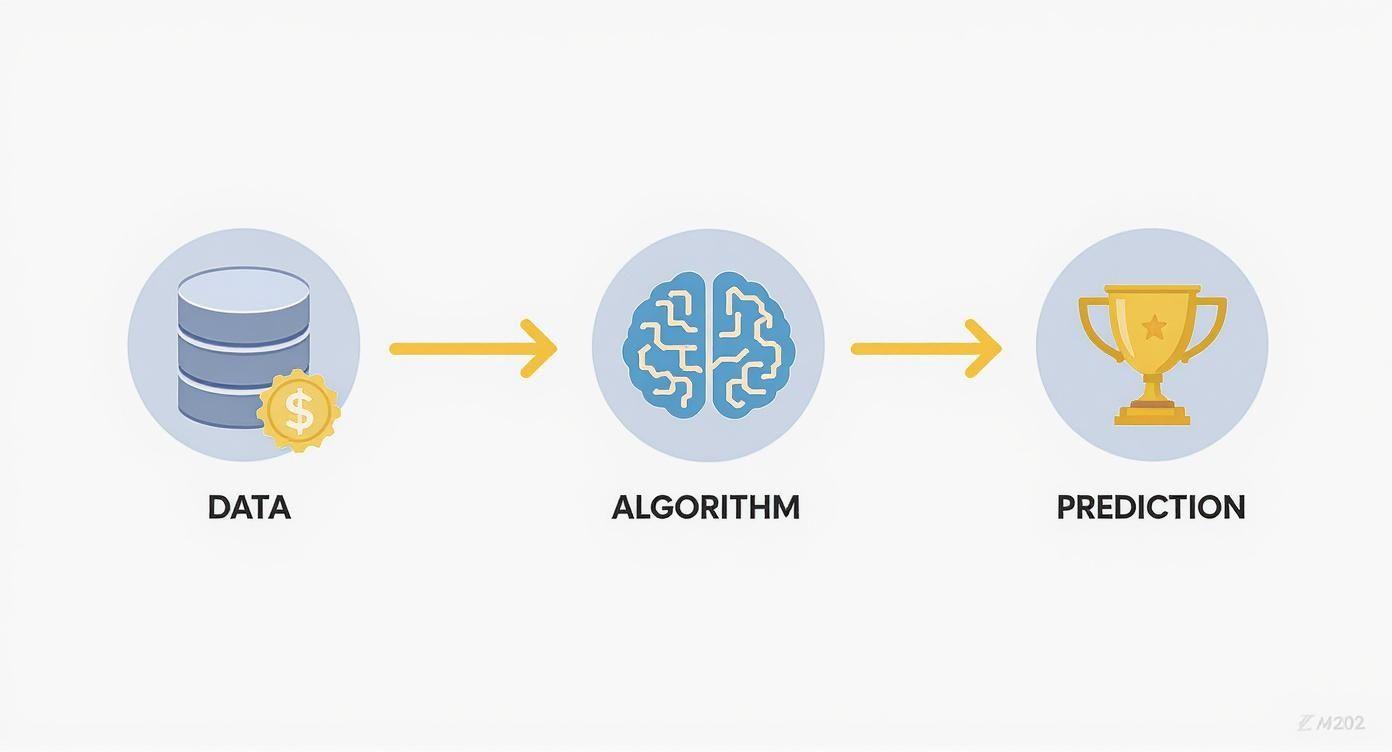
As you can see, the flow is straightforward but powerful: the system gathers immense amounts of data, the algorithm processes it to find patterns, and the output is a clear, data-backed prediction.
AI Prediction vs Traditional Handicapping
So, how does this AI-driven approach really stack up against old-school, human-led analysis? It’s a classic battle of machine scale versus human intuition. While a seasoned handicapper brings years of experience to the table, an AI brings pure, unbiased processing power.
Let's break down the key differences.
| Feature | AI Betting Prediction | Traditional Handicapping |
|---|---|---|
| Data Scope | Analyzes millions of data points across thousands of games. | Relies on personal experience, recent form, and select stats. |
| Speed | Identifies opportunities and processes live data in real-time. | Analysis takes hours or days; slow to react to live events. |
| Objectivity | 100% data-driven, immune to emotional bias or gut feelings. | Prone to human biases like favoritism or recency bias. |
| Scalability | Can monitor hundreds of markets and sports simultaneously. | Limited to the sports and markets one person can follow. |
| Pattern Recognition | Finds subtle, complex patterns invisible to the human eye. | Identifies obvious trends based on observation. |
The takeaway here isn't that one method is "bad" and the other is "good." Instead, it highlights how AI takes the core principles of handicapping-finding an edge-and supercharges them with a scale and objectivity that's simply beyond human capability.
Removing Emotional Bias and Processing Data at Scale
The human mind is wired with biases. We favor our home team, overreact to a big win, or get nervous during a losing streak. An AI has no such weaknesses. It operates purely on data, ensuring every decision is cold and objective. This disciplined approach is essential for long-term success. For a deeper look into the mechanics, check out our guide on how to build a sports betting model.
On top of that, the sheer volume of data these systems handle is staggering. Research shows that AI-driven experiences can boost revenue for sports betting operators by up to 25% through better user engagement. These models analyze years of historical game data, granular player statistics, and even unstructured text from news articles to find their edge. You can learn more about the financial impact of AI in sports betting on Boardroom.tv.
By instantly analyzing millions of data points, an AI betting prediction system does the heavy lifting that would take a human analyst weeks or even months to complete, all to find a single, profitable edge.
Using AI Betting Tools Effectively

Jumping into an AI betting platform for the first time can feel a bit like stepping onto a stock trading floor. You’re hit with alerts, numbers, and recommendations, and the real skill is learning how to turn all that data into simple, actionable decisions.
It’s not about blindly following every single tip the machine spits out. It’s about understanding the logic behind the suggestion.
The first step is simply learning to read the alerts. An AI betting tool like ValueBetFactory does the heavy lifting, scanning countless markets to find those rare opportunities. When it pings you with an alert, it's signaling a very specific kind of opportunity it has uncovered.
Your main job is to understand what the AI is actually telling you. At the heart of it all is one core concept: expected value (EV).
Decoding Your First AI Alert
Think of expected value as the average amount you'd win or lose per bet if you could place the exact same wager over and over again. A positive EV (+EV) means the bet is a profitable one in the long run, even if it doesn't win every time.
An AI spots these opportunities by calculating the "true" probability of something happening and comparing it to the odds a bookmaker is offering. When an alert pops up, it will usually highlight a few key details:
- The Event: The specific game or match (e.g., Manchester United vs. Liverpool).
- The Bet: The market the AI has flagged (e.g., Over 2.5 goals).
- The Value: This is the good stuff, often shown as a percentage. It tells you how much of an edge the AI has found. A bigger percentage means a larger gap between the AI's probability and the bookie's odds.
An AI alert is not a guarantee you'll win the bet. It's a statistical signal that the odds on offer are better than they should be, giving you a mathematical edge over the long term.
For example, an AI-powered dashboard is constantly scanning for these inefficiencies. Each line represents a distinct betting opportunity, showing the event, the bookmaker with the best odds, and that all-important calculated value percentage.
Acting on this means placing the suggested bet with that specific bookmaker to lock in the statistical advantage before the odds shift.
From Alert to Actionable Bet
Once you get an alert, the process is pretty straightforward. The platform will point you to the exact bookmaker offering the most generous odds for that bet. Your task is to act quickly, because odds can change in a flash once the market starts to correct the pricing error that the AI just found.
Another important concept to get your head around is the value threshold. This is a personal setting that lets you filter the noise. For instance, you could set your threshold to only notify you for bets with a value of 3% or higher, making sure you only focus on the most significant opportunities.
This disciplined, data-first approach is the cornerstone of using an ai betting prediction tool the right way. To get a better feel for the data crunching behind these alerts, you can explore our article to automate data analysis for betting.
By learning to interpret these key metrics, you stop being a passive bettor and start acting like an informed investor, making decisions based on probability, not just passion.
Understanding the Limits and Risks of AI
While an AI betting prediction can give you a powerful statistical edge, we need to dismantle one persistent myth right away: AI is not a crystal ball. It can't guarantee wins or magically erase the risk that comes with sports betting.
Think of it as a highly sophisticated tool for sniffing out a mathematical advantage, not for seeing the future. The system is designed to find value, but it operates in a world of probabilities, not certainties.
Even the most effective betting strategies will hit losing streaks. This is a fundamental concept known as variance, and accepting it is the first real step toward responsible and sustainable betting.
The Myth of Guaranteed Wins
The biggest limitation of any AI model is that it's only as good as the data it's trained on. An AI can analyze historical performance, player stats, and countless other variables, but it can’t predict a last-minute injury, a surprising tactical change from a coach, or a simple stroke of bad luck.
These "black swan" events are a natural part of sports and are impossible to model with perfect accuracy.
Because of this, every AI-driven bet still involves a degree of uncertainty. For a deeper dive into this idea, our guide on decision-making under uncertainty provides some valuable context. The goal isn't to win every single bet, but to consistently make wagers where the odds are in your favor over the long run.
An AI betting prediction doesn't remove risk; it helps you manage it more intelligently. It replaces emotional guesses with data-driven decisions, stacking the odds slightly in your favor over time.
Market Efficiency and Best Practices
Another key factor to consider is market efficiency. When a tool like ValueBetFactory flags a value bet, it’s because a bookmaker's odds are temporarily mispriced. But you're not the only one looking for an edge.
As more bettors jump on this information, the odds will quickly shift and correct themselves, causing the value to evaporate. In this game, speed is often essential.
Because of these limitations, it's vital to approach AI-assisted betting with a clear strategy and a responsible mindset. An ai betting prediction should be one component of your approach, not a blind command you follow without question.
To make sure you're using these tools safely and effectively, stick to these best practices:
- Manage Your Bankroll: Never bet more than you can afford to lose. A solid rule of thumb is to wager only 1-3% of your total bankroll on any single bet.
- Understand the Tool: Get to know what metrics like "expected value" actually mean and how the platform identifies opportunities.
- Avoid Chasing Losses: Stick to your strategy. Never make impulsive bets to try and recoup losses after a bad run. Remember, variance is normal.
- Stay Objective: Use the AI's data to fight your emotional biases, like betting on your favorite team no matter how bad the odds are.
Here is the rewritten section, crafted to sound completely human-written and natural, following the provided style guide and examples.
The Future of AI in Sports Betting
If you think AI in betting is impressive now, just wait. We're on the cusp of some massive leaps forward. The next wave is all about hyper-personalization, moving beyond generic tips to models that act like a personal betting analyst. Imagine an AI that learns your specific risk tolerance and betting style, then flags opportunities perfectly tailored to your strategy, not just what looks good on paper.
The world of live betting is getting a serious upgrade, too. We’re seeing models that are becoming ridiculously fast and sophisticated. Think about an AI that doesn't just react to a goal in real-time but actually anticipates momentum shifts based on granular player tracking data, feeding you insights seconds before the rest of the market catches on.
The Rise of Decentralized Prediction Markets
The next frontier is blowing past traditional sports altogether. AI is now the engine behind decentralized prediction markets, which are a fascinating blend of collective human intelligence and cold, hard algorithmic analysis. These platforms are being used to forecast a massive range of real-world events, from elections to economic shifts.
These markets are quickly becoming a powerful force for finding the truth in a sea of noise. Take the crypto-based platform Polymarket, for example. It processed over $1 billion in trading volume during the 2024 U.S. election alone, and its AI-boosted odds often proved more accurate than many traditional polls. This isn't just a niche hobby anymore; it's a global industry, a shift you can read more about in this deep dive into prediction market growth.
This shift represents a fundamental change in predictive technology. It’s becoming more powerful, transparent, and accessible to everyone, not just seasoned bettors.
This evolution is pointing toward a future where a well-structured ai betting prediction model isn't just about picking a winner in a football match; it's about accurately forecasting almost any measurable future event you can think of.
A Few Final Questions on AI Betting
It's only natural to have a few questions when you're looking at a new way of approaching betting. Let's tackle some of the most common ones that pop up when people first start exploring AI-powered tools.
Can AI Betting Predictions Guarantee a Profit?
Let's be blunt: no. And you should run from any platform that tells you otherwise. An AI betting prediction isn't a crystal ball; it's a high-powered tool designed to find a statistical edge. Its entire job is to hunt down "value bets"-wagers where the odds are better than the real probability of that outcome.
While this entire approach is built for long-term profitability, losing streaks and short-term swings are a baked-in part of the game. The goal is to make smart, data-driven decisions over and over again, not to chase some nonexistent "sure thing."
How Much Money Do I Need to Start?
You don’t need a huge bankroll to get going. The most important thing isn't how much you start with, but how you manage it. A core principle of smart betting is to only risk a tiny fraction of your total funds on any single bet, typically somewhere between 1-3%.
This strategy means you can start with a modest amount that you're comfortable losing while still following a sound, sustainable system. The focus is on a consistent strategy, not the size of your initial deposit.
Do I Need to Be a Sports Expert?
Not in the slightest. In fact, that's one of the biggest advantages of using a tool like this. The AI does all the heavy lifting for you, crunching millions of data points to find patterns and insights that even a seasoned sports analyst would probably miss.
Your job is to understand the outputs-like what a value bet alert means-and to manage your bankroll like a professional. The tool handles the deep-dive analytics so you can focus on making smart, strategic decisions.
Ready to stop guessing and start making data-driven decisions? Join ValueBetFactory today and get real-time alerts on value bets across global sports markets. Start your journey toward smarter betting.