
What Does Minus 1.5 Mean in Betting? An Expert Guide
Unlock Profits with betting tips!
Ever seen a -1.5 next to a team’s name and wondered what it meant? It might look a little confusing at first, but it’s actually a straightforward concept in sports betting.
So, what does that -1.5 really mean? In simple terms, it means the team you're betting on doesn't just have to win; they have to win by at least two full points. A one-point victory, as far as your bet is concerned, is the same as a loss.
Breaking Down the Minus 1.5 Handicap

That -1.5 is what’s known as a point spread, or a handicap. Think of it as spotting the underdog 1.5 points before the game even kicks off. For your bet on the favorite to cash, they have to overcome that built-in deficit.
This completely changes your perspective on the match. You're no longer just asking, "Who will win?" Instead, you're betting on how convincingly they'll win.
Why Do Bookmakers Offer This Bet?
You’ll usually see a -1.5 spread when one team is a heavy favorite. Without a handicap, the odds on the stronger team might be so low they’re not even worth your time. The spread makes things interesting. It presents a bigger challenge but also offers a much better payout.
Here's why the -1.5 spread is so common:
- Better Payouts: The odds on a -1.5 bet are always more attractive than just betting on the favorite to win outright (the moneyline).
- Deeper Analysis: It forces you to think more strategically. Will the favorite just scrape by, or will they dominate?
- Balanced Action: It gives bettors a reason to consider both sides, which helps sportsbooks balance the money coming in.
At its core, the rule is simple: a -1.5 bet demands a win by two or more goals, points, or runs. Since no team can win by exactly 1.5, a two-point margin is the clear line in the sand.
This is a fundamental concept in handicap betting, and it shares similarities with other spreads. If you want to see how a slightly different line works, you can check out our guide that explains the handicap minus 1 meaning for a side-by-side comparison.
Why Sportsbooks Use the Minus 1.5 Spread
Ever look at a -1.5 spread and wonder why it’s there? It’s not just an arbitrary number designed to make things confusing. It’s actually a brilliant tool that sportsbooks use to level the playing field and, more importantly, manage their own financial risk.
Think about a classic mismatch, a top-tier team facing a struggling underdog. If the only bet was on who wins, almost everyone would pile their money on the favorite. This creates a huge liability for the sportsbook; a shocking upset would mean a massive payout. That's a gamble they don't want to take.
This is where the -1.5 spread comes into play. By forcing the favorite to win by at least two goals or points, the bet suddenly becomes a real challenge. At the same time, this makes taking the underdog with a +1.5 head start look a lot more appealing.
Balancing the Action
Ultimately, a sportsbook’s dream is to get roughly the same amount of money bet on both sides of a game. When they pull this off, they make a profit from their commission (the "vig" or "juice") no matter who actually wins. The -1.5 handicap is one of their most effective tools for creating that perfect balance.
Point spreads effectively handicap the stronger team, turning a lopsided game into a much more even betting proposition. This principle is fundamental in major betting markets, as a -1.5 line requires the favorite to not just win, but win by two. If you'd like a deeper dive, you can learn more about how point spreads create balance on BettorEdge.com.
By introducing the spread, sportsbooks transform a one-sided matchup into a compelling, 50/50 betting proposition. Understanding this business logic helps you see the "why" behind the numbers on your screen.
It’s this shift, from just picking a winner to predicting the margin of victory, that separates casual betting from real strategy.
How the Minus 1.5 Spread Works in Different Sports
The idea behind a -1.5 handicap is the same everywhere, but you'll hear it called different things depending on the sport. Getting a handle on the lingo is the first step to using this bet smartly, whether you're looking at a hockey game or a tennis match.
No matter the sport, the core concept never changes: your team has to win by a margin of at least two. A victory by a single point, run, or goal just won't do. It shifts the question from a simple "who will win?" to a more interesting puzzle: "by how much will they win?"
From the Puck Line to the Run Line
In hockey, you'll almost always see the -1.5 spread called the "puck line." If you bet on the Toronto Maple Leafs -1.5, they need to beat their opponent by two goals or more for your bet to win. So, a tight 3-2 victory means your ticket is a loser, but a more comfortable 4-2 win gets you paid.
Baseball has its own version called the "run line." A bet on the Los Angeles Dodgers -1.5 means they have to win by a minimum of two runs. A final score of 5-4 is a loss for your bet, but a 5-3 final score is a winner. These specialized names are just one piece of a bigger vocabulary in sports betting. To get more familiar with the language, check out our full guide to common sport betting terms.
Applying Spreads in Other Major Sports
When you move over to higher-scoring games like football and basketball, the -1.5 is just a standard "point spread." Betting on an NFL team at -1.5 means they must win by two or more points. This is an incredibly slim margin in football, usually signaling that the oddsmakers expect an exceptionally close contest.
This simple breakdown shows you the black-and-white outcomes of any -1.5 wager.
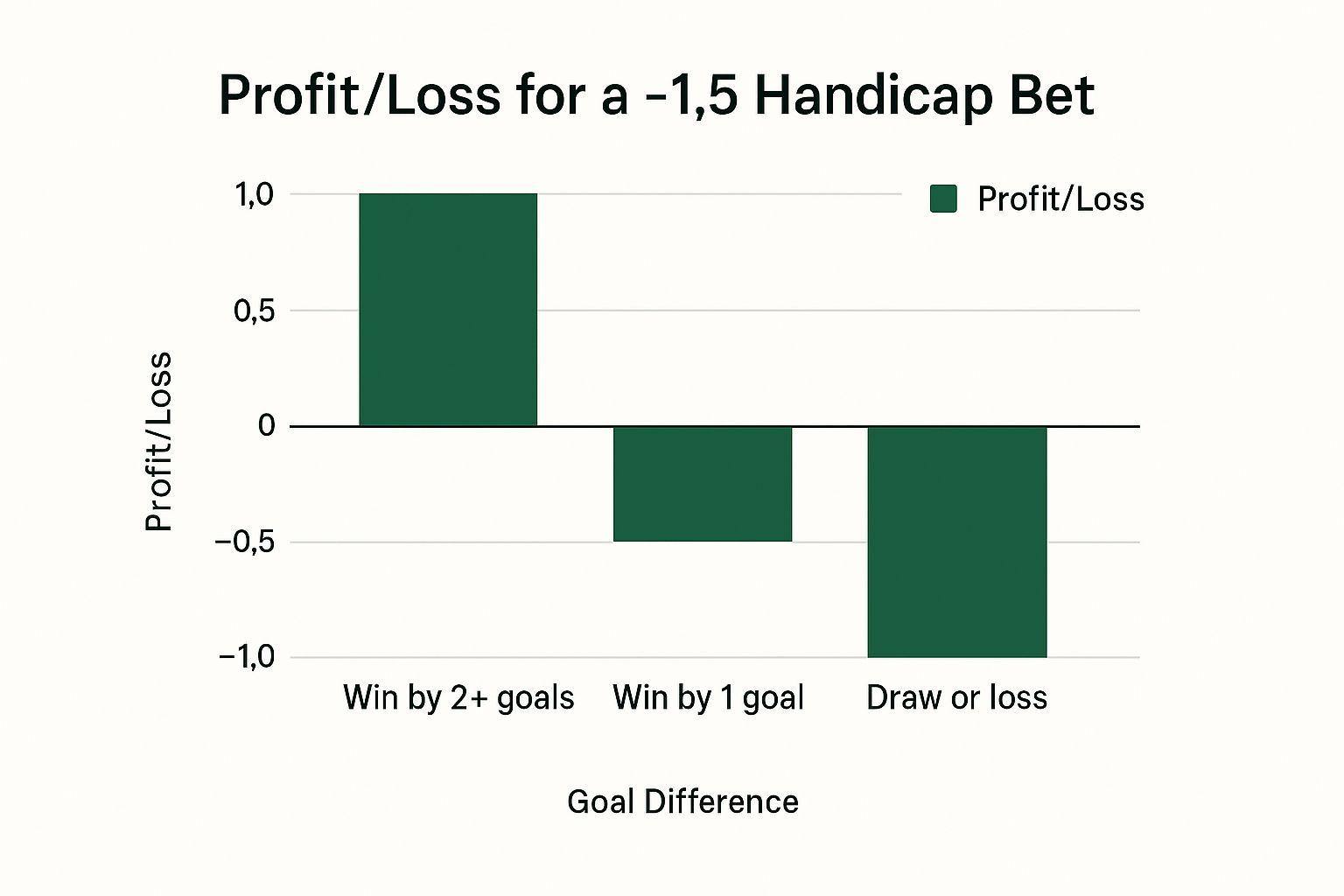
As you can see, the only path to a payout is a win by two or more. Anything else, a one-point win, a tie, or a loss, results in a lost bet.
Even in tennis, the -1.5 handicap shows up as a "set spread." If you bet on a player favored at -1.5 sets, they have to win the match without dropping a set. For a best-of-three match, that means winning 2-0. If they win the match 2-1, your bet loses because the margin was only one set.
A Look at -1.5 Spreads Across Popular Sports
To make things even clearer, this table breaks down what the -1.5 spread is called in different sports and exactly what you need to happen to win your bet.
| Sport | Common Name for the -1.5 Spread | Winning Condition for a -1.5 Bet |
|---|---|---|
| Hockey | Puck Line | Team must win by 2 or more goals |
| Baseball | Run Line | Team must win by 2 or more runs |
| Football | Point Spread | Team must win by 2 or more points |
| Basketball | Point Spread | Team must win by 2 or more points |
| Tennis | Set Spread | Player must win by 2 or more sets (e.g., 2-0) |
Ultimately, whether it's a puck line, run line, or point spread, the -1.5 always demands a victory by a clear margin of at least two, making it a powerful tool for bettors looking for better odds on strong favorites.
How to Figure Out Your Payout on a -1.5 Bet
So, what's the real appeal of a -1.5 bet? It’s all about the payout. Because you're taking on more risk by needing your team to win by two or more, the sportsbooks sweeten the deal with better odds.
Figuring out what you stand to win comes down to the American odds you see next to the spread. These will be shown as a positive (+) or negative (-) number, and they tell you everything you need to know about the risk and reward.
Calculating with Positive Odds (+)
Let’s say you see a team listed at -1.5 (+140). That +140 is your key. It means that even though this team is favored on the spread, they're considered the underdog to actually cover it.
- Your Bet: You wager $100 on the -1.5 spread.
- The Odds: +140.
- The Math: This one’s easy. The positive number shows your profit on a $100 bet. If your team wins by two or more, you pocket $140 in profit, plus your original $100 back. That’s a total return of $240.
This is common in sports like hockey. A team might be the moneyline favorite, but to cover the puck line (the hockey term for the spread), they'll often have attractive odds. You might see a team at -1.5 (+225). This means they have to win by two goals, and a $100 wager would win you $225. If you're interested in hockey specifics, you can dig deeper into insights on the puck line at Betsperts.com.
Calculating with Negative Odds (-)
Now for the flip side. You might see a line like -1.5 (-120). That minus sign tells you the sportsbook thinks this outcome is more likely to happen, so you have to risk more to win less.
The core principle is simple: With negative odds, the number is what you must risk to win $100.
In this case, that -120 means you have to risk $120 just to win $100.
- Your Bet: You risk $120 on the -1.5 spread.
- The Odds: -120.
- The Math: If your team wins by a comfortable margin of two or more, you get your $100 in profit, plus your $120 stake back. Your total return would be $220.
Getting a handle on how these odds work is fundamental. It’s what allows you to look at a -1.5 bet and decide if the potential reward is really worth the risk of needing that decisive victory.
Picking the Right Spot to Bet Minus 1.5

It’s one thing to understand the mechanics of a -1.5 handicap, but the real skill lies in knowing when to pull the trigger. Just betting on every heavy favorite is a fast way to drain your bankroll. The trick is to find those specific games where a lopsided victory isn't just a possibility; it's the most likely outcome.
You're essentially looking for a perfect storm. The classic setup is a team with a high-powered offense going up against an opponent with glaring defensive holes. This kind of mismatch creates the ideal conditions for a team to not only win but to win comfortably, covering the spread without a sweat.
A savvy -1.5 bet isn't just about picking the stronger team. It’s about spotting a matchup where one side has a clear, exploitable advantage that can lead to a multi-score victory.
Imagine an NFL team with a top-tier quarterback facing a defense that bleeds yards through the air. The favorite has a direct line to putting up points all game, making a win by two or more a very strong possibility.
Knowing When to Stick with the Moneyline
Of course, sometimes the smarter play is the safer one. If you're looking at a game between two evenly matched opponents, or if the favorite has a habit of winning tight, one-score games, the moneyline is your best friend. Why add the extra pressure of covering a spread when a simple win will do?
Developing this kind of instinct takes practice and a solid approach. To really level up your analysis, check out our complete guide on building a winning sports betting strategy. It’s packed with the kind of thinking that helps you find these valuable spots consistently.
Before you lock in that -1.5 handicap bet, run through this mental checklist:
- Offensive Firepower: Can the favorite score in multiple ways and consistently put points on the board?
- Defensive Vulnerability: Does the underdog have a key weakness, like a leaky secondary or poor run defense, that the favorite is built to attack?
- Recent Form: Has the favorite been on a tear lately, blowing teams out and winning by big margins?
- Situational Factors: Are there any injuries to key players, bad weather, or tough travel schedules that could prevent a team from dominating?
Common Mistakes to Avoid With -1.5 Bets
When you start betting the -1.5 spread, it’s easy to fall into a few common traps. It’s about more than just picking the stronger team; you need a sharper strategy to succeed.
One of the biggest mistakes is simply backing a big-name team because of their reputation. You see a powerhouse on the schedule and automatically assume they'll cover, but you haven't checked their recent form, how they play on the road, or who’s on the injury list.
Speaking of which, ignoring the context around the game is a classic blunder. Are they missing their star striker? Does the underdog have a massive home-field advantage? These details can easily turn a would-be blowout into a nail-biting one-goal win, which is a loss for your -1.5 bet.
It’s also incredibly tempting to chase a juicy payout. Those high odds on a favorite to cover the -1.5 spread look great, but there's a reason they're high: the bookmakers know it’s less likely to happen than a simple win.
Don't Overlook the Fundamentals
Every sport is different, and the -1.5 line plays out in unique ways depending on the game. In baseball, this is the standard "run line." Winning by two or more runs is a completely different ballgame than just winning, which is why the payouts are much better than a straight moneyline bet. You have to really understand the pitching matchup and team offense to nail these.
You can learn more about the specifics of baseball's -1.5 run line at Southern Pigskin.
Ultimately, avoiding these slip-ups comes down to discipline. Smart bettors do their homework, analyze the matchup beyond the team names, and treat every -1.5 bet with a clear head. It's the best way to protect your bankroll and make smarter wagers.
Digging Deeper Into the -1.5 Spread
Let's tackle a couple of the most common questions that pop up when people first start exploring the -1.5 spread. Getting these concepts down will help you place your bets with confidence.
What Happens if My -1.5 Team Wins by Just One Point?
Unfortunately, that's a losing ticket. For a -1.5 bet to cash, your team has to win by a margin of two or more.
A one-point victory is great for the team, but it doesn't "cover the spread" for your wager. Think of it as a clear, non-negotiable finish line they have to cross.
Is a Minus 1.5 Bet Just a Moneyline Bet With Extra Steps?
Not at all; they're two fundamentally different wagers. A moneyline bet is as simple as it gets: you're just picking the outright winner. It doesn't matter if they win by one point or fifty.
A -1.5 bet, on the other hand, is all about the margin of victory. Because it's a tougher condition to meet, the potential payout is almost always much better than what you'd get from a standard moneyline bet on the same favorite.
The flip side of this coin is the +1.5 spread, which is handed to the underdog. Betting on a team at +1.5 gives you a cushion; your bet wins if they pull off the upset or if they lose by only one point.
At ValueBetFactory, we provide the tools and insights to help you spot these valuable opportunities. Our platform uses advanced analysis to find discrepancies in odds, giving you an edge. Start your free trial at ValueBetFactory and begin making more informed betting decisions today.