
Teaser in Betting: Master Strategies for Profit | teaser in betting insights
Unlock Profits with betting tips!
A teaser bet is your way of getting a better deal on the point spread. It’s a multi-game wager where you get to "buy" points to make each game easier to win, but in exchange, the sportsbook cuts you a much smaller payout than a standard parlay.
Unpacking the Teaser Bet
Ever looked at two NFL games, liked both favorites, but felt those point spreads were just a little too tight for comfort? That’s the exact scenario where a teaser shines. Think of it as a tool that lets you slide the line in your favor, giving yourself a much bigger cushion to work with.
At its core, a teaser is just a modified parlay. A regular parlay bundles multiple bets (or "legs") into a single wager, and you have to win every single one for the ticket to cash. Parlays dangle those lottery-style payouts, but they're notoriously tough to hit because one loss sinks the whole bet. If you want a refresher on the basics, check out our guide on what is a parlay in betting.
A teaser uses that same multi-leg structure but throws in a game-changing twist. Instead of being stuck with the standard lines, you get to move them by a fixed number of points, usually 6, 6.5, or 7 points in football.
How Teaser Mechanics Work
The process itself is pretty simple:
- You pick two or more games for your bet.
- You choose your teaser point value (let's say 6 points).
- The sportsbook automatically adjusts the point spread or total for each of your selections by that amount.
For example, say you like a favorite at -8.5 points. In a 6-point teaser, that line shifts down to a much friendlier -2.5. Now, your team only needs to win by a field goal instead of by 9 points. On the flip side, a +2.5 underdog becomes a +8.5 underdog, giving you a massive safety net.
A teaser essentially trades a high payout for a higher probability of winning each individual leg. You are giving up the long-shot odds of a parlay in exchange for what feels like a safer, more achievable outcome on each game.
To see this in action, let's compare a standard parlay with a teaser using the same two NFL games.
Standard Parlay vs 6-Point Teaser Example
| Bet Type | Team A Selection | Team B Selection | Odds/Payout |
|---|---|---|---|
| Standard 2-Team Parlay | Chiefs -7.5 | Packers +3.5 | +260 ($100 wins $260) |
| 2-Team, 6-Point Teaser | Chiefs -1.5 | Packers +9.5 | -120 ($120 wins $100) |
As the table shows, the teaser makes both individual bets look much easier to win. You've moved the line through key numbers, giving yourself a much better shot on paper. But that advantage comes at a steep price.
The Trade-Off: Lower Payouts
Getting those sweet, adjusted lines isn't free. The catch is a dramatically lower payout. A typical two-team parlay might pay around +260 odds, turning a $100 bet into $260 of profit. A standard two-team, 6-point teaser, however, usually comes with odds around -120, meaning you have to risk $120 just to win $100.
This exchange of giving up a big payday for better lines is what defines a teaser. While moving the spread makes each leg feel like a slam dunk, the reduced payout is how the sportsbook keeps its edge. Understanding this balance is the first step in figuring out if a teaser is offering real value or is just another betting trap.
Understanding the Math Behind Teaser Payouts
Sportsbooks love to frame a teaser as an easy button for bettors. They let you move the point spread in your favor, making each individual bet, or "leg," look like a sure thing. But the real story isn't the points you get; it's the payout you give up.
Beneath the surface of those tempting, adjusted lines lies a carefully calculated house edge. The reduced payout isn't just a random haircut; it’s set at a level that gives the sportsbook a massive, often hidden, advantage. For any serious bettor, understanding this math is non-negotiable.
The Difference Between True Odds and Payout Odds
The whole game comes down to the gap between the true odds of hitting your teaser and the payout odds the book is offering. True odds are the real-world, statistical probability of something happening. The payout odds are simply what the house agrees to pay you if you pull it off.
In a perfectly fair world, those two numbers would be the same. But this is sports betting. The payout odds are always lower than the true odds, and that difference is the bookie’s profit margin, better known as the "vig" or house edge.
The second you place a standard teaser, you're almost always accepting a payout that doesn't come close to matching the actual difficulty of winning, even with those extra points. This built-in disadvantage is exactly why most teasers are a slow-drip loser for bettors over the long haul.
Think of it like this: you're buying an item for $10 that you know is only worth $8. You might really want the item, but you're starting in a hole. A teaser works the same way. You're "buying" points, but the price you pay in reduced odds is usually far too steep.
Calculating the House Edge
To beat a teaser, it's not enough for your adjusted legs to just win. They have to win at a rate that's much higher than what the payout odds imply. For a standard 2-team, 6-point teaser at -120 odds, you need each of your legs to hit more than 73.9% of the time just to break even. Hitting that win rate consistently is insanely difficult, even with six extra points cushioning your bet.
This is where the math gets brutal. A deep statistical analysis shows that a typical 2-team, 6.5-point teaser carries a massive house edge of -13.69% on sides and an even worse -16.27% on totals. And it gets uglier fast. A 3-team teaser can have a house edge as high as -27.48%, which shows you just how quickly these bets can torch a bankroll.
The chart below gives you a high-level look at the risk-reward tradeoff between a parlay and a teaser.
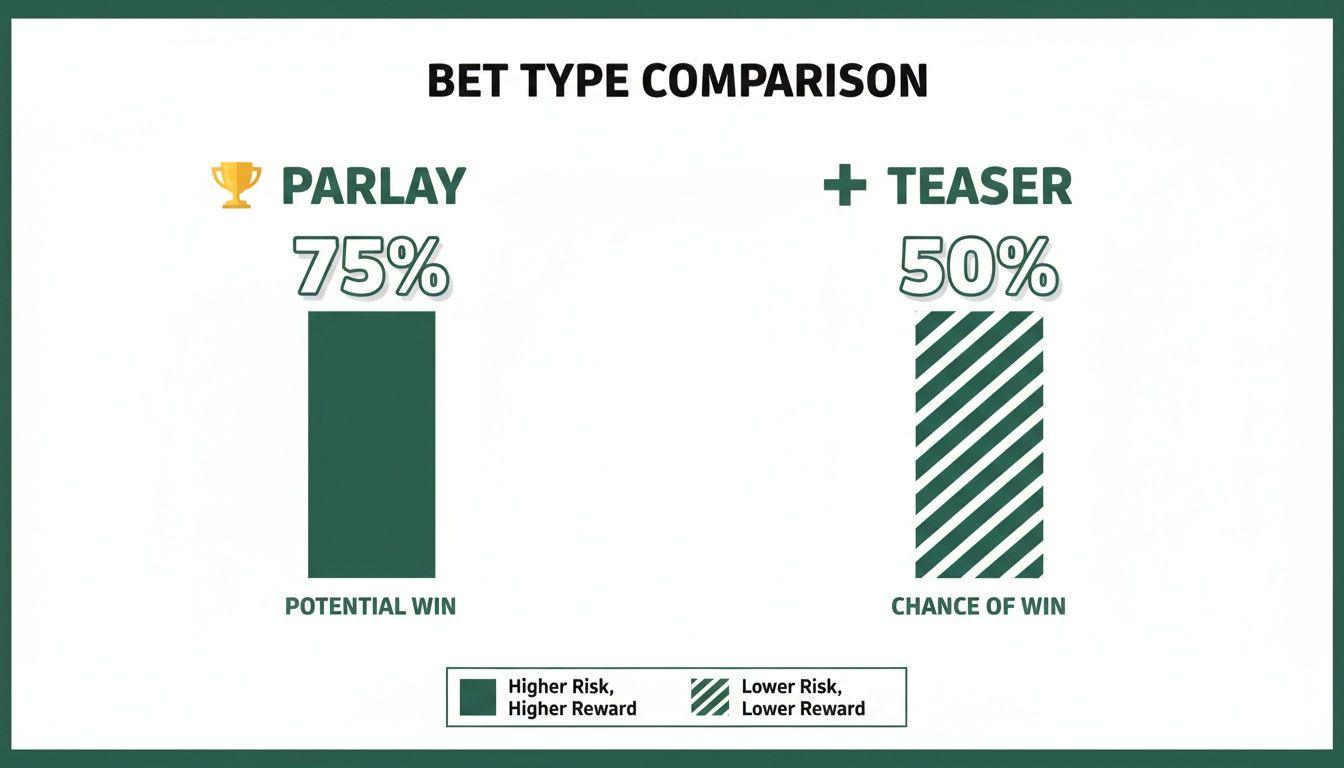
While that image makes teasers look like they have a much higher chance of winning, the punishing math of the house edge often makes them a terrible value compared to other wagers.
Why Not All Teasers Are Equal
The key thing to remember is that while the vast majority of teasers are sucker bets, not every single one is a trap. The sportsbook's standard pricing is designed to profit from bettors who see the "safer" lines and don't bother to calculate the actual value of what they're giving up.
So, how do you find that rare teaser that actually offers positive expected value (+EV)? It takes a much more strategic approach than just picking teams you like. You have to hunt for very specific situations where moving the line creates a statistical advantage big enough to overcome the terrible payout odds.
A great first step is to use a tool to figure out if your wager actually holds positive value. You can learn more about this by checking out our guide on using an expected value calculator.
This mathematical foundation is what sets the stage for the advanced strategies we'll get into next, the ones that can actually turn the house's built-in advantage back in your favor.
The Winning Strategy of Wong Teasers
We've already established that most teasers are a statistical trap. They're designed with a heavy house edge that slowly but surely drains a bettor's bankroll. So, is there ever a time when a teaser is actually a smart, strategic play? The answer is a resounding yes, but only under a very specific set of circumstances defined by a legendary strategy known as the Wong teaser.
This approach, developed by the iconic sports bettor and author Stanford Wong, isn't about trying to pick winners. It's a purely mathematical play that exploits a weakness in how sportsbooks price their lines by zeroing in on the most common margins of victory in the NFL.
The Power of Key NFL Numbers
In football, not all points are created equal. The game's scoring system, built around field goals (3 points) and touchdowns with extra points (7 points), means that final scores land on certain margins way more often than others. The numbers 3 and 7 are the undisputed kings of the gridiron.
A Wong teaser is a 2-team, 6-point NFL teaser that strategically moves the point spread across both of these key numbers. When you do that, you capture a massive amount of statistical value, turning what is normally a high-edge bet into one with a positive expected value (+EV). It's a simple concept with seriously powerful implications.
The core idea behind a Wong teaser is that the six points you "buy" aren't all of equal value. Moving a line from -8 to -2 is far more valuable than moving it from -5 to +1. Why? Because the first move crosses both key numbers of 7 and 3, while the second move crosses neither.
This strategy only works when you find specific point spreads that let you push a team's line through both 3 and 7. If you try to apply this logic to random spreads or other sports like basketball, where scoring is more fluid, you completely miss the point and the teaser reverts right back into a losing proposition.
Identifying a True Wong Teaser
To pull this strategy off, you have to be disciplined and patient. You're waiting for games with lines that fall into a very narrow sweet spot. There are really only two scenarios that qualify for a classic Wong teaser:
Teasing Favorites Down: You’re hunting for favorites with a point spread between -7.5 and -8.5. Applying a 6-point teaser slides this line down to between -1.5 and -2.5. This is the perfect setup because your team no longer has to win by more than a touchdown; they just need to win by a field goal. You cross the key numbers of 7, 6, 4, and 3.
Teasing Underdogs Up: The other prime situation involves finding underdogs with a point spread between +1.5 and +2.5. A 6-point teaser bumps this line up to between +7.5 and +8.5. This is just as powerful. You turn a team that had to stay within a field goal into one that can now lose by a full touchdown and still cover the spread for you. You cross the key numbers of 3, 4, 6, and 7.
Any line that falls outside these tight ranges fails to capture the full statistical punch of crossing the most critical margins of victory. For instance, teasing a favorite from -10 down to -4 is way less effective because you only cross the key number of 7, not 3.
The Proof Is in the Numbers
This isn't just some clever theory; it's a strategy backed by decades of hard data. The whole reason this teaser in betting strategy works is its ability to dramatically boost the win probability of each leg enough to overcome the poor -120 payout odds.
The break-even point for each leg in a typical -120 teaser is roughly 73.9%. While hitting that mark with random picks is nearly impossible, the Wong criteria specifically target situations where the win probability jumps way higher. Stanford Wong's strategy focused on crossing key NFL numbers like 3 and 7. After analyzing thousands of games, it was found that 'Wong teasers' achieved a 72.54% win rate, with some combinations giving the player an advantage of up to 4.74%. This effectively turns the sportsbook's edge completely on its head. You can read the full research about these teaser betting findings and see how the math flips the odds.
This historical performance shows how a disciplined, math-based approach can transform a "sucker bet" into a profitable long-term strategy. It takes patience and a sharp eye for the right numbers, but when the conditions line up, the Wong teaser is still one of the few proven ways to beat the books at their own game.
Applying Advanced Concepts to Find Betting Value
The Wong teaser is a brilliant blueprint for beating the odds, but it's really just the beginning. The core principle was never about rigidly following one formula; it’s about understanding why that formula works in the first place. Today's data-driven bettors apply that same logic to uncover new opportunities that go far beyond the classic Wong criteria.
This advanced approach means hunting for spots where the adjusted line offers a disproportionate amount of value, even with the lousy payout. Instead of just zeroing in on favorites between -7.5 and -8.5, a sharp bettor is on the lookout for other statistical edges buried in game totals, specific team matchups, and powerful situational trends.
The goal is to stop thinking like someone just trying to pick a winner and start acting like a strategic investor. You're searching for market inefficiencies where historical data and statistical analysis reveal a consistent edge. This simple shift in perspective turns basic gambling into a calculated, process-driven strategy.
Expanding the Definition of Value
While crossing the key numbers of 3 and 7 remains the gold standard for any teaser leg, other factors can create a similar statistical advantage. The trick is to find spots where the six points you buy have an outsized impact on the probability of that leg winning.
This means you have to dig a little deeper into the numbers. For instance, analyzing how a team performs against the spread (ATS) in specific situations can uncover powerful patterns. Does a certain team consistently overperform as a home underdog? Does another team's defense fall apart on the road, making them vulnerable even when they're favored?
These are the kinds of questions that lead you to real value. You might find a team that doesn't fit the classic Wong mold but whose profile suggests a 6-point teaser leg has a much higher win probability than the 73.9% break-even rate requires. It's about applying the spirit of the Wong teaser, not just the letter of the law.
The real edge comes from identifying scenarios where the market undervalues the impact of those six points. Whether it's a low-total game where points are precious or a situational trend that points to a close contest, the underlying principle is the same: find the hidden value.
Leveraging Data-Driven Situational Trends
This is where historical data becomes your most powerful weapon. By analyzing decades of game results, sharp bettors can pinpoint recurring trends that have consistently produced profitable outcomes. These aren't just gut feelings; they are data-backed systems proven to work over a massive sample size.
Here are a few examples of how situational trends can help you spot a valuable teaser leg:
- Low-Total Games: In games with a low projected total (think under 41 points), every single point is inherently more valuable. Teasing an underdog up by six points in a defensive slugfest is often far more effective than in a potential shootout where points come cheap.
- Divisional Underdogs: Familiarity breeds contempt, and in the NFL, it also breeds close games. Teasing divisional underdogs often carries extra value because these matchups are notoriously hard-fought and frequently decided by a single score.
- Analyzing Team Performance: Look at how teams perform in specific roles. Some teams are bullies as favorites but crumble as underdogs, and vice versa. Teasing a tough underdog against a favorite that's known for playing down to its competition is a classic way to find situational value.
These aren't foolproof rules, but they are fantastic analytical starting points. Modern data from StatSharp's NFL teaser stats shows just how effective these systems can be. For example, a strategy of betting against home favorites of 3.5-10 points after they've just lost by 10 or more points has hit at a 68.5% win rate since 1983. That translates to a +31.1 unit gain and a juicy 30.7% ROI. This is hard proof that a disciplined, data-driven approach can consistently find an edge. You can explore more insights about proven NFL betting systems on Wizard of Odds.
Ultimately, finding teaser value is all about the process. It takes research, discipline, and a willingness to look beyond the obvious. By analyzing game totals, matchups, and historical trends, you can start uncovering your own profitable opportunities and elevate your betting from guesswork to a calculated, long-term strategy.
Of course. Here is the rewritten section, crafted to sound like a human expert and match the provided style examples.
Common Teaser Betting Mistakes to Avoid
Even with a solid strategy in your back pocket, it’s alarmingly easy to fall into the common traps that come with teasers. These bets are designed to look like a bargain, and sportsbooks are banking on bettors making a few simple but expensive mistakes. If you want to protect your bankroll, you need the discipline to steer clear of the blunders that trip up most players.
Think of it like being a chef. You can have the best ingredients (a solid team pick), but if your technique is off (a bad teaser strategy), the final dish is going to be a disaster. Let's break down the most frequent slip-ups and how you can sidestep them to keep your betting sharp and profitable.
Mistake 1: Teasing Through Zero
This is one of the most fundamental errors you can make with a teaser in betting: moving a line across the number zero. It happens all the time when a bettor teases a small favorite, like -2.5, up to +3.5. On the surface, it feels like you're getting a comfy six-point cushion, but a massive chunk of that value is completely wasted.
Football games can't end in a 0-0 score, and a team can’t win or lose by zero points. So when you move a line from -1 to +1, you're covering outcomes that are statistically impossible. The points you "buy" when crossing zero are dead weight; they offer you no real advantage but still cost you in the form of a slashed payout.
- What to Do Instead: Keep your teaser legs focused on crossing the numbers that matter most. The most valuable points in an NFL teaser are the ones that move a line across the key numbers of 3 and 7. Never, ever waste your points crossing zero; the math just doesn't back it up as a winning play in the long run.
Mistake 2: Applying Football Logic to Basketball
Another classic pitfall is assuming that a winning football teaser strategy translates directly to basketball. While sportsbooks will happily offer you NBA teasers, they are almost always a horrendous value proposition for the bettor. This is a classic case of comparing apples and oranges.
The entire value proposition of an NFL teaser is built on its unique scoring system. The high frequency of 3 and 7 point margins of victory creates a predictable, exploitable pattern. Basketball, on the other hand, is a high-volume scoring game where points come in ones, twos, and threes. A five-point swing in an NBA game is nowhere near as meaningful as a six-point move in the NFL. There are simply no "key numbers" in basketball to anchor your strategy to.
Applying a Wong teaser strategy to an NBA game is like using a football playbook to coach a basketball team. The principles don't transfer because the rules and structure of the game are fundamentally different.
Mistake 3: Ignoring Payout Odds and Value
This is probably the most damaging mistake of all: focusing only on picking winners without giving a single thought to the price. Bettors get completely caught up in how "safe" an adjusted line looks, teasing a heavy favorite down to a pick'em without ever stopping to ask if the payout justifies the risk. This is the exact trap the sportsbooks want you to fall into.
As we've already covered, the standard -120 payout for a two-team, six-point teaser demands that each leg wins nearly 74% of the time just for you to break even. Most teaser legs, even the ones that look like a sure thing on paper, don't come anywhere close to hitting that mark. Chasing "easy wins" without calculating the required break-even point is a guaranteed recipe for bleeding your bankroll dry over time.
- What to Do Instead: Always start with the math. Before you even think about placing a teaser, calculate the implied probability and the break-even win rate. Use tools and historical data to figure out if your chosen legs have a legitimate shot at clearing that hurdle. A disciplined bettor knows that a bet is only as good as the price you get.
Using Tools to Calculate True Teaser Value

Turning all this theory into actual profit requires the right gear. While it's crucial to understand the math behind a teaser, nobody has time to crunch complex numbers on the fly for every bet. This is where technology steps in, bridging the gap between a smart strategy and a well-placed wager.
A teaser calculator is an absolutely essential piece of kit for any serious bettor. These simple tools do the heavy lifting, stripping away the mystery behind the numbers. They empower you to look past the sportsbook’s tempting lines and see what a teaser is actually worth.
You just plug in the odds (like -120) and the number of teams, and the calculator spits out the break-even win rate. That single number is your North Star. It tells you the exact performance threshold each of your picks needs to clear for the bet to be profitable.
A teaser calculator strips away the guesswork. It provides immediate clarity on whether a potential bet has a mathematical edge or if it's just another sportsbook trap designed to look appealing but lose over time.
Automating the Hunt for Value
While a basic calculator is great for sizing up a specific bet you're considering, the real pros take it a step further. Advanced platforms can automate the entire hunt, scanning the market 24/7 for odds discrepancies and flagging high-value opportunities the second they appear.
These tools are built to spot situations where a sportsbook has mispriced a line. For a value bettor, finding those moments where teaser lines drift away from their true probabilities is the entire game. Modern tools are brilliant at this, much like how users on platforms such as BettorEdge can find spots with a 40% profit chance, a massive leap from the typical 2% found at traditional sportsbooks. You can dig deeper into how these value gaps are identified over at Wizard of Odds.
This automation lets you focus on strategy instead of getting buried in manual calculations. You stop searching for value and start getting real-time alerts when it finds you, turning a reactive process into a proactive one. ValueBetFactory's own odds payout calculator is a great starting point for anyone looking to bring these kinds of tools into their workflow.
Ultimately, putting these tools to work completely changes your approach. You move from making educated guesses to making data-backed decisions, ensuring every teaser you place is grounded in solid math and has a genuine, quantifiable edge.
Frequently Asked Questions About Teaser Bets
Once you start exploring teasers, a few common questions always seem to pop up. Even with a good grasp of the basics, real-world situations can throw you a curveball. Let’s clear up some of the most frequent queries to sharpen your understanding.
Are Teaser Bets a Good Idea for Beginners?
Honestly, for most beginners, teasers are a trap. They look tempting because moving the line feels like it makes the bet easier to win, but this is usually a dangerous illusion. Most standard teasers are designed with a hefty house edge, making them long-term money losers for anyone betting without a specific strategy.
If you're new to betting, your first goal should be mastering single bets to get a feel for true value. If you're determined to try a teaser, it's absolutely critical that you only do so when the math is overwhelmingly in your favor. The classic "Wong teaser," which involves teasing NFL point spreads across the key numbers of 3 and 7, is the only widely accepted profitable approach.
A random teaser is one of the fastest ways to burn through a bankroll. A strategic one, placed only when the conditions are perfect, is a sharp bettor's tool. For a beginner, knowing the difference is everything.
What Happens in a Teaser if One Leg Pushes?
A push, a tie against your adjusted point spread, is handled differently depending on the sportsbook and how many teams are in your teaser. There’s no universal rule, so you should always check the house rules where you bet.
That said, most sportsbooks follow a general standard:
- For teasers with three or more teams: A push on one leg simply gets removed from the bet. Your 4-team teaser becomes a 3-team teaser, and the payout is recalculated at the lower odds.
- For a 2-team teaser: If one leg pushes and the other one wins, the entire bet is typically graded as a "push." This means your stake is refunded, no win, no loss.
And remember, if any leg in your teaser loses, the whole bet is a loser, no matter how many other legs pushed or won.
Can You Tease Sports Other Than Football?
You can, but you really, really shouldn't. While you’ll see sportsbooks offering teasers on sports like basketball, sharp bettors avoid them like the plague. The entire mathematical foundation that makes football teasers potentially valuable just doesn't exist in other sports.
Football's scoring is unique, revolving around key numbers like 3 and 7. Moving a line across both of these numbers has a massive statistical impact. A 6-point swing in an NFL game is huge. In contrast, a 5-point move in an NBA game, where teams can score 120 points, is almost meaningless. Because of that fundamental difference, basketball teasers offer atrocious value and are considered sucker bets.
Ready to stop guessing and start making data-driven decisions? The tools at ValueBetFactory are designed to help you spot real value in the market, turning complex math into actionable insights. Discover our suite of betting calculators and get real-time alerts by visiting ValueBetFactory today.