
Boost Profits with a Sports Betting ROI Calculator
Unlock Profits with betting tips!
A sports betting ROI calculator is a straightforward tool that does one thing incredibly well: it measures how profitable your betting is compared to the total amount you’ve staked. It cuts through the noise of wins and losses to show you the true efficiency of your wagers, revealing exactly how much profit you’re generating for every dollar you risk.
Why Betting ROI Is Your Most Important Metric

When you first get into betting, it’s easy to get swept up in the thrill of individual wins. Nailing a longshot for a big payout feels fantastic, but does it actually prove your strategy is sound? The hard truth is that isolated wins and losses don't tell you the whole story.
Return on Investment (ROI) is the ultimate report card for any serious bettor. It provides a standardized measure of your success that cuts out the luck factor. This metric is so powerful because it’s totally independent of your bankroll size; a bettor working with $100 and another with $10,000 can compare their skill using the exact same yardstick.
Before we go deeper, let's quickly cover the lingo. Understanding these terms is the first step to thinking like a pro.
Understanding Key Sports Betting ROI Terms
This table gives you a quick rundown of the essential terms you need to know before calculating your Return on Investment.
| Term | What It Means for Your Bets |
|---|---|
| ROI (Return on Investment) | The percentage of profit you've made relative to your total stakes. Your key performance metric. |
| Total Stakes | The cumulative amount of money you have wagered over a specific period. |
| Total Profit/Loss | The net amount of money you have won or lost from all your bets combined. |
| Value Betting | The strategy of finding bets where the probability of winning is higher than the odds suggest. |
With these terms in mind, you can start to see why ROI is so much more than just a number. It's a reflection of your ability to consistently find an edge.
The True Mark of a Skilled Bettor
A consistently positive ROI, even a seemingly small one like 3-5%, is the hallmark of a skilled bettor. It’s a clear signal that you aren't just getting lucky. You're effectively identifying profitable opportunities over and over again. This is the entire game when it comes to finding positive expected value, a concept we break down in our guide to value betting.
This shift in mindset is crucial, especially in a market that's exploding. The global sports betting scene was valued at around $102.4 billion and is on track to hit $265.5 billion by 2034. With user numbers climbing toward 231.9 million by 2029, the field is getting more crowded. Using professional metrics is what will separate you from the casual crowd.
ROI is your financial report card. It doesn’t care about your favorite team or a lucky guess. It only measures one thing: your ability to generate profit from the capital you risk.
Tracking your ROI forces you to think like an investor, not just a fan. It helps you pinpoint which sports, bet types, or strategies are actually making you money. By focusing on this single number, you stop chasing wins and start building a sustainable, profitable approach to sports betting.
How to Manually Calculate Your Betting ROI
Before you lean on an automated sports betting ROI calculator, it's a good idea to get your hands dirty with the math first. Manually calculating your Return on Investment gives you a much deeper feel for how your betting habits actually translate into profit or loss. The formula itself is dead simple, boiling down to just two key numbers.
The first piece is your Total Net Profit. This isn't just your winnings; it's the pure profit left over after you've subtracted all your initial stakes. To find it, you simply take the total amount returned from your winning bets and subtract the total amount you wagered to get there.
The second part of the equation is your Total Amount Wagered, often called your turnover. This is the grand total of every stake you've placed over a certain period, wins and losses included. It represents the total capital you put at risk.
Putting the Formula into Practice
Let's walk through a real-world scenario to see how this plays out. Imagine you spent a month betting on the Premier League:
- Total Wagered (Turnover): You placed 20 bets of $50 each, so your total turnover is $1,000.
- Total Returns: From the bets that came in, you got $1,150 back in total.
- Total Net Profit: Your profit is just your returns minus your turnover: $1,150 - $1,000 = $150.
With those two figures locked in, the ROI calculation is a piece of cake. The formula is (Total Net Profit / Total Turnover) x 100.
For our example, the math looks like this: ($150 / $1,000) x 100 = 15% ROI. This tells you that for every single dollar you risked that month, you earned a 15-cent profit on average.
This quick process shows just how easily you can figure out your ROI with only your profit and total stakes.
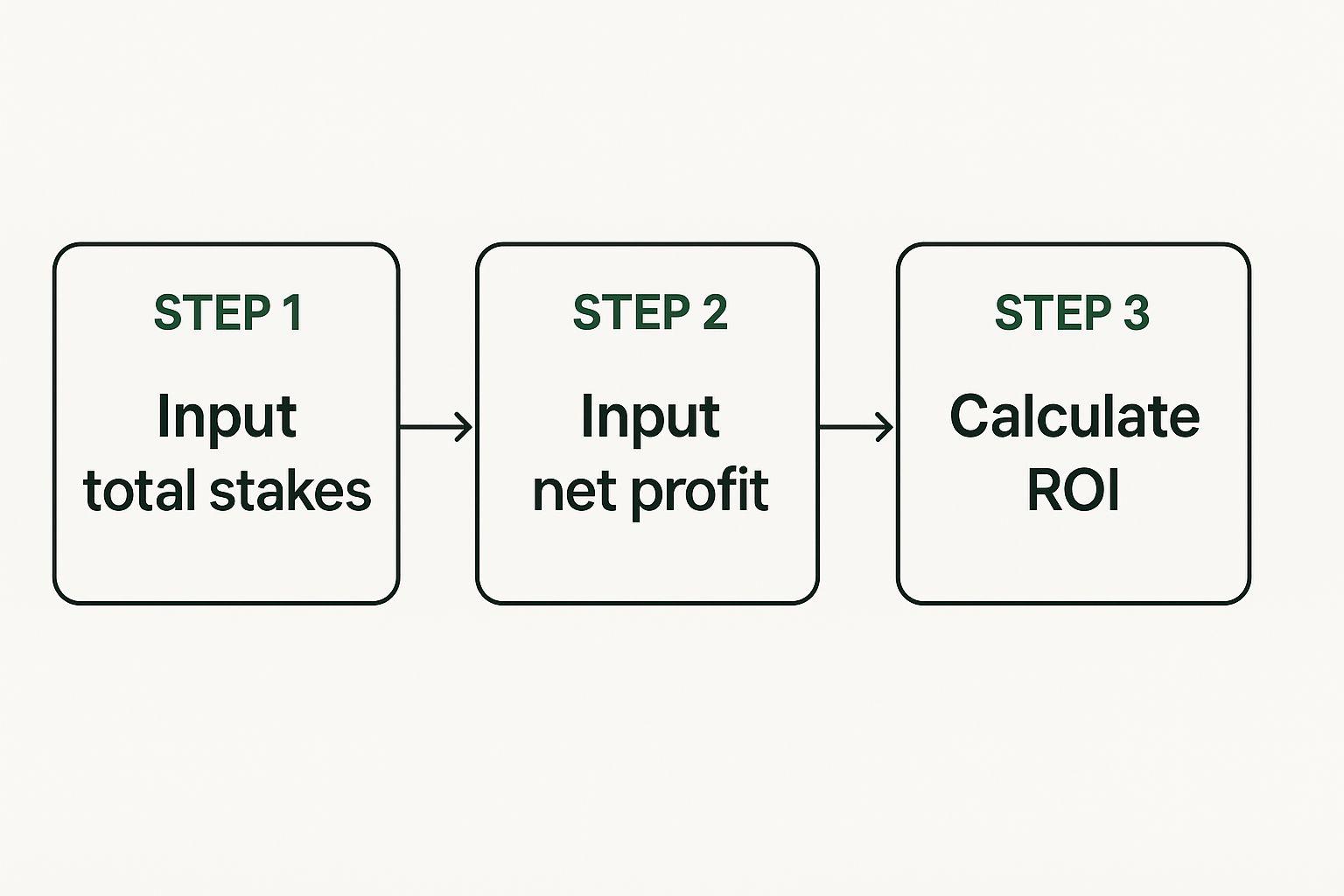
This visual breaks it down perfectly, showing that once you have your core numbers, the final calculation is straightforward. Doing a manual check like this is a great way to verify the results you get from online tools and to develop a better instinct for the odds you’re playing. If you want to dive deeper into how odds and probability are linked, check out our guide on the odds to percentage calculator.
Using an Online Sports Betting ROI Calculator
While calculating your ROI by hand is a great way to understand the math, it's not the most practical approach if you're betting regularly. Let's be honest, who has the time for that? This is where a good online sports betting ROI calculator becomes an essential piece of your kit. It automates the whole process, saving you time and, more importantly, preventing costly manual errors.
These tools are built for one reason: to give you fast, accurate feedback. Instead of wrestling with a spreadsheet and manually entering every stake and return, you can punch in the numbers and get an instant reading. This frees you up to focus on what actually matters: analyzing your performance and figuring out how to improve your strategy.
The shift to online betting has made these tools more important than ever. In fact, online platforms now account for a staggering 78.2% of the global sports betting market revenue. This just shows how much bettors value the convenience and transparent data tracking that digital tools offer.
Streamlining Your Analysis
Using an online tool gives you immediate, actionable insights. You can track your performance across different sports, leagues, or even specific bet types like parlays or moneylines. This is how you quickly spot what's working and cut out what's dragging your numbers down.
Here’s a look at how simple these calculators can be. You just need two numbers: your total profit and your total stake.

As you can see, it couldn't be more straightforward. Two input fields, one clear result. The calculator does the heavy lifting and spits out your precise ROI percentage without you having to touch a formula.
The real power of an ROI calculator isn't just getting a number; it's the ability to consistently track that number over hundreds of bets. This long-term view is what separates strategic betting from simple gambling.
By making a sports betting ROI calculator part of your routine, you move beyond guesswork and into data-driven decision-making. Of course, ROI is just one piece of the puzzle. To really sharpen your edge, you also need to understand the underlying value of each bet before you place it.
For a deeper dive into that, check out our guide on how to use an expected value calculator. It’s the perfect next step to help you assess whether your bets are actually profitable in the long run.
Right, so you've got your ROI number. Now what?
Getting a percentage from a calculator is the easy part. The real skill is knowing what that number actually tells you about your betting. This is where you move from just tracking numbers to gaining a genuine, sustainable edge.
A classic mistake is getting hung up on chasing some ridiculously high ROI. The truth is, in the world of serious betting, a consistent 1-5% ROI over the long haul is the signature of a sharp, successful bettor. Anything more is usually a short-term fluke.
Look Beyond the Headline Number
It's all about context, and the most important piece of context is your sample size.
Seeing a +25% ROI after just ten bets feels great, but let's be honest, it's almost certainly a lucky streak, not a repeatable strategy. On the other hand, a steady +4% ROI calculated across 500 or even 1,000 wagers? That's the real deal. That indicates you've found a genuine, profitable advantage. The second scenario is infinitely more impressive and, more importantly, sustainable.
This is where your data stops being a report card and starts being a powerful tool to refine your entire approach.
Find Your Strengths and Weaknesses
Your overall ROI is just the headline. The real story, the actionable intel, is buried in the details. By breaking down your results, you can see exactly where you're making money and where you're bleeding it.
For instance, after segmenting your betting history, you might uncover some powerful trends:
- You're crushing it on NFL moneyline bets, pulling in a healthy +7% ROI.
- But those NBA parlays you love are a disaster, sitting at a painful -15% ROI.
This is the kind of insight that changes everything. It tells you exactly where to focus your time and your bankroll. It shines a bright light on the specific bets and habits that are actively costing you money, so you can cut them out for good.
Your overall ROI is just a starting point. The real magic happens when you slice up the data. Analyze your ROI by sport, by league, and by bet type. This is how you discover your most profitable markets and double down on what’s actually working.
When you start treating your ROI as a diagnostic tool rather than just a score, you make the leap from casual punter to a strategic, analytical bettor. It allows you to systematically improve your process, eliminate losing habits, and build a betting strategy that relies on skill, not just luck.
Advanced Strategies to Improve Your Betting ROI

Tracking your ROI is a fantastic start, but it's a passive metric. The real goal is to grab the wheel and actively drive that number up. This means making a conscious shift from hoping for wins to systematically building an edge for yourself. It's the disciplined approach that separates profitable bettors from the rest of the pack.
The absolute cornerstone of this approach is value betting. In simple terms, this means hunting for odds that are better than the true statistical probability of something happening. You’re looking for those moments when a bookmaker has undervalued a team or an outcome, creating a pocket of profit just waiting to be claimed.
Of course, finding value is useless without disciplined bankroll management. Even the sharpest value-finding strategy can be completely wrecked by emotional staking. A strict system, whether it's the Kelly Criterion or a simple flat-staking model, protects your capital and ensures one bad beat doesn't derail your entire long-term strategy.
Embrace Data-Driven Betting
On top of discipline, today's sharpest bettors are armed with powerful analytical tools. Artificial intelligence (AI) is a key force reshaping the sports betting market, pushing predictive analytics and the way we calculate ROI to new levels of sophistication.
This isn't just a niche trend; it's a massive driver of growth. Between 2025 and 2029, the global sports betting market is projected to expand by an additional $221.1 billion. A huge chunk of that growth is fueled by machine learning that refines betting models, allowing you to calculate your potential ROI with far greater precision. You can learn more about these market trends and the impact of AI in the latest industry reports.
The best bettors combine three key elements: a deep understanding of value, unwavering bankroll discipline, and the smart application of data analytics. Neglecting any one of these pillars will ultimately limit your potential ROI.
By weaving these advanced strategies together, you create a robust framework for success. You stop relying on luck and start building a systematic process designed to elevate your ROI into a consistently profitable range. It’s all about making smarter, data-backed decisions on every single wager you place.
Common Questions About Sports Betting ROI
Once you start crunching the numbers and tracking your performance, a few questions always seem to pop up. Let's tackle some of the most common ones bettors ask when they first start using an ROI calculator, so you can move forward with total confidence.
Diving into this level of detail is exactly how you start to understand your real, sustainable edge over the books.
What Is a Good ROI in Sports Betting?
This is the big one, isn't it? It’s easy to get excited by a huge ROI over a weekend, but those spikes are usually just short-term luck, or variance, doing its thing.
In the long run, a sustainable ROI of 3-5% is considered excellent. It’s the benchmark many professional bettors strive for. If you can consistently hit anything north of 5% over a massive sample of bets, you're in truly elite territory.
Don't let those single-digit numbers fool you. In the world of sports betting, that kind of consistent, steady return is the true sign of a skilled, profitable, and disciplined strategy.
How Many Bets Do I Need for a Meaningful ROI?
You can technically calculate your ROI after just one bet, but the number doesn't mean much until you've built up a decent history. The more bets you place and track, the more the luck factor gets ironed out, leaving a clearer picture of your actual skill.
Most seasoned bettors agree that you need a history of at least 500 to 1,000 bets to get a meaningful ROI percentage. Before that point, your results can still be heavily influenced by short-term luck, both good and bad.
Hitting that kind of volume gives you confidence that your ROI reflects a solid strategy, not just a temporary hot or cold streak.
Should I Include Bonuses and Free Bets?
This really depends on what you’re trying to measure. If you want the purest, most honest assessment of your betting skill and edge-finding ability, you should exclude free bets and bonus funds.
Why? Because they don't represent your own capital at risk. Including them can seriously inflate your ROI and give you a false sense of how good your picks actually are.
That said, it can be a smart move to track a separate ROI that includes all those promotions. This tells you how profitable your entire operation is and how effectively you're capitalizing on sportsbook offers. Just make sure you never mix the two metrics. They tell very different stories about your performance.
Ready to stop guessing and start tracking your performance with precision? The ValueBetFactory ROI calculator gives you the clear, instant feedback you need to refine your strategy and boost your profits. Find your edge today by visiting ValueBetFactory.