
A Practical Guide to Sports Betting for Profit
Unlock Profits with betting tips!
Absolutely, making a consistent profit from sports betting is a real possibility. But let's be clear: it has almost nothing to do with luck. It’s about shifting your mindset from a casual hobby to a calculated investment, where every decision is backed by data, a solid strategy, and unwavering discipline.
The Reality of Sports Betting for Profit

If you're serious about turning a profit, the first thing to go is betting with your heart. No more backing your favorite team just because they're your favorite, and definitely no more chasing huge payouts on lottery-ticket parlays. Profitable sports betting is run like a business, plain and simple.
You have to start thinking like a stock trader or an entrepreneur. Every single wager is an investment, one that you've researched and calculated, never one based on a gut feeling or a hot tip from a friend.
Foundational Pillars of Success
I've seen countless bettors fail because they skip the fundamentals. To build a lasting, profitable approach, you need to master a few core principles. These aren't just tips; they're the absolute non-negotiables that separate the pros from the pack.
- Finding True Value: This is the bedrock of everything. You're not trying to pick winners. You're trying to find odds that are just plain wrong, where the bookmaker has underestimated a team's chances.
- Effective Risk Management: You have to protect your bankroll like it's your life savings. That means a strict staking plan that can weather the inevitable losing streaks without wiping you out.
- Emotional Control: This might be the hardest part. You have to stay completely level-headed, whether you're on a hot streak or a brutal cold spell. Emotional decisions, like chasing your losses, are the quickest way to go broke.
The sports betting market is massive. We're talking about a global industry projected to rocket from over $103 billion to nearly $234 billion by 2032. Yet, despite all that money flying around, the vast majority of people lose. Why? Because they can't overcome the bookmaker's built-in advantage, the 'vig' or margin, which usually sits around 5-10%.
The pros win because they find the cracks in the market. They use data, models, and disciplined strategies to find those rare spots where the odds are tilted in their favor. If you want to dive deeper into the numbers, you can find more in this detailed sports betting market research.
The single biggest hurdle for aspiring bettors is understanding that you are competing against a market designed to have an edge over you. Your job is to systematically find the rare instances where that edge flips in your favor.
Ultimately, this whole endeavor comes down to discipline and sharp analysis. You'll face real challenges, like variance that tests your patience and the psychological grind of a losing run. But accepting this and adopting a structured, analytical view is the first, most crucial step toward actually making money in the long run.
How to Master Finding Value Bets

Let's get one thing straight: profitable sports betting isn't about picking winners. It’s about finding value. It's a disciplined hunt for wagers where the bookie’s odds are actually better than the real statistical chance of something happening.
This is the entire game. You’re essentially looking for pricing mistakes in the betting market. Think of it like a stock trader finding an undervalued company, you're just doing it with sports odds.
Unlocking Implied Probability
Every set of odds has a hidden percentage baked into it, what we call implied probability. This is the bookmaker's take on how likely an outcome is, with their profit margin (the "vig") added on top. Getting a handle on this is your first real step toward spotting value.
The math for decimal odds is refreshingly simple: (1 / Decimal Odds) * 100.
So, if a team is priced at 2.50 to win, the implied probability is (1 / 2.50) * 100 = 40%. In the bookie's eyes, that team has a 40% shot. This simple calculation turns abstract odds into a concrete percentage, letting you ask the most important question in betting: "Is this team's actual chance of winning better than 40%?" If you can honestly answer yes, you've probably just found a value bet.
If you really want to get this concept down cold, our detailed guide on what a value bet is is the perfect next step.
Crafting Your Own Probability Models
The next move is to stop relying on the bookie's numbers and start making your own. This sounds intimidating, but it doesn't require a data science degree. All you need is a logical way to estimate the true probability of an outcome.
You can build a solid model using stats that are easy to find. Let's take a basketball game between Team A and Team B. You’d want to look at things like:
- Recent Form: How have they played over the last 10 games? Is one team hot and the other cold?
- Head-to-Head: What’s the track record when these two teams face off?
- Key Metrics: How do their offensive and defensive ratings stack up against the league average?
- Home Court Advantage: Does one team have a significant performance boost on their home court?
By weighing these factors based on what you think is most important, you can come up with your own probability. Maybe after crunching the numbers, you land on Team A having a genuine 45% chance of winning.
Key Takeaway: The goal isn't perfection. It’s about being more accurate than the bookmaker over the long haul. A consistent edge of just a few percentage points is what separates the pros from the pack.
Spotting the Gaps That Mean Profit
Now, it's time to put it all together. Let’s stick with our basketball example. The bookmaker is offering 2.50 on Team A, which we know is an implied probability of 40%. But your own model tells you their real chance is closer to 45%.
That 5% gap is your value. It’s the edge you've been looking for. The bookmaker has undervalued Team A, and that’s where you pounce.
Here's another real-world scenario from a soccer match. A team is priced at 3.00 to win an away game. The implied probability is 33.3%. But you've done your homework. You know their star striker is on fire, they have a fully healthy squad, and the home team is missing two key defenders. Your analysis puts their true winning chance at 38%. Bingo, another clear value opportunity.
Consistently placing bets in these situations, backed by a smart staking plan, is the only sustainable way to build a bankroll.
Your Go-To Resources for Sharper Predictions
To make your probability estimates as accurate as possible, you need solid data. Gut feelings are the fastest way to an empty account. Instead, you need to lean on trusted sources that give you the statistical firepower for your analysis.
Here are a few places I always have open:
- Statistical Databases: Sites like StatsBomb, Opta, and even the deep-dive sections on ESPN are goldmines. They have everything from basic records to advanced metrics that give you a genuine analytical edge.
- Betting Exchanges: A platform like Betfair is fantastic because it shows you where the market's money is really moving. Watching the odds shift on an exchange gives you the collective wisdom of thousands of bettors, which is often a more accurate picture than a single bookie’s line.
- Odds Comparison Sites: This is non-negotiable. These tools instantly show you which bookmaker has the best price on your bet. You’ve done all the hard work to find the value; don't leave money on the table by taking bad odds.
Finding value takes work. It means doing the research, trusting your own analysis, and having the patience to wait for the right spots. But once you master this process, you stop gambling and start investing.
Building a Sustainable Bankroll Management Strategy
Finding value is only half the battle. Without a rock-solid plan for your money, even the best betting system is doomed to fail. This is the part of sports betting that isn't glamorous, but honestly, it's the single most important piece of the puzzle. A smart bankroll strategy is what separates professional bettors from casual gamblers.
It’s the difference between building a long-term, profitable venture and just riding a rollercoaster of wins and losses until your cash runs out.
The image below paints a clear picture of this. It shows how different betting amounts impact your bankroll over just 50 bets. You can immediately see the difference between a patient, conservative approach and a risky, aggressive one.
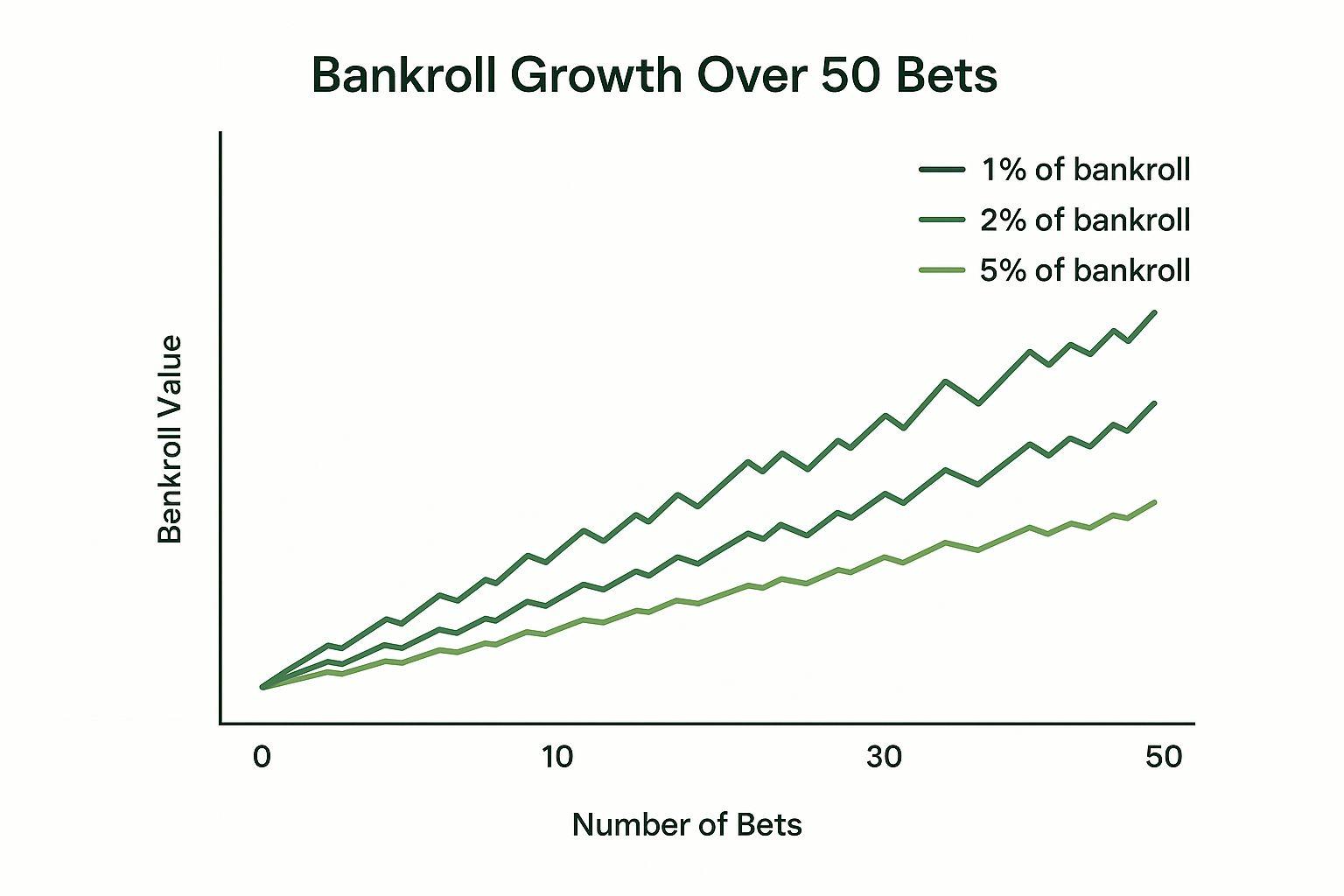
As the graph makes obvious, sticking to a small bet size like 1% or 2% of your bankroll delivers steady, sustainable growth. It smooths out the inevitable losing streaks. That 5% stake, on the other hand, creates wild swings and puts your entire operation at risk.
Defining Your Starting Bankroll and Unit Size
Before you place a single bet, you need to set aside a dedicated bankroll. This has to be money you are completely okay with losing; think of it like startup capital for a business. There are no guarantees here.
Let's say you start with $1,000. The next step is to define your "unit" size. A unit is just your standard bet amount, always calculated as a small percentage of your total bankroll. Most pros live by the 1% to 2% rule.
- On a $1,000 bankroll, a 1% unit is $10.
- A 2% unit is $20.
Sticking to a small unit size is your best defense against variance. It ensures that a bad run, and you will have bad runs, doesn't wipe you out.
Your bankroll is your business's most vital asset. Your number one job is to protect it. The goal isn't to get rich quick; it's to stay in the game long enough for your edge to pay off.
Comparing Staking Strategies
Choosing the right staking method is crucial. It dictates how you size your bets and manage risk. Here’s a quick breakdown of the most common strategies to help you decide which one fits your style and experience level.
| Staking Method | Description | Risk Level | Best For |
|---|---|---|---|
| Flat Staking | Betting the exact same amount (one unit) on every wager, regardless of odds or confidence. | Low | Beginners and bettors who want to remove emotion and enforce discipline. |
| Proportional Staking | Betting a fixed percentage of your current bankroll. Stakes increase after wins and decrease after losses. | Medium | Intermediate bettors looking to compound profits more aggressively while maintaining risk controls. |
| Kelly Criterion | A complex formula that calculates the optimal bet size based on your perceived edge and the odds. | Very High | Advanced, highly experienced bettors who can accurately quantify their statistical edge. |
For most people, especially when starting out, the simplicity and safety of flat staking are unmatched. It builds the discipline needed for long-term success.
Flat Staking Your Way to Consistency
If you're new to treating betting as an investment, flat staking is where you should start. It’s as straightforward as it gets: you bet one unit on every single wager. Period. If your unit is $10, every bet is $10.
This method strips all emotion and subjective "feelings" from your decision-making. It stops you from making the classic mistake of betting more when you're on a hot streak or, even worse, chasing your losses with bigger bets when you’re in a hole.
Think about it. If you hit a rough patch and lose five bets in a row, a $10 unit means you're down $50. It stings, but it’s a manageable hit. If you were risking 5% or 10% of your bankroll on each of those bets, that same losing streak could be devastating.
Advancing to Proportional Staking
Once you've built a solid track record and are comfortable with the process, you might look into proportional staking. Here, your unit is always a fixed percentage of your current bankroll, not your starting amount.
Let’s use that $1,000 bankroll again with a 1% strategy:
- Your first bet is $10 (1% of $1,000). You win, and your bankroll is now $1,010.
- Your next bet is $10.10 (1% of $1,010).
- If you had lost that first bet, your bankroll would be $990, so your next bet would shrink to $9.90.
This approach has risk management baked right in. It lets your profits compound faster by increasing your stakes as you win, but it also automatically reduces your bet size during a slump, protecting your capital when you need it most. To explore these methods in greater detail, check out our complete guide to sports betting bankroll management.
The Perils of the Kelly Criterion
You'll inevitably come across chatter about more complex strategies like the Kelly Criterion. This is a mathematical formula designed to calculate the theoretically perfect bet size by weighing the odds against your perceived edge.
While it sounds great on paper, it's incredibly dangerous in practice. The Kelly Criterion demands that you know your exact edge with perfect accuracy, something that's all but impossible in the real world of sports.
If you overestimate your edge even slightly, the formula will tell you to place terrifyingly large bets that can obliterate your bankroll in a flash. For this reason, nearly all bettors are better off sticking with the proven reliability of flat or proportional staking.
Using Tools and Data to Gain an Edge
Doing your own homework is a great skill, but let's be honest, the pros who consistently turn a profit in sports betting aren't just trusting their gut. They're leaning on technology. In today's market, using the right tools and data is what separates the hopefuls from the winners.
These tools do more than just save you time; they flip the script. They can condense hours of tedious research into a few seconds of automated analysis. More importantly, they give you a bird's-eye view of the entire market, something you could never achieve on your own, helping you make sharp, data-backed decisions.
Always Secure the Best Price
This is the golden rule of profitable betting, yet it's the one most people ignore. Not shopping around for the best odds is like walking into a store and willingly paying more for an item when a cheaper option is right next door. It's a surefire way to kill your profits.
Odds comparison sites are your best friend here. These platforms scan dozens of bookies in an instant, laying out exactly who is offering the best price for your bet. Grabbing odds of 2.10 instead of 2.00 might not feel like a big deal, but that extra 5% return adds up massively over a season.
This one habit alone can be the difference between a winning year and a losing one.
Tracking Closing Line Value (CLV)
If you need a single metric to prove you actually have an edge, Closing Line Value (CLV) is it. This is the ultimate litmus test for your betting instincts. CLV simply measures whether the odds you locked in were better than the final odds offered right before the event starts.
Picture this: you bet on a team at 2.20 odds on Tuesday. By the time the game kicks off Sunday, so much money has come in on them that their odds have dropped to 2.00. You successfully beat the closing line.
Consistently beating the closing line is a massive signal. It shows that your analysis is spotting value before the rest of the market catches on, which is one of the clearest indicators of long-term profitability.
The logic is simple: if you are consistently getting better numbers than the market's final price, you are placing positive expected value (+EV) bets. Over time, this almost guarantees profit, regardless of short-term results.
Automating the Hunt with Specialized Platforms
Manually hunting for value bets and tracking your CLV can feel like a full-time job. That's where specialized platforms come into the picture to do the heavy lifting for you. A service like ValueBetFactory is built from the ground up to automate this entire process.
Their systems are constantly scanning thousands of markets across a huge number of bookmakers. They use sophisticated algorithms to compare bookie odds against a highly accurate "true" probability model, instantly flagging any lines that are out of whack.
The screenshot below from the ValueBetFactory dashboard gives you a live look at these opportunities.
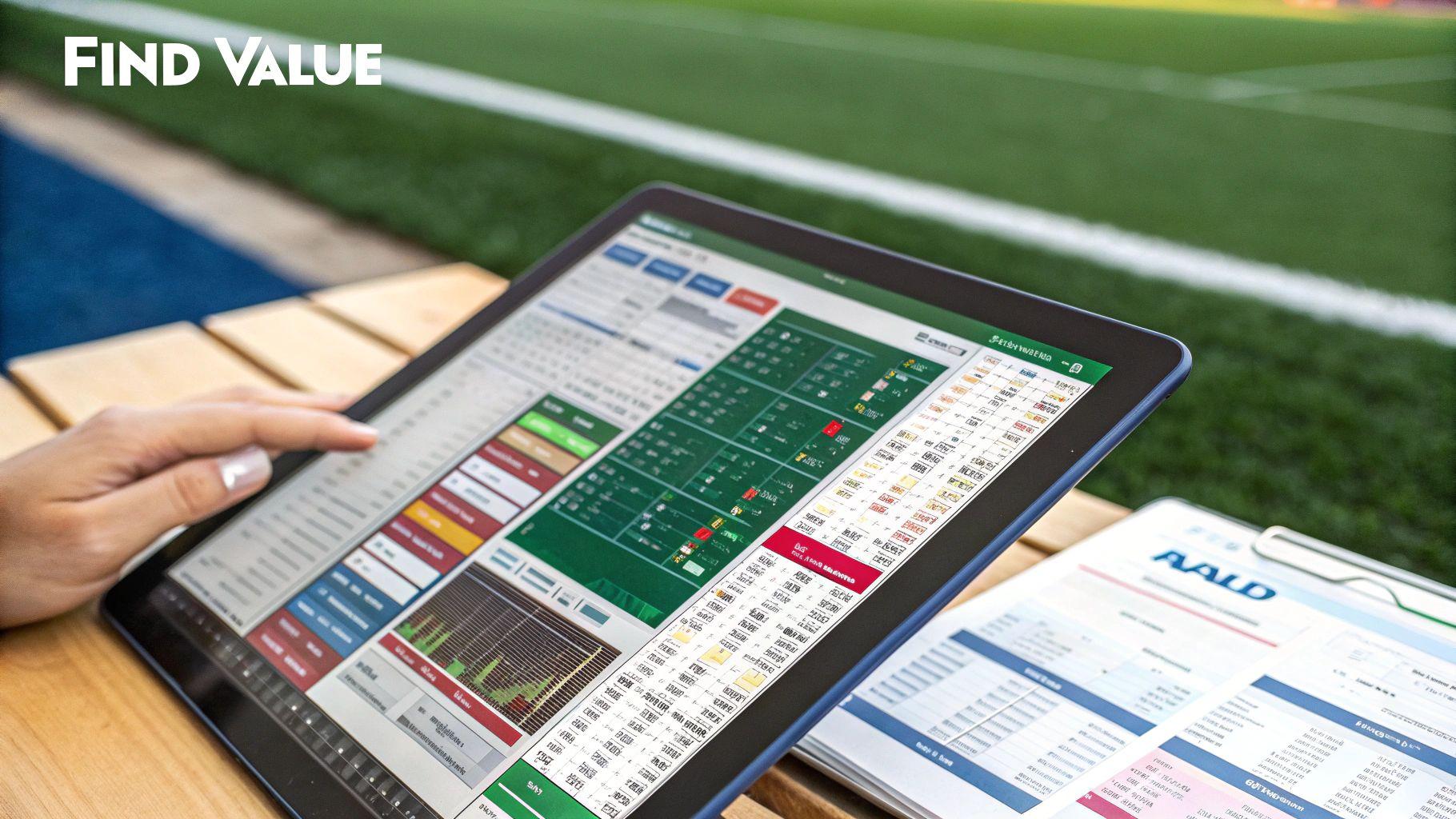
Each row is a potential edge. You can see the event, the specific bet, the bookmaker offering the mispriced odds, and the calculated "value" percentage; that’s your profit margin.
This shift to data-driven betting is part of a much bigger trend. The global sports betting market was pegged at around $102 billion, and it's projected to nearly double to $265.5 billion by 2034. With the number of bettors expected to hit 232 million by 2029, finding an analytical edge is more crucial than ever. You can discover more insights about these global market trends to see just how fast this space is growing.
Integrating Tools into Your Daily Routine
The key here isn't to blindly follow a tool. It's about building a smarter, more efficient workflow. A solid daily process might look something like this:
- Start with the Value Finder: First thing you do is check a platform like ValueBetFactory. See what high-value opportunities its algorithms have already found for you.
- Do Your Own Sanity Check: For the bets that look most promising, spend a few minutes on your own research. Does the value make sense? Are there any last-minute injuries or factors the model might have missed?
- Confirm with an Odds Checker: Once you’ve picked your spot, double-check with an odds comparison site. Make sure the bookmaker flagged by the tool is still offering the best price available.
- Record and Track Everything: After you place the bet, log it. Note the odds you got and, later, the closing line. This is how you track your CLV and prove your edge over time.
This structured approach combines the raw power of automation with your own human judgment. It keeps you efficient, disciplined, and focused on maximizing the return on every single wager you place.
Developing a Professional Betting Mindset
Long-term profit in sports betting is won in the mind just as much as it is on the spreadsheet. Your ability to find value and manage your bankroll is crucial, but it's your mindset that keeps you in the game when things get rocky. This is where you learn to operate like a business, not a fan.
Handling the emotional swings is easily the toughest part of this job. A long winning streak can make you feel invincible, tempting you to raise your stakes or jump on weaker opportunities. On the flip side, a losing streak can trigger panic, often leading to the disastrous mistake of chasing losses with bigger, undisciplined bets.
A true professional treats both outcomes with the same level of detachment. Wins are simply the expected result of a solid process. Losses are just a calculated business expense.
Overcoming Costly Cognitive Biases
Our brains are wired with mental shortcuts that, frankly, are terrible for betting. Recognizing these cognitive biases is the first step toward neutralizing their effect and making clear, logical decisions. If you don't, you're on a direct path to an empty bankroll.
Two of the most dangerous biases for bettors are:
- Confirmation Bias: This is our natural tendency to seek out information that confirms what we already believe. If you like a team to win, you'll subconsciously focus on stats that support your case while brushing aside evidence to the contrary.
- Gambler's Fallacy: This is the mistaken belief that past events influence future, independent ones. Just because a coin landed on heads five times in a row doesn't mean tails is "due." In the same way, a team on a five-game losing streak isn't automatically "due" for a win.
To fight these, you have to actively challenge your own assumptions. Force yourself to build a strong case against the bet you want to make. This kind of disciplined, counter-intuitive thinking is a hallmark of a professional mindset and a key part of learning how to win at sports betting consistently.
The market doesn't care about your gut feelings, hot streaks, or what you think is "due" to happen. It only responds to data and money. A professional mindset means you base decisions solely on verifiable value, not on emotion or flawed intuition.
It helps to remember the sheer scale of this industry. The sports betting landscape is massive, with the Asia-Pacific (APAC) region alone accounting for roughly 47% of the world's wagering volume. This is fueled by a population of over four billion and booming economies, with the market expected to grow at a CAGR of around 12.9%. Understanding just how big these markets are reinforces the need for an unemotional, data-driven approach if you want to compete.
The Non-Negotiable Habit of Meticulous Record-Keeping
You can't improve what you don't measure. Meticulous record-keeping is the single most practical habit you can adopt to go from being a casual bettor to a sharp investor. It’s not just about tracking profit and loss; it’s about building a rich dataset of your own performance.
Think of your spreadsheet or tracking software as your business ledger. For every single bet you place, it should contain, at a minimum:
- Date and Event: When and what you bet on.
- Bet Type: Moneyline, spread, totals, etc.
- Stake: The exact amount you wagered.
- Odds: The odds you locked in.
- Closing Line: The final odds right before the event started.
- Bookmaker: Where you placed the bet.
- Result: Win, loss, or push.
- Profit/Loss: The financial outcome.
This data is your personal performance review. Over time, it will reveal powerful insights. You might find out you're highly profitable on NBA totals but consistently lose money on NFL spreads. This is exactly how you identify leaks in your strategy and plug them.
More importantly, tracking your performance against the closing line is critical. If you are consistently beating the closing line, you have a quantifiable edge. It's proof that your process works, regardless of short-term variance. This data gives you the confidence to stick with your strategy during a downturn, knowing that in the long run, your edge will win out. It’s the ultimate tool for staying disciplined and making unemotional, data-backed adjustments.
Answering Your Profitable Betting Questions
When you decide to get serious about betting, a whole host of questions pop up. It’s one thing to throw a few bucks on a game for fun, but quite another to treat it like a business. Let's tackle some of the most common things people wonder about when they make that switch.
How Much Money Do I Need to Start?
There's no single magic number, but here’s a rule of thumb I’ve always followed: start with a dedicated bankroll you are completely comfortable losing. Treat it like start-up capital for a small business.
The industry standard, and something I highly recommend, is starting with enough cash to cover at least 100 bets, or "units." A unit is just your standard, everyday bet size.
So, if you decide your unit is $10, you should aim for a starting bankroll of $1,000 ($10 x 100). This isn't just an arbitrary figure; it gives you a crucial cushion to ride out the inevitable losing streaks. Every bettor has them, and a proper bankroll ensures a bad run doesn’t wipe you out.
Is It Realistic to Make a Living from Betting?
Honestly? It's possible, but it’s incredibly difficult and not a realistic goal for most people. Only a tiny fraction of bettors ever gets to that level. A much smarter and more achievable goal is to aim for a consistent second income.
Making it as a full-time pro requires a rare combination of skills and resources:
- A massive bankroll to absorb major swings and still generate a liveable income.
- Top-tier analytical skills to find a genuine edge over the bookies, day in and day out.
- Iron-clad emotional discipline to stick to your plan without tilting.
- Access to dozens of betting accounts to get your bets down and always find the best odds.
My Two Cents: Think of profitable betting as a marathon, not a sprint. The goal isn't to quit your job tomorrow. The real win is building a nice side hustle through smart, disciplined, value-focused betting.
What Are the Biggest Mistakes New Bettors Make?
I see newcomers make the same few mistakes over and over. These are the classic blunders that almost guarantee you won't be profitable long-term. If you can just avoid these, you're already way ahead of the curve.
The most common, and costly, errors are:
- Terrible Bankroll Management: This is, without a doubt, the #1 reason aspiring bettors go broke. Betting too much of your bankroll on a single game is a recipe for disaster.
- Emotional Betting: Chasing losses after a tough loss or betting on your favorite team because you "have a feeling" is driven by emotion, not logic. That has no place in a winning strategy.
- Not Shopping for the Best Odds: Taking whatever odds your one bookie gives you is like throwing away money. A small difference in the odds might not seem like much, but it adds up to a massive amount over hundreds of bets.
You can have the best strategy in the world for picking winners, but if you ignore these fundamental rules, you'll still end up losing. Success is about getting the whole process right, the analysis, the money management, and the mindset.
Ready to stop guessing and start making data-driven decisions? Let ValueBetFactory do the heavy lifting. Our platform scans thousands of odds in real-time to find you profitable value bets, giving you the edge you need to succeed. Start your free trial today and transform your approach to betting. Find your edge at ValueBetFactory.