
How to Win at Sport Betting A Bettor's Guide
Unlock Profits with betting tips!
Finding Your Edge by Calculating Betting Value

If you're serious about learning how to win at sports betting, you need to get one concept down cold: value. Forget about just picking winners. The real secret is finding bets where the odds are in your favor where the potential payout is bigger than the actual risk.
Think of odds not as a prediction, but as a price tag representing probability. Bookmakers aren't just guessing who will win; they're setting lines to balance their own books and build in a profit margin, what the pros call the vigorish or "vig." This is their baked-in commission. Your job is to hunt down the rare instances where their odds, even with that vig, are out of line with the true probability of an outcome.
Deconstructing Odds to Find Implied Probability
The first practical skill every sharp bettor masters is turning odds into a simple percentage. This cuts through the noise of American, decimal, or fractional formats and gives you a clear number to work with. With decimal odds, the math is refreshingly simple.
The formula is just: (1 / Decimal Odds) * 100
Let's imagine you're looking at a Premier League match and see a team listed at decimal odds of 2.50.
- The Math:
(1 / 2.50) * 100 = 40%
That 40% is the implied probability it’s what the sportsbook's odds suggest is that team's chance of winning. This is your baseline. If your own research tells you their actual chance to win is higher than 40%, you’ve just spotted a potential value bet.
This isn't just theory; it's the foundation of a disciplined approach that shifts you from pure guesswork to making calculated, data-driven wagers. The infographic below lays this out perfectly, showing the path from analyzing odds to figuring out what a winning bet really looks like.
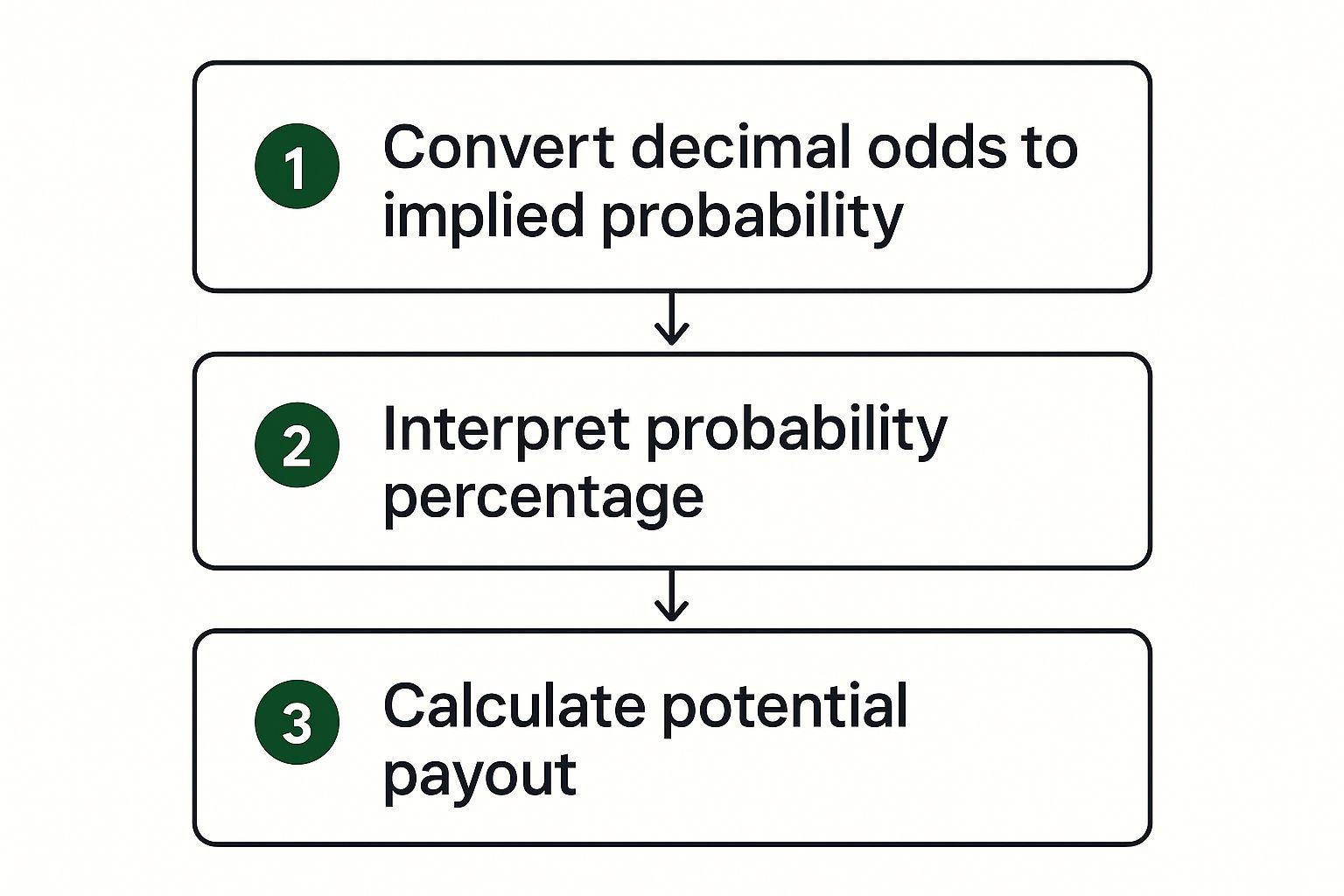
This visual guide is a great reference for the core steps: breaking down the odds, understanding the implied probability, and assessing what a successful bet could mean for your bankroll.
Comparing Implied Probability to Your Own Analysis
This is where you earn your stripes. The implied probability is just the market's opinion and the market isn't always right. Your goal is to form a more accurate opinion. That’s how you create an edge.
Let's stick with our Premier League team, where the odds imply a 40% chance of victory. Now, you do your homework. You dig into team form, injuries, head-to-head records, and even tactical matchups. Your analysis leads you to believe their actual chance of winning is closer to 50%.
That 10% gap between your assessment (50%) and the bookie's implied odds (40%) is your edge. In betting circles, we call this positive expected value (+EV). Making bets with +EV is, without question, the only way to be profitable in the long run.
Of course, any single value bet can still lose. A team with a 50% chance of winning will, by definition, lose half the time. The magic happens over the long haul. If you consistently place wagers where your probability is higher than the bookmaker’s, the law of large numbers will eventually work in your favor.
Long-term pros build their entire careers on finding these small advantages. In fact, research into betting markets shows that a consistent edge as small as 1-2% over the bookie's margin can lead to profit when paired with disciplined bankroll management. You can get more insights into the business side of the sports gaming industry over on Martech Zone.
A Practical Example of Finding a Value Bet
Let's walk through how this works with a real-world scenario. The table below breaks down a hypothetical NBA game, showing how you’d compare the bookmaker's numbers against your own analysis to find value.
| Metric | Team A (Underdog) | Team B (Favorite) |
|---|---|---|
| Bookmaker Odds | 3.00 (Decimal) | 1.50 (Decimal) |
| Implied Probability | (1/3.00) * 100 = 33.3% | (1/1.50) * 100 = 66.7% |
| Your Assessed Probability | 40% | 60% |
| Value Assessment | +6.7% Edge (+EV Bet) | -6.7% Edge (No Bet) |
In this example, the market gives Team A (the underdog) about a one-in-three shot at winning. But after you've analyzed player matchups, recent performance, and maybe even some insider info about a key player's health, your numbers tell you their chances are actually closer to 40%.
That +6.7% difference is a clear signal. You’ve found a significant value opportunity on the underdog. It doesn't mean they're guaranteed to win this game, but it's precisely this type of calculated, analytical bet that separates winning bettors from the crowd.
Protecting Your Capital with Bankroll Management

Finding value is a massive part of the puzzle, but it’s only half the battle. I’ve seen countless sharp bettors who could spot positive expected value (+EV) from a mile away go broke. Why? Because they didn't have a rock-solid plan for their money. This is where bankroll management comes in it's the operational backbone for anyone who wants to actually win at sports betting long-term.
Your bankroll is a specific pot of money you've set aside only for betting. It has to be money you can truly afford to lose without it messing with your day-to-day life. This isn't just an organizational trick; it’s a crucial psychological firewall. It helps you make clear-headed, logical decisions instead of panicked ones based on risking the rent money.
First thing’s first: define your bankroll. Whether you're starting with $100 or $10,000, that number becomes your foundation. Once you have it, the next move is figuring out your standard bet size, which we call a unit.
Choosing Your Staking Method
A staking method is just a set of rules for how much you'll wager on any single bet. Sticking to a consistent method is what separates disciplined bettors from gamblers throwing money around. It’s what stops you from chasing losses with huge, desperate bets or getting cocky and reckless after a winning streak.
Here are a few of the most trusted approaches:
Flat Betting: This is as straightforward as it gets. You bet the exact same amount one "unit" on every wager, no matter the odds or how confident you feel. A good starting point for a unit is 1% to 2% of your total bankroll. So, for a $500 bankroll, your unit would be a steady $5 to $10. This method is perfect for beginners because it keeps things simple and provides fantastic protection against the inevitable losing streaks.
Percentage-Based Staking: This approach is a bit more dynamic. Your bet size is always a fixed percentage of your current bankroll. Let’s say you decide on 2%. If your $500 bankroll grows to $600, your new bet size becomes $12 (
$600 * 0.02). On the flip side, if you hit a rough patch and it drops to $400, your bet size shrinks to $8. This method naturally compounds your winnings when you're hot and cushions the blow during a downturn.
The real secret to bankroll management is capital preservation. Your first goal isn't to get rich overnight; it's to stay in the game long enough for your edge to actually pay off. Losing streaks are going to happen a sound staking plan is the insurance policy that lets you ride them out.
Advanced and Aggressive Strategies
For bettors who have more experience and a higher tolerance for risk, more advanced methods come into play. The most famous is the Kelly Criterion, a mathematical formula that calculates the perfect stake size based on both the odds and your perceived edge.
While it's incredibly powerful on paper, the full Kelly Criterion can be wildly aggressive, leading to some gut-wrenching bankroll swings. Many pros use what’s called a "fractional Kelly" betting a fraction, like a quarter or a half, of the amount the formula suggests. This dials back the risk while still letting you size your bets according to how much value you've found.
To get a better feel for which approach might fit your style, here's a quick breakdown:
| Staking Method | Best For | Pros | Cons |
|---|---|---|---|
| Flat Betting | Beginners, Risk-Averse Bettors | Simple, protects bankroll effectively, prevents emotional decisions. | Slower growth, doesn't capitalize on high-value opportunities. |
| Percentage Staking | Intermediate Bettors | Automatically adjusts to bankroll size, balances risk and reward well. | Requires more calculation, can feel slow during downturns. |
| Kelly Criterion | Advanced Bettors, High-Risk Tolerance | Maximizes growth potential by sizing bets based on value. | Highly volatile, can recommend very large stakes, requires precise value assessment. |
If you want to dig deeper into these strategies, you can explore our complete guide on building a solid sports betting bankroll.
Ultimately, the best staking plan is the one you can follow with unwavering discipline. Winning at sports betting isn't just about who you pick; it's about having a system that guarantees you have the cash to keep placing bets, through the wins and the losses.
Building and Refining a Winning Betting System

A profitable betting approach isn’t something you just set up once and walk away from. The sharpest bettors I know are constantly tinkering, testing, and refining their methods. Building your own system is how you truly learn the ropes, moving past simply following tips and starting to create your own, unique edge.
This isn't about finding a magic formula. It’s about blending different analytical styles to discover what clicks for you. You’re essentially crafting a personal model that plays to your strengths and insights, which is a powerful advantage against the general market.
Combining Statistical and Situational Analysis
Any solid betting system has to look at more than just one thing. It needs to weigh the cold, hard numbers against the subtle, human factors that can decide a game. This balanced perspective gives you a much clearer picture of any given matchup.
For instance, your statistical work might involve a spreadsheet tracking key performance indicators points per game, defensive efficiency, turnover margins. These stats give you a solid, quantitative baseline for judging a team's raw ability.
But numbers don't tell the whole story, do they? That’s where situational handicapping comes into play. It’s the art of dissecting the qualitative factors that you’ll never find in a box score.
Think about things like:
- Travel and Fatigue: Is a team finishing up a long road trip? Are they playing their third game in four nights?
- Motivation: You've got a team out of playoff contention playing a team fighting for their postseason lives. Who do you think is going to try harder?
- Key Matchups: Does a star player have a documented history of struggling against a particular opponent or defensive scheme?
When you combine these two approaches, you get something special. Your statistical model might flag a team as a slight favorite, but your situational analysis could reveal they're at the tail end of a brutal travel schedule. That insight alone could be enough to flip your assessment and find incredible value on the other side.
Find Your Niche to Gain an Edge
Let’s be honest: trying to be an expert on every sport and every league is a surefire way to lose money. The betting markets for major leagues like the NFL or the English Premier League are incredibly efficient. Oddsmakers have mountains of data, and thousands of other sharp bettors are pounding the lines, making it tough to find a consistent edge.
The real opportunity often hides in the less popular markets.
Specializing in a niche sport or a specific type of bet (like player props or corner kicks in soccer) is one of the fastest ways to develop a genuine advantage. Bookmakers dedicate fewer resources to these smaller markets, which often leads to softer, less accurate lines.
Seriously consider focusing your energy on one of these areas:
- Lower-tier leagues in major sports (e.g., NCAA Division II football instead of the media-saturated Division I).
- Less common sports like volleyball, handball, or even eSports, where expert knowledge is rare.
- Specific prop bet markets where your deep player knowledge can give you a serious leg up.
By becoming a big fish in a small pond, your expertise can actually surpass that of the oddsmakers. Specialization is a core strategy for so many winning betting systems.
The Critical Role of Meticulous Record Keeping
If you aren't tracking your bets, you're just gambling. Meticulous record-keeping is the single most important habit you can build. It transforms your betting history from a simple list of wins and losses into a rich dataset you can analyze to see what’s working and more importantly, what isn't.
Your records need to go way beyond just wins and losses. For every single wager, you should be tracking several key data points.
What to Track in Your Betting Log
| Data Point | Why It's Important |
|---|---|
| Date and Sport | Helps you spot trends over time and see where you excel. |
| Bookmaker | Shows you which sportsbooks consistently offer the best odds for your bets. |
| Bet Details | The teams, the market (e.g., moneyline, spread), and the odds you got. |
| Stake/Unit Size | Absolutely essential for tracking your profit and loss accurately. |
| Profit/Loss (P/L) | The bottom line. This is the ultimate measure of success for each bet. |
| Your Reasoning | Crucial. Jot down why you made the bet. Was it stat-based? A situational spot? This exposes your biases and highlights your strengths. |
Once you've logged at least 50-100 bets, you can start digging into the data. Do you do better on favorites or underdogs? Are you more profitable on home teams? Does your reasoning actually hold up over time? Answering these questions with hard data, not just feelings, is how you make targeted, meaningful improvements to your system. To dig even deeper, check out our guide on how to make money from sports betting, which builds on these essential concepts.
Using Tech to Gain a Modern Betting Edge
If you want to win at sports betting these days, your gut instincts and manual analysis will only get you so far. The real advantage comes from using the right technology. Modern tools can crunch numbers and spot opportunities faster than any human ever could, which is a massive leg up in a market that moves in the blink of an eye especially with live betting.
Think of it this way: the right tech stack automates all the tedious work. Instead of spending hours manually comparing odds across a dozen different sportsbooks, the software does it for you instantly. This frees you up to do what you do best: make smart, informed decisions based on solid data, not just a hunch.
The Power of Real-Time Data in Live Betting
Live betting, or in-play betting, is where the action is. It's one of the most exciting and profitable areas for sharp bettors because, unlike pre-match odds that are mostly static, live odds are constantly on the move. A key player gets injured, a team suddenly finds its rhythm, a questionable penalty is called any of these moments can create huge value that simply didn't exist before the game started.
To capitalize on this, you have to be quicker and better informed than the bookmakers. This is where technology becomes your best friend. The best live betting tools monitor odds across multiple bookies at once, pinging you the second a valuable discrepancy pops up.
And this isn't just theory; the numbers back it up. We've seen from historical data and our own analysis that bettors using algorithmic tools for in-play betting consistently achieve win rates 5-10% higher than those relying purely on intuition. If you're curious about where the market is headed, this GammaStack analysis offers some great insights into industry growth.
Your Essential Betting Toolkit
Building out your tech stack is a fundamental step. While the market is flooded with options, a few core tools are the foundation of any successful, tech-driven approach.
Your Betting Tech Stack
- Odds Comparison Tools: These are absolutely non-negotiable. They scan dozens of sportsbooks in real-time to show you who’s offering the best price on any given bet. Consistently getting the best odds is often the single biggest factor separating losing bettors from long-term winners.
- Value Finding Software: This is the next level. Platforms like ValueBetFactory use sophisticated algorithms to compare a bookmaker's odds against the true statistical probability of an outcome. It then flags bets with a positive expected value (+EV), handing you profitable opportunities on a silver platter.
- Line Movement Trackers: These tools show you how odds have shifted over time. Watching the lines move can give you a clue as to where the "smart money" is going, helping you time your bets to get maximum value.
Staying Disciplined in the Live Betting Arena
The biggest risk in live betting isn’t a bad beat; it’s your own emotions. The fast pace and constant stream of opportunities can easily tempt you into making impulsive bets, chasing losses, or abandoning your strategy entirely. Technology can find the bets, but discipline is what makes you money.
The secret to consistent live betting success is to have your game plan locked in before the first whistle. Know exactly what scenarios you're looking for and the minimum odds you're willing to accept. This takes the emotion out of it and turns you into a machine executing a pre-defined plan.
For instance, maybe your pre-game research highlighted a team's shaky defense. Instead of betting blindly, you wait patiently. The moment the live odds for them to concede the next goal drift into your target value range, you strike. You're not reacting emotionally to the game's flow; you're capitalizing on a weakness you already identified. This disciplined, systematic approach is the bedrock of any solid system. For a deeper dive into building one, check out our guide to crafting a winning sports betting strategy.
When you combine powerful software with unwavering discipline, you can transform the chaotic world of live betting into your most profitable playground. Let the tech do the heavy lifting to find the opportunities, then let your strategy execute them perfectly.
Answering Your Lingering Questions
As you start putting these strategies into practice, you're bound to have some questions. Everyone does. Think of this as your final briefing before you head out into the field, where we'll tackle the most common uncertainties that trip up new bettors. Getting these sorted out now will give you the confidence to stick to the plan.
How Much Money Do I Really Need to Start?
This is the big one, isn't it? The truth is, there's no magic number. What's crucial is that you start with a dedicated bankroll money set aside only for betting, that you could lose without breaking a sweat. This isn't just financial advice; it's a psychological shield.
For most people just starting out, a bankroll somewhere between $100 and $500 is a realistic range. But honestly, the total amount matters far less than how you manage it. The golden rule is to set your standard bet size (your "unit") to just 1% to 2% of your total bankroll.
Let's make that real. With a $200 bankroll, your unit would be a mere $2 to $4 per bet. It might feel small, but this conservative approach is your lifeline. It’s what keeps you in the game long enough to ride out the inevitable cold streaks and let your edge actually pay off.
Is It Better to Bet on Favorites or Underdogs?
If you find yourself asking this, it's a sign you need a slight shift in perspective. The goal isn't to back the favorite or the underdog; it's to back value. Obsessing over one or the other is a classic rookie mistake that completely ignores the price tag.
Sometimes a powerhouse team is still undervalued, even as a heavy favorite. Other times, an underdog has a much better shot at an upset than the odds imply. A sharp bettor's job is to be a market analyst to figure out where the bookie's odds are just plain wrong.
Your entire focus should be on finding a gap between the bookmaker's implied probability and your own assessment. That's where you find positive expected value (+EV), and it's the only real secret to long-term profit, whether you're backing David or Goliath.
Can I Actually Make a Living Doing This?
Yes, it’s possible. But let’s be crystal clear: it is incredibly demanding. Making a living from sports betting requires a rare combination of analytical genius, ironclad discipline, and the emotional resilience of a bomb disposal expert. The hard truth is that the vast majority of people who try will lose money over time.
The pros treat this like a high-stakes, data-driven career. They aren't just casually picking winners; they're building statistical models, sinking countless hours into research, and managing their money with the precision of a seasoned financial trader. It is the absolute opposite of a get-rich-quick scheme.
For most of us, a much healthier and more achievable goal is to aim for a consistent side income by diligently following the principles of value betting. Shifting your mindset from "striking it rich" to "building profit methodically" is the most important step you can take.
The path to winning is a marathon, not a sprint. It’s built on solid strategy, disciplined execution, and a commitment to always be learning.
Ready to stop guessing and start finding real value in the betting markets? ValueBetFactory uses powerful algorithms to scan the odds and deliver real-time alerts on +EV opportunities directly to you. Take the analytical heavy lifting out of your process and focus on making smarter, data-driven decisions. Start your journey to becoming a sharper bettor today at ValueBetFactory.