
Smarter Betting A Guide to Sports Betting Education
Unlock Profits with betting tips!
Sports betting education is all about learning the skills, strategies, and discipline you need to be successful in the long run. It means getting past luck and guesswork by mastering concepts like odds, bankroll management, and finding real value. This methodical approach is what truly separates casual bettors from sharp, strategic players.
Why a Smarter Approach to Betting Matters

Consider this your starting line for a much smarter betting journey. This guide is founded on one simple truth: real, lasting success in sports betting isn’t about getting lucky-it’s about building skill. We're here to show you how a structured sports betting education can turn random punts into a calculated, repeatable process.
It’s a bit like learning to play chess. You could just move the pieces around and hope for the best, but you'll almost always lose to someone who understands strategy. Once you learn the principles, you start thinking ahead, controlling the board, and making every move with a purpose. That's what we're aiming for here.
The Foundation of Strategic Betting
The biggest shift you need to make is from thinking like a fan to thinking like an analyst. It’s a completely different mindset. Instead of betting based on team loyalty or gut feelings, you start focusing on the numbers, probabilities, and market inefficiencies.
A smarter approach isn't about winning every single bet-that’s just not going to happen. It's about consistently making bets that have a positive expected value (+EV), which is how you achieve steady growth over the long haul.
This guide will walk you through the core pillars of that approach:
- Mastering the Language: Really understanding what odds, spreads, and moneylines mean.
- Managing Your Money: Learning professional bankroll strategies to protect your capital.
- Finding Real Value: Spotting when the bookies have priced their odds incorrectly in your favor.
- Understanding Psychology: Recognizing the common mental traps that trip up most bettors.
Building a solid educational foundation is the only way to navigate this complex and competitive market. It gives you a framework for making informed decisions, cutting out unnecessary risks, and giving yourself a real shot at long-term profit.
Our mission is to arm you with this sustainable framework. When you commit to learning these fundamentals, you stop being a passive player and become an active, informed investor in the sports betting market. Many people ask if this disciplined approach actually pays off, and you can learn more about whether sports betting is profitable in our detailed guide. This educational journey is the first-and most important-step.
Learning the Language of the Sportsbook
Walking up to a sportsbook for the first time can feel a lot like trying to decipher a foreign language. You’re hit with a wall of numbers, plus and minus signs, and terms you've never heard before. It’s intimidating, but learning this language is the absolute first step on your journey. The real trick is to stop seeing odds as random numbers and start seeing them for what they are: the market's price for a specific outcome.
Think of it like the stock market. A stock's price is a reflection of the market's collective belief in a company's future. Betting odds work the exact same way-they represent the combined confidence of the sportsbook and the betting public in a team's chances of winning. Getting this concept down is far more important than memorizing any fancy formulas.
Deconstructing the Odds
Odds come in a few different formats, but they all tell you the same two things: the implied probability of an outcome and your potential payout if you're right. The main types you'll run into are American (also called moneyline), Decimal, and Fractional. They look different, but they’re just different dialects of the same language.
This diagram shows how these common formats all point back to the same core ideas of probability and payout.
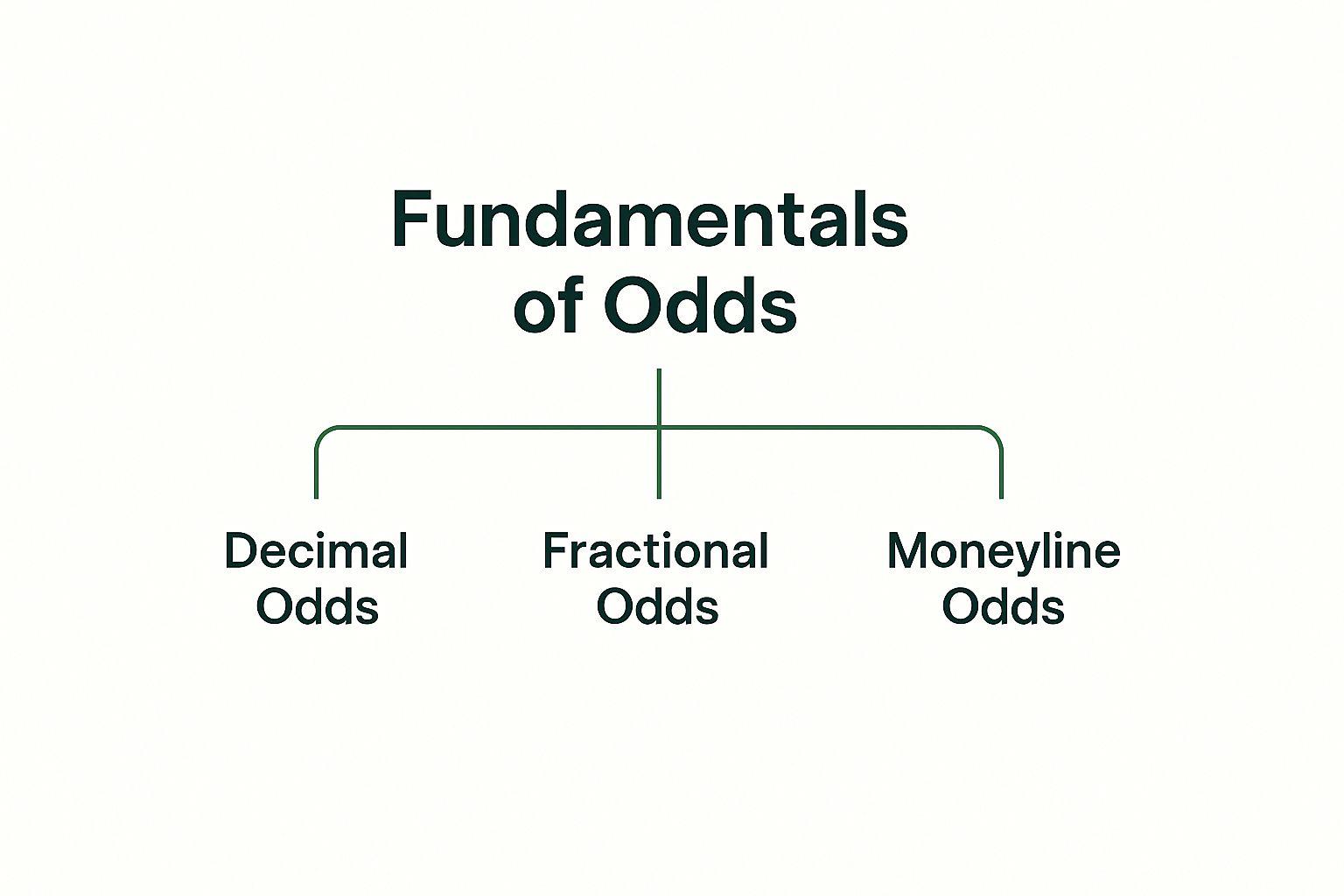
Each format is simply a different way to package the same information about a bet's risk, reward, and implied chance of success.
Moneyline odds are king in the United States. They're built around the number 100 and use a minus sign (-) for the favorite and a plus sign (+) for the underdog.
- The Favorite (-): If you see a team at -150, it means you have to risk $150 just to win $100. The minus sign is your clue that this is the expected winner, so the payout is less than your stake.
- The Underdog (+): A team listed at +130 means a successful $100 bet will net you $130 in profit. The plus sign signals this is the less likely outcome, offering a bigger reward for taking on more risk.
Understanding the relationship between risk and reward is central. A successful bettor doesn't just pick winners; they identify when the potential reward for taking a risk is greater than the odds suggest.
To help you get a handle on these foundational ideas, here’s a quick breakdown of the most common terms you'll encounter.
Key Betting Concepts at a Glance
| Betting Term | What It Represents | Simple Analogy |
|---|---|---|
| Moneyline | A straight-up bet on which team will win the game. | Like picking a horse to win the race-no strings attached. |
| Point Spread | A handicap given to the underdog to level the playing field. | Giving the slower runner in a race a head start. |
| Totals (Over/Under) | A bet on the combined total score of both teams in a game. | Guessing the total number of raindrops in a jar, not which cloud they came from. |
| Implied Probability | The win probability that the odds suggest for a given outcome. | The weatherman's "30% chance of rain" forecast for your bet. |
Think of these as the basic building blocks. Once you have them down, you can start building more complex strategies.
Beyond Winning and Losing
Once you’re comfortable with the moneyline, you can explore other popular ways to bet that open up entirely new strategic angles. These bet types are essential vocabulary for anyone who wants to get serious about sports betting.
Point Spreads The point spread is basically a handicap designed to make both teams an equally attractive betting option. It's not just about winning anymore; the favorite has to win by a specific number of points (the spread).
- Example: If the Kansas City Chiefs are -7.5 point favorites over the Denver Broncos, a bet on the Chiefs only wins if they win by 8 points or more. On the flip side, a bet on the Broncos at +7.5 wins if they win the game outright or if they lose by 7 points or fewer.
Totals (Over/Under) This bet completely ignores who wins or loses. Instead, you're betting on the total combined score of both teams. The sportsbook sets a number, and you wager on whether the final score will be over or under that line. It’s a fantastic option when you have a good feel for the pace of a game but aren't confident about which team will come out on top.
Mastering Your Money with Bankroll Management

If there's one lesson in your entire sports betting education that you absolutely must burn into your brain, it’s this: you can’t win if you run out of money. It sounds almost laughably obvious, but it’s the single biggest reason most bettors go bust. Even if you’re a genius at picking winners, your skills mean nothing if you don't have the cash to survive the inevitable cold streaks.
This is where bankroll management comes into play. It's not about gambling; it's about managing your betting funds with discipline to stay in the game long enough to grow your capital and avoid going broke. Start thinking of yourself as the manager of a small investment fund. Your number one job? Protect the principal.
The Foundation: The Unit System
The bedrock concept that separates amateurs from pros is the unit system. A "unit" is just a small, fixed percentage of your total bankroll, usually 1%. This simple trick standardizes your bet size, effectively taking emotion out of the equation and making sure a single bad beat doesn't wreck your finances.
Let's say you have a starting bankroll of $1,000. If you decide on a 1% unit size, then one unit is $10. That $10 now becomes your standard wager for every single bet you place, no matter how much of a "sure thing" it feels like. It creates a stable, repeatable framework for all your betting.
A disciplined unit system is the firewall between a sound betting strategy and panicked, emotional decisions. It’s what ensures a tough losing streak is just a bump in the road, not a financial catastrophe.
This incredibly simple method is your first real step toward professional-level discipline. It forces you to think about risk in a structured, logical way, which is the cornerstone of any serious approach to sports betting.
Choosing Your Staking Plan
Once you’ve defined your unit, the next step is picking a staking plan. This is just the rulebook that tells you exactly how much to risk on each bet. The whole point is to find a method that fits your personality and tolerance for risk.
There are dozens of complex strategies out there, but a couple of basic ones provide a fantastic starting point for anyone new to this. Each offers a slightly different way of managing your money as your bankroll ebbs and flows.
Here are the two fundamental staking plans to get you started:
Flat Betting: This is the simplest and most recommended method for beginners. You bet the exact same amount-one unit-on every single wager. Period. If your unit is $10, every bet is $10. This approach is brilliant because it's dead simple to follow and provides a powerful buffer against long, frustrating losing streaks.
Percentage Staking: This method is a bit more dynamic. Your unit size is always a fixed percentage (usually 1% to 3%) of your current bankroll, not your starting one. So, if your $1,000 bankroll grows to $1,200, your 1% unit climbs to $12. On the flip side, if it drops to $800, your unit size shrinks to $8. This lets your bets scale up when you're winning and automatically reduces your risk when you're in a slump.
For a much deeper look into these strategies and others, you can learn more about professional sports betting bankroll management in our complete guide. Choosing the right plan is a personal call, but you really can't go wrong starting with a flat-betting model.
Why Discipline Trumps Everything
Look, a perfect staking plan is completely worthless if you don't have the discipline to actually follow it. The real test of a bettor isn't how you act during a winning streak-it's how you handle a losing one. It’s human nature to want to double down to win back losses fast. This is called "chasing," and it’s the quickest way to zero out your account.
Likewise, getting overconfident during a hot streak and betting more than your plan allows is just as dangerous. Both mistakes are driven purely by emotion and are a direct violation of sound money management. Lasting success comes from sticking to your system with robotic consistency.
By committing to a strict bankroll management strategy, you give yourself the single most valuable asset in betting: time. You guarantee you can stay in the action long enough for your edge to win out over short-term luck. It is the bedrock on which all profitable sports betting is built.
How to Find and Bet on True Value
Alright, you've got the lingo down and a smart bankroll strategy in place. Now for the fun part: moving from the basics to building a real, profitable strategy. This is where your sports betting education starts to feel like a superpower. The end game here is to think like a professional, and that means being obsessed with one thing: value.
Finding value is simply the art of spotting odds that are wrong. Think of it like finding a vintage Rolex at a garage sale for ten bucks. You know its real worth is exponentially higher than the price tag. In betting, it’s the same deal-you're looking for wagers where the team's true chance of winning is better than what the odds suggest.
This shift in mindset is everything. You have to stop betting on teams and start betting on numbers. The question isn't, "Who's going to win?" It's, "Do these odds actually represent what's likely to happen?"
Moving Beyond Gut Feelings
Most bettors lose money because they bet with their heart. They pick their favorite team, follow media hype, or get swayed by last night's highlight reel. Bookmakers love this, as it's an emotional, biased approach. To find true value, you need to develop your own method for judging a game that has nothing to do with the market's opinion.
You don't need a supercomputer to get started. It can be as simple as picking a few key stats you believe really matter. For example, if you're betting on football, you might zero in on yards per play, turnover margin, and red zone success to create your own power ratings.
When you compare your ratings to the sportsbook's odds, you’ll start seeing where they don't line up. If your homework says a team has a 55% chance to win, but the odds are priced as if they only have a 50% shot, you’ve just found positive expected value (+EV). That, right there, is a value bet.
The secret to long-term profit isn't about being a fortune teller who never loses. It's about consistently finding spots where the odds pay you more than the real risk involved.
This is what separates sharp betting from just plain gambling. You're no longer just reacting to the odds on your screen; you're actively hunting for pricing mistakes.
The Math Behind Value
At its core, value betting is just a simple math problem. You don't have to be a math whiz, but you do need to understand the logic. The formula for sniffing out a value bet looks like this:
(Your Assessed Probability x Decimal Odds) - 1 > 0
Let's use a real-world example to make sense of that. Say the Los Angeles Lakers are playing the Boston Celtics, and a bookie is offering odds of 2.10 on the Lakers to win.
Find the Implied Probability: First, let's see what the odds are telling us. The formula is (1 / Decimal Odds). So, 1 divided by 2.10 is 0.476, which translates to a 47.6% chance. The bookmaker thinks the Lakers have a 47.6% chance of winning.
Do Your Own Assessment: Now it's your turn. After looking at recent performance, injuries, and how the teams match up, you figure the Lakers' actual chance of winning is closer to 52%.
Run the Value Calculation: Let's plug your numbers into the formula: (0.52 x 2.10) - 1 = 0.092.
Because that result (0.092) is a positive number, you've officially found a value bet. Placing wagers like this over and over again is how you build a profit, because you're consistently getting paid at a rate that's better than the actual risk. To go deeper on this, our full guide on betting for value breaks it down even further.
Tools That Supercharge Your Search
Let's be real: manually crunching the numbers for every single game is a massive, soul-crushing task. Thankfully, modern tools can do all the heavy lifting. Platforms like ValueBetFactory are designed to scan thousands of odds across countless sportsbooks in real-time, pinpointing these exact market errors for you.
When the platform's model calculates "true" odds that are better than what a bookie is offering, it flags it as a value bet. This gives you an instant list of opportunities you'd almost certainly miss on your own. It's like having a whole team of analysts working around the clock, digging through the racks to find you that mispriced Rolex. It turns a time-consuming grind into a sharp, efficient way to capitalize on data-driven advantages.
Understanding the Psychology of a Winning Bettor
Once you’ve got a handle on bankroll management and how to find value, the next real mountain to climb in your sports betting education is the mental game. It might sound cliché, but in this world, your biggest opponent is often the person staring back at you in the mirror. Even the most brilliant bettors can get completely thrown off course by emotional impulses and sneaky psychological traps.
Long-term success isn't just about spreadsheets and algorithms; it’s about having the mental toughness to make clear-headed decisions, whether you’re on a hot streak or a losing skid. The human mind has all sorts of built-in shortcuts and biases, and you can bet the bookmakers are counting on you to fall for them. Learning to spot these mental hurdles is just as important as knowing how to read the odds.
Recognizing Common Cognitive Biases
Cognitive biases are basically the little tricks your mind plays on you. They're patterns of thinking that can steer you away from a logical choice and toward a bad bet. Just knowing they exist is the first step toward not letting them run your life.
Two of the most common and damaging biases for bettors are recency bias and confirmation bias.
Recency Bias: This is the classic mistake of giving too much weight to what just happened. A team pulls off a massive upset on national TV, and suddenly everyone forgets they were mediocre for the previous ten games. The public piles on, the odds get skewed, and smart bettors look for the bigger picture, not just the last highlight reel.
Confirmation Bias: We all do this. It's that natural instinct to find proof that backs up what we already think. You get a feeling about a team, so you start hunting for stats and articles that support your gut, while conveniently ignoring anything that suggests you might be wrong. This creates a dangerous feedback loop that makes a bad idea seem brilliant.
The most profitable bettors I know are deeply skeptical, especially of their own initial hunches. They actively play devil's advocate and look for reasons why their bet is a bad one, not just reasons to feel good about it.
This kind of detached thinking is what separates the pros from the pack. It stops you from falling in love with a bet and forces you to judge every opportunity on its actual merit.
Techniques for Maintaining Discipline
Knowing about biases is one thing, but actually beating them is a different beast entirely. The trick is to build a betting system that forces you to be disciplined and takes emotion out of the equation. Think of your betting strategy as a fortress against your own worst impulses.
The best method is also the simplest: track every single bet you make. Keep a detailed log-date, sport, teams, bet type, how much you staked, the odds, and the result. And here's the most important part: write down a short, objective reason why you made the bet in the first place.
This simple habit is a game-changer for a few reasons:
- It Enforces Accountability: You can't hide from your mistakes anymore. The numbers don't lie, and a spreadsheet will quickly tell you if your strategy is broken or if you’re just betting on hunches.
- It Identifies Strengths and Weaknesses: Your records might reveal that you crush NBA totals but consistently lose your shirt on NFL spreads. That information is pure gold. It tells you exactly where to focus your energy.
- It Reinforces a Process: The very act of having to write down your reasoning makes you stop and think. It’s a built-in pause button that helps prevent those purely emotional, spur-of-the-moment wagers.
Another critical skill is learning to spot the signs of "chasing losses." We've all felt it-that pit in your stomach after a string of bad beats and the desperate urge to place a huge, reckless bet to win it all back in one shot. That is the fastest way to blow up your bankroll, bar none. A winning bettor knows when to walk away, accept a loss as part of the game, and get back to the plan tomorrow. This is a marathon, not a sprint.
Understanding the World You're Betting In
To start betting smarter, you have to get a feel for the arena you're stepping into. This isn't your local poker game anymore; think of it more like the World Series of Poker. While the basic rules are the same, the sheer scale, the technology involved, and the level of competition are on a completely different level. Grasping these market dynamics is the first step to understanding why a disciplined, educated approach is your only real shot at finding an edge.
The modern sports betting scene is absolutely massive and constantly evolving. The global market is already valued at an eye-watering USD 100.9 billion. This explosion is driven by easy internet access and everyone having a sportsbook in their pocket via their smartphone. And it’s not slowing down-experts predict the market will keep growing by about 11% each year from 2025 to 2030. If you want to dive into the numbers, you can check out the full sports betting market growth research on Grandviewresearch.com.
How Technology Changed the Game
Technology has turned the betting world on its head. What used to mean a trip to a smoky betting shop now happens in seconds on an app. This change has opened up incredible opportunities, but it’s also thrown up some new roadblocks for bettors.
On one hand, you have a firehose of information at your fingertips, with more sportsbooks and betting markets than you could ever imagine. On the other hand, so does everybody else-including the bookies. Sportsbooks now use sophisticated algorithms to set their lines with pinpoint accuracy, making it much tougher to spot a bad number. The market is sharper and moves faster than ever.
In today's market, betting on a gut feeling is like bringing a knife to a gunfight. The bookmakers are armed with data scientists and complex models; a structured, educational approach is your way of leveling the playing field.
This new reality means your education has to include a solid understanding of how data and tech shape the odds you see every day.
New Laws and Crowded Markets
Another huge piece of the puzzle is the shifting legal landscape. More and more places are legalizing sports betting, which means new markets are constantly popping up. This brings a flood of new, and frankly, inexperienced bettors into the mix, which can create some golden opportunities for sharp players to take advantage of.
But this accessibility also means sportsbooks are fighting tooth and nail for your business. This is fantastic news for you as a bettor, as it leads to:
- Better Odds: Bookmakers have to offer more competitive lines to stand out.
- Juicy Promotions: Bonuses and promotions are everywhere as books try to lure you in.
- More to Bet On: You can find odds on practically any sport or event under the sun.
In this competitive, data-driven world, a structured education isn't just nice to have-it's essential. This is exactly why tools like ValueBetFactory exist. They were built for this new reality, helping bettors cut through the noise by using technology to find the same market inefficiencies that the pros hunt for. It gives you a real advantage in a complicated industry where the old ways just don't cut it anymore.
Got Questions? Let's Talk Strategy.
It's natural to have questions as you dive deeper into the world of sports betting. Let's tackle some of the most common ones that pop up for new and experienced bettors alike. Think of this as a quick FAQ to clear up any confusion and get you focused on what really matters.
What Is the Single Most Important Skill in Sports Betting?
If you only master one thing, make it bankroll management. No question about it. You can be the best in the world at picking winners, but if you don't manage your money correctly, you'll eventually go bust. It’s the bedrock of any successful betting career.
A great strategy means nothing without the funds to see it through. Smart bankroll management is what allows you to survive the inevitable losing streaks and stay in the game long enough for your edge to actually show up in your profits.
How Do I Find Value in a Bet?
Finding value is about spotting a mispriced opportunity. You’re looking for bets where you think the real chance of something happening is higher than what the bookmaker's odds suggest. To pull this off, you have to develop your own way of handicapping a game, separate from what the market is telling you.
The heart of value betting is simply this: you're an error hunter. Your job is to consistently find odds that don't quite match reality, which gives you a mathematical advantage over the long run.
This could mean building your own statistical models, doing a deep dive into team analytics, or noticing key information the market might have missed. It’s a shift in mindset-you stop trying to just pick winners and start betting on numbers that offer you an edge.
How Long Does It Take to Become a Profitable Sports Bettor?
There’s no magic number here. Everyone's path is different. How quickly you get there depends on your dedication, your discipline with money, and your ability to stick with a solid strategy through thick and thin. This is definitely not a get-rich-quick game.
For most people, becoming consistently profitable is a marathon, not a sprint. It involves constant learning, tracking every single bet you make, and tweaking your approach based on cold, hard data. If you treat it like a continuous learning process instead of a race, you’ll give yourself the best shot at long-term success.
Ready to put all this knowledge into practice? ValueBetFactory does the heavy lifting, scanning the market with powerful tech to send real-time value bet alerts right to you. Start making smarter, data-driven decisions and find your edge today.
See how it works at ValueBetFactory.com.