
Is Sports Betting Profitable? The Real Answer
Unlock Profits with betting tips!
Is sports betting profitable? For the sportsbooks, you bet it is. For bettors, the answer gets a lot more complicated. It’s possible, but it’s incredibly tough. Forget thinking of it as a casual weekend hobby; if you want to win, you have to treat it like a high-stakes business.
The Reality of Sports Betting Profitability

Before you even think about placing a bet, you have to accept one cold, hard truth: the entire system is built for the house to win. While a tiny fraction of sharps turn a consistent profit, the overwhelming majority of people are just paying for the thrill.
This guide isn't here to sell you a dream. It’s about making a crucial mental shift from luck-based gambling to cold, hard strategic analysis. To succeed, you have to understand just how steep the climb is and what tools you need to make it to the top.
The Built-In Disadvantage: The Vig
Every single sportsbook builds a commission into its odds. This is called the vigorish, or "vig" for short (you'll also hear it called the juice). Think of it as their guaranteed profit margin, no matter who wins the game. It’s the single biggest reason the house always has a mathematical edge before a single point is even scored.
The vig is the hidden tax on every bet you place. Beating this built-in fee is the first and most important challenge for any bettor aiming for profit. If you don't have a clear strategy to overcome it, long-term success is a statistical impossibility.
This built-in margin means you have to be better than average just to break even. On a standard point spread bet, the vig forces you to win roughly 52.4% of your wagers just to get back to zero. It's this simple mathematical hurdle that explains why the sports betting industry is projected to hit nearly USD 187 billion by 2030, while so few individual bettors ever see a real return.
Let's quickly compare the two sides of the coin.
Profitability At A Glance: Bettor vs. Sportsbook
This table breaks down the core differences between a typical bettor's position and the sportsbook's built-in advantages.
| Factor | Typical Bettor | Sportsbook (The House) |
|---|---|---|
| Primary Goal | Win individual bets | Create a balanced market |
| Edge | Must find an analytical edge | Has a built-in mathematical edge (the vig) |
| Success Metric | Long-term profit (ROI) | Guaranteed commission on total wagers |
| Risk | High; can lose entire bankroll | Low; risk is spread across thousands of bets |
As you can see, the game is tilted in their favor from the start. Our job is to find a way to tilt it back.
Shifting from Hobbyist to Strategist
If you want any real shot at winning, you have to start acting like a professional. This means making a complete mental shift away from emotional, fan-based decisions and moving toward a calculated, analytical approach.
Here are the core principles you need to live by:
- Discipline Over Emotion: Bets are made on data and value, not gut feelings or team loyalty. End of story.
- Long-Term Perspective: Profitability isn't measured on a single weekend. It’s measured over hundreds, even thousands, of bets.
- Bankroll Management: You must have strict rules for how much you risk per bet. This is the only way to survive the inevitable losing streaks.
This foundation is non-negotiable for anyone serious about sports betting for profit. It’s what turns a hopeful gamble into a calculated investment. The rest of this guide will dig into the specific strategies and mindset you need to beat the house edge and carve out your own path to profitability.
Why the House Always Has an Edge
Ever get the feeling that winning consistently at sports betting is like swimming against the current? That’s not just in your head. It’s by design, and it’s the absolute core of the sportsbook business model. Before you can even think about profitability, you have to get to grips with the two massive hurdles standing in your way: the math and your own mind.
The whole system is built to give the "house" the sportsbook a permanent advantage. This edge has nothing to do with luck or some secret insider info on the games. It's a simple, cold, mathematical certainty baked into every single bet you place. Understanding this is the first real step to figuring out how to beat it.
The Math: The Vigorish
The bookie’s primary tool for guaranteeing a profit is the vigorish, but you’ll almost always hear it called "the vig" or "the juice." Just think of it as a small service fee or a commission that’s invisible but built right into the odds. It’s how they make their money, no matter who actually wins the game.
Let’s strip it down to a simple coin toss. A fair toss is a perfect 50/50 shot. If you and a friend each bet $10, the winner walks away with $20. Simple.
But a sportsbook isn't your friend, and they don't offer fair odds. Instead of offering even money, they’ll make you risk $11 just to win $10.
- If you call it right, you get your $11 back plus your $10 profit.
- If you call it wrong, the sportsbook pockets your $11.
Now, imagine two people bet on opposite sides of that coin toss. The bookie takes in a total of $22 in wagers but only pays out $21 to the winner. That extra $1 is their guaranteed, risk-free profit. That’s the vig. This subtle tax is applied to everything from point spreads to moneylines. It’s the fundamental reason how do bookmakers make money, and it’s the first wall you have to climb.
The vig is a silent tax on every wager. It stacks the odds against you from the start, forcing you to win more than you lose just to break even. Overcoming this mathematical disadvantage is the foundation of any profitable betting strategy.
The Mind: Common Mental Traps
Beyond the pure math, the second major obstacle is your own brain. Our built-in cognitive biases are often our worst enemies, pushing us into bad decisions that destroy any edge we might have found. Sportsbooks know all about these human tendencies; in many ways, their platforms are designed to take advantage of them.
These mental traps are everywhere, and even the pros have to actively fight them off:
- Chasing Losses: After a tough loss, that gut impulse to immediately place another bet to "win it all back" is incredibly powerful. This almost always leads to bigger, poorly-analyzed wagers.
- Confirmation Bias: We all love being right. This bias causes us to hunt for information that confirms what we already believe about a game while ignoring any stats or evidence that contradict our pick.
- Betting with Your Heart: Letting your loyalty to a team or your emotional connection to a player guide your bets is the fastest way to an empty bankroll. Profitable decisions are cold, calculated, and completely detached.
- Recency Bias: This is when you put way too much weight on recent results. Just because a team is on a three-game winning streak doesn't automatically make them a good bet next week, especially if you ignore the larger body of data.
Recognizing these built-in disadvantages both mathematical and mental is the first and most critical step. You can’t beat the house until you fully acknowledge the edge they hold. Only then can you start building a strategy designed to flip it in your favor.
Thinking Like a Professional Bettor

To figure out if sports betting is truly profitable, you have to make a crucial mental switch: stop gambling and start investing. This isn't just a catchy phrase; it's the fundamental change in mindset that separates the tiny fraction of winning bettors from everyone else. Amateurs cross their fingers and hope for a win. Professionals hunt for value.
This shift starts when you realize the goal isn't just to pick winners. It's to find bets where the odds are just plain wrong. Think of yourself less like a sports fan and more like a stock trader who's found an undervalued company the rest of the market has completely overlooked.
Hunting for Positive Expected Value
The engine driving this investment mindset is Positive Expected Value, or +EV. A +EV bet is any wager where the odds offered by a sportsbook are more generous than the true, underlying probability of that outcome. Finding these opportunities is the only way to beat the house edge over the long haul.
Here's a simple way to think about it: imagine a friend offers you 3-to-1 odds on a simple coin flip landing on heads. You know the real probability is 50%, which works out to even money odds. Your friend's offer is a massive +EV opportunity because the potential payout is way out of line with the actual risk.
A bettor’s job is not to predict the future. It’s to identify situations where the market price (the odds) does not reflect the real probability of an event. Every profitable decision stems from finding and exploiting these pricing errors.
Of course, spotting these inefficiencies in sports is a whole lot harder than a coin flip. It takes deep analysis, statistical modeling, and the discipline to completely remove personal bias from the equation. You're constantly searching for a disconnect between what the public thinks will happen and what the numbers say is likely to happen.
Moving Beyond Wins and Losses with ROI
So, how do you know if this approach is actually working? You have to stop tracking simple wins and losses. The ultimate yardstick for any successful betting strategy is Return on Investment (ROI).
ROI cuts through the noise and tells you exactly how much profit you're making relative to the total amount of money you've staked. A pro might place hundreds of bets in a month, and ROI gives them a clear, objective grade on their performance.
- Calculation: ROI is your total profit divided by your total amount staked (your turnover), then multiplied by 100 to get a percentage.
- Significance: A positive ROI over a large sample of bets is concrete proof that you have a winning strategy an "edge."
- Benchmark: In the world of sharp sports betting, even a consistent ROI of 3-5% is considered excellent.
Switching your focus to finding +EV and measuring your success with ROI is a game-changer. To really cement this mindset, you can dig deeper into the core principles behind professional sports betting and see how the sharpest minds in the game approach the market. This framework turns betting from a game of chance into a disciplined hunt for mathematical advantages the only path to sustainable profit.
Alright, let's move from the theory to the part that really matters: turning all this knowledge into actionable strategies. This is where the real work begins. To actually make money from sports betting, you need tangible methods that go way beyond just picking winners.
These strategies are the backbone of a disciplined, analytical approach. They’re what turn hopeful guesses into calculated investments. The whole game is about finding pricing errors in the market spotting those golden opportunities where a sportsbook’s odds don’t quite match up with the real probability of an outcome. Getting good at this is what separates the pros from everyone else.
This infographic breaks down how different strategies can lead to different returns, from the basics all the way to more advanced methods.
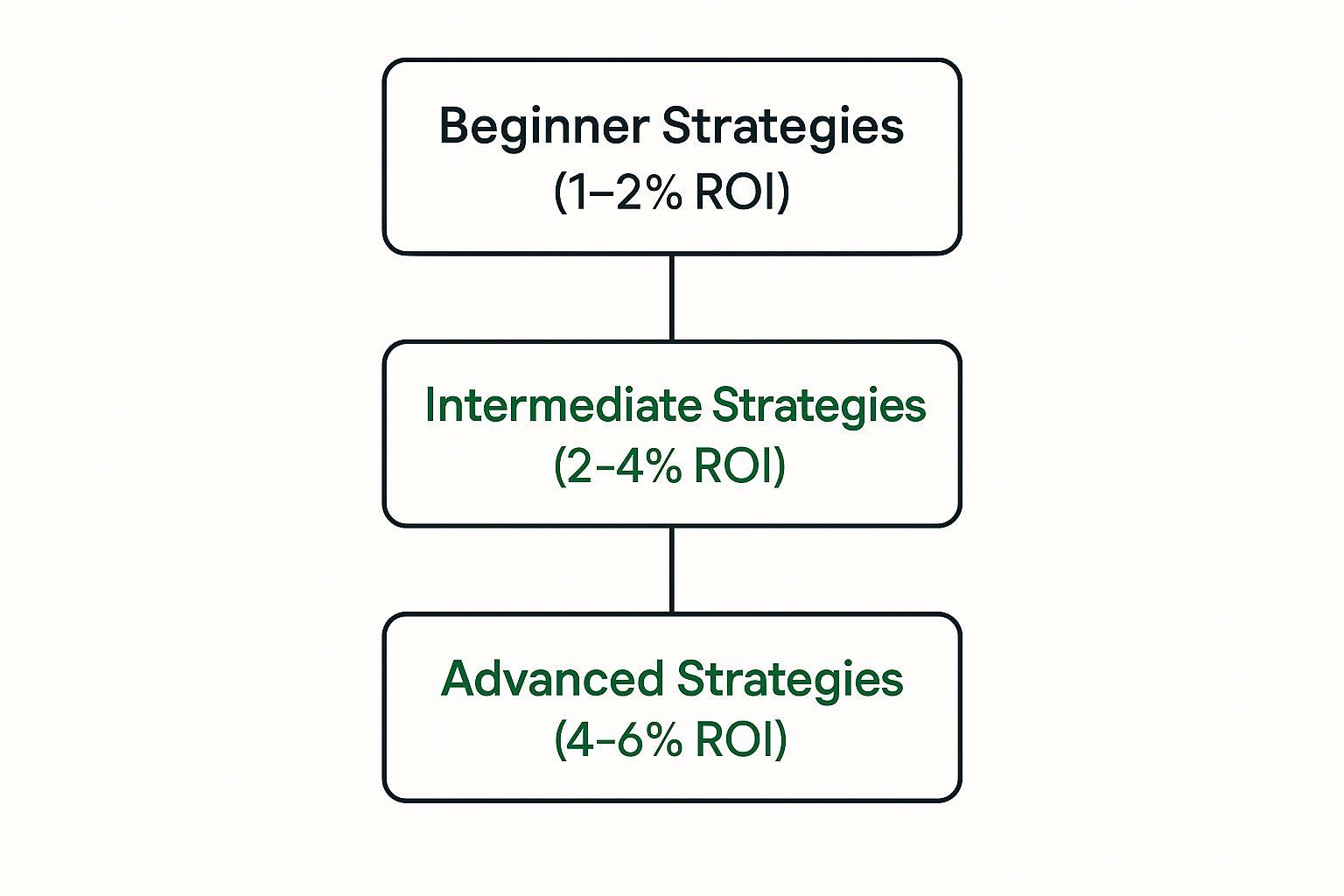
As you can see, the more advanced, data-heavy approaches generally pack a bigger punch in terms of potential ROI. Of course, they also demand more skill and effort to pull off correctly.
Mastering Value Betting
Value betting is the absolute cornerstone of long-term profitability. We’ve touched on it already, but it’s all about finding and placing bets where the odds are higher than they should be, creating that positive expected value (+EV). Think of it like finding a designer watch at a garage sale for ten bucks; you know its real worth is much higher, so buying it is an obviously smart move.
A true value bettor isn't obsessed with winning every single wager. Instead, their focus is on consistently making investments that hold a mathematical edge. Over hundreds or thousands of bets, that small edge compounds into real profit.
Locking in Profits with Arbitrage
Arbitrage betting, often just called "arbing," is a different beast entirely. It’s a method that can guarantee a small, risk-free profit by exploiting minor differences in odds across different sportsbooks.
Here’s the basic idea:
- Find an Opportunity: You spot a game where Bookmaker A has unusually high odds on Team 1, and Bookmaker B offers juicy odds on Team 2.
- Calculate Your Stakes: Using a specific formula, you figure out the exact amount to bet on each outcome to guarantee a profit.
- Place the Bets: By betting on both sides across the two books, you create a situation where your total payout is always more than your total stake, no matter who wins.
Arbitrage is a game of speed and precision. These opportunities are rare and they vanish in minutes, sometimes seconds. But for those who can act fast, they represent one of the only ways to lock in a guaranteed return.
While arbing is perfectly legal, sportsbooks hate it. If they catch on, they’ll be quick to limit your account. It’s a low-risk strategy, but it definitely requires a lot of effort and attention.
Bankroll Management: The Bedrock of Success
Listen, no strategy on earth will work if you run out of money. Bankroll management is the single most important discipline for survival and growth in this game. Period. It's simply a set of rules that tells you how much of your total betting fund (your bankroll) you should risk on any single bet.
Its main job is to protect you from those inevitable losing streaks what we call "variance" that every single bettor goes through. Without it, even a winning strategy can lead straight to ruin. The screenshot below shows a famous formula for this called the Kelly Criterion, which helps calculate the optimal bet size.
This formula helps you figure out the ideal percentage of your bankroll to wager based on how big your perceived edge is. But even simple staking plans, like betting a flat 1-2% of your bankroll on every single wager, are incredibly effective.
This kind of discipline is more important than ever. The global sports betting market hit an estimated USD 98.67 billion in 2024 and is only getting bigger. This growth creates more opportunities, but it also demands greater discipline if you want to stay in the game and remain profitable. If you're interested, you can read the full research about sports betting market growth trends.
The Unseen Skills of Winning Bettors
Finding a mathematical edge is just one piece of the puzzle. To really figure out if sports betting can be profitable for you, you have to master the other, much harder half of the battle: the psychological game.
The sharpest bettors in the world will tell you the same thing. What truly separates long-term winners from everyone else isn’t some secret formula it’s discipline and emotional control.
This all starts with one non-negotiable habit: meticulously tracking every single bet you place. This isn’t just about knowing your profit and loss. It’s about building a database of your own decisions so you can honestly analyze your strengths and weaknesses. Without data, you’re just guessing.
Confronting Variance and Downswings
Even with a proven edge, you will hit losing streaks. It's a mathematical certainty known as variance. These periods, called downswings, can be gut-wrenching and are the ultimate test of a bettor's resolve. The impulse to ditch your strategy and start chasing losses becomes overwhelming.
This is the moment that defines your potential. Sticking to your bankroll rules and trusting your process during a losing streak is what separates the top 1-3% of profitable bettors from the rest of the pack. Giving in to emotion is the fastest way to torch your bankroll and undo months of hard work.
"The market can stay irrational longer than you can stay solvent." This famous investing quote is a perfect fit for sports betting. Your edge doesn't guarantee a win today, but strict discipline ensures you'll be around long enough for that edge to finally pay off.
The Importance of Emotional Resilience
Profitability in betting is less about making brilliant picks and more about unwavering consistency. It demands a level of emotional resilience that, frankly, few people possess. You have to be able to treat winning and losing streaks with the same detached, analytical mindset.
This commitment to the process over the outcome boils down to a few key skills:
- Patience: Waiting for the right opportunities instead of forcing bets out of boredom.
- Objectivity: Never, ever letting your fandom or personal biases influence a wager.
- Accountability: Owning your mistakes and learning from your data rather than just blaming bad luck.
Ultimately, building these unseen skills is just another form of risk management. It protects your capital from your own worst impulses. This mental fortitude, when bolted onto a sound strategy, is the only sustainable path to answering "is sports betting profitable" with a resounding yes. It also reinforces the core idea of responsible gambling: betting with your head, not over it.
Your Questions About Profitable Betting Answered

We've covered a lot of ground, from the core strategies to the mental discipline required to win. To wrap things up, let's tackle a few of the most common questions that pop up when people start to get serious about making a profit from sports betting.
What Percentage of Sports Bettors Are Actually Profitable?
This is the million-dollar question, isn't it? While the books guard the exact numbers like a state secret, the consensus among industry insiders is pretty clear: a tiny fraction, somewhere between 1-3% of sports bettors, consistently make money in the long run.
This isn't to discourage you. It's to show that the elite few aren't just getting lucky. They're the ones applying disciplined, mathematical strategies to grind out an edge. For the other 97%, betting is simply a form of paid entertainment.
How Much Money Do I Need to Start?
There’s no magic number here. The most critical thing isn't the amount but its purpose: you need a dedicated bankroll that you are completely, 100% prepared to lose. Think of it as your business's starting capital.
Smart betting is a volume game it's about placing lots of smaller, value-positive wagers over time, not swinging for the fences. A non-negotiable rule is that a single bet should never exceed 1-2% of your total bankroll. This means if you start with $1,000, your typical bet size should be in the $10-$20 range. This approach is what keeps you in the game long enough for your edge to pay off.
What Is a Realistic ROI for a Profitable Sports Bettor?
Forget the wild claims you see online. A truly successful, consistently profitable bettor is often aiming for a Return on Investment (ROI) somewhere between 3% and 5%.
That might sound low if you're used to the stock market, but in the betting world, achieving that kind of return over thousands of bets is a massive accomplishment. It’s the definitive proof that you have a real, sustainable edge over the sportsbooks.
At ValueBetFactory, our entire mission is to provide you with the data and tools to find that edge. Our platform scans the market to identify odds discrepancies, sending you real-time alerts on potential value opportunities. See how we can sharpen your strategy at https://valuebetfactory.com.