
Sharps Betting Guide to Finding an Edge
Unlock Profits with betting tips!
Sharp money isn't just a buzzword; it's the invisible force that moves the entire sports betting market. Learning to spot its tracks is one of the most important steps you can take toward becoming a more calculated, strategic bettor.
Decoding the World of Sharps Betting

Think of the sports betting market like an ocean. The vast majority of the money comes from the public the everyday fans. Their bets create the choppy waves on the surface, driven by gut feelings, media hype, or simple team loyalty. It’s noisy and often emotional.
But underneath those waves are the deep, powerful ocean currents. That's the sharp money.
Sharps are the professionals, the syndicates, and the data scientists who treat sports betting like Wall Street trading. They aren't betting with their hearts; they're disciplined experts who use sophisticated statistical models, deep market knowledge, and massive bankrolls to hunt for long-term profit.
The Power of Sharp Money
When a sharp places a wager, the industry pays attention. This is what we call sharp money it's the informed, respected capital that forces sportsbooks to scramble and adjust their odds. A bookmaker might take a hundred small bets on the Lakers from the public, but a single, massive wager from a known sharp on the other side will trigger an immediate line shift.
Sharp money is a signal. It tells oddsmakers that their opening line might be wrong, forcing them to adjust the numbers to reduce their risk and balance their books.
This dynamic is everything. Sharps aren't interested in just picking winners. Their entire game is about finding and exploiting value where a bookmaker’s odds don’t reflect the true probability of an outcome. Success for them isn't measured by one big win, but by grinding out a consistent edge over thousands of wagers.
To help clarify the difference, here's a quick breakdown of how these two types of bettors operate.
Sharp Bettor vs Public Bettor At a Glance
This table provides a clear comparison between the characteristics, motivations, and strategies of professional (sharp) bettors and recreational (public) bettors.
| Characteristic | Sharp Bettor | Public Bettor |
|---|---|---|
| Motivation | Long-term profit, finding value | Entertainment, supporting a team |
| Analysis | Data models, statistics, market analysis | Gut feelings, media narratives, trends |
| Betting Style | Disciplined, calculated, high volume | Emotional, impulsive, low volume |
| Focus | Finding inaccurate odds (the number) | Picking the winning team (the outcome) |
| Bankroll | Strict bankroll management rules | No formal bankroll strategy |
| Timing | Bets early to get the best number | Bets late, closer to game time |
This side-by-side view really highlights the philosophical divide. Sharps play a numbers game, while the public is often just along for the ride. Understanding this distinction is the first step to thinking more like a professional.
What It Takes to Win
Let's be clear: beating the sportsbooks is incredibly difficult. They have a built-in advantage on every bet they offer. In the standard -110 betting market, you have to win at least 52.4% of your wagers just to break even because of the bookie's commission (the vig).
Sharps, sometimes called 'wiseguys', are defined by their ability to consistently clear that hurdle. Good sharps consistently hit win rates between 55% and 60%, and the true elites can climb even higher over a large sample of bets. To get a better sense of professional benchmarks, you can find more detail on the success rates of professional bettors on Betsperts.com.
How Sharps Move Betting Lines
Picture this: a sportsbook drops its opening line for a big NFL game. Within minutes, a monster wager comes in on the underdog from a high-limit account they know and respect. For the bookmaker, this isn't just another bet it’s a flashing red light. This is sharp money talking, and you can be sure the oddsmakers are listening.
Sportsbooks don't just put up with sharp bettors; they actively use their action. Those early, heavy wagers from professional accounts are basically a form of high-level market research. If a known sharp immediately bets against their number, it's a powerful signal that the sportsbook's initial assessment might be off the mark.
After all, a bookmaker's main goal is to set a line that gets people betting evenly on both sides. When they achieve this, it’s called a "balanced book," and it guarantees them a profit from the commission (the vig) no matter who wins. A wave of sharp money crashing onto one side throws that delicate balance completely out of whack.
The Information Behind the Money
When a sportsbook respects a bettor's opinion, they'll often move the line almost instantly after taking their wager. They aren't just reacting to the financial risk of one big bet; they're reacting to the information that bet contains. They know the sharp has likely found a flaw in their odds.
By shifting the line, the sportsbook is essentially saying, "We see your bet, we respect your opinion, and we agree our number was probably wrong." This makes the side the sharp took less appealing for the next person, while making the other side more attractive, helping the book get back to that balanced action they're looking for.
This is exactly why you'll see lines move even when the overall number of bets is still tiny. A single five-figure wager from a known sharp syndicate carries more weight than hundreds of small bets from the general public. It's a constant back-and-forth between the market makers and their smartest customers. For a deeper dive into these market dynamics, you can explore the fundamentals of betting line movement in our detailed guide.
A Real-World NFL Example
Let's break it down with a classic football scenario. Say the Green Bay Packers open as -3.5 point favorites against the Chicago Bears. The public, seeing a star quarterback, predictably starts hammering the Packers. But the sharps, looking at their own models, see a ton of value on the underdog.
- Sharp Action: A few trusted betting syndicates place large wagers on the Bears at +3.5.
- Bookmaker Reaction: Even though maybe 90% of the early tickets are on the Packers, the sportsbook moves the line down to Packers -3.
- Reverse Line Movement: This is a textbook example of reverse line movement, where the line moves in the opposite direction of the public betting majority. The handful of huge, respected bets on the Bears completely outweighed the mountain of small, public bets on the Packers.
This kind of scenario makes one thing crystal clear: line movement isn't random. It’s a direct response to where the most respected money is flowing, proving that in the world of sports betting, not all money is created equal.
How to Spot Sharp Betting Action
Figuring out where the sharp money is going is a skill that separates the casual bettors from the strategic ones. The pros themselves are a quiet bunch, but their actions send ripples across the entire betting market. Learning to spot these signals is like getting a pair of X-ray glasses it lets you see the real story behind the numbers.
This simple flowchart shows the powerful chain reaction a single, well-placed sharp bet can set off.
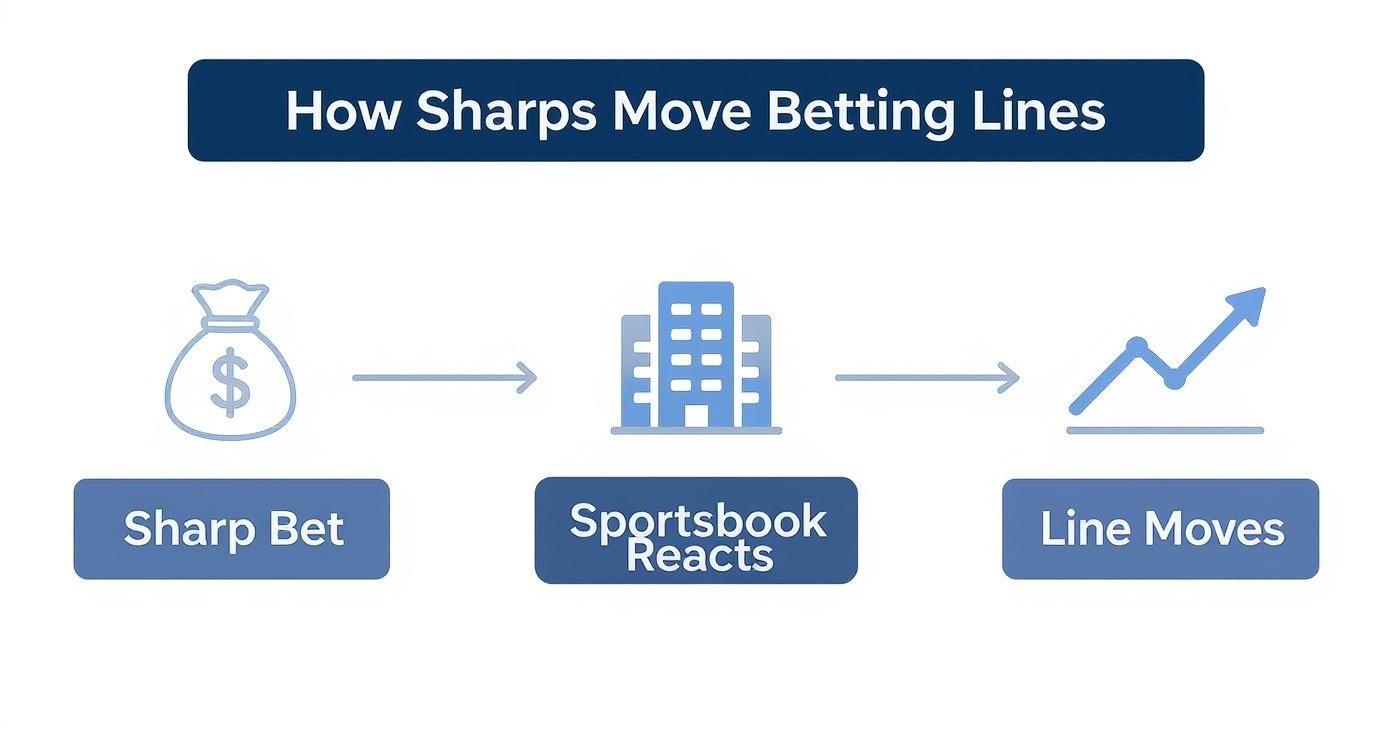
This whole process shows how sharp money is basically high-value intel for the sportsbooks. It forces them to move their lines to manage risk, and the key for us is knowing which moves are caused by the pros.
Key Indicators of Sharp Money
You don't need a secret informant to track sharp money; you just need to learn how to recognize the patterns. There are three big indicators that consistently point to where the professional action is flowing. Each tells a slightly different part of the story, but when you see them together, you get a crystal-clear picture of where the smart money is headed.
Here's a quick rundown of the main signals to watch out for.
| Signal Type | Description | When to Look for It |
|---|---|---|
| Early Week Line Moves | Significant odds changes that happen long before the average bettor is thinking about the game (e.g., Monday or Tuesday for a weekend NFL game). | Right after opening lines are released, typically early in the week. |
| Steam Moves | A sudden, rapid line move that happens across multiple sportsbooks at the same time. This signals that several sharp syndicates have all hit the same bet. | Can happen anytime, but it's very noticeable due to its speed and market-wide impact. |
| Reverse Line Movement (RLM) | The betting line moves in the opposite direction of the public betting percentages. The line moves against the side that's getting the majority of the bets. | Closer to game time, when public betting volume is at its peak and the contrast is most obvious. |
These are the footprints that sharps leave behind. Learning to spot them is the first step toward understanding the "why" behind the numbers.
Here's a closer look at what each of these signals really means.
Early Week Line Moves: The general public tends to wait until closer to game day to get their bets in. Sharps are the complete opposite. They attack the opening lines the moment they're posted, looking to grab what they see as the best value before the market has a chance to correct itself. A big line move on a Monday for a Sunday NFL game is almost always the result of sharp money.
Steam Moves: This is one of the most powerful signals of coordinated sharp action. A steam move is when a massive wave of money floods one side of a game across multiple sportsbooks all at once, triggering a rapid, widespread line change. It's a domino effect that tells you multiple sharp groups have all landed on the same value bet.
Reverse Line Movement (RLM): This might be the most famous sharp betting signal of them all. RLM is what happens when the betting line moves in the opposite direction of the public betting money. For example, if 80% of the bets are on the Kansas City Chiefs but the line moves to make them less of a favorite, that's a massive red flag. It means big, respected money is pouring in on their opponent.
A sportsbook is far more worried about a handful of huge, calculated bets from sharps than thousands of small, emotional bets from the public. Reverse line movement is the clearest sign that the bookmaker is adjusting for the pros, not the fans.
The Sharp Bettor's Process
These movements aren't just happening by chance; they're the direct result of a rigorous, data-first approach. Sharps are known for their sophisticated models and statistical analysis, which puts them in a different league from the average fan.
Many pros build their own power ratings and predictive models, using advanced stats to forecast game outcomes before the sportsbooks even post their lines. If their model says a team should be a 4-point favorite but the book opens the line at -3, that's a clear signal for them to bet. They usually place their wagers early, sometimes within minutes of a line release, to lock in the best possible odds. You can find more great insights into how professional bettors operate on SI.com.
Using Sharp Insights Responsibly
Spotting the footprints of sharp money is a powerful skill, but it's only half the battle. If you think you can just chase every line move without doing your own homework, you're on a fast track to an empty bankroll. The real art is using these signals responsibly as one part of a much larger, more disciplined strategy.
Think of sharp action as the ultimate confirmation tool, not a command to fire away. It’s the green light you get when you see a reverse line move on a game you already liked. That signal validates your own research and gives you a huge confidence boost that you're on the right side.
This is what turns following sharps from a guessing game into a methodical process. Your goal is to find where your own handicapping lines up with the signals from the pros. If they don't match, that’s a perfect reason to hit pause and double-check your work.
The Non-Negotiables of Following Sharp Action
Blindly tailing sharp money is one of the most common mistakes that separates aspiring bettors from successful ones. To use these insights the right way, you have to build a framework around a few core principles. This isn't just about picking the right team; it's about getting the right number at exactly the right time.
Here are the three pillars of betting with the sharps responsibly:
Aggressive Line Shopping: Never, ever settle for the first odds you see. Getting an extra half-point on a spread can easily be the difference between a winning and losing season over the long run. Sharp bettors live and die by squeezing every last bit of value out of the number.
Understanding Market Timing: If you’re late to the party, you've already missed the value. By the time a line moves from -3 all the way to -4.5, the edge the sharps jumped on is completely gone. You have to be ready to act the moment that value appears.
Disciplined Bankroll Management: This is the most critical rule of all. You should never risk more than a small, fixed percentage of your total bankroll on a single game, typically 1-3%. This discipline is what protects you from catastrophic losses and makes sure you can survive the inevitable losing streaks.
Following sharp signals without a strict bankroll strategy is like driving a race car without a seatbelt. Sooner or later, you're going to crash. Discipline is the only thing that keeps you in the game long enough to see a profit.
Integrating Sharp Insights with Value Betting
When you get right down to it, tracking sharp action is just another way to hunt for the most important thing in sports betting: value. A sharp bet is, by its very nature, a bet on a number the pro believes is flat-out wrong.
This lines up perfectly with the core concepts of finding and exploiting inefficiencies in the market. To build a solid foundation, it's essential to understand the principles behind value betting and how it connects directly to these market movements.
By combining your own analysis with the confirmation of sharp money and wrapping it all in strict discipline you can turn market signals into a sustainable, long-term advantage. This responsible approach is what elevates sharps betting from a simple tactic into a cornerstone of a winning strategy.
Common Myths and Pitfalls to Avoid
If you're going to navigate the world of sharp betting, you first have to learn how to filter out all the noise. A lot of newcomers get snagged by popular myths that sound convincing on the surface but lead to some seriously expensive mistakes. Getting these pitfalls on your radar is the first real step toward seeing how betting markets actually work.
One of the most dangerous ideas out there is that "fading the public" is some kind of foolproof system. Sure, it’s true that sharps often find themselves betting against the popular opinion, but blindly betting against the team with 80% of the public tickets is a deeply flawed strategy. There are plenty of games where the public and the sharps are on the same side, and hey, sometimes the public is just plain right.
Not All Line Movement Is Sharp Action
Another classic rookie mistake is thinking every single line move is driven by sharp money. While the pros are definitely a primary driver of odds changes, they aren't the only force at play. A single, massive bet from a wealthy but unsophisticated bettor what the industry calls a "whale" can temporarily send a market scrambling.
Sportsbooks can also be the ones moving the line, sometimes to test the market or bait certain action. This is a tactic often called a "head fake." A book might move a line from -3 down to -2.5, knowing it will attract sharp money, just so they can move it back later to balance their books.
A line move is just a clue, not a conclusion. True sharp money is consistent, respected, and often causes synchronized movement across the entire market, whereas other moves can be isolated or temporary noise.
This is exactly why context is king. A sudden, market-wide shift early in the week is a much stronger signal than a single book fiddling with its odds an hour before kickoff.
Debunking Common Betting Myths
To keep from falling into these common traps, you have to understand the logic behind why these markets move. Simply reacting to surface-level information without a deeper understanding is a recipe for disaster.
Here are a few myths you need to be wary of:
- Myth 1: Blindly Follow All Steam Moves. A steam move signals a flood of coordinated money, but the value can evaporate in seconds. Chasing a bad number just because it was a steam move is a losing game. You must get the same number the sharps bet on, or something very close to it.
- Myth 2: All Reverse Line Movement Is a Goldmine. While RLM is a powerful indicator, it's not infallible. The sharp bettors who caused the move might have been wrong, or maybe late-breaking injury news threw a wrench in the works. It should be a strong confirmation signal for your own analysis, not a blind trigger to bet.
- Myth 3: You Can "Outsmart" the Bookies Easily. Sportsbooks employ teams of expert oddsmakers and risk managers who do this for a living. They actually respect sharp action because it helps them sharpen their own lines. Your goal isn't to outsmart them on every single bet, but to consistently find small edges and value opportunities over the long haul.
By seeing these myths for what they are, you can sidestep the pitfalls that trap so many novice bettors. Instead of chasing every little move, you can start using sharp signals to validate your own research, stick to disciplined bankroll management, and make informed, calculated decisions.
Tools for Tracking Sharp Action

Trying to follow sharp money by manually watching dozens of sportsbooks is an exhausting and deeply inefficient way to operate. Fortunately, technology can do all the heavy lifting, letting you react instantly to the market signals that actually matter.
Modern betting tools are built to automate this entire process. Instead of staring at odds screens all day, you can lean on specialized software that monitors the market for you, sending an alert the moment significant action kicks off.
These platforms are the bridge between understanding the theory of sharp betting and actually putting it into practice. They deliver the raw data and context you need to spot steam moves, reverse line movement, and other key indicators in real time.
Key Features of Sharp Tracking Tools
The best tools offer a specific set of features designed to cut through the noise of public betting and highlight the wagers that are truly moving the odds. They turn a chaotic market into something you can read.
Look for platforms that give you these capabilities:
- Real-Time Odds Comparison: Seeing odds from multiple sportsbooks on a single screen is absolutely essential. This view makes it painfully obvious when a steam move is happening, as you can watch lines change across the entire market simultaneously.
- Line Movement Alerts: Automated notifications for big line shifts are a total game-changer. You can set alerts for specific games or point spread thresholds, ensuring you never miss an early move driven by sharp money.
- Public vs. Sharp Betting Splits: Some services provide data showing the percentage of bets versus the percentage of money on each side of a game. This is critical for spotting reverse line movement, where a small number of bets accounts for a huge percentage of the total handle.
These tools don't just show you what is happening; they help you understand why. By combining odds movement with betting percentage data, you can build a clear picture of where the professional money is flowing.
This kind of technology transforms sharp betting from a guessing game into a data-driven strategy. Using a dedicated sharp money tracker saves you countless hours and lets you focus your energy on analysis and execution, making smarter decisions based on powerful market intelligence.
A Few Common Questions About Sharp Betting
Let's clear up some of the most common questions that pop up when bettors start digging into the world of sharp money. Think of this as a quick guide to separate the myths from the reality.
Can I Just Blindly Follow Sharp Money?
While it sounds like a simple path to profit, blindly tailing every sharp move is a losing game. Why? Because by the time you see a line has moved, the incredible value the sharps jumped on is usually long gone. You're left with the scraps.
A much smarter way to think of it is as a powerful confirmation signal. If you've done your own homework and your analysis points to one side, seeing a big sharp move in the same direction adds a ton of confidence to your bet. It tells you that the pros agree with your read.
Is All Line Movement Caused By Sharps?
Not a chance. Plenty of things can move a line that have nothing to do with respected professional action. A star player getting injured, a sudden change in the weather forecast, or even just one wealthy amateur dropping a massive bet can all shift the odds.
The real skill is learning to tell the difference between market-wide, respected moves and isolated noise. True sharp action tends to cause fast, coordinated line changes across dozens of sportsbooks at once. A slow drift at a single bookmaker closer to game time? That's far less meaningful.
The most reliable signal of sharp money is not just that a line moved, but how and when it moved. An early, sudden, market-wide shift carries far more weight than a slow drift at a single bookmaker closer to game time.
How Can I Start Tracking Sharp Action?
Trying to do it manually is next to impossible. The most effective way is to use specialized betting tools. Platforms like ours are built to do the heavy lifting for you by aggregating real-time odds from across the market.
They send you alerts for major line moves and show you public betting percentages, making it easy to spot tell-tale signs like steam moves or reverse line movement. It's the only practical way to get the data you need without staring at a dozen screens all day.
Ready to turn these insights into a real advantage? ValueBetFactory gives you the real-time alerts and market data you need to spot professional action the moment it happens. Explore our tools and start making more informed betting decisions today.