
Sharp Money NFL Betting Explained
Unlock Profits with betting tips!
When you hear the term sharp money in NFL betting, it’s not just about a single big bet. It refers to the large, strategically placed wagers from professional bettors, the "sharps", who use incredibly detailed analysis to find an edge in the betting lines. Their wagers are so respected that sportsbooks will often move the odds in response, creating a ripple effect across the market. This guide will teach you how to spot those ripples and use them to your advantage.
The Secret Language of NFL Betting
Ever notice how a small percentage of people seem to consistently win at NFL betting, while everyone else is just guessing? It’s not about luck. It's about understanding the flow of sharp money.
Think of it like this: the betting market is a lot like the stock market. You have the general public, or "retail traders," who often buy and sell based on headlines and gut feelings. Then you have the professional Wall Street investors who live and breathe data, crunching numbers to find undervalued assets. The same exact dynamic plays out in sports betting.
This guide is designed to pull back the curtain on the world of these professional bettors. For sharps and betting syndicates, this isn't a hobby; it's a full-time job built on sophisticated models, deep analysis, and unwavering discipline. Their influence is powerful enough to shift entire betting markets with a handful of well-placed wagers.
The key isn't trying to become a sharp overnight. It's about learning to read the footprints they leave in the market. When you understand what their money is telling you, you gain a massive advantage over the average bettor.
Decoding the Professionals' Playbook
The goal here is to learn how to interpret the actions of sharp bettors. This isn't about blindly tailing their picks, that's a losing strategy. Instead, it’s about recognizing the patterns their money creates. You'll learn to see how large, respected wagers force sportsbooks to adjust their lines, turning what looks like random market noise into clear, actionable intelligence.
Learning to follow sharp money in the NFL helps you do three critical things:
- Identify undervalued teams: Sharps often bet against public perception, finding value in teams the casual fan might write off.
- Avoid popular traps: You'll learn to spot games where the public is piling on one side, creating an inflated line that’s ripe for a fade.
- Make informed decisions: Instead of betting with your heart, you'll start using real market data to guide your wagers.
Consider this your first step toward evolving from a fan who bets into a bettor who wins. It’s about equipping yourself with the knowledge to make more calculated, value-driven decisions and finally understanding the hidden forces that truly shape the NFL betting market.
Understanding Sharp Money vs Public Money
To really get a handle on sharp money in the NFL, you first have to understand the two very different forces that push and pull every betting line: sharp money and public money. Think of it as a tug-of-war between seasoned pros and casual fans, where each side has a completely different reason for being in the game.
Public money is exactly what it sounds like, it comes from the general betting public. These are the casual fans, the folks betting with their hearts, driven by gut feelings, media hype, and loyalty to their hometown team. They'll drop a few bucks on the star quarterback or the team that just won on Monday Night Football, usually without a deep dive into the analytics. While there are a ton of these bets, they're typically smaller and tend to follow predictable, emotionally-driven patterns.
Sharp money, on the other hand, is the big stuff. This is the capital wagered by professional bettors who treat sports betting as their full-time job. They aren't betting for fun; they're running a business. Their approach is all about calculated precision, using sophisticated statistical models, private data, and a finely-tuned sense of market dynamics to find and exploit any line that looks even slightly off.
The Sharp Bettor Mindset
Unlike a fan who's just hoping their team wins, a sharp bettor is on the hunt for one thing: value. They honestly couldn't care less who wins the game. Their only concern is whether the odds on the board are better than the actual probability of that outcome happening. This isn't easy, it takes ironclad discipline and an obsessive focus on the numbers.
Sharps aren't looking for a lottery ticket; they're grinding out a living by finding small, consistent advantages that add up over the long haul. They know winning every single bet is a fantasy. The real goal is to win just often enough to beat the sportsbook's built-in commission, often called the "vig" or "juice."
For instance, in the NFL, a sharp bettor's target is a win rate just a hair over 52.4%. That’s the magic number you need to be profitable against the standard -110 odds on point spreads. It might not sound like much compared to a coin flip's 50% chance, but that tiny edge is the difference between making a living and going broke. Hitting that mark consistently is what separates the pros from the public. You can find a more detailed breakdown of how betting odds work and affect your bottom line on wunderdog.com.
This image does a great job of showing the stark contrast in results and market influence between the two groups.
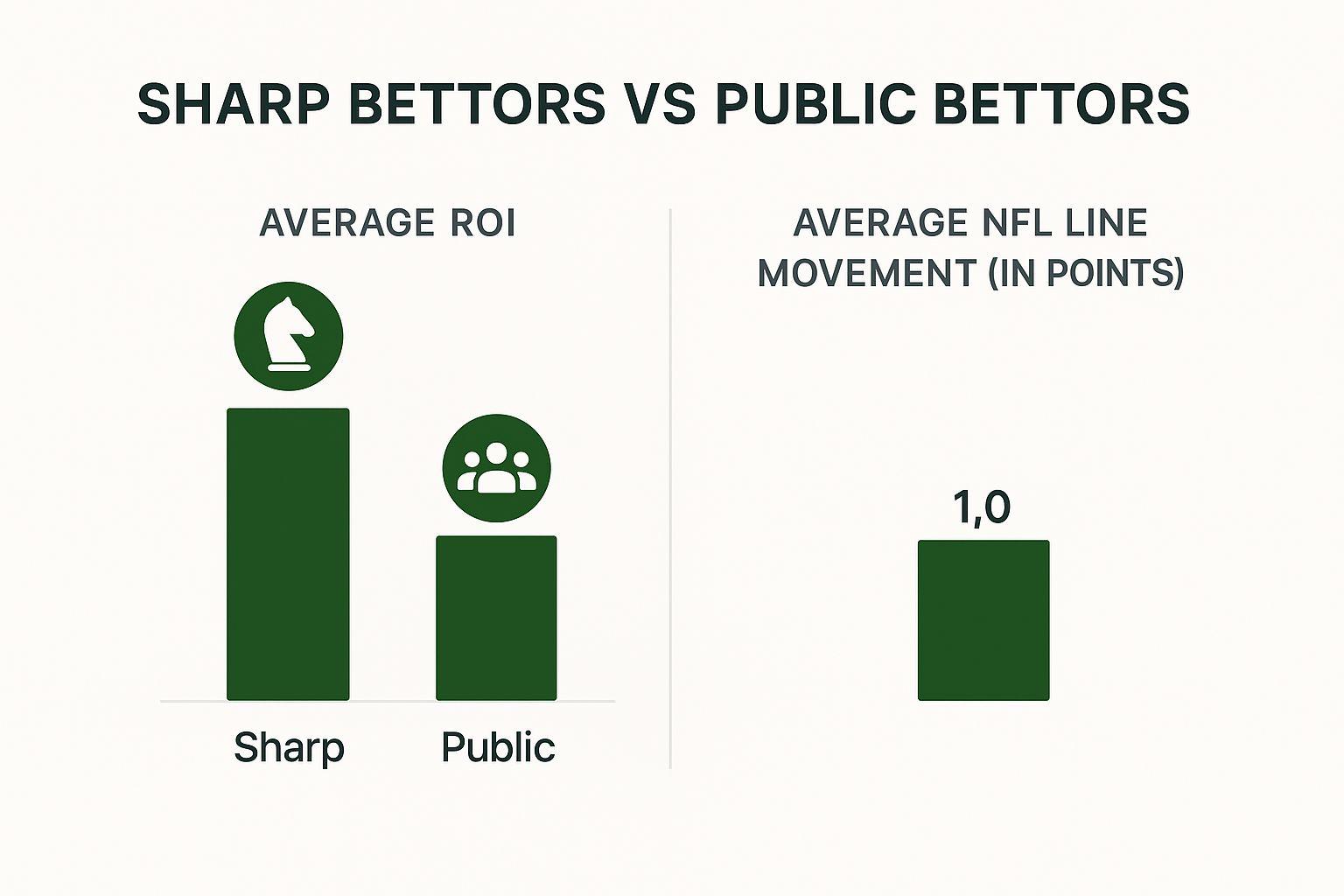
As you can see, sharp money consistently generates a positive return and, more importantly, its weight is what truly moves the betting lines. The sportsbooks respect it.
Sharp Bettor vs Public Bettor Profile Comparison
To really crystallize these differences, it helps to see them side-by-side. The public bets on teams and storylines, while sharps bet on numbers and probabilities. This table breaks down the core distinctions in their approach.
| Characteristic | Sharp Bettor (Professional) | Public Bettor (Casual) |
|---|---|---|
| Primary Goal | Find long-term positive expected value (+EV) | Entertainment, support a favorite team, hope for a big win |
| Strategy | Data-driven; uses statistical models, power ratings, and market analysis | Emotion-driven; influenced by media narratives, recent performance, and personal bias |
| Bet Size | Large, calculated wagers to maximize edge | Small, recreational wagers |
| Market Impact | High; sportsbooks move lines based on their action | Low; volume is high but predictable, often creating value on the other side |
| Timing of Bets | Bets early in the week to get the best number before the market corrects | Bets late, often closer to game time, after absorbing media hype |
| Common Bets | Underdogs, unders, and obscure markets where lines are softer | Favorites, overs, and popular primetime games |
| Mindset | Analytical, disciplined, and emotionally detached | Hopeful, emotional, and prone to chasing losses |
Ultimately, this fundamental clash in philosophy is what creates opportunities for savvy bettors.
A sharp bettor's goal isn't to predict the winner of a football game. Their goal is to identify and exploit a mispriced betting line created by public perception.
This dynamic leads to some very clear patterns. The public loves to pile on favorites and overs, it's more fun to root for a blowout, right? Knowing this, sharps often find their value on the other side, taking underdogs and unders after the sportsbooks have shaded the lines to protect themselves from the flood of one-sided public action. Once you understand this flow, you can start to read the market and see where the real value might be hiding.
How to Identify Sharp Money in the NFL

Now that we've drawn the line between sharp money and public money, let's get into the good stuff: spotting the pros in action. Uncovering sharp money in the NFL isn't about having an inside source or a secret handshake. It's about learning to read the clues the betting market leaves behind.
And the biggest, most reliable clue of all? A little something called Reverse Line Movement (RLM).
Reverse line movement is exactly what it sounds like, the betting line moves in the opposite direction of what you'd expect based on the betting percentages. In other words, one team is getting hammered with the majority of the bets, but their odds are actually getting better, not worse. This is a classic signal that big, respected wagers are hitting the other side, forcing oddsmakers to react.
Spotting Reverse Line Movement
Let's walk through an example. Say the Green Bay Packers open as 7-point favorites (-7) against the Chicago Bears. As the week goes on, the betting data rolls in, and you see that 75% of all point spread tickets are on the Packers. Common sense says the line should move to -7.5, maybe even -8, to tempt people to bet on the Bears and balance the book.
But then, the opposite happens. The line drops to Packers -6.5.
That’s it. That’s your red flag. This is textbook RLM. It tells you that even though most of the tickets are on the Packers, the serious money, the sharp money, is landing on the Bears +7. The sportsbook is more worried about the sharps than the public, so they adjust the line to make the Bears a less appealing bet.
When the line moves against the public, pay attention. Sportsbooks respect sharp bettors far more than the casual masses. They aren't trying to balance the number of bets; they're trying to balance their financial risk.
Following this signal isn't just theory; it's a historically profitable strategy. Data from Sports Insights, going all the way back to 2003, showed that NFL teams getting less than 40% of spread bets while the line moved in their favor went 290-249 against the spread. This simple strategy generated a profit of 25.82 units with a solid 4.8% ROI.
Other Key Sharp Money Indicators
While RLM is the heavyweight champion of sharp indicators, a few other tells can help you get a clearer picture of where the professional money is headed.
- Steam Moves: This is when a line moves suddenly and dramatically across the entire market, almost at the exact same time. It's the market's equivalent of a tsunami, caused by a flood of coordinated, high-limit wagers from a betting syndicate hitting multiple sportsbooks at once.
- Betting the Openers: Sharps don't wait around. They often get their money down right when the opening lines are posted early in the week. Their goal is to pounce on a number they believe is soft before the public has a chance to push it in the other direction.
- Opening vs. Closing Line Analysis: Simply comparing the opening line to the line right before kickoff (the closing line) tells a story. Significant movement reveals which side the market, and therefore the sharp money, ultimately favored. To really dig into how these market forces work, take a look at our guide on betting line movement.
Spotting sharp money is the first step. Knowing what it means across different types of bets is where the real edge is found. Pros don't just pick winners; they hunt for value everywhere, and their fingerprints on spreads, totals, and moneylines each tell a unique story.
Point Spreads and Key Numbers
In the NFL, sharp money has a huge say in how point spreads move, especially around key numbers. The most frequent victory margins are 3 and 7 points. When a wave of professional money pushes a line across one of those numbers, you need to pay attention.
For instance, if a team opens as a -2.5 favorite and sharp action pushes them to -3.5, that’s a massive vote of confidence. It means the pros are so sure about their side that they’re willing to give up the crucial field goal margin to place their bet.
Where Sharps Hunt for Value: Totals and Underdogs
While the public loves hammering the "over," dreaming of a high-scoring shootout, sharps often find their value on the "under." This is a classic "sharps vs. squares" scenario. The public's enthusiasm can inflate the total, creating an opening that professionals are more than happy to pounce on.
We even saw this play out on the biggest stage. For the Super Bowl between the Chiefs and Eagles, sportsbooks took six-figure wagers from respected bettors on the under. One massive bet was for $110,000 on the UNDER when the line was hovering around 49.5 points. That kind of money helped pull the line down, even as most fans were betting on a ton of points being scored. You can read more about that specific Super Bowl bet and its market impact.
It's a similar story with underdogs. Casual bettors are drawn to favorites, but sharps are digging deep into the matchups, looking for underdogs whose chances of winning are much better than the odds imply.
When you see an underdog's moneyline price getting shorter even though the public is all over the favorite, it’s a flashing red light. It's a clear sign that respected money sees a potential upset on the horizon. They're betting on probability, not popularity.
This kind of line movement suggests the underdog might be seriously undervalued by the market. Learning to spot these signals across different wager types is what separates a novice from a seasoned bettor. To brush up on the fundamentals, take a look at our guide covering the different types of sports bets.
In the end, reading sharp money isn't about focusing on a single market. It's about seeing the entire board and understanding where the professionals are putting their cash. By piecing together their moves on spreads, totals, and moneylines, you can get a much clearer, more accurate picture of the betting landscape for any given game.
Applying Sharp Insights to Your Betting Strategy
Alright, so you can spot the signals of sharp money. That’s a huge first step. But just knowing what the pros are doing isn't enough to make you profitable. Turning that knowledge into a real, tangible edge is where the magic happens.
Let's get one thing straight: the goal is not to blindly follow every sharp move you see. By the time a line has steamed across the market and the signals are screaming at you, the best of the number is usually long gone.
Instead, think of sharp money as a powerful confirmation tool. It's that final check before you pull the trigger on a bet, like a pilot running through their pre-flight checklist. The real power comes from blending these market insights with your own well-researched analysis. This approach shifts sharp action from a simple "follow the leader" game into a sophisticated validation system for your own handicapping.
A Practical Framework for Using Sharp Money
The smartest way to use sharp insights is to let them either confirm or challenge your own work. This creates a disciplined process that stops you from just chasing steam and forces you to make more calculated decisions. It's a fantastic check and balance against your own biases.
Here’s a simple, three-step framework to put this into action:
Form Your Own Opinion First: Before you even glance at betting percentages or line movement, do your own homework. Break down the matchup, dig into the stats, and come to your own conclusion about which side has value. This initial analysis has to be yours and yours alone.
Check for Sharp Money Indicators: Once you have a lean, it's time to see where the pros are putting their money. Look for tell-tale signs like reverse line movement, steam moves, or big discrepancies between the opening and closing lines. This is where you hunt for the sharp side.
React to What You Find: This is the moment of truth. How you respond depends on whether the market agrees with you or not.
- If sharp money aligns with your analysis: That’s a massive green light. It validates your handicapping and should boost your confidence in the wager. Go for it.
- If sharp money contradicts your analysis: This is a huge red flag. It doesn't automatically mean you're wrong, but it’s a clear signal to pump the brakes and dig deeper. What could the sharps be seeing that you've missed? An injury? A specific matchup exploit?
Following this framework helps you avoid the single biggest trap in sports betting: making emotional decisions. It forces you to justify every wager with both your own research and the sentiment of the most respected bettors in the market.
This process builds a more robust and self-aware betting style. The end goal is to create a consistent, repeatable process that adapts to market signals. For a deeper dive into building that foundation, check out our complete guide on developing a successful betting strategy.
Essential Habits for Long-Term Success
Using sharp insights the right way requires discipline and solid habits. Without a strong foundation, even the best information can lead to poor results.
Focus on mastering these core principles:
- Always Line Shop: Never, ever place a bet without checking the odds at multiple sportsbooks. Getting a team at -2.5 instead of -3, or +7.5 instead of +7, is an enormous advantage over the long run. These half-points are gold.
- Practice Disciplined Bankroll Management: Stick to betting a small, consistent percentage (1-3%) of your total bankroll on any single game. This is non-negotiable. It protects you from disastrous losses and ensures you live to bet another day.
- Don't Misread the Signals: Remember, not every big bet comes from a sharp. Wealthy fans, often called "whales", can move lines with big, uninformed wagers. That's why you always look for corroborating evidence like reverse line movement, not just a single large bet.
When you combine your own analysis with the powerful confirmation that sharp money in the NFL provides, you elevate your entire process. You move away from simple guesswork and toward a structured, value-driven approach that gives you a real shot at winning.
Busting Common Myths About Sharp Money
To really get a handle on sharp money NFL betting, we need to clear away some of the smoke and mirrors. A lot of newcomers trip over common myths about how the pros operate. Honestly, knowing what sharp money isn't can be just as valuable as knowing what it is.
Let's start with the biggest one: the idea that sharps win every single bet. That's just not how it works. In reality, the best bettors in the world often lose 40-45% of their wagers. Their entire game is built on a long-term strategy of finding positive expected value (+EV) and grinding out a small, consistent profit over a massive volume of bets, not on some magical ability to predict the future.
Sharp betting is a game of probability, not prophecy. Their edge comes from consistently finding lines that offer better odds than the true likelihood of an outcome, ensuring profitability over time.
Another myth that trips people up is thinking any huge bet is automatically sharp money. It’s a bit more nuanced than that.
Separating Sharps from Whales
Not all big bets are created equal. You have what the industry calls "whales", wealthy recreational bettors who might drop a six-figure wager on their favorite team just for the fun of it. That bet might move a line, sure, but it's driven by fandom, not sophisticated analysis.
A sportsbook might react to a whale's bet, but that move doesn't have the same predictive power as a calculated wager from a respected professional syndicate. This is exactly why it's so important to look for other clues, like reverse line movement, to confirm what you're seeing.
Finally, let's kill the fantasy that you can just tail sharp picks and print money. It’s a dangerous trap. By the time a sharp move is obvious enough for the public to notice, the value is long gone. The line has already shifted, leaving you with a much worse number than the pros got. Timing is everything.
The smarter play is to use sharp action as one more piece of the puzzle. It's a powerful confirmation tool to support your own research, not a get-rich-quick scheme.
Got Questions About Sharp Money? We've Got Answers
Let's tackle a few common questions that pop up when you first start digging into the world of sharp money in the NFL. Getting these concepts straight will help you put everything you've learned into practice.
Is Following Sharp Money Illegal?
Not in the slightest. Following sharp money is a perfectly legal strategy. Think of it like a stock trader watching what the big Wall Street firms are buying and selling.
All the information you need, betting percentages, line movements, etc., is public data published by sportsbooks. You’re simply an analyst interpreting market signals to make smarter decisions.
What Tools Track Betting Percentages?
Plenty of them. A whole ecosystem of sports data sites and betting media outlets offer real-time betting percentages for every NFL game. These platforms break down exactly how the public is betting on the spread, moneyline, and total for each game.
We don't play favorites with any one service, but a quick search for "NFL betting percentages" will give you a ton of options. The key is to find a reputable source that provides up-to-the-minute data, as that’s where you’ll see the clearest picture of where the money is flowing.
Sharp betting is about probability, not perfection. Sharps accept losses as part of the process, knowing their analytical edge will lead to long-term profitability over a large volume of wagers.
Can I Apply These Principles with a Small Bankroll?
Absolutely. The size of your bets doesn't matter; the thinking behind them does. Analyzing line movement, spotting value, and using sharp action as another piece of the puzzle are smart habits for any bettor.
The goal isn't to bet huge amounts of cash, it's to think like a pro. Focusing on finding that sliver of value and managing your money wisely will improve your results, whether you’re betting $10 a game or $10,000.
Do Sharps Ever Get It Wrong?
Constantly. There's a huge misconception that sharps are fortune-tellers who never lose. In reality, even the most successful professional bettors are wrong 40% to 45% of the time.
Their success doesn't come from being perfect. It comes from consistently finding a mathematical edge that pays off over the long haul.
Ready to turn market insights into a real advantage? ValueBetFactory provides the tools and real-time data to spot value bets and make smarter, more informed decisions. Stop guessing and start betting with an analytical edge. Learn more at ValueBetFactory.