
Sharp Money Betting A Guide to Winning Bets
Unlock Profits with betting tips!
Ever heard the term sharp money? It's one of those concepts that separates the casual punter from someone who treats betting like a serious investment.
Simply put, sharp money betting is all about tracking the wagers of professional, highly respected bettors. These aren't your average fans placing a few quid on their favorite team; these are the "whales" of the sports betting world, and their bets are so large and strategic they can literally move the entire market. Think of them as the elite investors of sports betting.
What Is Sharp Money Betting and Why It Matters
Let's stick with that stock market analogy for a second. Imagine the sports betting world is a massive stock exchange. The vast majority of people the "public" are betting based on media hype, gut feelings, or emotional attachment to a team. This is what's known as public money.
But then there's a small, elite group that consistently turns a profit. They're not guessing. They're using deep analysis, sophisticated models, and an ironclad discipline. This is the sharp money.
These pros, often called "sharps," don't bet for the thrill of it; they bet to win. Their wagers are calculated, informed, and big enough to force sportsbooks to adjust their lines. Figuring out where they're putting their money isn't about finding some secret insider tip. It's about learning to read the market and spot the footprints they leave behind.
The Power of Professional Insight
So, why should any of this matter to you? Because following these signals gives you a powerful layer of insight that goes way beyond looking at basic stats. It helps you:
- Spot True Value: Sharps are masters at finding mispriced odds where the real probability of something happening is much higher than the odds suggest.
- Dodge Public Traps: The public loves to pile on popular teams, creating inflated lines that sharps are more than happy to bet against.
- Build a Smarter Strategy: Following sharp money forces you to think more analytically and less emotionally about where you put your cash.
One of the clearest signs of sharp action is a classic market indicator called Reverse Line Movement (RLM). This is what happens when the betting line moves in the opposite direction of the public betting percentages.
For example, let's say 80% of all bets are on Team A, but the odds suddenly shift to make Team B more of a favorite. That’s a massive red flag. It’s a strong signal that a huge amount of sharp money has just come in on Team B, forcing the bookies to adjust. You can read the full research on Reverse Line Movement and what it means for spotting sharp money over at Oddsshopper.com.
When you learn to spot the signals left by these betting professionals, you're no longer just guessing. You're making informed, value-driven decisions. It's a fundamental shift from betting like a fan to thinking like an investor.
Understanding Sharp Bettors vs Public Bettors
To really get a handle on sharp money, you first need to understand the two forces constantly pushing and pulling on the sports betting market: the public and the sharps. These groups are worlds apart in how they think, what drives them, and the strategies they use. It’s this constant tug-of-war that ultimately shapes the odds you see every day.
Public bettors are the bread and butter for sportsbooks. They’re usually casual fans betting with their hearts, throwing money down on their favorite teams, big-name superstars, and whatever story the media is hyping up that week. Their bets are driven by emotion and popular opinion, not cold, hard data.
Sharps, on the other hand, treat betting like a business. These are the professionals, the data geeks who operate with calculated discipline. Their goal isn't to root for a team to win; it's to find and exploit tiny inefficiencies in the market those mispriced odds that the average fan completely overlooks.
The Mindset That Separates Pros from the Public
The real difference comes down to their entire approach. A public bettor might back the heavily favored home team just because they're a household name and riding a hot streak. This emotional buy-in often means they'll accept terrible value just for the thrill of backing a popular choice.
In contrast, a sharp bettor is on the hunt for value, completely detached from personal bias. They run sophisticated models, crunch huge amounts of data, and look for any gap between a team's true probability of winning and the odds on the board. For them, a wager on an underrated underdog with juicy odds is way more appealing than an overhyped favorite. For a deeper look into their methods, you can check out our guide on how to identify and place sharp bets.
"The public bets on teams, while sharps bet on numbers." This old saying nails the key distinction perfectly. Sharps aren't really betting on a team to win; they're investing in a number they believe is wrong.
This visual shows the real-world impact sharp money has on betting lines and how it can affect potential returns when compared to standard odds.
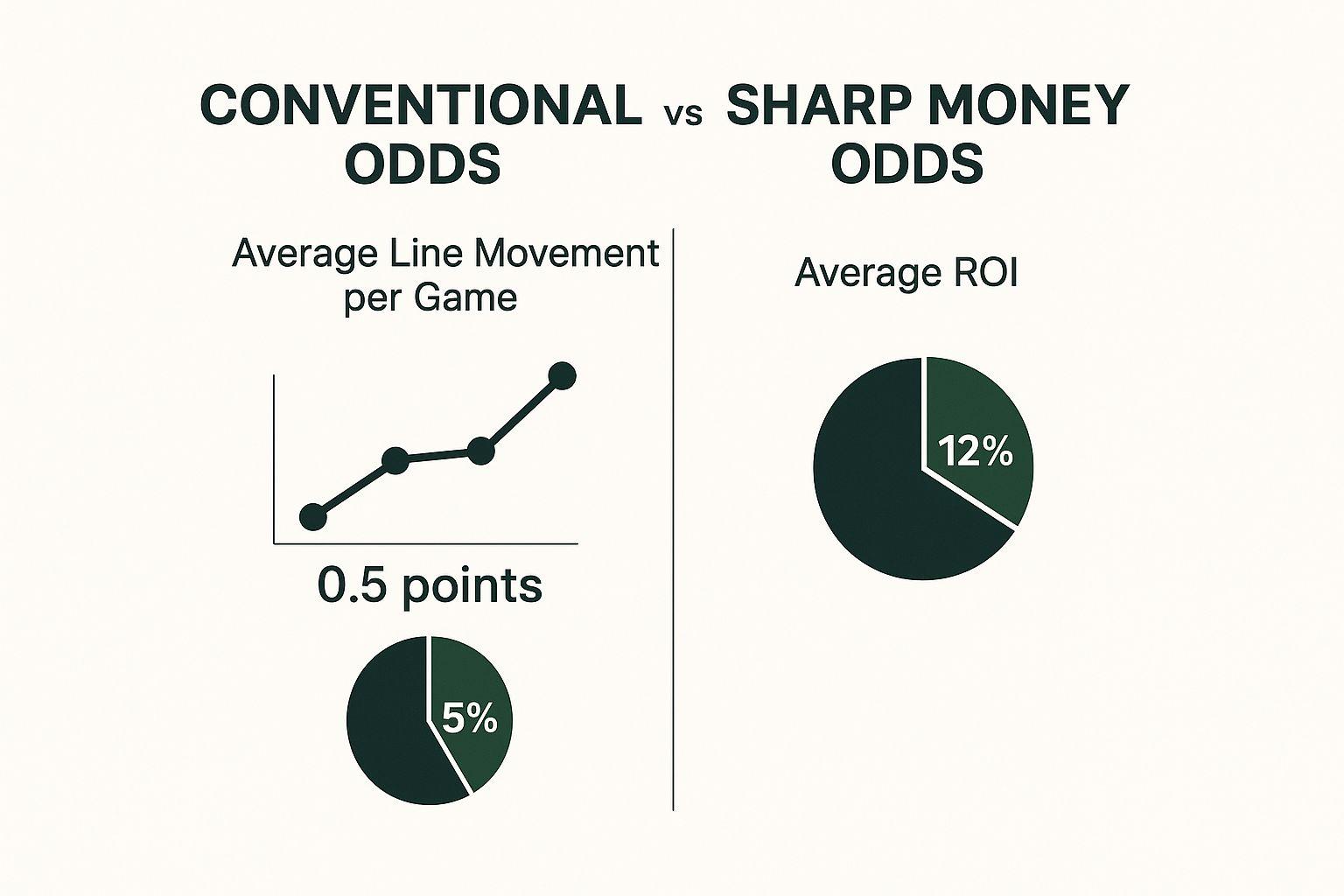
As you can see, sharp action is a major driver of line movement and is linked to a much higher return on investment, which really underscores its influence on the market.
Sharp Bettor vs Public Bettor Key Differences
Getting a feel for these two betting styles is the first step toward thinking less like a casual fan and more like a successful bettor. The table below breaks down the key differences in how they operate.
| Characteristic | Sharp Bettor (Professional) | Public Bettor (Casual) |
|---|---|---|
| Primary Motivation | Finding long-term mathematical value and profit. | Entertainment, emotional investment, and cheering for a favorite team. |
| Research Method | Advanced statistical models, data analysis, and situational handicapping. | Mainstream media narratives, team reputation, and gut feelings. |
| Bet Timing | Bets early to secure the best number or late when limits are highest. | Often bets just before game time, following popular trends. |
| Goal | Achieve consistent, long-term profitability (5-10% ROI). | The thrill of winning a single bet, regardless of the odds. |
Once you understand these fundamental contrasts, you can start to see why spotting the influence of sharp money is so critical to finding long-term success.
How to Spot Sharp Money Signals in the Market

Knowing the difference between sharp money and public money is half the battle. The real work begins when you learn to spot the pros' footprints in the market. The good news is, you don't need a secret password to figure out where the smart money is going. Sharp action leaves behind distinct, actionable signals if you know what you’re looking for.
Think of these signals as breadcrumbs. Follow them, and they’ll lead you to a much more informed betting decision. Once you learn to interpret them, you'll start reading the market with a whole new level of clarity, moving beyond just picking a winner and into genuine strategic analysis.
Reverse Line Movement: The Strongest Signal
The most powerful and undeniable sign of sharp action is Reverse Line Movement (RLM). This is what happens when the betting line moves in the opposite direction of where the public is betting. It's a glaring contradiction, and it’s a massive tip-off that something important is happening behind the curtain.
Let's imagine the Kansas City Chiefs are playing the Denver Broncos. A huge 80% of the betting public is piling their money on the Chiefs. Logically, a sportsbook would want to make it less attractive to bet on the Chiefs to balance their books. But then you see something strange: the line moves in favor of the Chiefs, shifting from -7 down to -6.5. That’s classic RLM.
What does this tell you? It means that even though only a few people are betting on the Broncos, the money behind those bets is so significant that it’s forcing the sportsbook to react. That kind of weight almost always comes from respected sharps.
Reverse Line Movement is the market’s way of screaming that professional bettors disagree with the public consensus. When the odds move against the crowd, it’s time to pay close attention.
Ticket Count vs. Money Percentage
Another crucial signal is the gap between the percentage of bets (ticket count) and the percentage of money wagered on a game. Public bettors tend to place lots of small wagers, while sharps drop large amounts. This creates a powerful dynamic you can easily track.
Say the Los Angeles Lakers are getting 70% of the total tickets in a game against the Boston Celtics. But when you look at the total money wagered, you see that only 40% of the cash is actually on the Lakers. This means the other 60% of the money is on the Celtics, even though they only have 30% of the tickets.
This kind of discrepancy is a massive red flag. It shows that a small number of bettors are wagering huge sums on the Celtics, completely dwarfing the thousands of small, casual bets on the Lakers. That's a crystal-clear sign of sharp money in action.
In big markets like the NFL, the public loves to bet on favorites. Sharps, on the other hand, often find value with the underdogs. You might see a situation where 78% of tickets are on one team, but the money is split 50/50, which tells you the bigger bets are on the other side. If you want to dive deeper into these signals, you can learn more about assessing sharp money moves on Betsperts.com.
Other Key Sharp Money Indicators
Beyond RLM and money splits, a few other patterns can give away professional action.
Steam Moves: This is a sudden, drastic, and uniform line change that happens across multiple sportsbooks all at once. It’s triggered when a powerful betting syndicate places large, coordinated wagers at several books simultaneously, forcing a market-wide correction.
Late Week Bets: Sharps often hold their fire until later in the week, closer to game day. Why? That’s when betting limits are at their highest, allowing them to get more money down. It also gives them time to watch how the market reacts to all the public sentiment before they make their move.
Using Analytics to Track Professional Action
Spotting signals like Reverse Line Movement is a fantastic starting point, but the modern game has moved on. To get a real edge, you need to go beyond simple observation and start crunching the numbers. This is where you shift from instinct to data-driven analysis, confirming what your gut is telling you with hard proof.
Luckily, powerful analytical tools now exist that can do the heavy lifting for you. They sift through mountains of market data to show you exactly where the expert money is flowing, all without the emotional bias that clouds our judgment. Think of these platforms not as crystal balls, but as powerful filters that turn millions of data points into simple, actionable insights. They help you move from making educated guesses to data-backed decisions.
Quantifying Sharp Momentum with Indexes
One of the cleanest ways to measure professional action is with a dedicated index. A great example is The Sharp Plays Index (TSP-I), a tool designed specifically to score the momentum between sharp and public money in different sports markets. It looks at performance and market reactions to spit out a single, clear number.
The index runs on a simple scale from -5 to +5. A negative score means the public is piling on one side, while a positive score shows that the pros are making their move. In the real world, you'll usually see the index hover somewhere between 0.5 and 3.5.
A score near zero suggests a balanced market where neither side has a clear advantage. But as that number starts to climb, it’s a strong signal that sharp momentum is building.
A strong positive TSP-I score is a powerful confirmation that professional money is heavily influencing a particular game. When scores approach the higher end of the scale, like +3.3 to +3.5, it suggests an intense run of sharp dominance that may be due for a market correction.
Applying Analytics to Your Betting Process
Bringing these kinds of tools into your workflow takes a lot of the guesswork out of finding sharp action. Instead of trying to piece together a single signal, you get a consolidated view of the entire market's sentiment. This is how you build a more robust and repeatable betting process.
Here’s how you can put these analytics into practice:
- Confirm Your Own Research: Got a good feeling about a team? Use an index score as your final gut check. If your analysis points one way and the sharp index is high for that same team, it adds a massive layer of confidence to your bet.
- Challenge Your Assumptions: On the flip side, if you really like a team but see a strong negative score, that's a huge red flag. The market is telling you that the pros disagree with you, and it’s time to take a hard second look at your reasoning.
- Identify Market Disagreements: Hunt for games where the public is all over one side, but the sharp index is moving in the opposite direction. These are the classic scenarios that create Reverse Line Movement and often signal the best betting opportunities.
Ultimately, the goal is to use data to sharpen your own judgment, not replace it. Diving deeper into sports betting analytics can give you a significant leg up. When you combine old-school observational skills with modern quantitative data, you develop a well-rounded strategy that is both informed and disciplined.
Common Mistakes to Avoid When Following Sharps

While tracking sharp money can give you a serious leg up, it's no magic bullet. A lot of aspiring bettors fall into the trap of blindly copying every move they think is sharp. That's a fast track to an empty bankroll. The goal isn’t to mimic the pros, but to understand how they think.
Simply tailing sharp action is a reactive, not a proactive, strategy. It's a classic pitfall because it completely ignores the single most important factor in successful betting: value. To build a profitable approach that lasts, you have to sidestep the most common and costly mistakes.
Blindly Tailing Without Context
The biggest mistake you can make is assuming every line move is caused by sharp money. Sportsbooks adjust their odds for all sorts of reasons a key player gets injured, the weather forecast changes, or they simply need to balance their books. A line might shift just because a flood of public money is pouring in on one side, not because a pro syndicate dropped a huge wager.
Jumping on a line after it’s already moved is another rookie error. By the time a line shifts due to sharp action, the best number and the value that came with it is long gone. Sharps get in early at the best price. The followers who show up late are left fighting for scraps, forced to accept worse odds and a much smaller edge.
Following sharps should be about confirmation, not imitation. Use sharp signals to validate or challenge your own research, never as a substitute for doing the analytical work yourself. Your own handicapping must always come first.
Misinterpreting the Numbers
Another common blunder is failing to realize what the pros have already factored into the line. A sharp bettor's analysis runs incredibly deep, covering everything from advanced metrics to subtle situational spots. If you don't understand why they're on a certain side, you can't possibly know if the bet still holds any value.
This is where having a firm grasp of betting fundamentals becomes non-negotiable. To really get why sharps target specific numbers, you need a solid foundation in concepts like implied probability and positive expected value. You can learn more about how to calculate expected value in our detailed guide, which is essential reading.
A disciplined approach is about more than just spotting a trend. Keep these key points in mind:
- Don't Chase Steam: A "steam move" is a rapid, market-wide line shift. Chasing it after the fact almost guarantees you’re getting a bad number.
- Focus on the Why: Instead of just seeing what the sharps bet, try to figure out why. Is there an injury the public is overreacting to? A coaching matchup they're exploiting?
- Develop Your Own Opinion: Always start with your own analysis. Formulate your opinion on a game before looking at market signals. This stops you from being swayed by line moves alone and helps you spot true value when it pops up.
At the end of the day, sharp money signals are a powerful tool for refining your strategy, not replacing it. By avoiding these common mistakes, you can use professional insights to build a smarter, more disciplined, and ultimately more profitable betting process.
How to Weave Sharp Insights Into Your Strategy
Knowing how to spot sharp money is one thing. Actually weaving that information into a repeatable betting process is what separates the consistently profitable bettors from everyone else. It’s not enough to just see what the pros are doing. You need a structured game plan to use their insights to sharpen your own analysis.
This isn't about blindly copying bets. Far from it. It's about building a framework that uses professional action as a final, powerful layer of confirmation or as a critical red flag that forces you to challenge your own logic. This is how you build a smarter, more sustainable betting strategy for the long haul.
Develop an Independent Opinion First
This is the most crucial step, and you can't skip it. Before you even glance at market data, betting splits, or line movements, you have to do your own homework. Form an independent opinion on the game based on your own research, stats, and handicapping methods.
This initial analysis becomes your baseline. It prevents you from getting swept up in market noise and ensures you're betting your own numbers, not just chasing steam. Without this foundation, you’re just reacting to what others are doing instead of acting on your own informed judgment.
The core discipline of every professional bettor is to trust their own process first. Sharp money signals should serve as a tool to refine your analysis, not replace it entirely.
Use Market Signals for Confirmation
Once you have your initial read on a game, then it's time to check the market. Keep an eye out for those key sharp indicators we’ve talked about, like Reverse Line Movement (RLM) and those big gaps between ticket counts and money percentages.
Use these signals to put your original thesis to the test:
- Got Confirmation? If your analysis points to an underdog and you see RLM pushing the line in their favor, that's a powerful sign that sharps agree with your assessment. It's a green light.
- Time to Re-evaluate? If you love a favorite but see the money splits heavily backing the other side, that’s a huge red flag. This signal is telling you to go back and take a much closer look. Did you miss a key injury, a situational factor, or a critical matchup?
Prioritize Finding the Best Line
Finally, make it your mission to always get the best possible number. Sharps are absolutely obsessed with value, and even a half-point difference can be the deciding factor between a winning and losing bet over the long run.
This means having accounts at multiple sportsbooks and being ready to act decisively the moment you find an edge. This methodical approach empowers you to evolve your own process. You start using sharp money betting insights not as a crutch, but as a guide to sharpen your skills, challenge your own biases, and ultimately, improve your bottom line.
Common Questions About Sharp Money
It’s only natural to have a few questions when you’re trying to wrap your head around a concept like sharp money. It's a powerful idea, but let's be honest getting it to work in the real world can be a bit tricky at first.
This section is all about clearing up the common sticking points and myths so you can start using these signals with confidence. We’ll cover everything from the dangers of blind copying to the single most powerful indicator you should be looking for.
Can I Just Copy Every Sharp Bet?
The short answer is no. Blindly tailing sharp bets is almost always a losing strategy in the long run. Think about it: by the time you see a major line move, the party is already over. The original value that the pros jumped on is long gone.
Professional bettors are all about getting the best possible number, a luxury that simply isn't available to those who show up late. A much smarter approach is to use sharp money signals to either confirm or challenge your own research, not as a replacement for it.
Where Do I Find Reliable Betting Percentages?
You can find public betting splits the difference between ticket percentages and money percentages on plenty of reputable sports information sites and specialized betting platforms. For the most accurate picture, though, you want to look for sources that pull their data from several major sportsbooks.
The strongest signals always come from a market-wide consensus. When you see multiple sources showing a big gap between the ticket count and the money wagered, that's a rock-solid sign that professional action is moving the line.
What Is the Best Sharp Money Indicator?
Hands down, Reverse Line Movement (RLM) is the most powerful signal in the world of sharp money betting. It’s the smoking gun that tells you exactly where the big money is going.
RLM happens when the betting line moves against the public betting percentages. So, if 80% of the tickets are on Team A, but the odds on Team A are getting worse (e.g., moving from -7 to -6.5), that's a huge tell. It means a smaller number of large, respected wagers have forced the sportsbooks to adjust against the popular side. RLM is a direct clash between public opinion and market reality and you always want to be on the side of reality.
Ready to stop guessing and start making data-driven decisions? ValueBetFactory uses advanced algorithms to identify market discrepancies and alert you to high-value opportunities in real time. Explore our tools and start your free trial today.