
Psychology of Sports Betting: Insights to Improve Your Winning Edge
Unlock Profits with betting tips!
Winning at sports betting isn't just about crunching numbers and analyzing matchups; it's a battle fought inside your own mind. The most successful bettors get this. They know their greatest opponent is often their own emotional and psychological wiring.
This internal struggle is the very core of sports betting psychology. It’s about understanding why you bet, not just what you bet on, and finally seeing the hidden biases that quietly influence every wager you make.
Understanding the Bettor's Brain
So many bettors fall into the same traps without ever realizing it. Betting on your favorite team to win, even when the stats scream otherwise, is a classic emotional play. That powerful urge to "chase" your losses with bigger, riskier bets after a tough beat? It's a natural reaction, but it's also a costly one.
These subconscious impulses can sabotage even the most carefully researched picks. They're the little gremlins in the system that turn a winning strategy into a losing one.
The Role of Mental Shortcuts
Our brains are wired for efficiency. To get through the day, they rely on mental shortcuts, often called cognitive biases, to make quick decisions. These are super helpful when you're deciding what to have for lunch, but they are absolutely disastrous in betting.
In the world of odds and probabilities, these shortcuts create massive blind spots that prevent you from thinking clearly and objectively. The main culprits usually fall into three camps:
- Emotional Decision-Making: Letting your feelings about a team, player, or recent outcome dictate your bets instead of sticking to the data.
- Subconscious Impulses: Acting on gut feelings or knee-jerk reactions, like chasing losses, without a rational game plan.
- Cognitive Biases: These are the invisible mental filters that warp your perception of risk and probability, leading you straight to flawed conclusions.
The real challenge in betting isn’t picking winners; it’s overcoming the flawed mental habits that make you pick losers. A disciplined mind is the most valuable asset a bettor can have.
Recognizing these patterns is the first step toward building a more disciplined, rational betting approach. To get a better handle on the bigger picture, our guide on the psychology of gambling is the perfect place to start.
Laying this groundwork will help you spot these tendencies in your own betting and start making smarter, more profitable decisions for the long haul.
Common Mental Traps That Cost You Money
Knowing your brain uses shortcuts is one thing. Spotting them in the heat of the moment is a whole different ballgame. The world of sports betting psychology is littered with these cognitive biases, flawed mental patterns that feel perfectly logical but consistently steer you toward bad decisions. They are the invisible forces that make you second-guess a solid pick or, even worse, double down on a losing one.
These mental traps are so effective because they work on a subconscious level. You might be convinced you're making a data-driven choice, but a hidden bias is often pulling the strings behind the scenes, quietly costing you money without you even realizing it.
This is where things get tricky. The image below shows just how subtly these biases can sneak into your decision-making process.
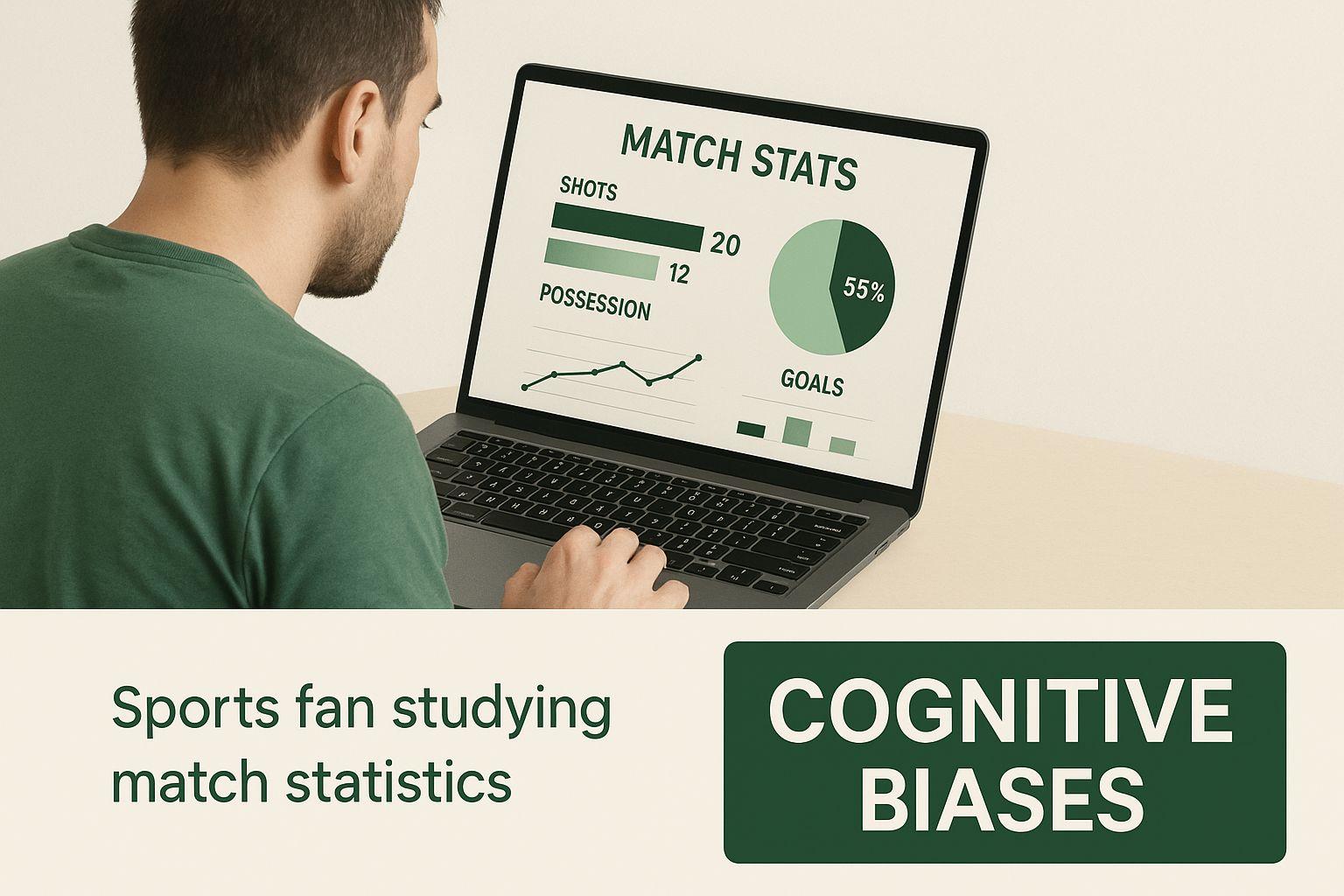
It’s a powerful reminder that your best defense isn't a gut feeling; it's a disciplined, analytical process that keeps these common mental errors in check.
Let's break down some of the most frequent culprits that trip up bettors every single day. These mental shortcuts are incredibly common, but just being aware of them is the first step toward avoiding them.
Common Cognitive Biases in Sports Betting
| Cognitive Bias | What It Means | Sports Betting Example |
|---|---|---|
| Confirmation Bias | You tend to look for and remember information that confirms what you already believe. | You think Team A will win, so you only read articles and stats that support that idea, ignoring any negative news about them. |
| Gambler's Fallacy | The mistaken belief that past events influence future independent outcomes. | A coin has landed on "heads" five times in a row. You bet big on "tails," thinking it's "due" to happen. |
| Availability Heuristic | You overestimate the likelihood of events that are more easily recalled in memory. | You saw a huge underdog win on a highlight reel last night, so now you think betting on longshots is more likely to pay off than it actually is. |
| Recency Bias | You give more importance to recent events than to older ones. | A team won their last game in a blowout, so you bet on them to win again, overlooking their mediocre performance for the rest of the season. |
Recognizing these patterns in your own thinking is crucial. They feel natural, but they're often leading your bankroll astray.
Spotting Confirmation Bias
Confirmation bias is the classic trap of making a decision first and then hunting for stats to back it up. It’s our natural tendency to search for, interpret, and remember information that reinforces our pre-existing beliefs.
Let's say you have a gut feeling the Los Angeles Lakers are going to crush their next opponent. With that idea already in your head, you subconsciously start ignoring reports about their star player's nagging knee injury. Instead, you laser-focus on their historical win record against this specific team. You've just cherry-picked the data to fit the story you wanted to believe, a perfect recipe for a bad bet.
The Gambler's Fallacy Trap
This one is a killer. The Gambler's Fallacy is the mistaken belief that if something happens more frequently than normal, it's bound to happen less frequently in the future. It’s that dangerous "due for a win" mentality that has drained countless bankrolls.
Imagine a star quarterback has thrown an interception in three straight games. The Gambler's Fallacy whispers in your ear that he's "due" for a clean game, so you bet on him to have zero interceptions. This completely ignores the fact that each game is an independent event. The previous interceptions have zero bearing on the outcome of the next pass he throws.
A losing streak doesn't magically increase the probability of a future win. Each bet, each game, and each play exists as an independent event governed by its own set of probabilities.
Overlooking the Availability Heuristic
The availability heuristic is a mental shortcut that relies on immediate, vivid examples that pop into your head. If you just saw a highlight of a massive underdog pulling off a shocking upset, that memorable image can trick your brain into overestimating the likelihood of another longshot winning.
This bias is especially dangerous because it's fueled by high-impact, emotional events, not cold, hard statistical reality. These cognitive biases are a huge reason why so many people overestimate their chances, often leading them to chase losses. With around 46% of American adults interested in sports betting, the financial impact of these psychological factors is massive. You can discover more insights about betting statistics to get a better sense of the scale of this behavior.
The Powerful Pull of the Near Miss
Ever lost a bet on a last-second fumble and felt a stronger urge to bet again than after a total blowout? That intense feeling isn’t just bad luck; it’s a powerful psychological tripwire known as the near-miss effect. This little quirk of the mind is a huge part of betting psychology, tricking your brain into blurring the line between almost winning and actually losing.
A near miss is agonizing. Your team covers the spread for 59 minutes, only to give up a meaningless touchdown at the buzzer that ruins your ticket. Your brain, however, doesn't just chalk this up as a complete failure. Instead, it lights up the very same reward pathways that an actual win would.
This neurological glitch is what makes a near miss so dangerous. It gives you a taste of victory without the payout, reinforcing the idea that you're so close and just need to try again.
Why Almost Winning Feels Like Winning
This near-miss effect is a massive driver of betting frequency. Neuroscientific studies have shown these close calls activate reward centers in the brain much like genuine wins do, which deceives bettors into thinking they have more skill than they actually do. In fact, research across major markets shows that bettors who experience near-miss scenarios tend to bet up to 20-30% more frequently than those who just suffer clear losses. You can discover more insights about sports betting statistics to see just how big of an impact this has.
This creates a dangerous loop where the feeling of being close encourages more action, even if your underlying strategy is completely broken.
A near miss isn’t a sign of future success; it’s a psychological trap that reinforces the betting action itself, regardless of the outcome. It makes you feel skilled when you were simply unlucky.
This feeling of being on the verge of a breakthrough is often supercharged by another powerful cognitive bias that every single bettor has to fight.
The Illusion of Control
Working hand-in-hand with the near-miss effect is the illusion of control, the unfounded belief that your personal skill, rituals, or deep knowledge can somehow influence a random outcome. It's why you might wear your "lucky" jersey or sit in the exact same spot on the couch for every big game you have money on.
Now, don't get me wrong, research and sharp analysis are vital parts of a winning strategy. But the illusion of control takes this a step too far. It convinces you that your actions have a direct pipeline to the players on the field. This belief leads straight to overconfidence and, ultimately, irrational bets.
This potent one-two punch works like this:
- The Illusion of Control makes you feel your strategy is sound and you know what you're doing.
- A Near Miss then provides the "proof" that your brilliant strategy almost worked perfectly.
Together, these two forces create a powerful psychological cocktail. They keep you hooked and betting, convinced that a huge win is just around the corner, even when cold, hard logic is screaming that it’s time to take a break and rethink your entire approach.
How to Control Your Betting Emotions
In sports betting, your biggest opponent isn't the sportsbook. It's almost always the person staring back at you in the mirror.
The pure rush of a big win is an incredible feeling, but it's also a trap. It coaxes you into feeling invincible, leading to reckless, oversized bets. On the other side of the coin, the sting of a tough loss fuels that destructive urge to "chase" your money back with impulsive, desperate wagers.
Winning in the long run isn't about trying to suppress these feelings; that's impossible. It's about building a system so solid that your emotions can't dictate your decisions. The goal is to shift your focus from the wild ride of individual outcomes to the disciplined execution of a sound strategy. Think of it like training your mind the same way an athlete trains their body; you're building mental muscle to withstand the highs and the lows.
This isn't about willpower. It's about putting practical, actionable rules in place that create a buffer between your emotions and your bankroll. Without them, you're just betting with your heart, not your head.
Implement Strict Bankroll Management
Your first and most important line of defense is a non-negotiable bankroll management plan. This is the bedrock of emotional control because it rips the guesswork right out of your staking. By defining your unit size as a tiny percentage of your total bankroll, typically 1-3%, you remove the temptation to go big out of excitement or desperation.
A losing streak stings a whole lot less when each loss is just a tiny nick in your overall funds. By the same token, a massive win won't trick you into thinking you've cracked the code and can suddenly risk 10% or 20% of your bankroll on the next "sure thing."
Bankroll management isn't just a financial strategy; it's a psychological tool. It forces discipline when your emotions are screaming for you to abandon it.
Create Mandatory Cool-Down Periods
Your emotions are at their peak right after a game ends. Whether you won or lost, placing another bet in that moment is almost always a mistake driven by adrenaline or frustration. A mandatory cool-down period is the simple, powerful rule you need to fight this.
Set a specific amount of time you must wait after a bet settles before you can even think about placing another one. This could be a few hours or even a full 24 hours. This forced pause gives that initial emotional spike time to die down, allowing your rational mind to get back in the driver's seat.
Here are a few more simple habits to build emotional discipline:
- Set Clear Stop-Losses and Take-Profits: Before you even start a betting session, decide on a maximum loss amount or a profit goal. The second you hit either number, you walk away for the day. No exceptions.
- Separate Self-Worth from Outcomes: Your intelligence isn't tied to the result of a single game. Even the sharpest bettors in the world lose, and randomness will always have its say. Don't let a loss make you feel stupid, or a win make you feel like a genius.
- Track Your Bets: Keep a detailed record of every single wager. This data-driven approach keeps you grounded in your long-term performance, not the emotional chaos of short-term swings.
By building this kind of structure, you turn betting from a reactive, emotional habit into a proactive, strategic business. This mental fortitude is what separates casual gamblers from disciplined, successful bettors.
Building a Psychologically Strong Betting Strategy
Alright, so you’ve got a handle on the biases and emotional triggers that mess with our heads in sports betting. That’s the first step. Now it’s time to actually use that knowledge and build a process that’s designed to counteract your own mental weak spots. This is all about ditching the impulsive, gut-feeling wagers and committing to a structured, data-first approach.
Think of a psychologically strong strategy as your fortress against emotional decision-making. It’s a clear, repeatable system that keeps you rational when your brain is screaming at you to make those familiar, costly mistakes. This isn’t about finding a magic formula; it’s about creating a personal blueprint that forces discipline and consistency.

This blueprint is your defense against the near-miss effect, confirmation bias, and wild emotional swings. It’s the difference between reacting to games and proactively managing your betting like a long-term investment.
Identify True Value in the Odds
The absolute cornerstone of any sound strategy is the ability to identify value. And no, this has nothing to do with picking the team you think will win. It’s all about finding odds that are mispriced compared to the true probability of something happening.
It’s like shopping for a stock. You don't just buy a company because you like their products; you buy it because you believe its stock price is lower than its actual worth. In betting, a "value bet" is a wager where you believe the bookmaker has underestimated a team's chances, giving you odds that are just too generous.
A winning bettor doesn't just find winners; they find pricing errors. Your job is to act like an analyst, not a fan, hunting for discrepancies between the market odds and reality.
Keep Meticulous Betting Records
One of the most powerful and most overlooked tools for bulletproofing your betting psychology is a detailed tracking spreadsheet. Recording every single bet you make is non-negotiable. Why? Because it forces you to confront the cold, hard reality of your performance, cutting through the feelings of big wins and frustrating losses.
Your records will expose your biases in stark, undeniable numbers. Do you consistently bleed money betting on your favorite team? Are you completely unprofitable when betting on prime-time games? A spreadsheet doesn't lie.
This simple habit gives you a few massive psychological advantages:
- Bias Exposure: It shines a spotlight on patterns you would otherwise miss, like constantly overvaluing home-field advantage or getting burned on certain types of props.
- Emotional Detachment: Focusing on the long-term data helps you step back from the emotional rollercoaster of short-term streaks.
- Accountability: It creates a system of self-accountability, making it impossible to conveniently "forget" your losses.
Specialize in Specific Sports or Leagues
Trying to be an expert in everything is a guaranteed recipe for failure. The sports betting world is enormous, and you can't possibly maintain a genuine edge across the NFL, NBA, Premier League, and tennis all at once. Specialization is everything.
By zeroing in on one or two specific sports, or even just a single league, you can develop a much deeper understanding than the average bettor. This lets you spot the little nuances, player trends, and situational factors that bookmakers might overlook in their broader models. This focused expertise is a critical piece of a strong sports betting strategy and helps build the confidence you need to make rational decisions when the pressure is on.
Knowing When to Step Away
Getting a handle on the psychology of sports betting isn't just about finding an edge and making smarter wagers. It's also about developing the self-awareness to know when a hobby might be turning into something more. For most of us, betting is a fun pastime. But for a small percentage of people, it can become a compulsion with some pretty serious consequences.
Catching the early warning signs is the most important part of keeping things under control. These red flags are often just subtle shifts in your behavior, signaling that you're moving from responsible fun to something more concerning.
The key is being brutally honest with yourself and watching for patterns that suggest a problem might be developing. A disciplined bettor is always in control; problem gambling, by definition, is a loss of that control.
Key Warning Signs to Watch For
The slide from a strategic hobby into a compulsive one almost never happens overnight. It's a slow drift. Being aware of these behaviors, in yourself or even in a friend, is the best way to prevent bigger problems down the road.
Keep an eye out for these common red flags:
- Increasing Bet Sizes: Do you find yourself needing to wager larger and larger amounts of money just to get the same thrill you used to?
- Chasing Losses: This is a classic. It's when you throw your strategy out the window to immediately try and win back money after a loss, usually with bigger and riskier bets.
- Betting with Money You Can't Afford to Lose: Are you dipping into funds meant for rent, bills, groceries, or other essentials to fund your betting?
- Hiding Your Betting Activity: Lying to family or friends about how much you're betting or how much you've lost is a huge warning sign.
Recognizing these signs isn't a sign of weakness. It's an act of strength and self-awareness. The goal is to keep betting enjoyable and sustainable for the long haul.
If any of these behaviors feel a little too familiar, it's vital to reach out for help. There are some excellent, completely confidential resources available. For immediate support, you can contact the National Council on Problem Gambling's helpline at 1-800-GAMBLER.
Frequently Asked Questions
Mastering the psychology of sports betting is a journey, not a destination. It’s all about constant learning and course correction. To help sharpen your mental game, let's tackle a few common questions that pop up time and again.
Why Do I Bet on My Favorite Team Even When I Know It’s a Bad Bet?
Ah, the classic heart-over-head mistake. This is a perfect storm of emotional bias and familiarity bias. Your loyalty and history with the team create a powerful mental shortcut that completely bulldozes any objective analysis you might have.
You're not just betting; you're rooting with your wallet. It's a common trap. The key is to recognize this blind spot and treat any game involving your favorite team as a high-risk situation for your bankroll. Honestly, the smartest move for most people is to just not bet on them at all.
Successful betting requires emotional detachment. If you can't separate your feelings as a fan from your analysis as a bettor, it's better to stay away from the game entirely.
What’s the Single Biggest Psychological Mistake Bettors Make?
While plenty of biases will drain your bankroll, chasing losses is hands-down the most destructive. It’s that impulsive, gut-wrenching reaction after a loss where you immediately try to win your money back, usually by doubling down on an even riskier bet.
This isn't a strategy; it's a panic attack. This behavior throws all discipline and logic out the window. It’s driven by loss aversion, the psychological kick-in-the-gut that makes the pain of losing feel twice as strong as the pleasure of winning. Your best defense is to acknowledge this impulse and set hard rules, like a mandatory cool-down period after a tough loss.
How Can I Tell If My Strategy Is Working or I’m Just Lucky?
There’s only one way to separate skill from luck, and it's not a secret: meticulous record-keeping. You have to track every single bet you make over a large sample size, we're talking at least a few hundred wagers.
Luck is a flash in the pan. A solid, value-driven strategy will always show a positive return over the long haul. Your data tells the true story, helping you understand how to make money by betting on sports through consistent, smart decisions rather than just riding a hot streak.
Ready to turn psychological insights into a powerful betting advantage? ValueBetFactory uses advanced algorithms to find odds discrepancies, giving you the data-driven edge you need to bet smarter. Stop guessing and start making informed decisions. Discover real value today at ValueBetFactory.