
Betting the Odds On Favorite A Guide to Finding Real Value
Unlock Profits with betting tips!
An odds-on favorite is a term you'll hear all the time in betting, and it boils down to one simple idea: the potential profit is less than the amount you stake. It’s the market’s way of screaming that a team or player is heavily expected to win, meaning you have to risk more than you stand to gain.
What Exactly Is an Odds-On Favorite?
Let's cut through the betting jargon. Imagine a world-champion boxer stepping into the ring against a little-known contender. Everyone and their dog expects the champion to win easily. Because that outcome is seen as almost a foregone conclusion, the payout for betting on the champ will be small.
That, in a nutshell, is an odds-on favorite.
When you back an odds-on selection, you’re accepting a return that’s smaller than your initial wager. For example, if you bet $10, you might only get $5 back in pure profit, for a total return of $15. This is the complete opposite of an "odds against" bet, where the potential profit is greater than your stake, like betting $10 to win $30.
This concept is the bedrock of understanding betting markets. Odds don't just tell you how much you can win; they tell a story about perceived probability.
Recognizing an Odds-On Bet
Spotting an odds-on favorite is simple once you know what to look for across the three main odds formats. Each one presents the information differently, but the underlying message is always the same: this outcome is heavily favored.
The table below breaks down how an odds-on price looks in each format, so you can identify them in a split second.
How to Spot an Odds-On Favorite Instantly
| Odds Format | Example Price | What It Means |
|---|---|---|
| Fractional | 1/2, 2/5, 1/4 | The first number is smaller than the second. You win a fraction of your stake. |
| Decimal | 1.50, 1.40, 1.25 | The number is less than 2.00. Your total return is your stake multiplied by this number. |
| American | -200, -250, -400 | The number is negative. It shows how much you must risk to win $100. |
Once you get the hang of it, you'll see these numbers and instantly know the market's expectation without even thinking about it.
An odds-on favorite isn't just a label; it's a direct signal from the market about the high expectation of a specific outcome. Learning to read these signals across different formats is the first step toward making more informed betting decisions.
Understanding this distinction is crucial. It shifts your focus from merely picking winners to evaluating whether the low return justifies the financial risk involved. While the probability of winning is high, one unexpected upset can do serious damage to your bankroll, a topic we'll dig into later. Recognizing these bets instantly is a fundamental skill for any serious bettor.
Translating Odds Into Winning Probabilities
Odds are much more than just numbers that tell you what a bet pays out. Think of them as the bookmaker's native language for probability. Every price, whether it’s for a red-hot odds-on favorite or a massive underdog, has a hidden percentage baked right into it: the estimated chance of that outcome happening. Learning to decode this is the first real step you take toward smarter, more calculated betting.
This isn't about doing complicated algebra in your head. It’s a simple translation that turns those betting numbers into a clear percentage, what we call the implied probability. Mastering this skill lets you move beyond just trying to pick a winner and start asking a much more important question: is the potential reward here really worth the risk?
It’s this shift in thinking that separates casual punters from strategic bettors. It gives you the power to see exactly what the market thinks the chances are, so you can compare that to your own analysis and find where the real value lies.
The infographic below shows you the three main ways you'll see odds displayed for the same odds-on favorite.
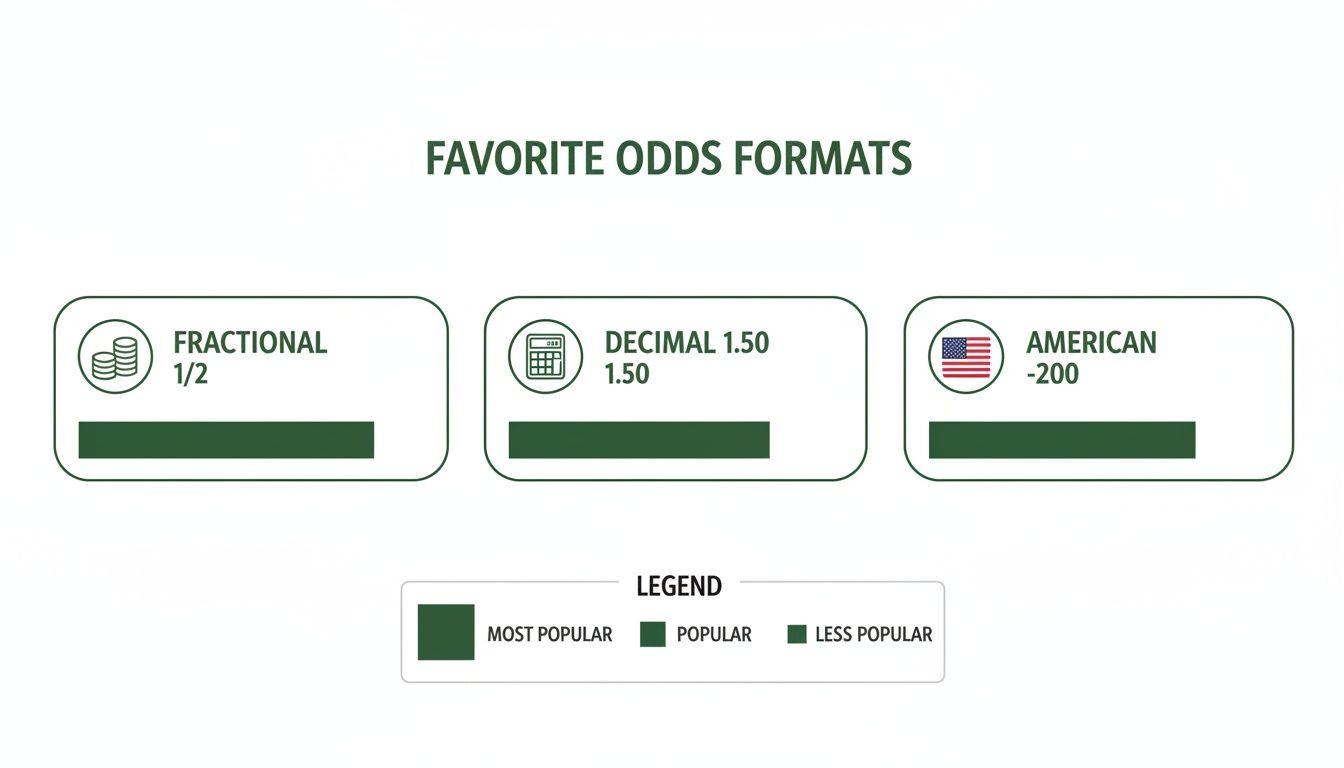
While the formats look completely different, each one of those prices represents the exact same 66.7% implied probability of winning.
Calculating Implied Probability From Odds
Converting odds to a percentage is much easier than you might think. Let’s break it down with simple formulas and a clear example for each format, using the prices from the infographic. This process is absolutely essential for properly evaluating any bet, especially when you're dealing with an odds-on favorite.
Decimal Odds (e.g., 1.50)
This is the most straightforward conversion of the bunch.
- Formula: (1 / Decimal Odds) * 100
- Example: (1 / 1.50) * 100 = 66.7%
Fractional Odds (e.g., 1/2)
This one just requires one extra little step.
- Formula: Denominator / (Denominator + Numerator) * 100
- Example: 2 / (2 + 1) * 100 = 66.7%
American Odds (e.g., -200)
Just remember that for favorites, American odds will always be a negative number.
- Formula: Negative Odds / (Negative Odds + 100) * 100
- Example: 200 / (200 + 100) * 100 = 66.7%
Mastering these quick calculations is like getting a decoder ring for the betting world. It instantly transforms confusing numbers into the universal language of probability, giving you an immediate feel for the market's expectation for any event.
By consistently converting odds into probabilities, you start to train your brain to look past the payout and focus on the underlying chances. For those who want to practice this and really let it sink in, you can learn more about how to convert odds to probability in our detailed guide. This fundamental skill is the foundation on which all successful value betting strategies are built.
The Hidden Dangers of Backing Heavy Favorites
It’s one of the most tempting traps in sports betting. Backing a heavy favorite feels like the smart, safe move. The odds are short, the win seems almost guaranteed, and you get that comforting sense of security. But more often than not, this feeling is a dangerous illusion.
The real risk isn't just that you might lose a bet. It's the catastrophic damage a single loss does to your bankroll. When you repeatedly back an odds-on favorite, you're putting a lot of capital on the line for a tiny return. Imagine winning five straight bets at odds of 1/5 (-500). That string of wins barely nets you the profit of a single stake.
Then, the inevitable upset happens on the sixth bet. In one fell swoop, that single loss doesn't just erase all your hard-earned gains; it puts you deep in the red. This is a brutal high-risk, low-reward cycle that snares countless bettors, creating a false sense of invincibility with small, frequent wins that makes the eventual crash even more painful.
The Myth of the Sure Thing
History is littered with monumental upsets that serve as a brutal reminder: there is no such thing as a guaranteed win in sports. Every heavy favorite has a weakness, and the unpredictable is always lurking right around the corner.
We’ve all seen the legendary moments that prove it:
- Buster Douglas vs. Mike Tyson (1990): As a massive 42-to-1 underdog, Douglas delivered one of the most stunning upsets in boxing history, proving that even the most unbeatable champions can be toppled.
- Leicester City's Premier League Title (2016): Starting the season at absurd 5000-to-1 odds, their fairytale victory reminded everyone that season-long narratives can defy all logic and expectation.
These examples completely shatter the illusion that short odds equal certainty. They highlight the raw volatility of sports and underscore the financial peril of treating any odds-on favorite as a "sure thing." Chasing these obvious-looking wins usually means you're ignoring much smarter, more calculated opportunities elsewhere on the board.
The core danger lies in the imbalance between risk and reward. Backing heavy favorites requires a near-perfect win rate just to break even, a standard that is unsustainable over the long term due to the inherent randomness of sports.
This doesn't mean all favorites are bad bets, of course. In the high-stakes world of the NFL, historical data shows that favorites with a 7-point spread win the game outright 76.8% of the time. This translates to implied moneyline odds of around -331. So, if a sportsbook offers -280, a savvy bettor might spot an edge. You can discover more insights about NFL odds and spreads on OpticOdds.com.
The key is to shift your mindset entirely. Stop chasing "safe" wins and start hunting for genuine value, no matter what the price tag says.
Uncovering Value When Everyone Sees a Sure Thing
Just because an odds-on favorite has a sky-high implied probability doesn't mean it's a bad bet. In fact, some of the smartest wagers are hiding in plain sight, disguised as these obvious outcomes. The real skill is separating the public hype from the cold, hard reality to figure out when the bookmaker has actually underestimated the favorite.
This is the entire art of value betting. At its core, it's a simple but powerful idea: you only place a bet when you believe the true probability of something happening is higher than what the odds suggest. It's the betting equivalent of finding a blue-chip stock the market has somehow overlooked.
The average person sees a short price and either blindly throws money on it or avoids it completely. A sharp bettor, however, knows to dig deeper. They do their own homework to form an independent opinion, hunting for that crucial mismatch between their assessment and the bookie's price.
A Framework for Finding Value
Finding value isn't about gazing into a crystal ball. It’s about having a disciplined process for research and analysis. Before you even think about backing an odds-on favorite, you need a solid framework to cut through the noise and evaluate the matchup with a clear head.
Your goal is to build a case that the favorite’s actual chance of winning is even stronger than those short odds imply.
- Scrutinize Recent Form: Look past the simple win/loss column. How did they actually look in those recent victories? Were they utterly dominant, or did they just scrape by?
- Analyze Head-to-Head History: Some teams or players just have a psychological hold over certain opponents, and that can often trump current form.
- Assess Key Player Status: Is the favorite’s star player finally returning from injury? Is the underdog missing a crucial defender? These details can swing the real probability in a big way.
This methodical approach is what shifts you from guessing to making calculated, evidence-based decisions. You can learn more about the principles driving this strategy in our complete guide to value betting.
The essence of value betting is disagreeing with the market and being right. You're not just picking a winner; you're arguing that the price offered is a bargain based on the real-world evidence you've gathered.
Putting It Into Practice: A Real-World Example
Let's imagine a top-tier NBA team is playing at home against a middle-of-the-pack opponent. The home team is priced at -400 (1.25), which gives them an 80% implied probability of winning. Most bettors would look at that and immediately pass, thinking it's not worth the risk.
But your own research uncovers a few key nuggets:
- The home team is riding a five-game winning streak where they won each game by 15+ points.
- The visiting team's star player, who averages 28 points per game, is out with an injury.
- The home team has won the last seven head-to-head matchups between the two.
Based on this evidence, you might decide their true chance of winning is actually closer to 90%. Since your assessed probability (90%) is higher than the implied probability (80%), this -400 bet suddenly looks like excellent value.
Historical data often backs this kind of thinking up. For example, NBA playoff favorites with a -6 point spread win 74.2% of the time, and that number climbs to 81% for -10 point favorites. These heavy favorites, often priced around -500, win their games a staggering 83.5% of the time. You can dig into more historical odds insights over at sportsdata.io. It all goes to show that with the right analysis, a heavy odds-on favorite can absolutely be a very smart investment.
Protecting Your Bankroll With Smart Staking
Finding a bet that holds genuine value is only half the battle. A fantastic strike rate means absolutely nothing if you're reckless with your money. This is where bankroll management comes in, and frankly, it's the single most critical skill for anyone serious about long-term betting.
Too many bettors get suckered into upping their stakes on an odds on favorite just because it feels like a sure thing. This is pure emotion talking, and it's a fast-track ticket to a zero balance. A single, shocking upset can instantly wipe out the profits from a dozen previous wins, leaving you right back where you started.
Sustainable profit isn't built on a few oversized, hopeful punts; it's forged through consistent, intelligent staking. Adopting a structured plan is your armor against the inevitable losing streaks, keeping you in the game long enough for your edge to shine through.
Proven Staking Plans to Preserve Capital
Instead of just guessing how much to put down, successful bettors use proven methods to decide their stake size. These strategies yank emotion out of the driver's seat and ensure no single loss can kneecap your bankroll. The two most common and effective approaches are Level Staking and Percentage Staking.
- Level Staking: You bet the exact same fixed amount, or "unit", on every single wager, no matter the odds. If your unit size is $10, you bet $10 every time. Simple.
- Percentage Staking: You bet a fixed percentage of your current bankroll, usually somewhere between 1-3%. If you have a $1,000 bankroll and a 2% plan, your first bet is $20. If you win and your bankroll grows to $1,100, your next bet automatically adjusts to $22.
The goal of any staking plan is brutally simple: survival. It forces discipline, stops you from chasing losses, and makes sure you can withstand the natural ups and downs inherent in sports betting.
Even in sports that seem highly predictable, this discipline is non-negotiable. Take the Tennis Grand Slams, which are often loaded with heavy favorites. A look at historical odds shows that No. 1 seeds win 78% of their opening matches when priced under -500. But upsets still happen, and when they do, a smart staking plan is the only thing that will save you. You can dig through years of historical tennis odds on a site like OddsPortal.com.
Ultimately, a good staking plan works hand-in-glove with your value-finding strategy. When you combine disciplined money management with sharp analysis, you create a robust, professional approach built for the long haul. For a deeper dive, check out our comprehensive guide on sports betting bankroll management.
Your Action Plan for Smarter Betting
Success in sports betting isn't about chasing the safest-looking bet; it's about executing a disciplined, repeatable process. The journey from casual punter to sharp bettor involves a clear strategic framework, especially when you're looking at an odds-on favorite. The price alone tells you nothing about its true value.
Your path forward is built on four core pillars. This is your new approach to making calculated, informed decisions, turning guesswork into a well-honed skill.
Your Four Pillars of Value Betting
Understand the Odds
First, you need to instantly recognize an odds-on favorite and translate its price into the implied probability the bookmaker has assigned. This is your baseline, the market's opinion set in stone.Calculate True Probability
Next, you do your own homework. Conduct independent research, analyzing form, injuries, and historical data to create your own probability estimate, completely separate from what the odds are telling you.Identify the Value
This is where the magic happens. Compare the bookmaker’s implied probability with your own. If your calculated chance of winning is higher, you've just identified a potential value bet, an opportunity worth a closer look.Protect Your Bankroll
Finally, apply a strict staking plan, like level or percentage staking, to every single bet you place. This discipline is your shield; it protects you from upsets and ensures you stay in the game long enough for your edge to pay off.
A Few Final Questions
To wrap this up, let's tackle some of the most common questions that pop up when bettors first start dealing with odds-on favorites. Think of this as a quick reference guide to help clear up any lingering confusion and sharpen your thinking.
We'll cover whether it's ever a good idea to bet on incredibly short odds, how bookies actually come up with these prices, and the single costliest mistake bettors make when backing a heavy favorite.
Is It Ever Smart to Bet on Extremely Short Odds?
Absolutely, but only if you've done your homework and found genuine value. An eye-wateringly short price like 1/10 (-1000) isn't automatically a bad bet; it's just the bookmaker's way of saying an outcome is extremely likely.
The real question is whether it's even more likely than the odds suggest. If your own analysis tells you the favorite’s true chance of winning is higher than the implied probability, then even a tiny return can be a smart, value-driven move. It's never about the price; it's always about the probability.
How Do Bookmakers Set the Odds for a Favorite?
Bookies don't just pull these numbers out of thin air. They start by using a complex blend of statistical models, historical data, and expert analysis to create an "opening line." This initial price is based on factors like team strength, recent form, injuries, and specific matchup dynamics.
But their job doesn't end there. Once those odds go live, they are constantly adjusted based on how the public is betting. The bookmaker's goal is to balance their book so they can lock in a profit no matter who wins. This is why you'll see odds shift right up until the event starts.
The biggest mistake bettors make is assuming that the price of an odds-on favorite is a direct and pure reflection of its true probability to win. In reality, public perception and betting volume heavily influence the final odds you see.
What Is the Biggest Mistake When Backing an Odds-On Favorite?
The number one mistake, without a doubt, is poor staking. It’s a classic psychological trap. Bettors see a short price, assume it's a guaranteed win, and then massively increase their stake just to chase a meaningful profit. This is a fast track to disaster.
Even the most dominant favorites have bad days and lose. When that inevitable upset happens, an oversized bet can wipe out all the small profits you've patiently built up and do serious damage to your bankroll. The only way to survive in the long run is to stick to a disciplined staking plan, no matter how much of a "sure thing" a bet looks.
Stop guessing and start finding true value in the odds. ValueBetFactory uses powerful analysis to scan the market for you, delivering real-time alerts on potential value bets, including those on an odds-on favorite. Discover a smarter way to bet at ValueBetFactory.